
Joseph Tobias
banner
josephtobias.bsky.social
Joseph Tobias
@josephtobias.bsky.social

Birds, biodiversity, evolutionary biology, macroecology, conservation biology, ecosystem science, sustainable development, world birding, and other stuff. He/him
More at http://www.tobiaslab.net

Environmental science 42%
Biology 24%

If you're sure that there was pale on the bill and face then presumably you're right. Pochard would of course be far more likely, but recent Canvasback records in S England mean it's worth checking carefully

Perhaps it's just a misleading photo in poor light but the head/bill shape looks more reminiscent of canvasback than pochard. Do you have other photos of same bird?

Looks like female Canvasback? Where was this?

Reposted by Joseph A. Tobias

Why is there such variation in the birds encountered as you go up or down a mountain? New paper in #ScienceAdvances examines how climate and ecological interactions drive bird distributions in mountains throughout the year:

www.science.org/doi/10.1126/...

1/10 ⬇️
Climate, ecological dynamics, and the seasonal distribution of birds in mountains
Ecological dynamics related to energy use and competition drives the seasonal distribution of birds in mountains across the world.
www.science.org

Thanks, Ralph! I have a lab member working in the bird collection at Tring right now. I don’t think they’ll be able to finish all 13500 bulbul specimens in there! But we’ll do as many as possible. (I’m based Oxford/London)

Very kind offer, Michael. I can supply all those needs to get you up and running if there are enough specimens to make it worthwile. Is there any way of finding out how many Pycnonotidae specs the Hancock has?

Coarse categorisation is definitely an issue. I think we’re a long way from refined social traits at macro scales for birds but hopefully better datasets will develop over time. 🤞
🚨 For those with access to collections of bird specimens: we are looking for collaborators who can quickly measure bulbuls/greenbuls (Pycnonotidae) for a project on intraspecific trait variation. We need 100s specimens measured from common species in return for co-authorship. Anyone up for it? 🧪🌐🪶

Great stuff, Ben, and clearly reflects real patterns in that part of the world. On the other hand, if you did a ton of playbacks in Australia, S Africa, Argentina etc. I think you would see effect of latitude weaken and be outcompeted by social traits associated with stable climates/resources.
📣 Grad student wanted
PhD position in avian evolution, with emphasis on phylogenetics, macroevolution, Neotropical radiations, flight and dispersal.
Based at the University of New Orleans (soon to be LSU New Orleans).
Start: September 2026.
Contact me if interested.
claramuntlab.org
Chatbots offer a magnificent bribe - a fast, frictionless route to information that bypasses the discomfort of learning. In this op-ed, we describe this as a Faustian bargain, in which we trade away what it means to be human & universities trade away their value
www.irishexaminer.com/opinion/comm...

Learning is complex, messy, emotional: AI can’t replicate that
ChatGPT and other AI tools may seem irresistible. But educators should beware, as they could end up trading away the thing that gives them value — the rich experience of slow learning
www.irishexaminer.com
MAJOR NEWS! We just launched an awesome new tool! The illustrated Birds of the World Phylogeny Explorer lets users trace any bird’s lineage, compare species relationships, and explore major evolutionary milestones with a click of a button. SHARE and EXPLORE! birdsoftheworld.org/bow/news/phy...

Hi Juliana, this is a great paper. Congrats!
It looks like there is a remarkable geographical mix in the lice phylogeny. Closely related lice lineages often occur on bird species living in different continents. How would you explain that pattern and doesn't it greatly increase uncertainty?

Fascinating stuff. And great to see our data on wing bone length and wing area being put to good use 👍

I think Bearded improves the name, although strictly speaking it should be Moustached!

I’d hate it if the Bearded Mountaineer was renamed to just Mountaineer. Would be a tragedy. At least that incredible hummingbird actually has a beard

Another vote for ‘reedling’. Bearded tit is a joke of a name to non-birders, and this special bird deserves a historically/taxonomically/ecologically informative name

Arguably they will never need to as Ai will write for them. Sad but true. We aren’t going to stop it. I agree that this will damage their ability to think and process information. More hand-written tests is one way, and marking down for ‘generic writing’ or ‘no personal voice’ (which is what I do)

Agree that computer-based writing is no longer viable as coursework. I’m trying to figure out ways of teaching students how to work with, critically appraise and learn from ai-generated horseshit. Apart from that, verbal, practical and hand-written exams/coursework is our only solution
A data collection mission that began in 2012 is finally released as AVONICHE.

Designed as a companion to AVONET bird trait database and updated to Avilist taxonomy, it’s an Open Access dataset providing updated diets and a detailed breakdown of foraging behaviours used by all bird species.

🪶🌐
New paper out! 🐦📊

We realease AVONICHE, a global dataset with detailed information on the proportional use of 32 foraging niches, combining dietary categories with the behaviours and substrates used to access resources.

Openly access the paper and data in GEB: doi.org/10.1111/geb....
New paper out! 🐦📊

We realease AVONICHE, a global dataset with detailed information on the proportional use of 32 foraging niches, combining dietary categories with the behaviours and substrates used to access resources.

Openly access the paper and data in GEB: doi.org/10.1111/geb....
I was wondering the same thing. I can also imagine some less interesting reasons, including a few samples with poor DNA quality, failure to amplify W-linked fragment, contamination, amplification artefacts, sample mislabelling etc. Looking forward to seeing more direct tests of this result.
Seed dispersal by 🦜🦇 underpins rainforest recovery. We want to understand more about its timing + traits driving recovery through obs, exp + genomic data. Ready to join the @reassemblynet.bsky.social team working in Ecuadorian Chocó? Pls apply to our 4-yr PhD position @sgn.one: tinyurl.com/2pkryc99
Huge News from the Western Amazon: it's the year 2025 and we are still describing entirely new, strikingly-distinctive large-bodied bird species! Behold Tinamus resonans sp. nov. the Slaty-masked Tinamou mapress.com/zt/article/v... #Ornithology @tetzoo.bsky.social 🪶

Pretty obvious AI in this case but it's getting tougher to tell. Huge problems ahead for anyone assessing rare bird records 😬

Reposted by Joseph A. Tobias

Lovely link-up between @josephtobias.bsky.social's #Avonet and the #PredictsProject, with @nhm.org's @patrickawalkden.bsky.social among the authors

Reposted by Andy Purvis

Although the title misses the point by a long way. It's not the "safety net for birds" that is at stake here, but the "safety net provided by birds" - the resilience of ecological functions supporting the whole ecosystem.

As touched on here: www.imperial.ac.uk/news/article...
Global bird study reveals declining ecosystem resilience
Human-driven changes to landscapes worldwide are ‘thinning out’ the ecological services supplied by wild birds, eroding the functions tha...
www.imperial.ac.uk

Reposted by Joseph A. Tobias

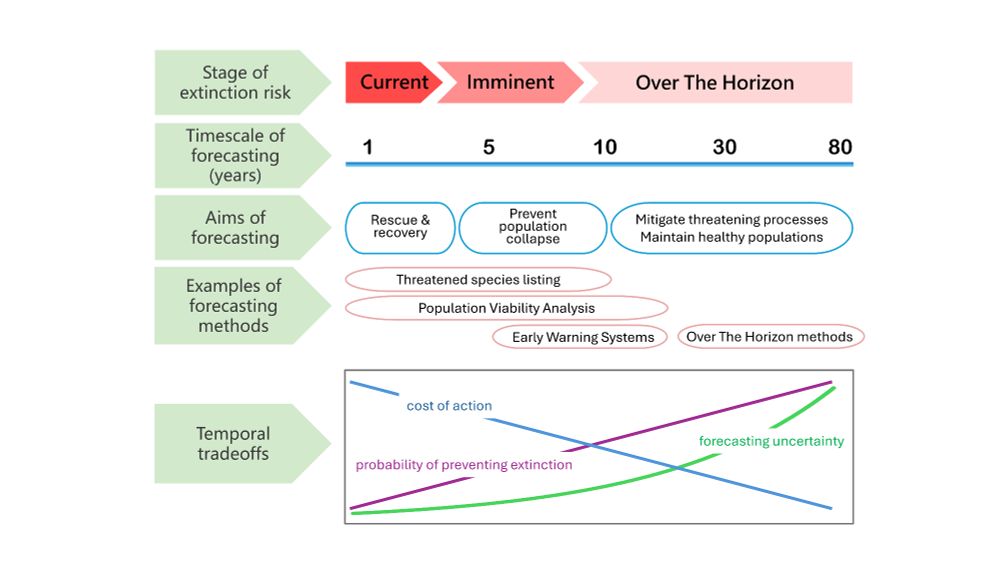
Online now: Forecasting extinction risk for future-proof conservation decisions.

www.sciencedirect.com/science/arti...

Should conservation focus on threatened species? Or should we be proactive and protect species before they become threatened? This paper explores how to get the balance right.

This was an amazing workshop bringing together a wide range of perspectives. Thanks to the funders and everyone involved. Looking forward to next steps! 🌿🪶🌐
Our @sgn.one workshop organized together with @josephtobias.bsky.social and Susanne Fritz was enlightening, fun and will surely lead to many future interactions and outputs on how plant/animal traits translate into functions. Thanks to all for your excellent ideas and very respectful discussions! 🌐