



One of Australia's most common and distinctive ants is the colorful Rhytidoponera metallica, seen here with silken cocoons in the brood nest. Diamond Creek, Victoria.

January 1, 2026 at 2:52 PM
One of Australia's most common and distinctive ants is the colorful Rhytidoponera metallica, seen here with silken cocoons in the brood nest. Diamond Creek, Victoria.
Eucharitid wasps are parasites of ants, infiltrating their colonies as larvae and feeding on the young. Here, an adult female Tricoryna eucharitid that emerged in the nest is carried about by an unwitting host Rhytidoponera ant (Australia, December 2025). A rare find of a fascinating insect.

December 31, 2025 at 5:01 PM
Eucharitid wasps are parasites of ants, infiltrating their colonies as larvae and feeding on the young. Here, an adult female Tricoryna eucharitid that emerged in the nest is carried about by an unwitting host Rhytidoponera ant (Australia, December 2025). A rare find of a fascinating insect.

They have: general pseudomyrmecine body; amblyoponine petiole; Cryptopone traction setae on legs; Rhytidoponera iridiscente cuticle. Did I miss anything? ;)
December 23, 2025 at 2:57 PM
They have: general pseudomyrmecine body; amblyoponine petiole; Cryptopone traction setae on legs; Rhytidoponera iridiscente cuticle. Did I miss anything? ;)
Rhytidoponera tasmaniensis

November 20, 2025 at 3:04 AM
Rhytidoponera tasmaniensis

New publication: "Genome of the green-head ant, #Rhytidoponera metallica, reveals mechanisms of toxin evolution in a genetically hyper-diverse eusocial species" with Isaksen, Nachtigall, Araya, Hansen & Undheim from @biovitenskap.bsky.social
Published in Genome Biology by @springernature.com
Published in Genome Biology by @springernature.com
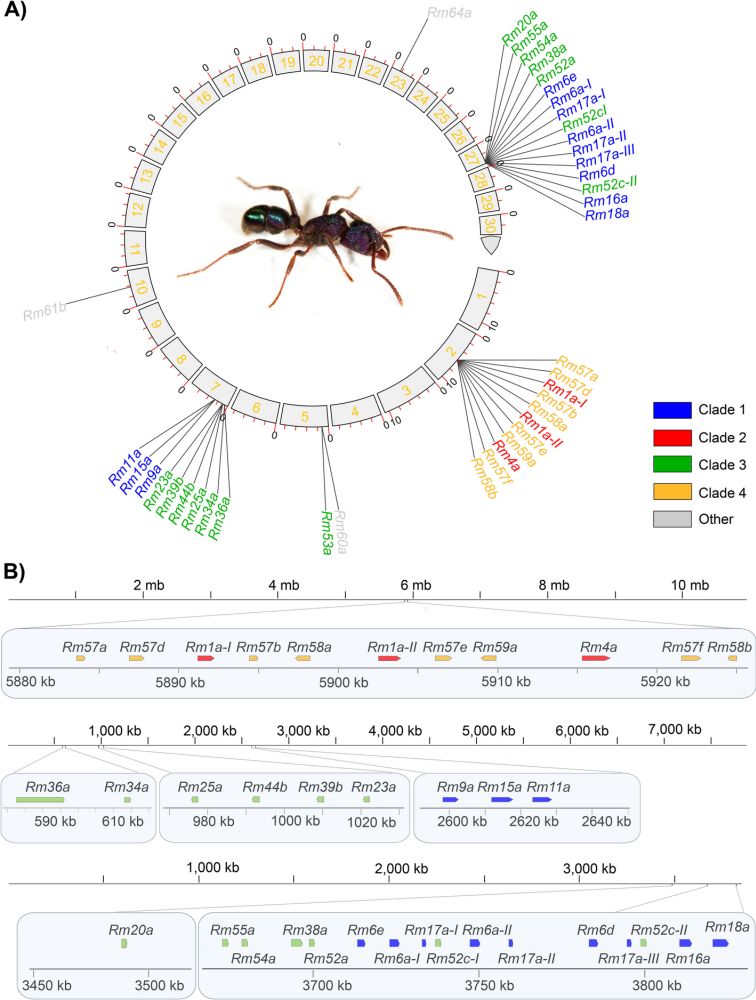
Genome of the green-head ant, Rhytidoponera metallica, reveals mechanisms of toxin evolution in a genetically hyper-diverse eusocial species - Genome Biology
Background While ants are textbook examples of eusocial animals in which altruistic behavior is maintained through kin selection, several ants form genetically diverse colonies that challenge this concept. One example is the Australian green-head ant (Rhytidoponera metallica) whose colonies harbor such extreme genetic variation that they have been speculated to represent an unstable form of eusociality. Yet, R. metallica is among the most successful ants on the Australian subcontinent. This success has been hypothesized to be partly due to the diverse venoms harbored within each colony. However, the genomic basis and evolutionary scenarios that maintain this toxin diversity remain unknown. Results To examine toxin genomic architecture, quantify individual-level genetic variation, and identify both proximate and ultimate mechanisms that have facilitated the toxin diversity in R. metallica, we generate a high-quality draft genome from a single worker. Most ectatotoxin genes are in clusters that contain evidence of multiple, complex gene-family expansions, some of which are likely explained by the presence of transposable elements. We also show that toxin regions of the genome exhibit elevated genetic variation despite being under strong selection and that this variation can translate to phenotypic diversity through toxin alleles with different functional properties. Conclusions Taken together, our results point to classical gene duplication and diversification as the main evolutionary mechanism by which the main toxin family in ant venoms evolves, suggest toxin-gene functional diversification under frequency-dependent selection maintains colony-level venom hypervariability in R. metallica, and provide new insight into the role of multi-level selection in eusocial animals.
genomebiology.biomedcentral.com
October 2, 2025 at 10:00 AM
New publication: "Genome of the green-head ant, #Rhytidoponera metallica, reveals mechanisms of toxin evolution in a genetically hyper-diverse eusocial species" with Isaksen, Nachtigall, Araya, Hansen & Undheim from @biovitenskap.bsky.social
Published in Genome Biology by @springernature.com
Published in Genome Biology by @springernature.com

Genome of the green-head ant, Rhytidoponera metallica, reveals mechanisms of toxin evolution in a genetically hyper-diverse eusocial species
Background While ants are textbook examples of eusocial animals in which altruistic behavior is maintained through kin selection, several ants form…
Background While ants are textbook examples of eusocial animals in which altruistic behavior is maintained through kin selection, several ants form…

Genome of the green-head ant, Rhytidoponera metallica, reveals mechanisms of toxin evolution in a genetically hyper-diverse eusocial species
Background While ants are textbook examples of eusocial animals in which altruistic behavior is maintained through kin selection, several ants form genetically diverse colonies that challenge this concept. One example is the Australian green-head ant (Rhytidoponera metallica) whose colonies harbor such extreme genetic variation that they have been speculated to represent an unstable form of eusociality. Yet, R. metallica is among the most successful ants on the Australian subcontinent.
animeaura.store
September 28, 2025 at 3:28 AM
Genome of the green-head ant, Rhytidoponera metallica, reveals mechanisms of toxin evolution in a genetically hyper-diverse eusocial species
Background While ants are textbook examples of eusocial animals in which altruistic behavior is maintained through kin selection, several ants form…
Background While ants are textbook examples of eusocial animals in which altruistic behavior is maintained through kin selection, several ants form…

I usually research hashtags before using them, but did not for the above tweet, going for “feeling lucky” mode.
Did not have high hopes for #myrmecology, but that tag is hoppin’ on Bsky.
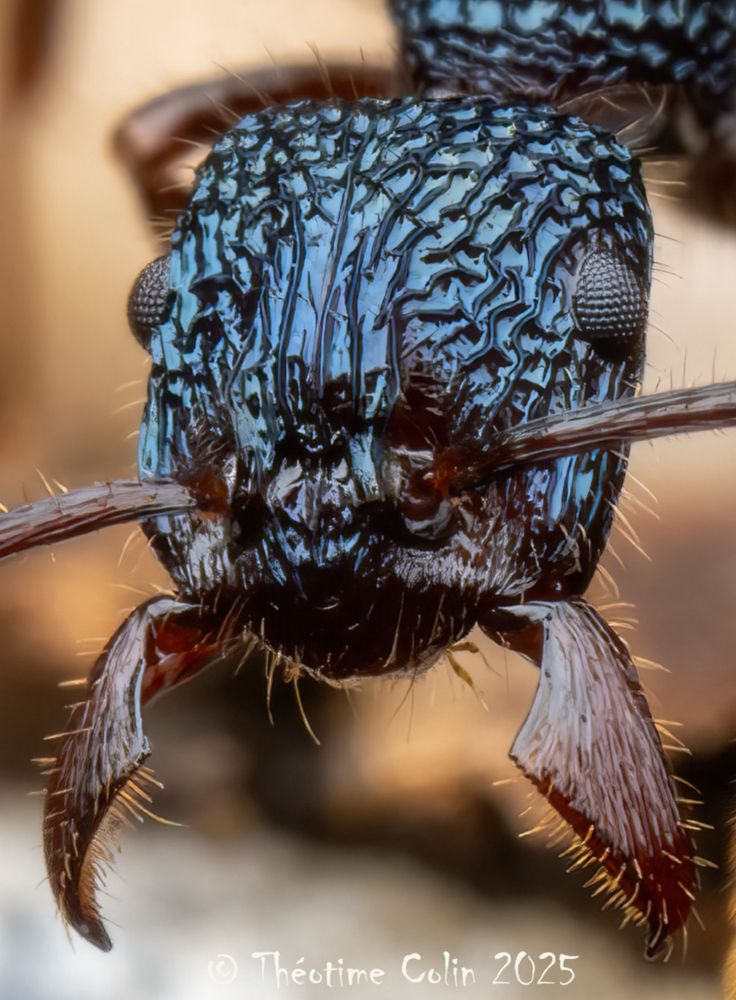
Image: head of a “pony ant” a.k.a. Rhytidoponera confusa posted by @theotimecolin.bsky.social
#AntSky 🐜
Did not have high hopes for #myrmecology, but that tag is hoppin’ on Bsky.
Image: head of a “pony ant” a.k.a. Rhytidoponera confusa posted by @theotimecolin.bsky.social
#AntSky 🐜
August 25, 2025 at 1:38 AM
I usually research hashtags before using them, but did not for the above tweet, going for “feeling lucky” mode.
Did not have high hopes for #myrmecology, but that tag is hoppin’ on Bsky.
Image: head of a “pony ant” a.k.a. Rhytidoponera confusa posted by @theotimecolin.bsky.social
#AntSky 🐜
Did not have high hopes for #myrmecology, but that tag is hoppin’ on Bsky.
Image: head of a “pony ant” a.k.a. Rhytidoponera confusa posted by @theotimecolin.bsky.social
#AntSky 🐜
A green ant with a lawn prawn :) (Rhytidoponera metallica with an amphipod)

August 14, 2025 at 10:51 PM
A green ant with a lawn prawn :) (Rhytidoponera metallica with an amphipod)
Closeup of head of the ant Rhytidoponera metallica from Australia. The name "metallica" is most apropos.
June 4, 2025 at 8:04 PM
Closeup of head of the ant Rhytidoponera metallica from Australia. The name "metallica" is most apropos.

March 11, 2025 at 3:27 AM

Arthropod Photo of the Week: February 26, 2025
Spider ants attack pony ant
Leptomyrmex sp./Rhytidoponera sp.
Hymenoptera: Formicidae
By François Brassard, Madang, Papua New Guinea
#arthropodPOTW
Spider ants attack pony ant
Leptomyrmex sp./Rhytidoponera sp.
Hymenoptera: Formicidae
By François Brassard, Madang, Papua New Guinea
#arthropodPOTW

February 27, 2025 at 1:36 PM
Arthropod Photo of the Week: February 26, 2025
Spider ants attack pony ant
Leptomyrmex sp./Rhytidoponera sp.
Hymenoptera: Formicidae
By François Brassard, Madang, Papua New Guinea
#arthropodPOTW
Spider ants attack pony ant
Leptomyrmex sp./Rhytidoponera sp.
Hymenoptera: Formicidae
By François Brassard, Madang, Papua New Guinea
#arthropodPOTW
Rhytidoponera metallica.
February 6, 2025 at 2:19 AM
Rhytidoponera metallica.

Me estreno en ésta plataforma con una de mis últimas adquisiciones: Rhytidoponera metallica

January 29, 2025 at 8:27 PM
Me estreno en ésta plataforma con una de mis últimas adquisiciones: Rhytidoponera metallica

Pony ants often have amazing metallic colours to help other animals like me remember how painful their sting is. It works just fine. This is Rhytidoponera confusa.
#ants #fourmis #myrmecology #nature #wildlife
#ants #fourmis #myrmecology #nature #wildlife


January 27, 2025 at 3:57 AM
Pony ants often have amazing metallic colours to help other animals like me remember how painful their sting is. It works just fine. This is Rhytidoponera confusa.
#ants #fourmis #myrmecology #nature #wildlife
#ants #fourmis #myrmecology #nature #wildlife
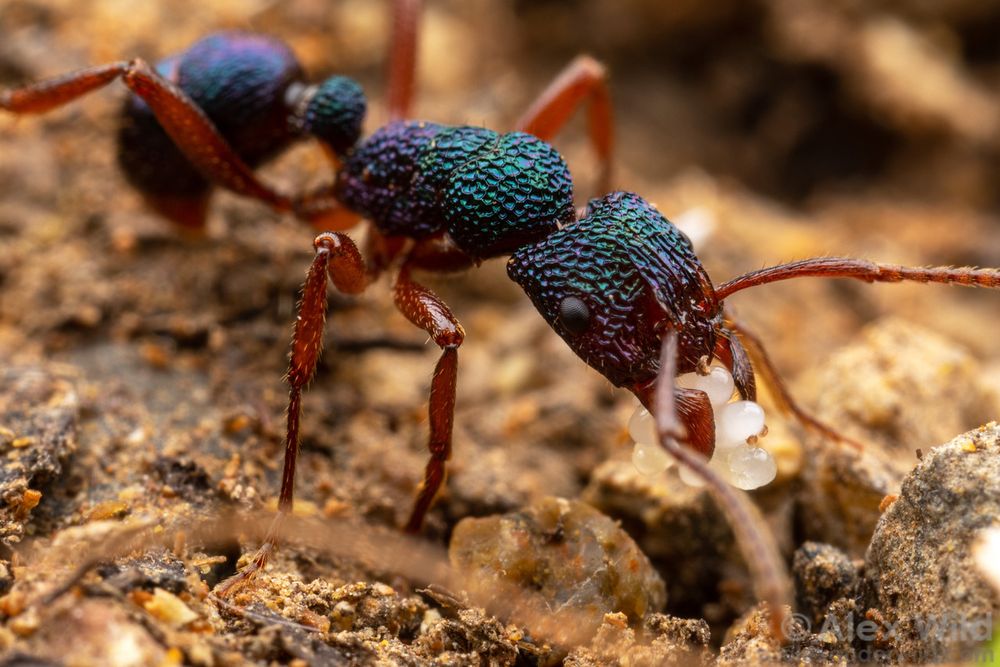
Australia has the shiniest ants.
This is a worker of Rhytidoponera aspersa carrying eggs among her colony's nest sites.
This is a worker of Rhytidoponera aspersa carrying eggs among her colony's nest sites.
January 24, 2025 at 7:48 PM
Australia has the shiniest ants.
This is a worker of Rhytidoponera aspersa carrying eggs among her colony's nest sites.
This is a worker of Rhytidoponera aspersa carrying eggs among her colony's nest sites.
Green headed ant. Rhytidoponera metallica.

January 21, 2025 at 2:02 PM
Green headed ant. Rhytidoponera metallica.
Rhytidoponera tasmaniensis

January 20, 2025 at 1:25 AM
Rhytidoponera tasmaniensis
The beautiful Rhytidoponera aspersa. Bright, Victoria, Australia.

January 18, 2025 at 2:19 AM
The beautiful Rhytidoponera aspersa. Bright, Victoria, Australia.
Test z-stacks using our new ✨🔬✨
This is a Rhytidoponera from Canberra 🥰
This is a Rhytidoponera from Canberra 🥰


November 28, 2024 at 3:09 AM
Test z-stacks using our new ✨🔬✨
This is a Rhytidoponera from Canberra 🥰
This is a Rhytidoponera from Canberra 🥰