



## Enhanced Pore-Network Modeling for Multi-Phase Flow Prediction in Hierarchical Zeolite Structures: A Data-Driven Approach
**Abstract:** Hierarchical zeolites, exhibiting interconnected micropores, mesopores, and macropores, are crucial materials for advanced separation and catalytic processes,…
**Abstract:** Hierarchical zeolites, exhibiting interconnected micropores, mesopores, and macropores, are crucial materials for advanced separation and catalytic processes,…
## Enhanced Pore-Network Modeling for Multi-Phase Flow Prediction in Hierarchical Zeolite Structures: A Data-Driven Approach
**Abstract:** Hierarchical zeolites, exhibiting interconnected micropores, mesopores, and macropores, are crucial materials for advanced separation and catalytic processes, particularly in multi-phase flow applications. Accurate prediction of multi-phase flow behavior within these complex structures remains a significant challenge. This paper introduces a novel, data-driven approach leveraging advanced pore-network modeling (PNM) combined with machine learning algorithms. By integrating high-resolution experimental data with dynamic PNM simulations, we develop a predictive framework capable of accurately forecasting multi-phase flow performance in hierarchical zeolites, offering significant advancements over deterministic PNM models.
freederia.com
January 18, 2026 at 1:25 AM
## Enhanced Pore-Network Modeling for Multi-Phase Flow Prediction in Hierarchical Zeolite Structures: A Data-Driven Approach
**Abstract:** Hierarchical zeolites, exhibiting interconnected micropores, mesopores, and macropores, are crucial materials for advanced separation and catalytic processes,…
**Abstract:** Hierarchical zeolites, exhibiting interconnected micropores, mesopores, and macropores, are crucial materials for advanced separation and catalytic processes,…

Multifractal analysis reveals how nanopore complexity controls gas occurrence in Zhaotong area. Mesopores and lithofacies type dominate reservoir quality in tectonically complex areas. #Openaccess at h7.cl/1hI8Y
#naturalgas #ShaleGas #Nanopores #EnergyGeology
#naturalgas #ShaleGas #Nanopores #EnergyGeology

January 12, 2026 at 5:48 AM
Multifractal analysis reveals how nanopore complexity controls gas occurrence in Zhaotong area. Mesopores and lithofacies type dominate reservoir quality in tectonically complex areas. #Openaccess at h7.cl/1hI8Y
#naturalgas #ShaleGas #Nanopores #EnergyGeology
#naturalgas #ShaleGas #Nanopores #EnergyGeology

Ending the year with separation science 🧪
Fabrice Gritti reviews Bo Zhang’s precision-made LC microspheres and why independent control of particle size, PSD, morphology, mesopores, and chemistry could enable the experiments needed for real HPLC/UHPLC breakthroughs.
https://ow.ly/88N050XN3kg
Fabrice Gritti reviews Bo Zhang’s precision-made LC microspheres and why independent control of particle size, PSD, morphology, mesopores, and chemistry could enable the experiments needed for real HPLC/UHPLC breakthroughs.
https://ow.ly/88N050XN3kg

December 31, 2025 at 11:00 AM
Ending the year with separation science 🧪
Fabrice Gritti reviews Bo Zhang’s precision-made LC microspheres and why independent control of particle size, PSD, morphology, mesopores, and chemistry could enable the experiments needed for real HPLC/UHPLC breakthroughs.
https://ow.ly/88N050XN3kg
Fabrice Gritti reviews Bo Zhang’s precision-made LC microspheres and why independent control of particle size, PSD, morphology, mesopores, and chemistry could enable the experiments needed for real HPLC/UHPLC breakthroughs.
https://ow.ly/88N050XN3kg

💬 Synthèse de nanovecteurs mésoporeux à base de silices hybrides pour le relargage de principes actifs par Manisa Kongkaew
📅 1er décembre 2025
🕑 14h
📍 Campus Balard Recherche - Amphithéâtre Balard.
#Thèse2025 #SilicesHybrides #Nanovecteurs #Mésopores #RelargageDePrincipesActifs
#ICGM
📅 1er décembre 2025
🕑 14h
📍 Campus Balard Recherche - Amphithéâtre Balard.
#Thèse2025 #SilicesHybrides #Nanovecteurs #Mésopores #RelargageDePrincipesActifs
#ICGM

November 20, 2025 at 9:30 AM
💬 Synthèse de nanovecteurs mésoporeux à base de silices hybrides pour le relargage de principes actifs par Manisa Kongkaew
📅 1er décembre 2025
🕑 14h
📍 Campus Balard Recherche - Amphithéâtre Balard.
#Thèse2025 #SilicesHybrides #Nanovecteurs #Mésopores #RelargageDePrincipesActifs
#ICGM
📅 1er décembre 2025
🕑 14h
📍 Campus Balard Recherche - Amphithéâtre Balard.
#Thèse2025 #SilicesHybrides #Nanovecteurs #Mésopores #RelargageDePrincipesActifs
#ICGM

🌽 We turn corn waste into a climate solution!
Our new study shows how microwave + dual-activation creates super-porous biochar that captures CO₂ efficiently — up to 3.43 mmol/g at room temperature!
~40% mesopores is the sweet spot for speed + capacity.
Read more:
www.maxapress.com/article/doi/...
Our new study shows how microwave + dual-activation creates super-porous biochar that captures CO₂ efficiently — up to 3.43 mmol/g at room temperature!
~40% mesopores is the sweet spot for speed + capacity.
Read more:
www.maxapress.com/article/doi/...

November 10, 2025 at 7:04 AM
🌽 We turn corn waste into a climate solution!
Our new study shows how microwave + dual-activation creates super-porous biochar that captures CO₂ efficiently — up to 3.43 mmol/g at room temperature!
~40% mesopores is the sweet spot for speed + capacity.
Read more:
www.maxapress.com/article/doi/...
Our new study shows how microwave + dual-activation creates super-porous biochar that captures CO₂ efficiently — up to 3.43 mmol/g at room temperature!
~40% mesopores is the sweet spot for speed + capacity.
Read more:
www.maxapress.com/article/doi/...
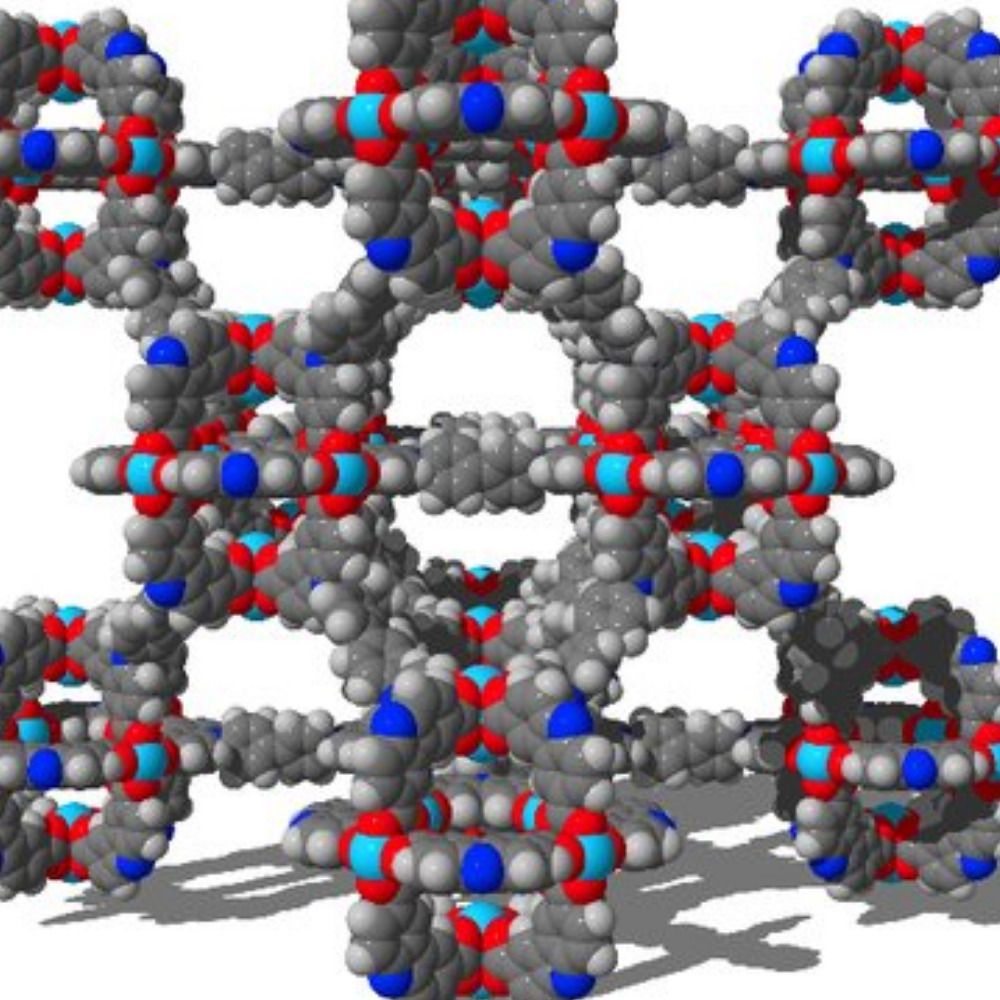
Mesopores in Metal–Organic Frameworks Rendering Enhanced Rate Capability of Pore-Confined Polyaniline for Supercapacitors http://dx.doi.org/10.1021/acsami.5c16579
October 8, 2025 at 9:16 AM
Mesopores in Metal–Organic Frameworks Rendering Enhanced Rate Capability of Pore-Confined Polyaniline for Supercapacitors http://dx.doi.org/10.1021/acsami.5c16579

Power of large pores in MOFs!
In our latest work by our student Tsan-Yu, aniline was polymerized in Zr-MOFs with large mesopores, small mesopores, and only micropores. PANI@large mesoporous MOF shows the best rate capability!
Check it in ACS Appl. Mater. Interfaces:
doi.org/10.1021/acsa...
In our latest work by our student Tsan-Yu, aniline was polymerized in Zr-MOFs with large mesopores, small mesopores, and only micropores. PANI@large mesoporous MOF shows the best rate capability!
Check it in ACS Appl. Mater. Interfaces:
doi.org/10.1021/acsa...

October 8, 2025 at 1:15 AM
Power of large pores in MOFs!
In our latest work by our student Tsan-Yu, aniline was polymerized in Zr-MOFs with large mesopores, small mesopores, and only micropores. PANI@large mesoporous MOF shows the best rate capability!
Check it in ACS Appl. Mater. Interfaces:
doi.org/10.1021/acsa...
In our latest work by our student Tsan-Yu, aniline was polymerized in Zr-MOFs with large mesopores, small mesopores, and only micropores. PANI@large mesoporous MOF shows the best rate capability!
Check it in ACS Appl. Mater. Interfaces:
doi.org/10.1021/acsa...

Why such a disparity? The superfine silt in glacial flour fills the big gaps between sand grains, forming “mesopores.” These tiny spaces hold water against gravity (think of a paper towel effect), distributing moisture evenly across the soil.
October 7, 2025 at 1:01 PM
Why such a disparity? The superfine silt in glacial flour fills the big gaps between sand grains, forming “mesopores.” These tiny spaces hold water against gravity (think of a paper towel effect), distributing moisture evenly across the soil.
Scribing mesopores in zirconium-based MOF thin films via metal-node and linker self-assembly https://dx.doi.org/10.26434/chemrxiv-2025-ss2f9?rft_dat=source%3Ddrss
September 24, 2025 at 6:13 PM
Scribing mesopores in zirconium-based MOF thin films via metal-node and linker self-assembly https://dx.doi.org/10.26434/chemrxiv-2025-ss2f9?rft_dat=source%3Ddrss
In-situ Construction of Hierarchical Ultrasmall MOF Aerogels with Tunable Mesopores for Selective Adsorption and Efficient Catalysis http://pubs.rsc.org/en/Content/ArticleLanding/2025/QI/D5QI01205H
August 21, 2025 at 10:17 AM
In-situ Construction of Hierarchical Ultrasmall MOF Aerogels with Tunable Mesopores for Selective Adsorption and Efficient Catalysis http://pubs.rsc.org/en/Content/ArticleLanding/2025/QI/D5QI01205H
Combining Soft-Templating and Post-Synthetic Methods for the Rational Design of an Amidoximated Metal–Organic Framework with Mesopores for Efficient Uranium Extraction http://dx.doi.org/10.1021/acsami.5c06581
August 20, 2025 at 2:13 PM
Combining Soft-Templating and Post-Synthetic Methods for the Rational Design of an Amidoximated Metal–Organic Framework with Mesopores for Efficient Uranium Extraction http://dx.doi.org/10.1021/acsami.5c06581
Mesopore matters! Our master student Tzu-Hsien's work shows that creating large mesopores in Zr-MOF by surfactant-assisted synthesis can accelerate the ion-coupled charge-hopping process and thus boost electrochemical performances. It is out in Electrochimica Acta:
doi.org/10.1016/j.el...
doi.org/10.1016/j.el...

May 17, 2025 at 2:51 PM
Mesopore matters! Our master student Tzu-Hsien's work shows that creating large mesopores in Zr-MOF by surfactant-assisted synthesis can accelerate the ion-coupled charge-hopping process and thus boost electrochemical performances. It is out in Electrochimica Acta:
doi.org/10.1016/j.el...
doi.org/10.1016/j.el...
Isoreticular 3D covalent organic frameworks with non-interpenetrated pcu-derived dia topology: pore regulation from micropores to mesopores http://pubs.rsc.org/en/Content/ArticleLanding/2025/SC/D5SC01227A

March 25, 2025 at 6:13 PM
Isoreticular 3D covalent organic frameworks with non-interpenetrated pcu-derived dia topology: pore regulation from micropores to mesopores http://pubs.rsc.org/en/Content/ArticleLanding/2025/SC/D5SC01227A
Back Cover: Unlocking of Hidden Mesopores for Enzyme Encapsulation by Dynamic Linkers in Stable Metal−Organic Frameworks https://onlinelibrary.wiley.com/doi/10.1002/anie.202419457?af=R
October 31, 2024 at 9:13 AM
Back Cover: Unlocking of Hidden Mesopores for Enzyme Encapsulation by Dynamic Linkers in Stable Metal−Organic Frameworks https://onlinelibrary.wiley.com/doi/10.1002/anie.202419457?af=R
Unlocking of Hidden Mesopores for Enzyme Encapsulation by Dynamic Linkers in Stable Metal‒Organic Frameworks https://onlinelibrary.wiley.com/doi/10.1002/anie.202409951?af=R
August 24, 2024 at 8:13 AM
Unlocking of Hidden Mesopores for Enzyme Encapsulation by Dynamic Linkers in Stable Metal‒Organic Frameworks https://onlinelibrary.wiley.com/doi/10.1002/anie.202409951?af=R
Hierarchical porous covalent organic framework nanosheets with adjustable large mesopores https://www.cell.com/chem/fulltext/S2451-9294(24)00244-4?rss=yes
June 26, 2024 at 3:11 PM
Hierarchical porous covalent organic framework nanosheets with adjustable large mesopores https://www.cell.com/chem/fulltext/S2451-9294(24)00244-4?rss=yes
Engineering Single Cu Atoms Anchored via N‐Heterocyclic Carbene in COF Mesopores for Modulating Electron Kinetics of CO2 Photoconversion https://onlinelibrary.wiley.com/doi/10.1002/aenm.202401713?af=R
June 10, 2024 at 9:12 AM
Engineering Single Cu Atoms Anchored via N‐Heterocyclic Carbene in COF Mesopores for Modulating Electron Kinetics of CO2 Photoconversion https://onlinelibrary.wiley.com/doi/10.1002/aenm.202401713?af=R
Mesopores and macropores engineering in metal-organic frameworks for energy environmental-related applications http://pubs.rsc.org/en/Content/ArticleLanding/2024/TA/D3TA07697K
January 30, 2024 at 2:12 PM
Mesopores and macropores engineering in metal-organic frameworks for energy environmental-related applications http://pubs.rsc.org/en/Content/ArticleLanding/2024/TA/D3TA07697K

Hofmeister Effect Promoted the Introduction of Tunable Large Mesopores in MOFs at Low Temperature for Femtomolar ALP Detection
Hofmeister Effect Promoted the Introduction of Tunable Large Mesopores in MOFs at Low Temperature for Femtomolar ALP Detection
Based on the synergistic effects of low-temperature microemulsions and Hofmeister ions, hierarchically mesoporous MOFs (HMMOFs) with adjustable mesopore sizes are successfully achieved, which are competent to detect femtomolar level alkaline phosphatase (ALP). Such high sensitivity for ALP detection highlights the importance of adjustable mesopore structures of HMMOFs in advanced sensing applications, and prefigures their potential for biomedical diagnostics.
Abstract
In addressing the demand for hierarchically mesoporous metal-organic frameworks (HMMOFs) with adjustable large mesopores, a method based on the synergistic effects of low-temperature microemulsions and Hofmeister ions is developed. Low temperature dramatically enhanced the solubility of hydrophobic solvent in the microemulsion core, enlarging the mesopores in HMMOFs replica. Meanwhile, Hofmeister salt-in ions continuously controlled mesopore expansion by modulating the permeability of swelling agent into the microemulsion core. The large mesopores up to 33 nm provided sufficient space for the alkaline phosphatase (ALP) enrichment, and retained the remaining channel to facilitate the free mass diffusion. Leveraging these advantages, a colorimetric sensor is successfully developed using large-mesopore HMMOFs for femtomolar ALP detection based on the enrichment and cycling amplification principles. The sensor exhibited a linear detection range of 100 to 7500 f m and a limit of detection of 42 f m , presenting over 4000 times higher sensitivity than classic para-nitrophenyl phosphate colorimetric methods. Such high sensitivity highlights the importance of adjustable mesoporous structures of HMMOFs in advanced sensing applications, and prefigures their potential for detecting large biomolecules in diagnostics and biomedical research.
onlinelibrary.wiley.com
December 1, 2023 at 9:56 AM
Hofmeister Effect Promoted the Introduction of Tunable Large Mesopores in MOFs at Low Temperature for Femtomolar ALP Detection