




True Science Stories
@truesciencestories.bsky.social
Data may tell you what’s happening, but stories tell you why it matters. Time to frame your research like an epic tale of football fans and organ donations. #healthcareinnovation
#clinicaltrials
#clinicalresearch
buff.ly/vFIE6jR
#clinicaltrials
#clinicalresearch
buff.ly/vFIE6jR
April 27, 2025 at 10:15 AM
Data may tell you what’s happening, but stories tell you why it matters. Time to frame your research like an epic tale of football fans and organ donations. #healthcareinnovation
#clinicaltrials
#clinicalresearch
buff.ly/vFIE6jR
#clinicaltrials
#clinicalresearch
buff.ly/vFIE6jR
Want your research to stand out? Make it a competition. If it works for doctors to wash their hands, it can work for your study sign-ups.
#healthcareinnovation
#clinicaltrials
#clinicalresearch
#healthcareinnovation
#clinicaltrials
#clinicalresearch
April 25, 2025 at 9:36 PM
Want your research to stand out? Make it a competition. If it works for doctors to wash their hands, it can work for your study sign-ups.
#healthcareinnovation
#clinicaltrials
#clinicalresearch
#healthcareinnovation
#clinicaltrials
#clinicalresearch
Forget cold, hard data. What you need is a juicy story about a football team and immortality. Here’s how the Brazilian organ donor campaign did it. #healthcareinnovation
#clinicaltrials
#clinicalresearch
buff.ly/vFIE6jR
#clinicaltrials
#clinicalresearch
buff.ly/vFIE6jR

April 24, 2025 at 5:36 PM
Forget cold, hard data. What you need is a juicy story about a football team and immortality. Here’s how the Brazilian organ donor campaign did it. #healthcareinnovation
#clinicaltrials
#clinicalresearch
buff.ly/vFIE6jR
#clinicaltrials
#clinicalresearch
buff.ly/vFIE6jR
Storytelling isn't just for marketers trying to sell you toothpaste—it's for researchers too! Learn how immortal football fans convinced Brazilians to donate organs.
#healthcareinnovation
#clinicaltrials
#clinicalresearch
buff.ly/vFIE6jR
#healthcareinnovation
#clinicaltrials
#clinicalresearch
buff.ly/vFIE6jR
April 23, 2025 at 7:36 PM
Storytelling isn't just for marketers trying to sell you toothpaste—it's for researchers too! Learn how immortal football fans convinced Brazilians to donate organs.
#healthcareinnovation
#clinicaltrials
#clinicalresearch
buff.ly/vFIE6jR
#healthcareinnovation
#clinicaltrials
#clinicalresearch
buff.ly/vFIE6jR
I spent the week analysing 7 top science communicators. One of the biggest takeaways from my analysis: Media matters. Whether it’s podcasts, books, or videos, the greats choose the right format and know how to use its strengths. Don’t try to make a podcast feel like a paper. #Science buff.ly/owmKS2U

March 28, 2025 at 7:36 PM
I spent the week analysing 7 top science communicators. One of the biggest takeaways from my analysis: Media matters. Whether it’s podcasts, books, or videos, the greats choose the right format and know how to use its strengths. Don’t try to make a podcast feel like a paper. #Science buff.ly/owmKS2U
I recently analyzed seven top science communicators. What did I learn? The best have a clear goal for every explanation—they know exactly what they’re trying to achieve. This is key to making science easy to understand. buff.ly/3HucFai

March 27, 2025 at 1:15 PM
I recently analyzed seven top science communicators. What did I learn? The best have a clear goal for every explanation—they know exactly what they’re trying to achieve. This is key to making science easy to understand. buff.ly/3HucFai
The best communicators know their audience. They focus on what’s relevant to the people they’re talking to—not everyone, but the ones who matter for the message they want to share. buff.ly/CSUKfMU

March 26, 2025 at 7:36 PM
The best communicators know their audience. They focus on what’s relevant to the people they’re talking to—not everyone, but the ones who matter for the message they want to share. buff.ly/CSUKfMU
I analyzed seven science communicators to figure out what makes them great. Here’s the deal: They start with a clear goal. What do they want their audience to understand? What’s their mission? #science Find out more: buff.ly/5ynJKCc

March 25, 2025 at 7:36 PM
I analyzed seven science communicators to figure out what makes them great. Here’s the deal: They start with a clear goal. What do they want their audience to understand? What’s their mission? #science Find out more: buff.ly/5ynJKCc
Stock photos give a very inaccurate impression of laboratories. Real labs have stuff everywhere, most of it old, some of it broken and neon lighting doesn’t do anyone skintones any favours. I’m also willing to bet the lab techs in those stock photos aren’t nerds. Shocking.

March 20, 2025 at 12:15 PM
Stock photos give a very inaccurate impression of laboratories. Real labs have stuff everywhere, most of it old, some of it broken and neon lighting doesn’t do anyone skintones any favours. I’m also willing to bet the lab techs in those stock photos aren’t nerds. Shocking.
The standard metric for measuring written English clarity in science is called Hemingway. I assume that’s because he worked hard to write clear, simple, concrete prose, rather than ending up alone with his cats, a bottle of rum, and a shotgun.

March 19, 2025 at 7:36 PM
The standard metric for measuring written English clarity in science is called Hemingway. I assume that’s because he worked hard to write clear, simple, concrete prose, rather than ending up alone with his cats, a bottle of rum, and a shotgun.
When I was a kid I read a strip cartoon in an old Eagle comic annual about Fleming’s bad lab hygiene leading to the invention of penicillin. In retrospect it must’ve had more of an effect than I realised at the time, given what I do now.

March 19, 2025 at 1:15 PM
When I was a kid I read a strip cartoon in an old Eagle comic annual about Fleming’s bad lab hygiene leading to the invention of penicillin. In retrospect it must’ve had more of an effect than I realised at the time, given what I do now.
Think public involvement is just a tick-box exercise?
So did a lot of the researchers whose grants got rejected.
Here's how to actually get funded:
buff.ly/ykBVYlR
So did a lot of the researchers whose grants got rejected.
Here's how to actually get funded:
buff.ly/ykBVYlR

March 11, 2025 at 4:05 AM
Think public involvement is just a tick-box exercise?
So did a lot of the researchers whose grants got rejected.
Here's how to actually get funded:
buff.ly/ykBVYlR
So did a lot of the researchers whose grants got rejected.
Here's how to actually get funded:
buff.ly/ykBVYlR
Public involvement isn't a box to tick — it's how you get your research funded.
Grants panels reject half of applications over weak engagement plans.
Want to stand out?
Ask. Listen. Include.
👇 Here's how to do it right:
buff.ly/ykBVYlR
Grants panels reject half of applications over weak engagement plans.
Want to stand out?
Ask. Listen. Include.
👇 Here's how to do it right:
buff.ly/ykBVYlR
March 10, 2025 at 8:36 PM
Public involvement isn't a box to tick — it's how you get your research funded.
Grants panels reject half of applications over weak engagement plans.
Want to stand out?
Ask. Listen. Include.
👇 Here's how to do it right:
buff.ly/ykBVYlR
Grants panels reject half of applications over weak engagement plans.
Want to stand out?
Ask. Listen. Include.
👇 Here's how to do it right:
buff.ly/ykBVYlR
Why did a study about how often to shower beat the sexier stuff to funding?
Because patients asked for it.
If you're not involving the public in your research design, you're missing out on funding — and better science.
Read this before your next grant application:
buff.ly/ykBVYlR
Because patients asked for it.
If you're not involving the public in your research design, you're missing out on funding — and better science.
Read this before your next grant application:
buff.ly/ykBVYlR
March 10, 2025 at 1:15 PM
Why did a study about how often to shower beat the sexier stuff to funding?
Because patients asked for it.
If you're not involving the public in your research design, you're missing out on funding — and better science.
Read this before your next grant application:
buff.ly/ykBVYlR
Because patients asked for it.
If you're not involving the public in your research design, you're missing out on funding — and better science.
Read this before your next grant application:
buff.ly/ykBVYlR
The secret grants panels won't tell you...
Many applications are rejected for bad public involvement plans.
Not the science or the budget. How you involve the public.
The ones who get funded treat it as an opportunity.
Here's how to play the game — and win:
buff.ly/ykBVYlR
Many applications are rejected for bad public involvement plans.
Not the science or the budget. How you involve the public.
The ones who get funded treat it as an opportunity.
Here's how to play the game — and win:
buff.ly/ykBVYlR
March 9, 2025 at 5:36 PM
The secret grants panels won't tell you...
Many applications are rejected for bad public involvement plans.
Not the science or the budget. How you involve the public.
The ones who get funded treat it as an opportunity.
Here's how to play the game — and win:
buff.ly/ykBVYlR
Many applications are rejected for bad public involvement plans.
Not the science or the budget. How you involve the public.
The ones who get funded treat it as an opportunity.
Here's how to play the game — and win:
buff.ly/ykBVYlR
Public involvement is the most underrated skill in clinical research. It's not just a box to tick — it's how you get funded.
Many rejected grants fail on this, but most researchers treat it like an afterthought.
Do it properly, and you'll outshine the competition.
Here's how:
buff.ly/ykBVYlR
Many rejected grants fail on this, but most researchers treat it like an afterthought.
Do it properly, and you'll outshine the competition.
Here's how:
buff.ly/ykBVYlR

March 8, 2025 at 9:15 AM
Public involvement is the most underrated skill in clinical research. It's not just a box to tick — it's how you get funded.
Many rejected grants fail on this, but most researchers treat it like an afterthought.
Do it properly, and you'll outshine the competition.
Here's how:
buff.ly/ykBVYlR
Many rejected grants fail on this, but most researchers treat it like an afterthought.
Do it properly, and you'll outshine the competition.
Here's how:
buff.ly/ykBVYlR
The biggest mistake scientists make?
Thinking their audience is “the general public.”
In reality, you need to connect with three distinct groups.
Find out who they are: buff.ly/4hRlGtP
Thinking their audience is “the general public.”
In reality, you need to connect with three distinct groups.
Find out who they are: buff.ly/4hRlGtP
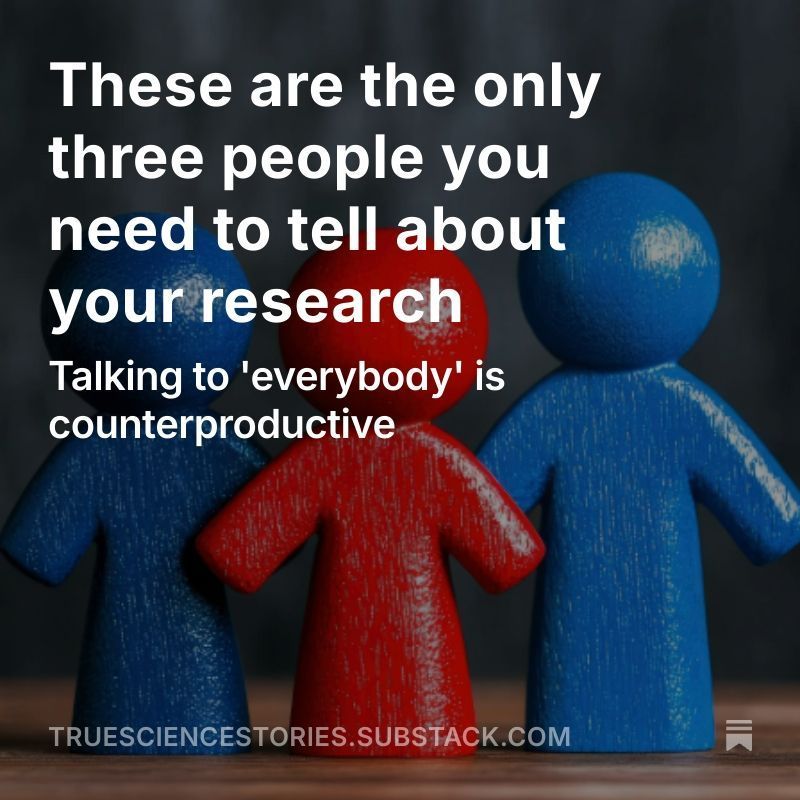
February 28, 2025 at 8:52 AM
The biggest mistake scientists make?
Thinking their audience is “the general public.”
In reality, you need to connect with three distinct groups.
Find out who they are: buff.ly/4hRlGtP
Thinking their audience is “the general public.”
In reality, you need to connect with three distinct groups.
Find out who they are: buff.ly/4hRlGtP
The biggest mistake scientists make?
Thinking their audience is “the general public.”
In reality, you need to connect with three distinct groups—or your work won’t land.
Find out who they are: https://buff.ly/4hRlGtP
Thinking their audience is “the general public.”
In reality, you need to connect with three distinct groups—or your work won’t land.
Find out who they are: https://buff.ly/4hRlGtP
February 26, 2025 at 6:43 PM
The biggest mistake scientists make?
Thinking their audience is “the general public.”
In reality, you need to connect with three distinct groups—or your work won’t land.
Find out who they are: https://buff.ly/4hRlGtP
Thinking their audience is “the general public.”
In reality, you need to connect with three distinct groups—or your work won’t land.
Find out who they are: https://buff.ly/4hRlGtP
Your research isn’t meant for everyone.
Trying to reach everyone = reaching no one.
The scientists who make an impact focus on three specific audiences.
Are you?
https://buff.ly/4hRlGtP
Trying to reach everyone = reaching no one.
The scientists who make an impact focus on three specific audiences.
Are you?
https://buff.ly/4hRlGtP

February 26, 2025 at 1:19 PM
Your research isn’t meant for everyone.
Trying to reach everyone = reaching no one.
The scientists who make an impact focus on three specific audiences.
Are you?
https://buff.ly/4hRlGtP
Trying to reach everyone = reaching no one.
The scientists who make an impact focus on three specific audiences.
Are you?
https://buff.ly/4hRlGtP
Most patient information sheets for clinical trials put patients off. Here’s a research-backed solution to up your recruitment rate.
https://buff.ly/41koHwW
https://buff.ly/41koHwW

February 22, 2025 at 7:04 PM
Most patient information sheets for clinical trials put patients off. Here’s a research-backed solution to up your recruitment rate.
https://buff.ly/41koHwW
https://buff.ly/41koHwW
You’ve crunched the numbers and worked out how many patients you need to recruit to your study, and it’s…. so, so many. A quarter of clinical trials fold for lack of recruitment, so how do you make sure yours isn’t one?
My latest newsletter has some evidence-based ideas for keeping you on track.
My latest newsletter has some evidence-based ideas for keeping you on track.
February 21, 2025 at 6:57 PM
You’ve crunched the numbers and worked out how many patients you need to recruit to your study, and it’s…. so, so many. A quarter of clinical trials fold for lack of recruitment, so how do you make sure yours isn’t one?
My latest newsletter has some evidence-based ideas for keeping you on track.
My latest newsletter has some evidence-based ideas for keeping you on track.
What’s the best way to get patients signed up for your clinical trial? This three-step process is what the evidence says.
https://buff.ly/41koHwW
https://buff.ly/41koHwW

February 20, 2025 at 8:57 AM
What’s the best way to get patients signed up for your clinical trial? This three-step process is what the evidence says.
https://buff.ly/41koHwW
https://buff.ly/41koHwW
You know when you're researching one thing and you discover something else entirely? That's how this piece started.... it's about recruiting patients into clinical studies.
#science #biomedical #research
open.substack.com/pub/truescie...
#science #biomedical #research
open.substack.com/pub/truescie...
February 18, 2025 at 5:27 PM
You know when you're researching one thing and you discover something else entirely? That's how this piece started.... it's about recruiting patients into clinical studies.
#science #biomedical #research
open.substack.com/pub/truescie...
#science #biomedical #research
open.substack.com/pub/truescie...
Once upon a time there was a brave, perceptive researcher - but they could never explain their work to any non scientists. Then one day, they read a Substack post and discovered the solution to their problem...
https://buff.ly/4aTIqqB
https://buff.ly/4aTIqqB

February 15, 2025 at 3:35 AM
Once upon a time there was a brave, perceptive researcher - but they could never explain their work to any non scientists. Then one day, they read a Substack post and discovered the solution to their problem...
https://buff.ly/4aTIqqB
https://buff.ly/4aTIqqB
Once upon a time there was a brave, perceptive researcher - but they could never explain their work to any non scientists. Then one day, they read a Substack post and discovered the solution to their problem...
https://buff.ly/4aTIqqB
https://buff.ly/4aTIqqB
February 13, 2025 at 1:27 PM
Once upon a time there was a brave, perceptive researcher - but they could never explain their work to any non scientists. Then one day, they read a Substack post and discovered the solution to their problem...
https://buff.ly/4aTIqqB
https://buff.ly/4aTIqqB