



Silvia Ceausu
@silviaceausu.bsky.social
Postdoc at UCL CBER https://www.ucl.ac.uk/biosciences/gee/ucl-centre-biodiversity-and-environment-research. Biodiversity conservation research focused on agriculture, trade, ecosystem services, human-wildlife coexistence, rewilding
Pinned

Geography and availability of natural habitat determine whether cropland intensification or expansion is more detrimental to biodiversity
Nature Ecology & Evolution - Both agricultural expansion and intensification drive biodiversity losses. Here the authors quantify and compare globally the biodiversity impact of land conversion...
rdcu.be
Our study on the biodiversity impacts of agriculture in @natureecoevo.bsky.social rdcu.be/ekept Minimizing biodiversity loss requires a balance of expansion and intensification,while preserving unmodified land #Biodiversity #LandUse #ConservationScience @dleclere.bsky.social @tnewbold31.bsky.social
Reposted by Silvia Ceausu

🐺 Wolves and other large carnivore species are making a comeback in Europe.
Yet current conservation policies are still geared toward protecting species on the brink of extinction. This no longer reflects reality, argue researchers in a new commentary. www.stockholmresilience.org/5.1a496cd119...
Yet current conservation policies are still geared toward protecting species on the brink of extinction. This no longer reflects reality, argue researchers in a new commentary. www.stockholmresilience.org/5.1a496cd119...

September 18, 2025 at 11:16 AM
🐺 Wolves and other large carnivore species are making a comeback in Europe.
Yet current conservation policies are still geared toward protecting species on the brink of extinction. This no longer reflects reality, argue researchers in a new commentary. www.stockholmresilience.org/5.1a496cd119...
Yet current conservation policies are still geared toward protecting species on the brink of extinction. This no longer reflects reality, argue researchers in a new commentary. www.stockholmresilience.org/5.1a496cd119...
Reposted by Silvia Ceausu

Hot from the @consletters.bsky.social press: "Now What? The Conundrum of Successful Recovery of Wolves and Other Species for European Conservation", where Erica Von Essen and I discuss future trajectories of species recovery and management in Europe. Here summarised by @sthlmresilience.bsky.social.
🐺 Wolves and other large carnivore species are making a comeback in Europe.
Yet current conservation policies are still geared toward protecting species on the brink of extinction. This no longer reflects reality, argue researchers in a new commentary. www.stockholmresilience.org/5.1a496cd119...
Yet current conservation policies are still geared toward protecting species on the brink of extinction. This no longer reflects reality, argue researchers in a new commentary. www.stockholmresilience.org/5.1a496cd119...
September 18, 2025 at 12:58 PM
Hot from the @consletters.bsky.social press: "Now What? The Conundrum of Successful Recovery of Wolves and Other Species for European Conservation", where Erica Von Essen and I discuss future trajectories of species recovery and management in Europe. Here summarised by @sthlmresilience.bsky.social.
New paper: Londoners are more likely to donate to national & global environmental causes than local. Our findings suggest environmental giving isn’t as parochial as human-directed altruism #EnvEcon #Climate #Philanthropy
authors.elsevier.com/a/1lnZw3Hb%7...
authors.elsevier.com/a/1lnZw3Hb%7...
authors.elsevier.com
September 17, 2025 at 1:51 PM
New paper: Londoners are more likely to donate to national & global environmental causes than local. Our findings suggest environmental giving isn’t as parochial as human-directed altruism #EnvEcon #Climate #Philanthropy
authors.elsevier.com/a/1lnZw3Hb%7...
authors.elsevier.com/a/1lnZw3Hb%7...
Reposted by Silvia Ceausu

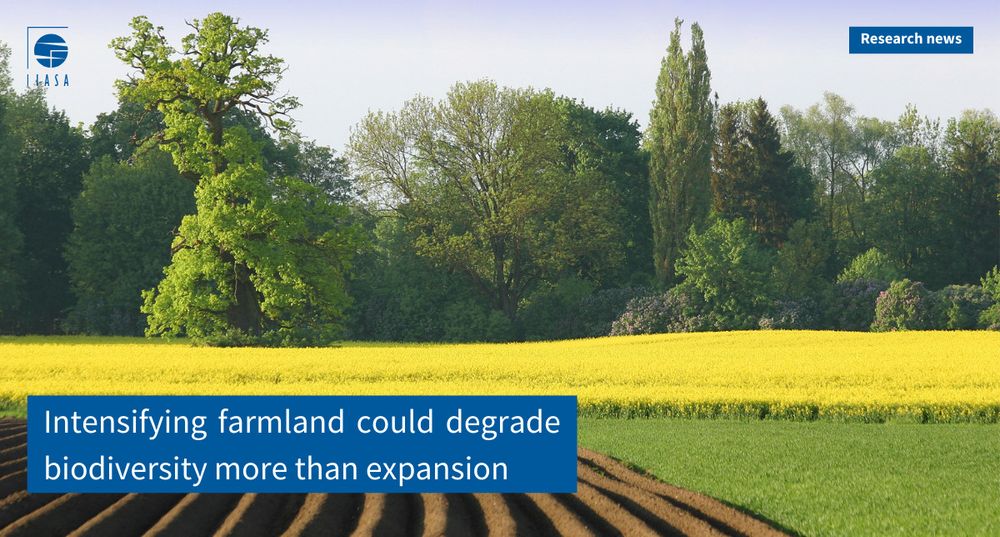
🌾📉 New research published in @natureecoevo.bsky.social shows that intensifying existing farmland can sometimes harm local biodiversity more than expanding agricultural land.
Read more 👉 iiasa.ac.at/news/may-202...
@ucl.ac.uk @silviaceausu.bsky.social @tnewbold31.bsky.social
Read more 👉 iiasa.ac.at/news/may-202...
@ucl.ac.uk @silviaceausu.bsky.social @tnewbold31.bsky.social
May 7, 2025 at 2:28 PM
🌾📉 New research published in @natureecoevo.bsky.social shows that intensifying existing farmland can sometimes harm local biodiversity more than expanding agricultural land.
Read more 👉 iiasa.ac.at/news/may-202...
@ucl.ac.uk @silviaceausu.bsky.social @tnewbold31.bsky.social
Read more 👉 iiasa.ac.at/news/may-202...
@ucl.ac.uk @silviaceausu.bsky.social @tnewbold31.bsky.social
Reposted by Silvia Ceausu

The intensification of existing farmland can sometimes be more harmful to local #biodiversity than expanding the area covered by agricultural land, finds a new study led by Dr @silviaceausu.bsky.social with Prof @tnewbold31.bsky.social @uclcber.bsky.social @ucllifesciences.bsky.social #LandUse

Intensifying farmland can sometimes degrade biodiversity more than expansion
The intensification of existing farmland can sometimes be more harmful to local biodiversity than expanding the area covered by agricultural land, finds a new study led by UCL researchers.
www.ucl.ac.uk
May 1, 2025 at 1:54 PM
The intensification of existing farmland can sometimes be more harmful to local #biodiversity than expanding the area covered by agricultural land, finds a new study led by Dr @silviaceausu.bsky.social with Prof @tnewbold31.bsky.social @uclcber.bsky.social @ucllifesciences.bsky.social #LandUse
Our study on the biodiversity impacts of agriculture in @natureecoevo.bsky.social rdcu.be/ekept Minimizing biodiversity loss requires a balance of expansion and intensification,while preserving unmodified land #Biodiversity #LandUse #ConservationScience @dleclere.bsky.social @tnewbold31.bsky.social
Geography and availability of natural habitat determine whether cropland intensification or expansion is more detrimental to biodiversity
Nature Ecology & Evolution - Both agricultural expansion and intensification drive biodiversity losses. Here the authors quantify and compare globally the biodiversity impact of land conversion...
rdcu.be
May 1, 2025 at 11:11 AM
Our study on the biodiversity impacts of agriculture in @natureecoevo.bsky.social rdcu.be/ekept Minimizing biodiversity loss requires a balance of expansion and intensification,while preserving unmodified land #Biodiversity #LandUse #ConservationScience @dleclere.bsky.social @tnewbold31.bsky.social