



Shanid Shrestha
@shaniddd.bsky.social
I move fluid around. PhD Candidate @pennstatechemistry.bsky.social | Sen Lab
My labmate @sanjanakmani.bsky.social killing it as usual!
Thrilled to receive the Poster Award at Materials Day 2025 organized by PennStateMRI! We explore how interfacial phenomena drive dynamic #emulsions and life-like behavior in soft #materials.
More @ sites.psu.edu/sengroup/ !
Grateful to @ayusmansen.bsky.social @pennstatechemistry.bsky.social
More @ sites.psu.edu/sengroup/ !
Grateful to @ayusmansen.bsky.social @pennstatechemistry.bsky.social
The Sen Group – Active autonomous systems; synthetic nano and micromotors; micropumps; nanotechnology, systems chemistry research at Penn State
Active autonomous systems; synthetic nano and micromotors; micropumps; nanotechnology, systems chemistry research at Penn State
sites.psu.edu
November 9, 2025 at 2:05 AM
My labmate @sanjanakmani.bsky.social killing it as usual!
Reposted by Shanid Shrestha

Spiral patterns form by simply dropping protein solutions on to denser sugar solutions, showing reaction-diffusion pattern formation can be replicated by replacing the reaction-induced inhomogeneous solute distribution by evaporation-induced inhomogeneity: rdcu.be/eMUyR

Pattern formation in isothermal miscible protein-sugar systems driven by Marangoni effects and evaporation
Communications Physics - Pattern formation in miscible fluid systems is typically driven by reaction-diffusion processes or thermal gradients. This study demonstrates pattern formation in an...
rdcu.be
October 27, 2025 at 1:53 PM
Spiral patterns form by simply dropping protein solutions on to denser sugar solutions, showing reaction-diffusion pattern formation can be replicated by replacing the reaction-induced inhomogeneous solute distribution by evaporation-induced inhomogeneity: rdcu.be/eMUyR
Reposted by Shanid Shrestha

Deeply grateful to my advisor @ayusmansen.bsky.social for his invaluable guidance, and to Dr. Lauren Zarzar, and all the amazing collaborators who made this work possible!
@pennstatechemistry.bsky.social @pennstatescience.bsky.social
@pennstatechemistry.bsky.social @pennstatescience.bsky.social
Our latest work in @jacs.acspublications.org!
Artificial system that can sense, grow, and adapt—just like cells! Our #droplets form directional filopodia in response to chemical cues- a step toward life-like materials. #SoftMatter #MatterToLife
🔗https://pubs.acs.org/doi/10.1021/jacs.5c11719
Artificial system that can sense, grow, and adapt—just like cells! Our #droplets form directional filopodia in response to chemical cues- a step toward life-like materials. #SoftMatter #MatterToLife
🔗https://pubs.acs.org/doi/10.1021/jacs.5c11719
October 16, 2025 at 4:09 PM
Deeply grateful to my advisor @ayusmansen.bsky.social for his invaluable guidance, and to Dr. Lauren Zarzar, and all the amazing collaborators who made this work possible!
@pennstatechemistry.bsky.social @pennstatescience.bsky.social
@pennstatechemistry.bsky.social @pennstatescience.bsky.social
Reposted by Shanid Shrestha
Our latest: Like bacteria, oil-in-water emulsions sense specific amino acids, sending out finger-like projections towards or away from the source! Droplets as Cell Models: Chemical Gradient-Induced Directional Filopodia Formation. Great work by @sanjanakmani.bsky.social pubs.acs.org/doi/full/10....
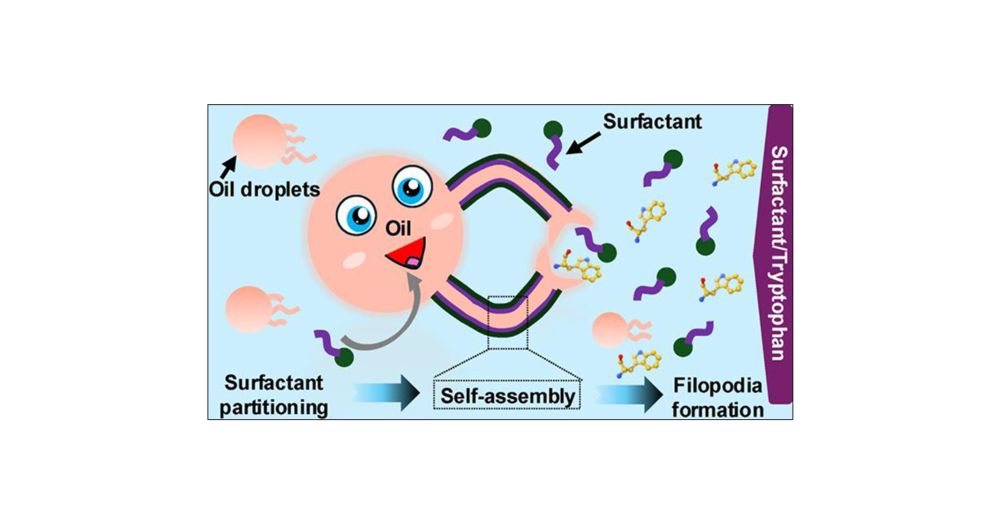
Droplets as Cell Models: Chemical Gradient-Induced Directional Filopodia Formation
Cells are complex chemical systems capable of sensing and responding to environmental cues by dynamically reshaping themselves, e.g., by forming arm-like protrusions such as filopodia. Recapitulating cellular behavior in artificial systems is a long-standing goal in understanding the matter-to-life transition and designing responsive soft materials. Here, we use oil-in-water emulsions that mimic cellular environmental sensing and form directional arm-like filopodia in response to external chemical cues. Our work analyzes the step-by-step process involved in the formation of artificial filopodia, and we engineer ways to direct filopodia growth through different chemical gradients. The process is driven by asymmetric surfactant partitioning across the oil–water interface, followed by ordering at the interface to form lamellar structures, which are projected out as filopodia. We observe filopodia growing away from the source of kosmotropic anions and toward the source of chaotropic anions from the Hofmeister series. Significantly, these systems also respond to amino acid gradients, similar to cells: tryptophan gradients favor growth toward the source, while lysine and arginine gradients cause growth away from the amino acid source. Our findings open new avenues for fabricating life-like materials that sense and grow in response to external signals.
pubs.acs.org
October 15, 2025 at 7:29 PM
Our latest: Like bacteria, oil-in-water emulsions sense specific amino acids, sending out finger-like projections towards or away from the source! Droplets as Cell Models: Chemical Gradient-Induced Directional Filopodia Formation. Great work by @sanjanakmani.bsky.social pubs.acs.org/doi/full/10....
Reposted by Shanid Shrestha
Fellow motorists, follow the roadmap for an exciting journey! Many thanks to Samuel Sanchez and others for their insights:
New Perspective Article:
A roadmap for next-generation nanomotors.
"to inspire future generations of researchers to advance both fundamental understanding & practical breakthroughs, thereby engineering a paradigm shift in #nanomotor research."
#SystemsMaterials
www.nature.com/articles/s41...
A roadmap for next-generation nanomotors.
"to inspire future generations of researchers to advance both fundamental understanding & practical breakthroughs, thereby engineering a paradigm shift in #nanomotor research."
#SystemsMaterials
www.nature.com/articles/s41...

August 1, 2025 at 11:33 AM
Fellow motorists, follow the roadmap for an exciting journey! Many thanks to Samuel Sanchez and others for their insights:
Reposted by Shanid Shrestha
We are on our way to designing intelligent communicating systems involving particle populations that carry out different tasks. Non-reciprocal chemotactic movement in enzyme cascade under flow-free conditions: Cell Reports Physical Science www.cell.com/cell-reports...

Non-reciprocal chemotactic movement in enzyme cascade under flow-free conditions
Sapre et al. showcase a hydrogel-based microfluidic device that creates chemical gradients
under flow-free conditions for studying enzyme-powered chemotaxis. The setup allows
long-term observation of ...
www.cell.com
June 28, 2025 at 8:30 PM
We are on our way to designing intelligent communicating systems involving particle populations that carry out different tasks. Non-reciprocal chemotactic movement in enzyme cascade under flow-free conditions: Cell Reports Physical Science www.cell.com/cell-reports...
Reposted by Shanid Shrestha
Our perspective on swarm intlligence in nanomotors is out in Nature Review Materials. Fun collaboration with friends across the Atlantic. doi.org/10.1038/s415...

Swarming intelligence in self-propelled micromotors and nanomotors - Nature Reviews Materials
Biological swarming behaviours inspire artificial motile nanosystems. This Perspective highlights recent advances in swarm navigation and biomedical applications, while addressing challenges such as c...
doi.org
June 14, 2025 at 12:32 PM
Our perspective on swarm intlligence in nanomotors is out in Nature Review Materials. Fun collaboration with friends across the Atlantic. doi.org/10.1038/s415...
Reposted by Shanid Shrestha
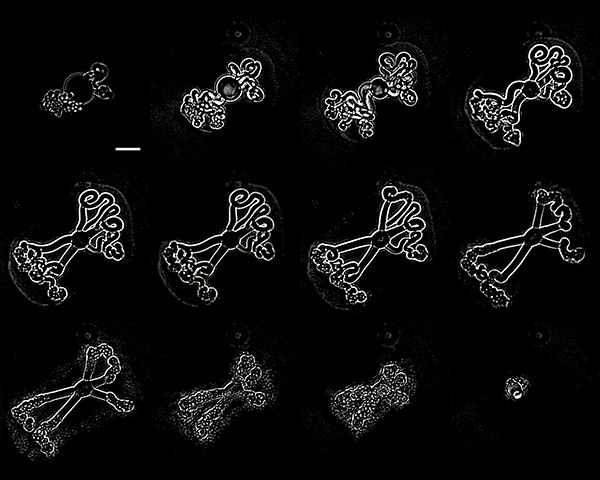
"Life of a Droplet: A Non-Equilibrium Drama." Congratulations @sanjanakmani.bsky.social @pennstatechemistry.bsky.social for winning first prize in Visual Appeal at the Penn State Materials Visualization Competition.
April 10, 2025 at 3:48 AM
"Life of a Droplet: A Non-Equilibrium Drama." Congratulations @sanjanakmani.bsky.social @pennstatechemistry.bsky.social for winning first prize in Visual Appeal at the Penn State Materials Visualization Competition.
Reposted by Shanid Shrestha
An accidental discovery 😃
Unraveling the Secrets of Pattern Formation in Proteins and Sugars thesciencearchive.org/2502-20465v1/
Unraveling the Secrets of Pattern Formation in Proteins and Sugars thesciencearchive.org/2502-20465v1/
Unraveling the Secrets of Pattern Formation in Proteins and Sugars – The Science Archive
thesciencearchive.org
March 30, 2025 at 6:05 PM
An accidental discovery 😃
Unraveling the Secrets of Pattern Formation in Proteins and Sugars thesciencearchive.org/2502-20465v1/
Unraveling the Secrets of Pattern Formation in Proteins and Sugars thesciencearchive.org/2502-20465v1/