




Samantha Rumschlag
@rumschsl.bsky.social
Ecologist specializing in water quality trends, ecotoxicology, and biodiversity.
Reposted by Samantha Rumschlag

How #climatechange is reshaping fish communities in the United States as temperatures rise and non-native fishes proliferate: @ian-vaughan.bsky.social overviews recent extensive work by @rumschsl.bsky.social www.nature.com/articles/d41... www.nature.com/articles/s41...
Climate change is reshaping fish communities in the United States
Rising temperatures and the introduction of non-native fishes have been linked to rapid changes in fish communities across the United States.
www.nature.com
September 29, 2025 at 10:19 AM
How #climatechange is reshaping fish communities in the United States as temperatures rise and non-native fishes proliferate: @ian-vaughan.bsky.social overviews recent extensive work by @rumschsl.bsky.social www.nature.com/articles/d41... www.nature.com/articles/s41...
Reposted by Samantha Rumschlag

Climate change is reshaping the fish communities of rivers across the US - my commentary in @nature.com to accompany the new study led by @rumschsl.bsky.social rdcu.be/eHY6B 🌍🧪
Climate change is reshaping fish communities in the United States | Nature
Rising temperatures and the introduction of non-native fishes have been linked to rapid changes in fish communities across the United States. Rising temperatures and the introduction of non-native fishes have been linked to rapid changes in fish communities across the United States.
rdcu.be
September 25, 2025 at 7:37 PM
Climate change is reshaping the fish communities of rivers across the US - my commentary in @nature.com to accompany the new study led by @rumschsl.bsky.social rdcu.be/eHY6B 🌍🧪
Reposted by Samantha Rumschlag

Changing water temperatures and human-driven introductions of fish have altered the composition of fish populations in streams and rivers across the USA over the past three decades, a study in Nature suggests. go.nature.com/47ZCcWH 🧪

September 24, 2025 at 10:30 PM
Changing water temperatures and human-driven introductions of fish have altered the composition of fish populations in streams and rivers across the USA over the past three decades, a study in Nature suggests. go.nature.com/47ZCcWH 🧪
Reposted by Samantha Rumschlag
Fish communities in US rivers have changed a lot since the 1990s, linked to climate change and species introductions - new research in @nature.com led by @rumschsl.bsky.social www.nature.com/articles/s41...

Diverging fish biodiversity trends in cold and warm rivers and streams - Nature
In the past three decades, fish abundance, richness and uniqueness have diverged across cold and warm streams, and the effects on native fish communities of stream warming and increases in introduced fishes have magnified each other.
www.nature.com
September 25, 2025 at 5:44 PM
Fish communities in US rivers have changed a lot since the 1990s, linked to climate change and species introductions - new research in @nature.com led by @rumschsl.bsky.social www.nature.com/articles/s41...
Reposted by Samantha Rumschlag

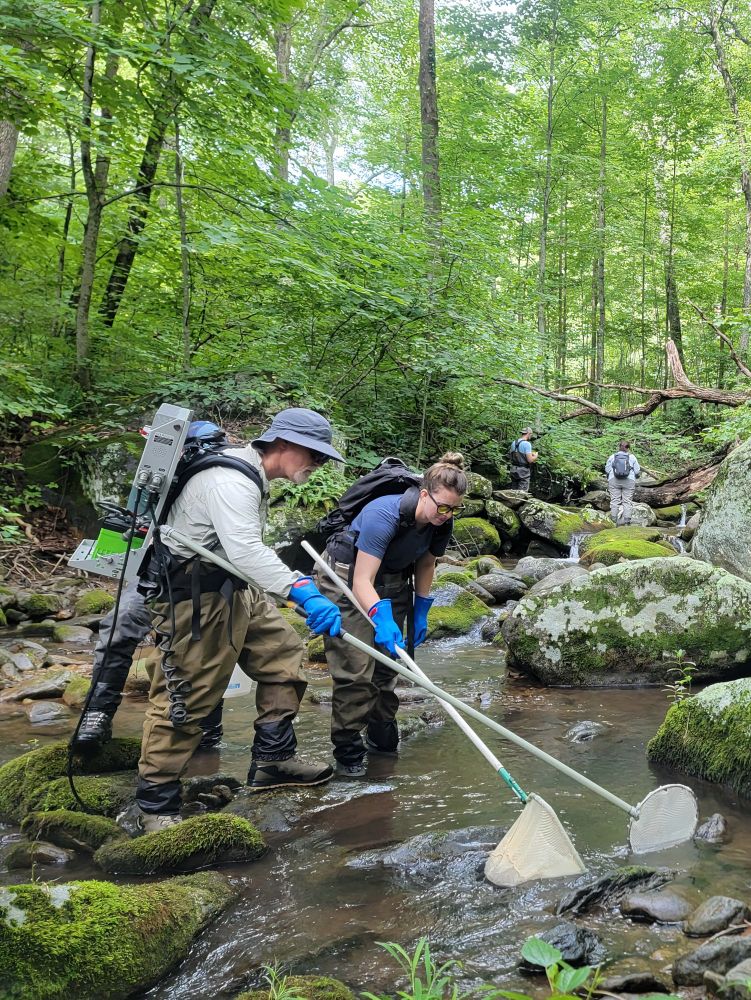
Sometimes you set out to ask one question and you end up addressing something different. Here is an example of that where we set out to synthesize US biomonitoring data and pesticide data and ended up asking a biodiversity question. Fun working with this team!
Our research group just published a study in Nature on how fish biodiversity in U.S. rivers and streams has been changing over the past 27 years (1993–2019). The results show sharply diverging trends depending on historic and changing water temperature. 🧵 rdcu.be/eH0l8
September 24, 2025 at 8:48 PM
Sometimes you set out to ask one question and you end up addressing something different. Here is an example of that where we set out to synthesize US biomonitoring data and pesticide data and ended up asking a biodiversity question. Fun working with this team!
Reposted by Samantha Rumschlag

Our research group just published a study in Nature on how fish biodiversity in U.S. rivers and streams has been changing over the past 27 years (1993–2019). The results show sharply diverging trends depending on historic and changing water temperature. 🧵 rdcu.be/eH0l8
September 24, 2025 at 5:08 PM
Our research group just published a study in Nature on how fish biodiversity in U.S. rivers and streams has been changing over the past 27 years (1993–2019). The results show sharply diverging trends depending on historic and changing water temperature. 🧵 rdcu.be/eH0l8
Reposted by Samantha Rumschlag

Exciting collaboration with colleagues from the US and Frederik de Laender - lead by S. Rumschlag and Mike Mahon - on how climate change has lead to alterations in US fish diversity over the last decades. Paper just out: www.nature.com/articles/s41...

Diverging fish biodiversity trends in cold and warm rivers and streams - Nature
In the past three decades, fish abundance, richness and uniqueness have diverged across cold and warm streams, and the effects on native fish communities of stream warming and increases in introduced fishes have magnified each other.
www.nature.com
September 24, 2025 at 4:20 PM
Exciting collaboration with colleagues from the US and Frederik de Laender - lead by S. Rumschlag and Mike Mahon - on how climate change has lead to alterations in US fish diversity over the last decades. Paper just out: www.nature.com/articles/s41...