



Queen Mary Faculty of Science and Engineering
@qmulse.bsky.social
Science and engineering news from Queen Mary University of London, one of the UK's leading research universities.
Pinned

Queen Mary early-career researchers awarded prestigious European Research Council Starting Grants
www.qmul.ac.uk
Congratulations to Dr Marc Fernández-Yagüe (School of Physical and Chemical Sciences) who has received a European Research Council Starting Grant.
A fantastic achievement and recognition of Queen Mary’s research strength in materials chemistry.
Find out more: tinyurl.com/bde9yh79
A fantastic achievement and recognition of Queen Mary’s research strength in materials chemistry.
Find out more: tinyurl.com/bde9yh79
Congratulations to Dr Marc Fernández-Yagüe (School of Physical and Chemical Sciences) who has received a European Research Council Starting Grant.
A fantastic achievement and recognition of Queen Mary’s research strength in materials chemistry.
Find out more: tinyurl.com/bde9yh79
A fantastic achievement and recognition of Queen Mary’s research strength in materials chemistry.
Find out more: tinyurl.com/bde9yh79
Queen Mary early-career researchers awarded prestigious European Research Council Starting Grants
www.qmul.ac.uk
September 4, 2025 at 3:39 PM
Congratulations to Dr Marc Fernández-Yagüe (School of Physical and Chemical Sciences) who has received a European Research Council Starting Grant.
A fantastic achievement and recognition of Queen Mary’s research strength in materials chemistry.
Find out more: tinyurl.com/bde9yh79
A fantastic achievement and recognition of Queen Mary’s research strength in materials chemistry.
Find out more: tinyurl.com/bde9yh79
Queen Mary is delighted to be a ‘University of the Year’ finalist in the #THEAwards!
And we’re so proud Professors @larschittka.bsky.social and @alastairhackney.bsky.social have been shortlisted for Outstanding Research Supervisor of the Year. @timeshighered.bsky.social.
tinyurl.com/ebe8yx23
And we’re so proud Professors @larschittka.bsky.social and @alastairhackney.bsky.social have been shortlisted for Outstanding Research Supervisor of the Year. @timeshighered.bsky.social.
tinyurl.com/ebe8yx23

September 4, 2025 at 8:10 AM
Queen Mary is delighted to be a ‘University of the Year’ finalist in the #THEAwards!
And we’re so proud Professors @larschittka.bsky.social and @alastairhackney.bsky.social have been shortlisted for Outstanding Research Supervisor of the Year. @timeshighered.bsky.social.
tinyurl.com/ebe8yx23
And we’re so proud Professors @larschittka.bsky.social and @alastairhackney.bsky.social have been shortlisted for Outstanding Research Supervisor of the Year. @timeshighered.bsky.social.
tinyurl.com/ebe8yx23
A new study from our researchers shows that highly sensitive people are more likely to experience mental health problems compared to less sensitive people.
The findings suggest these individuals could benefit more from interventions like mindfulness.
shorturl.at/IHUsD @qmul.bsky.social
The findings suggest these individuals could benefit more from interventions like mindfulness.
shorturl.at/IHUsD @qmul.bsky.social

People with sensitive personalities more likely to experience mental health problems
shorturl.at
August 18, 2025 at 1:05 PM
A new study from our researchers shows that highly sensitive people are more likely to experience mental health problems compared to less sensitive people.
The findings suggest these individuals could benefit more from interventions like mindfulness.
shorturl.at/IHUsD @qmul.bsky.social
The findings suggest these individuals could benefit more from interventions like mindfulness.
shorturl.at/IHUsD @qmul.bsky.social
Fantastic to see this paper in @nature.com, co-authored by @qmul.bsky.social researchers, showing how arrow worms invent new genes!
New Nature study (co-authored by Queen Mary researchers) reveals that arrow worms evolved unique organs by inventing brand-new genes — not just reusing old ones. 🧬🌊
🔗 www.qmul.ac.uk/sbbs/news/it...
@qmulse.bsky.social
🔗 www.qmul.ac.uk/sbbs/news/it...
@qmulse.bsky.social

Cracking the Genetic Code of Arrow Worms: How Chaetognaths Got Their Unique Body Plan
www.qmul.ac.uk
August 14, 2025 at 12:57 PM
Fantastic to see this paper in @nature.com, co-authored by @qmul.bsky.social researchers, showing how arrow worms invent new genes!
Reposted by Queen Mary Faculty of Science and Engineering

www.nature.com/articles/s41...
Arctic winter is changing fast. In February 2025, #Svalbard saw rain, thawing tundra, and pooling meltwater. The comment by Bradley and co-authors shows how winter #warming is reshaping #polar ecosystems—and why this is the new #Arctic.
Arctic winter is changing fast. In February 2025, #Svalbard saw rain, thawing tundra, and pooling meltwater. The comment by Bradley and co-authors shows how winter #warming is reshaping #polar ecosystems—and why this is the new #Arctic.
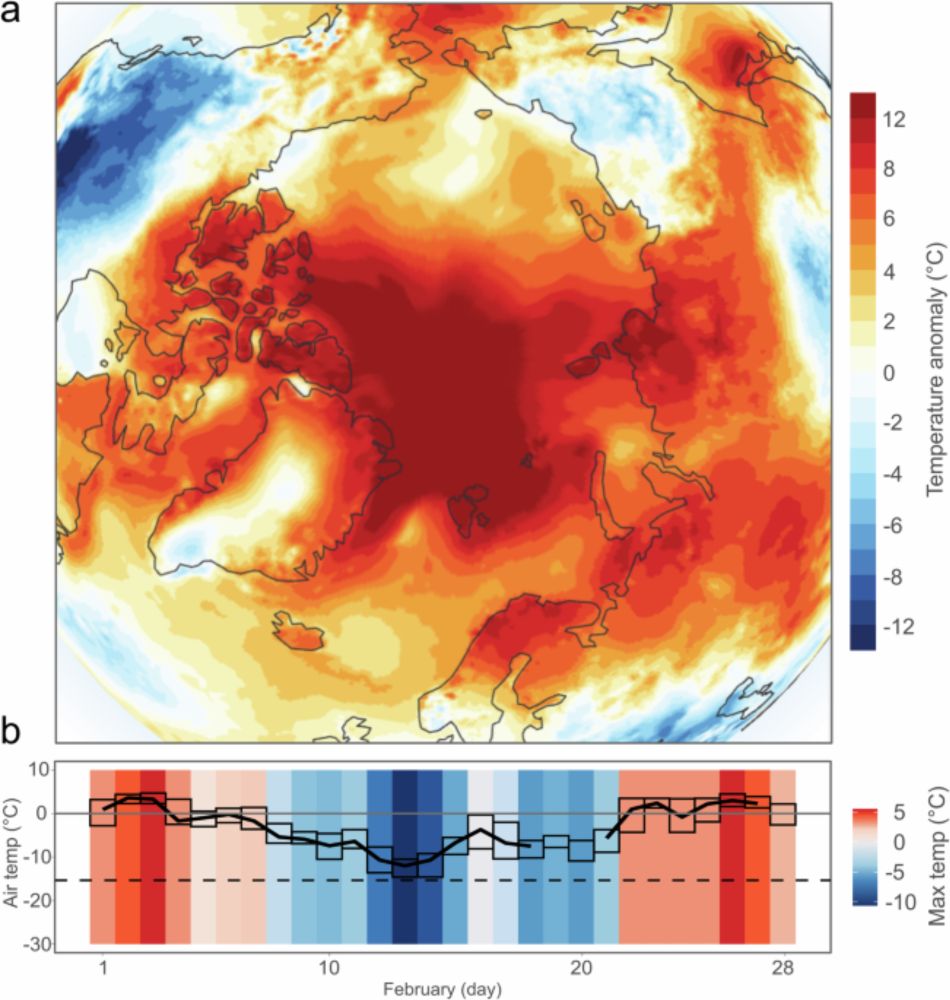
Svalbard winter warming is reaching melting point - Nature Communications
The Arctic winters are changing fast. In February 2025, Svalbard endured rain, thawing tundra, and pooling meltwater. The Comment by Bradley and coauthors describes how winter warming is reshapin...
www.nature.com
July 22, 2025 at 1:23 PM
www.nature.com/articles/s41...
Arctic winter is changing fast. In February 2025, #Svalbard saw rain, thawing tundra, and pooling meltwater. The comment by Bradley and co-authors shows how winter #warming is reshaping #polar ecosystems—and why this is the new #Arctic.
Arctic winter is changing fast. In February 2025, #Svalbard saw rain, thawing tundra, and pooling meltwater. The comment by Bradley and co-authors shows how winter #warming is reshaping #polar ecosystems—and why this is the new #Arctic.
"The gear I packed felt like a relic from another climate." – @drbradbrad.bsky.social, on a shocking February in #Svalbard. The new Nature Comms commentary reveals the #Arctic winter reaching its melting point, with widespread thaw & vegetation bloom. Read more: www.nature.com/articles/s41...
July 21, 2025 at 9:25 AM
"The gear I packed felt like a relic from another climate." – @drbradbrad.bsky.social, on a shocking February in #Svalbard. The new Nature Comms commentary reveals the #Arctic winter reaching its melting point, with widespread thaw & vegetation bloom. Read more: www.nature.com/articles/s41...
If you're melting, take comfort: even fruit flies are apparently over this heatwave. 🫠
A fantastic new study shows how #Drosophila larvae have repeatedly evolved to pick their perfect temperature, essentially "fine-tuning" their comfort zone.
Read more: www.qmul.ac.uk/media/news/2...
A fantastic new study shows how #Drosophila larvae have repeatedly evolved to pick their perfect temperature, essentially "fine-tuning" their comfort zone.
Read more: www.qmul.ac.uk/media/news/2...
July 18, 2025 at 11:29 AM
If you're melting, take comfort: even fruit flies are apparently over this heatwave. 🫠
A fantastic new study shows how #Drosophila larvae have repeatedly evolved to pick their perfect temperature, essentially "fine-tuning" their comfort zone.
Read more: www.qmul.ac.uk/media/news/2...
A fantastic new study shows how #Drosophila larvae have repeatedly evolved to pick their perfect temperature, essentially "fine-tuning" their comfort zone.
Read more: www.qmul.ac.uk/media/news/2...
Brilliant to see this fascinating research! We're especially delighted to see @ehowaspi.bsky.social, visiting researcher at the @qmulsbbs.bsky.social, contributing to this amazing study.

Then vs Now: Same chimp, same task - 17 years apart 🐒🔧
New Oxford-led research suggests that ageing can affect how wild chimpanzees use tools, though the impact varies widely between individuals.
More info ⬇️
www.ox.ac.uk/news/2025-07...
New Oxford-led research suggests that ageing can affect how wild chimpanzees use tools, though the impact varies widely between individuals.
More info ⬇️
www.ox.ac.uk/news/2025-07...
July 16, 2025 at 1:58 PM
Brilliant to see this fascinating research! We're especially delighted to see @ehowaspi.bsky.social, visiting researcher at the @qmulsbbs.bsky.social, contributing to this amazing study.
Our very own Dr Babis Rallis's fascinating work on #caffeine and #cellularageing has been featured in Bloomberg. Beyond just a morning boost, new insights suggest caffeine could play a role in slowing cellular ageing.
Find out more about this exciting research: www.bloomberg.com/news/newslet...
Find out more about this exciting research: www.bloomberg.com/news/newslet...

Scientists Probe Caffeine’s Hidden Benefits
Hey, it's Tim in Munich, where I'm feeling rather virtuous right now about my morning coffee habit. But first ...
www.bloomberg.com
July 15, 2025 at 2:26 PM
Our very own Dr Babis Rallis's fascinating work on #caffeine and #cellularageing has been featured in Bloomberg. Beyond just a morning boost, new insights suggest caffeine could play a role in slowing cellular ageing.
Find out more about this exciting research: www.bloomberg.com/news/newslet...
Find out more about this exciting research: www.bloomberg.com/news/newslet...
Researchers at @qmulspcs.bsky.social confirmed the "helicity barrier" in solar wind using NASA Parker Solar Probe data. This explains why the Sun's atmosphere is millions of degrees hotter than its surface! A breakthrough for space weather & astrophysics.
Read more: www.qmul.ac.uk/media/news/2...
Read more: www.qmul.ac.uk/media/news/2...

Pioneering space probe reveals secrets of mysterious solar barrier
www.qmul.ac.uk
July 9, 2025 at 9:37 AM
Researchers at @qmulspcs.bsky.social confirmed the "helicity barrier" in solar wind using NASA Parker Solar Probe data. This explains why the Sun's atmosphere is millions of degrees hotter than its surface! A breakthrough for space weather & astrophysics.
Read more: www.qmul.ac.uk/media/news/2...
Read more: www.qmul.ac.uk/media/news/2...
Reposted by Queen Mary Faculty of Science and Engineering

Smaller islands in Wallacea, Indonesia, provide vital, higher-quality habitats for endangered mammals, highlighting the importance of targeted conservation and habitat protection on these landmasses. doi.org/g9rdch

Smaller islands offer crucial refuge for endangered mammals in Wallacea, Indonesia
A new study published in the Proceedings of the National Academy of Sciences reveals that smaller islands within the Wallacea biodiversity hotspot are crucial refuges for endangered vertebrates, providing higher-quality habitats and supporting populations.
phys.org
June 25, 2025 at 8:02 PM
Smaller islands in Wallacea, Indonesia, provide vital, higher-quality habitats for endangered mammals, highlighting the importance of targeted conservation and habitat protection on these landmasses. doi.org/g9rdch
Reposted by Queen Mary Faculty of Science and Engineering

Researchers from Queen Mary and Kew Gardens, have found that natural selection is working to combat the devastating ash dieback disease.
Find out more: www.qmul.ac.uk/media/news/2...
Find out more: www.qmul.ac.uk/media/news/2...

June 27, 2025 at 10:01 AM
Researchers from Queen Mary and Kew Gardens, have found that natural selection is working to combat the devastating ash dieback disease.
Find out more: www.qmul.ac.uk/media/news/2...
Find out more: www.qmul.ac.uk/media/news/2...
Reposted by Queen Mary Faculty of Science and Engineering

A new study led by our researchers finds women with ADHD could be 3x more likely to have PMDD — a severe premenstrual disorder with serious health impacts.
Even undiagnosed ADHD symptoms = higher risk.
Find out more: www.qmul.ac.uk/sbbs/news/it...
@agnewblais.bsky.social @qmulse.bsky.social
Even undiagnosed ADHD symptoms = higher risk.
Find out more: www.qmul.ac.uk/sbbs/news/it...
@agnewblais.bsky.social @qmulse.bsky.social

Researchers uncover link between ADHD and severe premenstrual disorder in women
www.qmul.ac.uk
June 24, 2025 at 9:41 AM
A new study led by our researchers finds women with ADHD could be 3x more likely to have PMDD — a severe premenstrual disorder with serious health impacts.
Even undiagnosed ADHD symptoms = higher risk.
Find out more: www.qmul.ac.uk/sbbs/news/it...
@agnewblais.bsky.social @qmulse.bsky.social
Even undiagnosed ADHD symptoms = higher risk.
Find out more: www.qmul.ac.uk/sbbs/news/it...
@agnewblais.bsky.social @qmulse.bsky.social
Congratulations to Professor Andrew Livingston, VP for Research & Innovation at Queen Mary, who has been recognised with a Lifetime Achievement Award from the World Chemical Engineering Council and has secured a major grant from @ukri.org's EPSRC! www.qmul.ac.uk/media/news/2...

Professor Andrew Livingston celebrated for double honours in chemical engineering
www.qmul.ac.uk
June 20, 2025 at 11:00 AM
Congratulations to Professor Andrew Livingston, VP for Research & Innovation at Queen Mary, who has been recognised with a Lifetime Achievement Award from the World Chemical Engineering Council and has secured a major grant from @ukri.org's EPSRC! www.qmul.ac.uk/media/news/2...
Reposted by Queen Mary Faculty of Science and Engineering
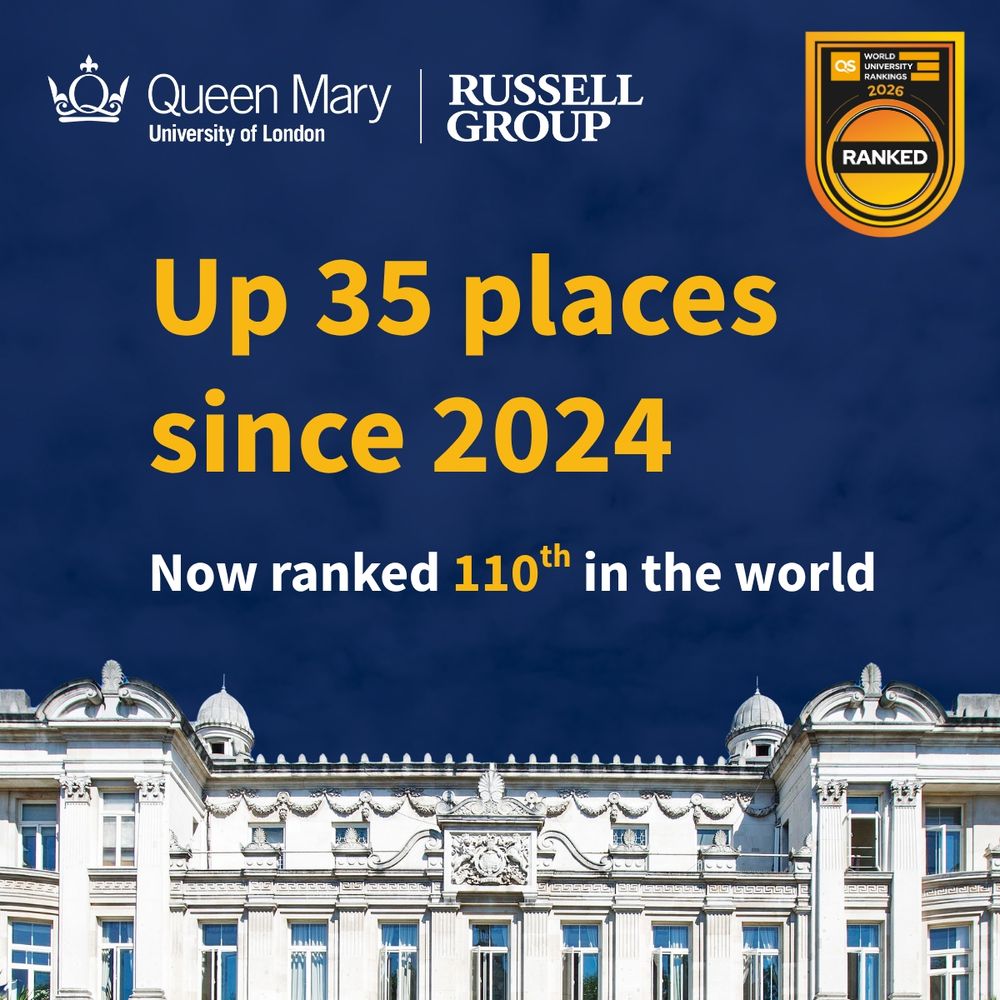
Queen Mary has risen 35 places in two years in the QS league table.
We’re now ranked 110th in the world according to QS, and for the second year, a top 100 university globally and top 10 in the UK by @usnews.com
Learn more: www.qmul.ac.uk/media/news/2...
We’re now ranked 110th in the world according to QS, and for the second year, a top 100 university globally and top 10 in the UK by @usnews.com
Learn more: www.qmul.ac.uk/media/news/2...
June 19, 2025 at 7:50 AM
Queen Mary has risen 35 places in two years in the QS league table.
We’re now ranked 110th in the world according to QS, and for the second year, a top 100 university globally and top 10 in the UK by @usnews.com
Learn more: www.qmul.ac.uk/media/news/2...
We’re now ranked 110th in the world according to QS, and for the second year, a top 100 university globally and top 10 in the UK by @usnews.com
Learn more: www.qmul.ac.uk/media/news/2...
Reposted by Queen Mary Faculty of Science and Engineering
Expert panellists have recognised Queen Mary’s innovation and research excellence at the University’s Research and Innovation Awards.
Judges were incredibly impressed by the high standard of submissions and positive impact of their work.
www.qmul.ac.uk/media/news/2...
Judges were incredibly impressed by the high standard of submissions and positive impact of their work.
www.qmul.ac.uk/media/news/2...


June 12, 2025 at 10:06 AM
Expert panellists have recognised Queen Mary’s innovation and research excellence at the University’s Research and Innovation Awards.
Judges were incredibly impressed by the high standard of submissions and positive impact of their work.
www.qmul.ac.uk/media/news/2...
Judges were incredibly impressed by the high standard of submissions and positive impact of their work.
www.qmul.ac.uk/media/news/2...
Reposted by Queen Mary Faculty of Science and Engineering
A robotic hand featuring high-resolution tactile sensing across 70% of its surface achieves human-like dexterity and adaptive grasping, outperforming previous systems in dynamic real-world tasks. doi.org/g9psjw

Robotic hand with unprecedented tactile sensitivity achieves human-like dexterity in real-world tasks
Researchers have unveiled a robotic hand, the F-TAC Hand, which integrates high-resolution tactile sensing across an unprecedented 70% of its surface area, allowing for human-like adaptive grasping.
techxplore.com
June 9, 2025 at 5:02 PM
A robotic hand featuring high-resolution tactile sensing across 70% of its surface achieves human-like dexterity and adaptive grasping, outperforming previous systems in dynamic real-world tasks. doi.org/g9psjw
Ever wonder how your cells build themselves? 🤔 New research from @qmulsbbs.bsky.social & @dundee.ac.uk, out in @pnas.org, reveals the key mechanism behind microtubule growth. It's crucial for understanding cell division and has potential impacts on cancer treatments. www.qmul.ac.uk/media/news/2...

Cellular scaffolding secrets unlocked: scientists discover key to microtubule growth
www.qmul.ac.uk
June 4, 2025 at 1:38 PM
Ever wonder how your cells build themselves? 🤔 New research from @qmulsbbs.bsky.social & @dundee.ac.uk, out in @pnas.org, reveals the key mechanism behind microtubule growth. It's crucial for understanding cell division and has potential impacts on cancer treatments. www.qmul.ac.uk/media/news/2...
Scientists from @mpi-nat.bsky.social & @qmul.ac.uk cracked the code on ion channel currents with atomic-level accuracy. As Dr @wojciechkopec.bsky.social says, this "opens up entirely new avenues for studying physiology and developing therapeutics."
June 4, 2025 at 1:30 PM
Scientists from @mpi-nat.bsky.social & @qmul.ac.uk cracked the code on ion channel currents with atomic-level accuracy. As Dr @wojciechkopec.bsky.social says, this "opens up entirely new avenues for studying physiology and developing therapeutics."
Reposted by Queen Mary Faculty of Science and Engineering

Our paper on testing #Alphafold predictions and structural phylogenetics of a #photosystem subunit is now published in @pplplantarum.bsky.social. Work by @tomdongmin.bsky.social, with JW Murray & D Pretorius at Imperial. onlinelibrary.wiley.com/doi/full/10.... @qmulse.bsky.social @qmul.ac.uk 🌳
Exploring the Structural Diversity and Evolution of the D1 Subunit of Photosystem II Using AlphaFold and Foldtree
Although our knowledge of photosystem II has expanded to include time-resolved atomic details, the diversity of experimental structures of the enzyme remains limited. Recent advances in protein struc...
onlinelibrary.wiley.com
May 28, 2025 at 5:32 PM
Our paper on testing #Alphafold predictions and structural phylogenetics of a #photosystem subunit is now published in @pplplantarum.bsky.social. Work by @tomdongmin.bsky.social, with JW Murray & D Pretorius at Imperial. onlinelibrary.wiley.com/doi/full/10.... @qmulse.bsky.social @qmul.ac.uk 🌳
Excited to kick off Digital Environment Research Institute (DERI)'s inaugural Research Day and explore "Hard Problems: Can Interdisciplinarity Solve Them?" with world-leading researchers exploring critical challenges like #ClimateChange, #HumanHealth, and the impact of #AI.

May 21, 2025 at 12:00 PM
Excited to kick off Digital Environment Research Institute (DERI)'s inaugural Research Day and explore "Hard Problems: Can Interdisciplinarity Solve Them?" with world-leading researchers exploring critical challenges like #ClimateChange, #HumanHealth, and the impact of #AI.
Thrilled to see Dr @lindacremonesi.bsky.social on BBC Breakfast this morning! She was talking about the scientific race to uncover why our Universe exists within the Deep Underground Neutrino Experiment (DUNE). Read more about this groundbreaking research here: www.bbc.co.uk/news/article...

May 20, 2025 at 10:40 AM
Thrilled to see Dr @lindacremonesi.bsky.social on BBC Breakfast this morning! She was talking about the scientific race to uncover why our Universe exists within the Deep Underground Neutrino Experiment (DUNE). Read more about this groundbreaking research here: www.bbc.co.uk/news/article...
Reposted by Queen Mary Faculty of Science and Engineering
The structure of a light-harvesting nanodevice in ancient cyanobacteria offers new insight into how early life used sunlight to generate oxygen, shaping Earth's atmosphere. doi.org/g9kcwz

Light-to-electricity nanodevice found in cyanobacteria reveals how early life utilized sunlight to make oxygen
An international team of scientists have unlocked a key piece of Earth's evolutionary puzzle by decoding the structure of a light-harvesting "nanodevice" in one of the planet's most ancient lineages of cyanobacteria.
phys.org
May 16, 2025 at 3:02 PM
The structure of a light-harvesting nanodevice in ancient cyanobacteria offers new insight into how early life used sunlight to generate oxygen, shaping Earth's atmosphere. doi.org/g9kcwz
Reposted by Queen Mary Faculty of Science and Engineering

A paper in Nature presents a high-precision prediction of the gravitational waves produced by interacting black holes. The work may pave the way for more accurate gravitational wave models, which will guide future efforts to detect gravitational waves. go.nature.com/4kEUcsH ⚛️ 🧪

May 16, 2025 at 1:53 PM
A paper in Nature presents a high-precision prediction of the gravitational waves produced by interacting black holes. The work may pave the way for more accurate gravitational wave models, which will guide future efforts to detect gravitational waves. go.nature.com/4kEUcsH ⚛️ 🧪
Reposted by Queen Mary Faculty of Science and Engineering
Our paper: Structure and evolution of photosystem I in the early-branching cyanobacterium Anthocerotibacter panamensis is out now in PNAS! www.pnas.org/doi/10.1073/... Great collab with the labs of Ming-Yang Ho and Chris Girsiel.

Structure and evolution of photosystem I in the early-branching cyanobacterium Anthocerotibacter panamensis | PNAS
Thylakoid-free cyanobacteria are thought to preserve ancestral traits of early-evolving
organisms capable of oxygenic photosynthesis. However, and ...
www.pnas.org
May 14, 2025 at 3:44 PM
Our paper: Structure and evolution of photosystem I in the early-branching cyanobacterium Anthocerotibacter panamensis is out now in PNAS! www.pnas.org/doi/10.1073/... Great collab with the labs of Ming-Yang Ho and Chris Girsiel.