



Jake Rogers
@nsneuro-jr.bsky.social
Nova Scotian neuroscientist with part time editorial roles on @natrevneuro.nature.com and on Research Briefings across the @natureportfolio.nature.com
Reposted by Jake Rogers
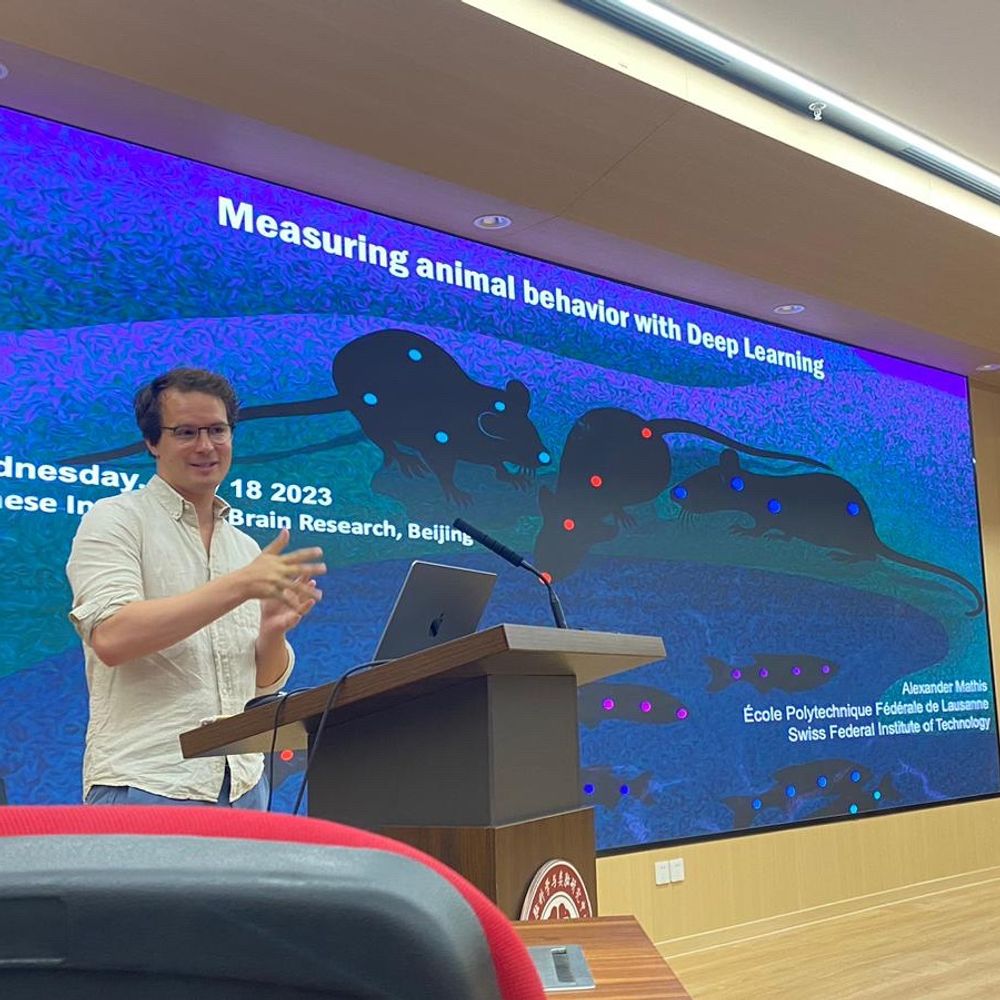
This is just our second M&M review!
The first one in 2020 was on AI for behavior - and now we discuss advances for jointly modeling behavioral and neural data!! Here is the first www.sciencedirect.com/science/arti...
The first one in 2020 was on AI for behavior - and now we discuss advances for jointly modeling behavioral and neural data!! Here is the first www.sciencedirect.com/science/arti...
December 5, 2025 at 3:13 PM
This is just our second M&M review!
The first one in 2020 was on AI for behavior - and now we discuss advances for jointly modeling behavioral and neural data!! Here is the first www.sciencedirect.com/science/arti...
The first one in 2020 was on AI for behavior - and now we discuss advances for jointly modeling behavioral and neural data!! Here is the first www.sciencedirect.com/science/arti...
Reposted by Jake Rogers

Connectomics is Method of the Year 2025!!
@natmethods.nature.com
just released the news nature.com/articles/s41... In my perspective piece, I afford some predictions into the future and compare how we are doing vs. genomics www.nature.com/articles/s41...
@natmethods.nature.com
just released the news nature.com/articles/s41... In my perspective piece, I afford some predictions into the future and compare how we are doing vs. genomics www.nature.com/articles/s41...

December 8, 2025 at 4:44 PM
Connectomics is Method of the Year 2025!!
@natmethods.nature.com
just released the news nature.com/articles/s41... In my perspective piece, I afford some predictions into the future and compare how we are doing vs. genomics www.nature.com/articles/s41...
@natmethods.nature.com
just released the news nature.com/articles/s41... In my perspective piece, I afford some predictions into the future and compare how we are doing vs. genomics www.nature.com/articles/s41...
Reposted by Jake Rogers

Tiny recurrent neural networks for discovering cognitive strategies — a Tools of the Trade article by Li Ji-An
#neuroscience #neuroskyence
www.nature.com/articles/s41...
#neuroscience #neuroskyence
www.nature.com/articles/s41...

December 5, 2025 at 3:10 PM
Tiny recurrent neural networks for discovering cognitive strategies — a Tools of the Trade article by Li Ji-An
#neuroscience #neuroskyence
www.nature.com/articles/s41...
#neuroscience #neuroskyence
www.nature.com/articles/s41...
Reposted by Jake Rogers
How distributed is the brain-wide network that is recruited for cognition? A Perspective by Matthew C. Rosen & David J. Freedman
#neuroscience #neuroskyence
www.nature.com/articles/s41...
#neuroscience #neuroskyence
www.nature.com/articles/s41...

How distributed is the brain-wide network that is recruited for cognition? - Nature Reviews Neuroscience
Both localized and distributed views on the functional organization of the brain have been put forward. In this Perspective, Rosen and Freedman examine the degree to which these two views account for ...
www.nature.com
December 4, 2025 at 9:30 AM
How distributed is the brain-wide network that is recruited for cognition? A Perspective by Matthew C. Rosen & David J. Freedman
#neuroscience #neuroskyence
www.nature.com/articles/s41...
#neuroscience #neuroskyence
www.nature.com/articles/s41...
Reposted by Jake Rogers
Joint modelling of brain and behaviour dynamics with artificial intelligence — a Review by Mackenzie Weygandt Mathis & Alexander Mathis
@trackingactions.bsky.social @trackingskills.bsky.social
#neuroscience #neuroskyence
www.nature.com/articles/s41...
@trackingactions.bsky.social @trackingskills.bsky.social
#neuroscience #neuroskyence
www.nature.com/articles/s41...

Joint modelling of brain and behaviour dynamics with artificial intelligence - Nature Reviews Neuroscience
Artificial intelligence is rapidly advancing our mechanistic understanding of the shared structure between the brain and higher-order behaviours. In this Review, Mathis and Mathis synthesize state-of-...
www.nature.com
December 4, 2025 at 9:29 AM
Joint modelling of brain and behaviour dynamics with artificial intelligence — a Review by Mackenzie Weygandt Mathis & Alexander Mathis
@trackingactions.bsky.social @trackingskills.bsky.social
#neuroscience #neuroskyence
www.nature.com/articles/s41...
@trackingactions.bsky.social @trackingskills.bsky.social
#neuroscience #neuroskyence
www.nature.com/articles/s41...
Reposted by Jake Rogers

When @natrevneuro.nature.com asked me to highlight a paper that influenced both my field and my own research, I immediately thought of the work on mixed selectivity by @matrig.net, @stefanofusi.bsky.social, and colleagues.
More on this journal club: rdcu.be/eRKLk
More on this journal club: rdcu.be/eRKLk
Mixed selectivity: when neurons stopped looking like specialists
Nature Reviews Neuroscience - In this Journal Club, Fanny Cazettes highlights a 2013 paper that demonstrated the importance of mixed selectivity for cortical computations.
rdcu.be
November 26, 2025 at 6:35 AM
When @natrevneuro.nature.com asked me to highlight a paper that influenced both my field and my own research, I immediately thought of the work on mixed selectivity by @matrig.net, @stefanofusi.bsky.social, and colleagues.
More on this journal club: rdcu.be/eRKLk
More on this journal club: rdcu.be/eRKLk
Reposted by Jake Rogers

Just out in Nature Reviews Neuroscience! We've been studying information synergy within the brain for a few years now: here we explore how we can take this approach to the level of synergy *between* brains! 🧠🔄🧠
Thanks to @edoardochidichimo.bsky.social for making this inter-brain synergy possible!
Thanks to @edoardochidichimo.bsky.social for making this inter-brain synergy possible!
Delighted to share our new Perspective article @natrevneuro.nature.com, led by the great @edoardochidichimo.bsky.social : "Towards an informational account of interpersonal coordination". With @loopyluppi.bsky.social, Pedro Mediano, @introspection.bsky.social, Victoria Leong and Richard Bethlehem.

November 19, 2025 at 2:40 PM
Just out in Nature Reviews Neuroscience! We've been studying information synergy within the brain for a few years now: here we explore how we can take this approach to the level of synergy *between* brains! 🧠🔄🧠
Thanks to @edoardochidichimo.bsky.social for making this inter-brain synergy possible!
Thanks to @edoardochidichimo.bsky.social for making this inter-brain synergy possible!
Reposted by Jake Rogers

Delighted to share our new Perspective article @natrevneuro.nature.com, led by the great @edoardochidichimo.bsky.social : "Towards an informational account of interpersonal coordination". With @loopyluppi.bsky.social, Pedro Mediano, @introspection.bsky.social, Victoria Leong and Richard Bethlehem.
November 19, 2025 at 2:27 PM
Delighted to share our new Perspective article @natrevneuro.nature.com, led by the great @edoardochidichimo.bsky.social : "Towards an informational account of interpersonal coordination". With @loopyluppi.bsky.social, Pedro Mediano, @introspection.bsky.social, Victoria Leong and Richard Bethlehem.
Reposted by Jake Rogers
Time, space, memory and brain–body rhythms — a Perspective by György Buzsáki
#neuroscience #neuroskyence
www.nature.com/articles/s41...
#neuroscience #neuroskyence
www.nature.com/articles/s41...

Time, space, memory and brain–body rhythms - Nature Reviews Neuroscience
Understanding how the brain represents experienced time and how representations of space and time are integrated to form episodic memories has been a goal of much neuroscientific research. In this Per...
www.nature.com
November 13, 2025 at 11:43 AM
Time, space, memory and brain–body rhythms — a Perspective by György Buzsáki
#neuroscience #neuroskyence
www.nature.com/articles/s41...
#neuroscience #neuroskyence
www.nature.com/articles/s41...
Reposted by Jake Rogers

First neurons didn’t appear overnight. We trace their roots to ancient secretory cells - showing how lifestyle & behavior shaped the evolution of first synapses.🧠🌊 #Evolution #Neuroscience
Our latest in @natrevneuro.nature.com
Link: rdcu.be/eMX3E
@jeffcolgren.bsky.social @msarscentre.bsky.social
Our latest in @natrevneuro.nature.com
Link: rdcu.be/eMX3E
@jeffcolgren.bsky.social @msarscentre.bsky.social

The evolutionary origins of synaptic proteins and their changing roles in different organisms across evolution
Nature Reviews Neuroscience - Recent studies have shed further light on the evolutionary origins of chemical synapses, In this Review, Colgren and Burkhardt explore how ancient proteins were...
rdcu.be
October 27, 2025 at 6:48 PM
First neurons didn’t appear overnight. We trace their roots to ancient secretory cells - showing how lifestyle & behavior shaped the evolution of first synapses.🧠🌊 #Evolution #Neuroscience
Our latest in @natrevneuro.nature.com
Link: rdcu.be/eMX3E
@jeffcolgren.bsky.social @msarscentre.bsky.social
Our latest in @natrevneuro.nature.com
Link: rdcu.be/eMX3E
@jeffcolgren.bsky.social @msarscentre.bsky.social
Reposted by Jake Rogers
Nature Reviews Neuroscience has turned 25!
To mark the anniversary, the October issue features an expanded selection of Comments and Journal Clubs, and our first World View and Tools of the Trade articles. Check out the issue here: www.nature.com/nrn/volumes/...
#neuroscience #neuroskyence
To mark the anniversary, the October issue features an expanded selection of Comments and Journal Clubs, and our first World View and Tools of the Trade articles. Check out the issue here: www.nature.com/nrn/volumes/...
#neuroscience #neuroskyence

September 18, 2025 at 10:28 AM
Nature Reviews Neuroscience has turned 25!
To mark the anniversary, the October issue features an expanded selection of Comments and Journal Clubs, and our first World View and Tools of the Trade articles. Check out the issue here: www.nature.com/nrn/volumes/...
#neuroscience #neuroskyence
To mark the anniversary, the October issue features an expanded selection of Comments and Journal Clubs, and our first World View and Tools of the Trade articles. Check out the issue here: www.nature.com/nrn/volumes/...
#neuroscience #neuroskyence
Reposted by Jake Rogers
Working together to build strong scientific communities — a Comment article by Megan R. Carey
@megancarey.bsky.social
#neuroscience #neuroskyence
www.nature.com/articles/s41...
@megancarey.bsky.social
#neuroscience #neuroskyence
www.nature.com/articles/s41...
Working together to build strong scientific communities - Nature Reviews Neuroscience
The scientific enterprise depends on attracting and retaining the very best talent, yet barriers persist that perpetuate inequities in the scientific workforce. Here I discuss the efforts of the ALBA ...
www.nature.com
August 27, 2025 at 1:53 PM
Working together to build strong scientific communities — a Comment article by Megan R. Carey
@megancarey.bsky.social
#neuroscience #neuroskyence
www.nature.com/articles/s41...
@megancarey.bsky.social
#neuroscience #neuroskyence
www.nature.com/articles/s41...
Reposted by Jake Rogers
Some scientists haven't yet internalized the "why" behind science writing for the public - not just as a service, but for themselves. (I didn't always get it). In this piece for @natrevneuro.nature.com, I draw on the neuroscience of curiosity & decision making to unpack its value.
rdcu.be/eCGr7
rdcu.be/eCGr7

The unexpected value of communicating science to the public
Nature Reviews Neuroscience - As a group, our scientific community has a responsibility to unpack the ‘what’ and ‘why’ behind our work for the public, not least because much...
rdcu.be
August 27, 2025 at 11:21 AM
Some scientists haven't yet internalized the "why" behind science writing for the public - not just as a service, but for themselves. (I didn't always get it). In this piece for @natrevneuro.nature.com, I draw on the neuroscience of curiosity & decision making to unpack its value.
rdcu.be/eCGr7
rdcu.be/eCGr7
Reposted by Jake Rogers

It was a good experience to step back and briefly take stock of the amazing progress in connectomics since I started working on this stuff (20 years ago!)
thanks as well to @natrevneuro.nature.com for the constructive editorial interactions.
thanks as well to @natrevneuro.nature.com for the constructive editorial interactions.

August 14, 2025 at 7:40 PM
It was a good experience to step back and briefly take stock of the amazing progress in connectomics since I started working on this stuff (20 years ago!)
thanks as well to @natrevneuro.nature.com for the constructive editorial interactions.
thanks as well to @natrevneuro.nature.com for the constructive editorial interactions.
Reposted by Jake Rogers
Time to let the model speak for itself with closed-loop neurophysiology — a Journal Club by Benjamin R. Cowley
@benjocowley.bsky.social
#neuroscience #neuroskyence
www.nature.com/articles/s41...
@benjocowley.bsky.social
#neuroscience #neuroskyence
www.nature.com/articles/s41...
Time to let the model speak for itself with closed-loop neurophysiology - Nature Reviews Neuroscience
In this Journal Club, Benjamin Cowley discusses a 2009 tour-de-force that provided a recipe for constructing closed-loop algorithms by letting predictive models speak for themselves.
www.nature.com
August 20, 2025 at 9:26 AM
Time to let the model speak for itself with closed-loop neurophysiology — a Journal Club by Benjamin R. Cowley
@benjocowley.bsky.social
#neuroscience #neuroskyence
www.nature.com/articles/s41...
@benjocowley.bsky.social
#neuroscience #neuroskyence
www.nature.com/articles/s41...
Reposted by Jake Rogers

𝐖𝐡𝐚𝐭 𝐰𝐞 𝐚𝐫𝐞 𝐫𝐞𝐚𝐝𝐢𝐧𝐠 “The emergence of NeuroAI: bridging neuroscience and artificial intelligence,” by Sadra Sadeh and Claudia Clopath in 𝑁𝑎𝑡𝑢𝑟𝑒 𝑅𝑒𝑣𝑖𝑒𝑤𝑠 𝑁𝑒𝑢𝑟𝑜𝑠𝑐𝑖𝑒𝑛𝑐𝑒
doi.org/10.1038/s415...
doi.org/10.1038/s415...
The emergence of NeuroAI: bridging neuroscience and artificial intelligence - Nature Reviews Neuroscience
Neuroscience has inspired artificial intelligence (AI) for decades but, in recent years, AI tools have begun to revolutionize neuroscience research. The emerging field of NeuroAI has the potential to ...
doi.org
August 20, 2025 at 4:32 PM
𝐖𝐡𝐚𝐭 𝐰𝐞 𝐚𝐫𝐞 𝐫𝐞𝐚𝐝𝐢𝐧𝐠 “The emergence of NeuroAI: bridging neuroscience and artificial intelligence,” by Sadra Sadeh and Claudia Clopath in 𝑁𝑎𝑡𝑢𝑟𝑒 𝑅𝑒𝑣𝑖𝑒𝑤𝑠 𝑁𝑒𝑢𝑟𝑜𝑠𝑐𝑖𝑒𝑛𝑐𝑒
doi.org/10.1038/s415...
doi.org/10.1038/s415...
Reposted by Jake Rogers
I wrote a Comment on neurotheory, and now you can read it!
Some thoughts on where neurotheory has and has not taken root within the neuroscience community, how it has shaped those subfields, and where we theorists might look next for fresh adventures.
www.nature.com/articles/s41...
Some thoughts on where neurotheory has and has not taken root within the neuroscience community, how it has shaped those subfields, and where we theorists might look next for fresh adventures.
www.nature.com/articles/s41...
Theoretical neuroscience has room to grow
Nature Reviews Neuroscience - The goal of theoretical neuroscience is to uncover principles of neural computation through careful design and interpretation of mathematical models. Here, I examine...
www.nature.com
August 20, 2025 at 4:09 PM
I wrote a Comment on neurotheory, and now you can read it!
Some thoughts on where neurotheory has and has not taken root within the neuroscience community, how it has shaped those subfields, and where we theorists might look next for fresh adventures.
www.nature.com/articles/s41...
Some thoughts on where neurotheory has and has not taken root within the neuroscience community, how it has shaped those subfields, and where we theorists might look next for fresh adventures.
www.nature.com/articles/s41...
Reposted by Jake Rogers
Top-down and bottom-up neuroscience: overcoming the clash of research cultures — a Comment article by Fernando E. Rosas, Andrea I. Luppi, Pedro A. M. Mediano, Morten L. Kringelbach, Luiz Pessoa & Federico Turkheimer
#neuroscience #neuroskyence
www.nature.com/articles/s41...
#neuroscience #neuroskyence
www.nature.com/articles/s41...
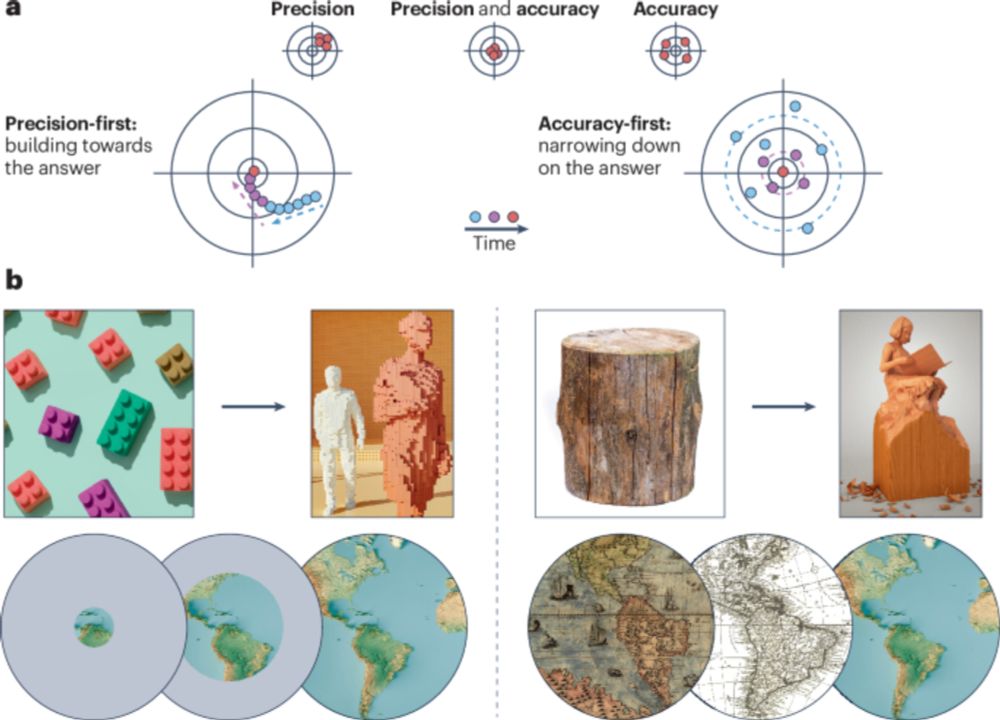
Top-down and bottom-up neuroscience: overcoming the clash of research cultures - Nature Reviews Neuroscience
As scientists, we want solid answers, but we also want to answer questions that matter. Yet, the brain’s complexity forces trade-offs between these desiderata, bringing about two distinct research app...
www.nature.com
July 22, 2025 at 9:08 AM
Top-down and bottom-up neuroscience: overcoming the clash of research cultures — a Comment article by Fernando E. Rosas, Andrea I. Luppi, Pedro A. M. Mediano, Morten L. Kringelbach, Luiz Pessoa & Federico Turkheimer
#neuroscience #neuroskyence
www.nature.com/articles/s41...
#neuroscience #neuroskyence
www.nature.com/articles/s41...
Reposted by Jake Rogers

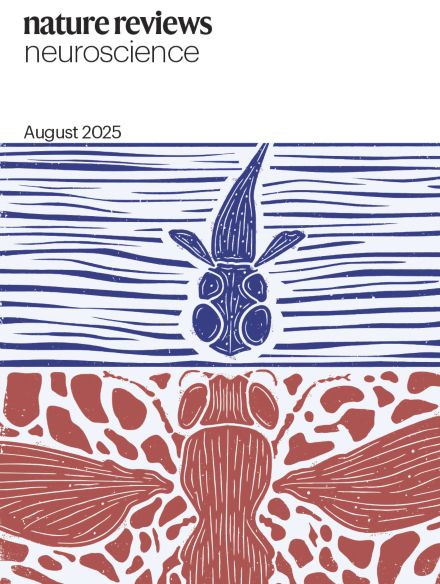
@natrevneuro.nature.com just published a beautiful cover for the issue that includes the recent review on analogies in the visual system of vertebrates and invertebrates (@ryosuketanaka.bsky.social). Read it here doi.org/10.1038/s415...
Science and Art, what could be better?
Science and Art, what could be better?
July 23, 2025 at 4:43 PM
@natrevneuro.nature.com just published a beautiful cover for the issue that includes the recent review on analogies in the visual system of vertebrates and invertebrates (@ryosuketanaka.bsky.social). Read it here doi.org/10.1038/s415...
Science and Art, what could be better?
Science and Art, what could be better?
Reposted by Jake Rogers

I was given the opportunity to write a brief highlight of a paper that is important to the field & personally meaningful, and I chose to write about @drjenryan.bsky.social's elegant work linking the hippocampus to eye movement markers of relational memory. Read more about it here! 👇🏼
rdcu.be/eyaXA
rdcu.be/eyaXA
Eye movements provide insight into amnesia
Nature Reviews Neuroscience - In this Journal Club, Mariam Aly discusses a 2000 study that attempted to settle the debate about whether implicit memories are lost or retained in amnesia.
rdcu.be
July 28, 2025 at 4:09 PM
I was given the opportunity to write a brief highlight of a paper that is important to the field & personally meaningful, and I chose to write about @drjenryan.bsky.social's elegant work linking the hippocampus to eye movement markers of relational memory. Read more about it here! 👇🏼
rdcu.be/eyaXA
rdcu.be/eyaXA
Reposted by Jake Rogers
Early adversity alters brain architecture and increases susceptibility to mental health disorders — a Review by Charles A. Nelson, Eileen F. Sullivan & Viviane Valdes
#neuroscience #neuroskyence
www.nature.com/articles/s41...
#neuroscience #neuroskyence
www.nature.com/articles/s41...
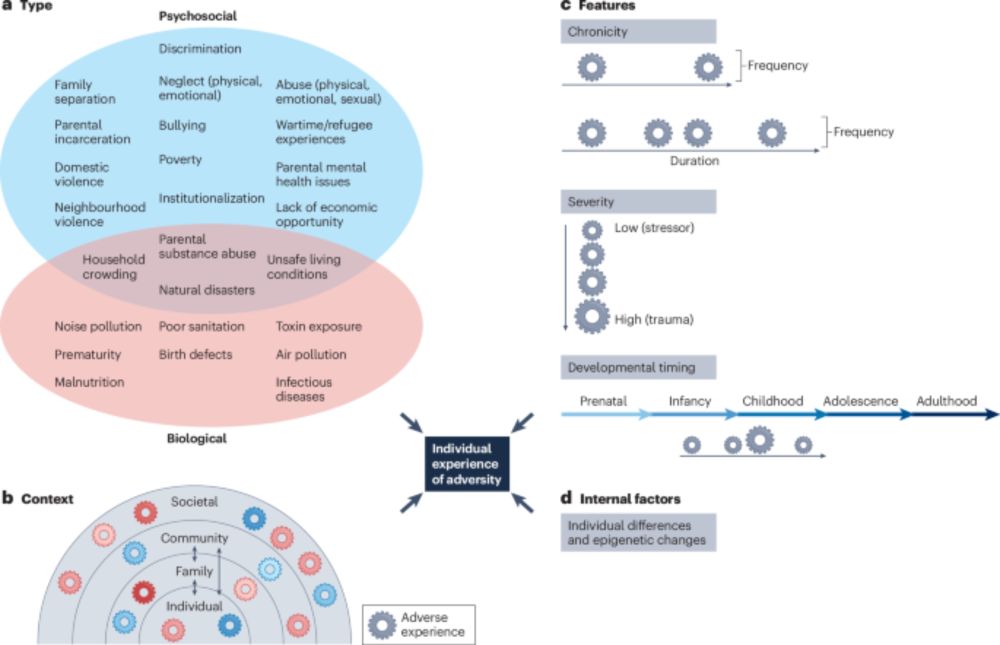
Early adversity alters brain architecture and increases susceptibility to mental health disorders - Nature Reviews Neuroscience
Adverse experiences in early life affect brain development across species. In this Review, Nelson, Sullivan and Valdes discuss neuroimaging evidence for how these adversity-induced changes to human br...
www.nature.com
July 25, 2025 at 10:04 AM
Early adversity alters brain architecture and increases susceptibility to mental health disorders — a Review by Charles A. Nelson, Eileen F. Sullivan & Viviane Valdes
#neuroscience #neuroskyence
www.nature.com/articles/s41...
#neuroscience #neuroskyence
www.nature.com/articles/s41...
Reposted by Jake Rogers

I wrote a little digest + tribute to an article that shaped my career: Sadtler et al Neural constraints on learning! (and also managed to sneak in a shout out to another one)
Read for free here: rdcu.be/eg5To
Thanks to the editors for the invite and input!
Read for free here: rdcu.be/eg5To
Thanks to the editors for the invite and input!

Neural manifolds: more than the sum of their neurons
Nature Reviews Neuroscience - In this Journal Club, Juan Gallego discusses a 2014 article that provided a first causal hint that neural manifolds may not only be a convenient way to interpret...
rdcu.be
April 16, 2025 at 10:04 PM
I wrote a little digest + tribute to an article that shaped my career: Sadtler et al Neural constraints on learning! (and also managed to sneak in a shout out to another one)
Read for free here: rdcu.be/eg5To
Thanks to the editors for the invite and input!
Read for free here: rdcu.be/eg5To
Thanks to the editors for the invite and input!
Reposted by Jake Rogers
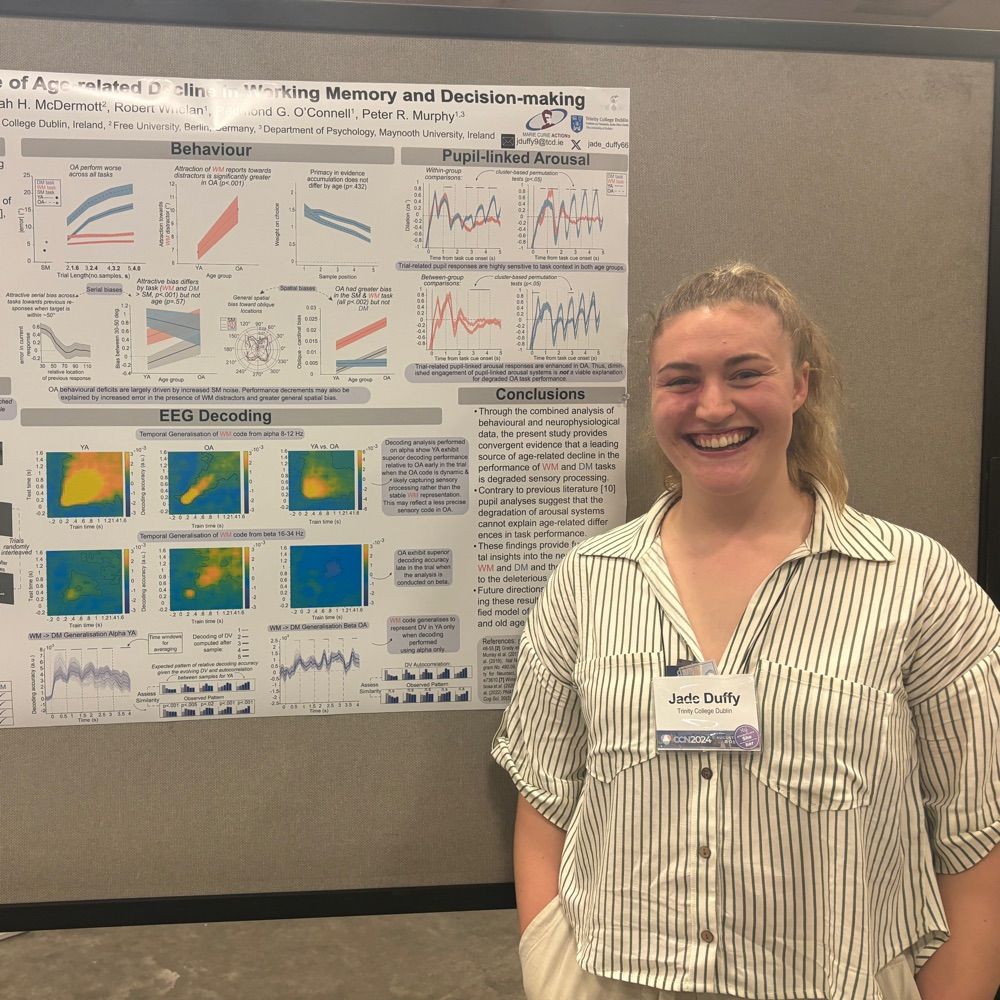
In life, 3 things are certain: death, taxes, and decision-making variability🧠. Our review tinyurl.com/4dcwafc4 explores how computational models 💻 explain variability, their limits, and recent advances. A thread🧵👇
@redmondoconnell.bsky.social @neuromurphy.bsky.social Mark Bellgrove (not on Bluesky)
@redmondoconnell.bsky.social @neuromurphy.bsky.social Mark Bellgrove (not on Bluesky)
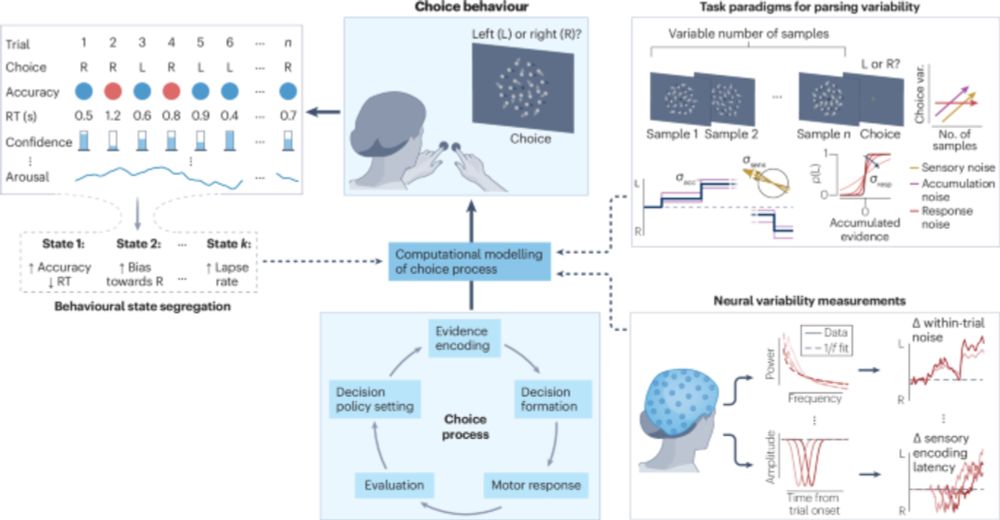
Disentangling sources of variability in decision-making - Nature Reviews Neuroscience
Identifying the psychological and neurobiological processes underpinning intra-individual variations in choice behaviour presents a formidable challenge. In this Review, Duffy et al. discuss how algor...
www.nature.com
March 24, 2025 at 12:29 PM
In life, 3 things are certain: death, taxes, and decision-making variability🧠. Our review tinyurl.com/4dcwafc4 explores how computational models 💻 explain variability, their limits, and recent advances. A thread🧵👇
@redmondoconnell.bsky.social @neuromurphy.bsky.social Mark Bellgrove (not on Bluesky)
@redmondoconnell.bsky.social @neuromurphy.bsky.social Mark Bellgrove (not on Bluesky)
Reposted by Jake Rogers
The curious case of dopaminergic prediction errors and learning associative information beyond value — a Perspective by Thorsten Kahnt & Geoffrey Schoenbaum
www.nature.com/articles/s41...
www.nature.com/articles/s41...

The curious case of dopaminergic prediction errors and learning associative information beyond value - Nature Reviews Neuroscience
Midbrain dopamine neurons are widely assumed to signal a unidimensional value-based prediction error. In this Perspective, Kahnt and Schoenbaum overview accumulating evidence that challenges this assu...
www.nature.com
January 21, 2025 at 9:46 AM
The curious case of dopaminergic prediction errors and learning associative information beyond value — a Perspective by Thorsten Kahnt & Geoffrey Schoenbaum
www.nature.com/articles/s41...
www.nature.com/articles/s41...
Reposted by Jake Rogers

Excited to share this perspective with @yaelniv.bsky.social about how schemas might be learned and instantiated via reinforcement learning, latent cause inference, and dimensionality reduction, and what's the medial prefrontal cortex might be doing for all of these www.nature.com/articles/s41...
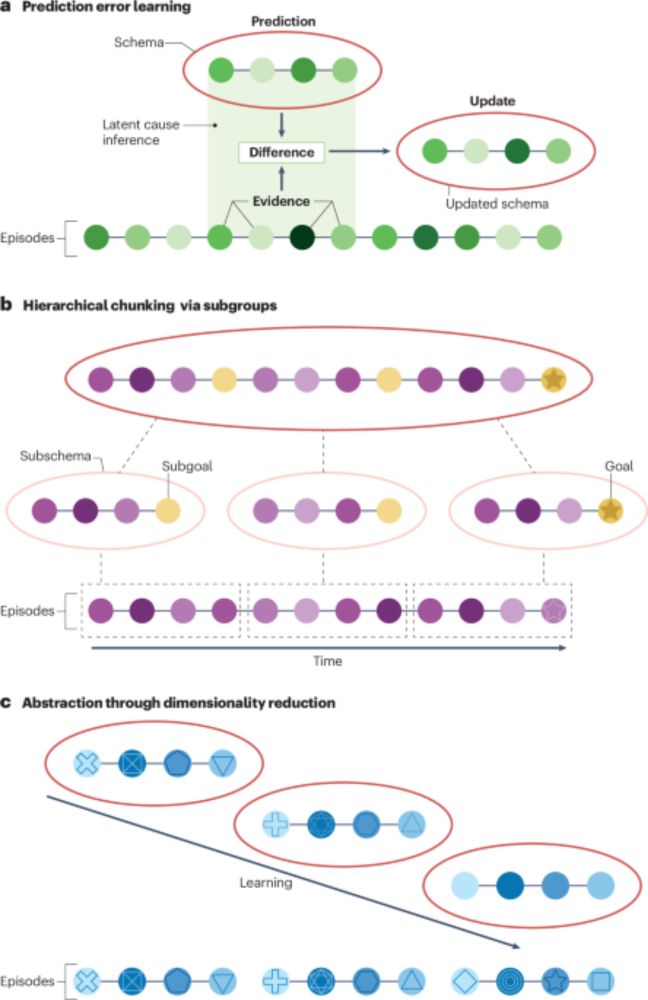
Schemas, reinforcement learning and the medial prefrontal cortex - Nature Reviews Neuroscience
A computational account of how schemas are learned through experience is lacking. In this Perspective, Bein and Niv synthesize schema theory and reinforcement learning research to derive computational...
www.nature.com
January 7, 2025 at 6:12 PM
Excited to share this perspective with @yaelniv.bsky.social about how schemas might be learned and instantiated via reinforcement learning, latent cause inference, and dimensionality reduction, and what's the medial prefrontal cortex might be doing for all of these www.nature.com/articles/s41...