



Mehrzad Samadi
@mehrzads.bsky.social
GenAI at #NVIDIA, Former CEO and cofounder of #Parabricks. Views are my own.
Reposted by Mehrzad Samadi

Being anti-trans is really an elite phenomenon that elites are mistakenly convinced is widely shared.

March 5, 2025 at 1:44 AM
Being anti-trans is really an elite phenomenon that elites are mistakenly convinced is widely shared.
Reposted by Mehrzad Samadi

My experience is that people like @chrishayes1.bsky.social never look closely enough at the output.
See my substack yesterday on hallucinations by Grok 3 DeepSearch, and see Daniel Litt’s X thread (added in an update) for even worse with OpenAI DeepSearch.
garymarcus.substack.com/p/grok-3-bet...
See my substack yesterday on hallucinations by Grok 3 DeepSearch, and see Daniel Litt’s X thread (added in an update) for even worse with OpenAI DeepSearch.
garymarcus.substack.com/p/grok-3-bet...
February 19, 2025 at 6:41 PM
My experience is that people like @chrishayes1.bsky.social never look closely enough at the output.
See my substack yesterday on hallucinations by Grok 3 DeepSearch, and see Daniel Litt’s X thread (added in an update) for even worse with OpenAI DeepSearch.
garymarcus.substack.com/p/grok-3-bet...
See my substack yesterday on hallucinations by Grok 3 DeepSearch, and see Daniel Litt’s X thread (added in an update) for even worse with OpenAI DeepSearch.
garymarcus.substack.com/p/grok-3-bet...
Reposted by Mehrzad Samadi

Based on the early stats, looks like Grok 3 base is going to be a very solid frontier model (leads Chatbot Arena), suggesting pre-training scaling law continues with linear improvements to 10x compute, but no massive gains.
Their unreleased reasoner does not beat o3 based on these early numbers.
Their unreleased reasoner does not beat o3 based on these early numbers.


February 18, 2025 at 4:50 AM
Based on the early stats, looks like Grok 3 base is going to be a very solid frontier model (leads Chatbot Arena), suggesting pre-training scaling law continues with linear improvements to 10x compute, but no massive gains.
Their unreleased reasoner does not beat o3 based on these early numbers.
Their unreleased reasoner does not beat o3 based on these early numbers.
Reposted by Mehrzad Samadi
@wired.com has been doing incredible work
Today, for the first time, @wired.com got my money. The work the Wired journos are doing is incredibly solid and technically adept while being clear. Thank you to @telliotter.bsky.social @lhn.bsky.social @agreenberg.bsky.social & more.
www.wired.com/story/treasu...
www.wired.com/story/treasu...

A US Treasury Threat Intelligence Analysis Designates DOGE Staff as ‘Insider Threat’
An internal email reviewed by WIRED calls DOGE staff's access to federal payments systems “the single biggest insider threat risk the Bureau of the Fiscal Service has ever faced.”
www.wired.com
February 8, 2025 at 4:45 AM
@wired.com has been doing incredible work
Reposted by Mehrzad Samadi

Research universities are often the largest employers in their region. They are often the primary health care providers to communities. This funding shift will not only reduce US research leadership, it will put working people out of work and reduce healthcare access.
Excellent 🧵 on this evening's NIH announcement of a dramatic reduction in indirect rates for research institutions, which amounts to a generational restructuring of the US research and development ecosystem. These cuts are effective immediately, not just for new grants but for existing ones.
6. The policy does not just affect funding going forward. All existing NIH grants will have their indirect rates cut to 15% as of today, the date of issuance.
For a large university, this creates a sudden and catastrophic shortfall of hundreds of millions of dollars against already budgeted funds.
For a large university, this creates a sudden and catastrophic shortfall of hundreds of millions of dollars against already budgeted funds.
February 8, 2025 at 1:40 AM
Research universities are often the largest employers in their region. They are often the primary health care providers to communities. This funding shift will not only reduce US research leadership, it will put working people out of work and reduce healthcare access.
Reposted by Mehrzad Samadi

1. Today the NIH director issued a new directive slashing overhead rates to 15%.
I want to provide some context on what that means and why it matters.
grants.nih.gov/grants/guide...
I want to provide some context on what that means and why it matters.
grants.nih.gov/grants/guide...
NOT-OD-25-068: Supplemental Guidance to the 2024 NIH Grants Policy Statement: Indirect Cost Rates
NIH Funding Opportunities and Notices in the NIH Guide for Grants and Contracts: Supplemental Guidance to the 2024 NIH Grants Policy Statement: Indirect Cost Rates NOT-OD-25-068. OD
grants.nih.gov
February 8, 2025 at 12:18 AM
1. Today the NIH director issued a new directive slashing overhead rates to 15%.
I want to provide some context on what that means and why it matters.
grants.nih.gov/grants/guide...
I want to provide some context on what that means and why it matters.
grants.nih.gov/grants/guide...
Reposted by Mehrzad Samadi

"Trans activist Ceyenne Doroshow created a queer-friendly housing project with a focus on Black trans women and sex workers"
https://xtramagazine.com/power/activism/glits-doroshow-housing-insecurity-270722
#sharegoodnewstoo
https://xtramagazine.com/power/activism/glits-doroshow-housing-insecurity-270722
#sharegoodnewstoo

This New York project offers a blueprint for fighting housing insecurity
<p class="has-drop-cap">In her two-storey home in Queens, New York, Ceyenne Doroshow paces between her kitchen and living room, fielding phone calls. Fragrances of cardamom and cinnamon escape from the kitchen: there is always something on the stove in case of an unexpected guest. On the walls are framed photos of Doroshow with friends and newspaper clippings about her community projects providing resources to the local LGBTQ2S+ community. “The girls are on their way,” Doroshow says, holding her phone between her ear and shoulder as she tidies up.</p>
<p>“The girls” are three of the residents at a housing project in Queens that Doroshow created through Gays and Lesbians Living in a Transgender Society (GLITS), a non-profit she started in 2015. Many of the residents are current or former sex workers who have experienced housing insecurity, often because of the criminalization of their jobs. The first Uber that Doroshow called to bring the girls to her house that day drove off when the driver saw them. “He saw three Black trans women on the sidewalk and left straight away,” she says.</p>
<div class="ad-container desktop ad-0">
<div class="ad-positioner">
<div class="advertisement">
<div aria-label="Advertisement" class="ad-label">Advertisement</div>
<p><ins class="ad article-revive-ad" data-revive-id="4711d63d745c6d6976c7346e7e75650a" data-revive-terms="activism,feature,housing,identity,politics,race-issues,seniors,sex-work,united-states" data-zone-large="348" data-zone-small="356" id=""></ins></p></div>
</div>
</div>
<p>A car door slams shut. A minute later, a shower of glitter bursts through the front door. The girls hug Doroshow one after the other. “Auntie, look!” shouts one of them, flashing her manicured nails in her direction. The visitors are dressed up for a Black trans community dinner in the West Village. Doroshow listens to their chatter as she begins to get ready herself. She swaps her purple plastic sandals for thigh-high black boots. She puts on a long black coat as she rushes the girls out of the door. She applies a flowery Yves Saint Laurent perfume that she says is only available in Europe; she gets it through a friend: two sprays on the neck, two on the wrists. Taking care of her appearance, Doroshow says, is a way to appear professional in a world that used to not take her seriously because of her past as a sex worker.</p>
<p>Trans women of colour who are sex workers face particular dangers, including housing insecurity—one of the most damaging forms of discrimination in a city where affordable housing is already scarce. In 2015, the same year GLITS was founded to address these systemic challenges, the <a href="https://transequality.org/sites/default/files/docs/usts/USTS-Black-Respondents-Report.pdf" rel="noopener" target="_blank">National Center for Transgender Equality’s 2015 U.S. Transgender Survey</a> (USTS) revealed that 42 percent of Black trans respondents had experienced homelessness at some point in their lives. And sex workers across North America are among the most vulnerable to homelessness. The criminalization of their work not only leaves them more at risk of being targeted by landlords and neighbours who might harass or threaten them but they are often denied the right to public and subsidized housing. The New York City Housing Authority (NYCHA), for instance, does not allow someone with previous prostitution convictions to access affordable housing: a form of discrimination that the United Nations’ <a href="http://www.bestpracticespolicy.org/wp-content/uploads/2023/10/csw68_statement_Oct2023.docx.pdf" rel="noopener" target="_blank">Commission on the Status of Women</a> has identified as counterproductive because it perpetuates cycles of poverty and insecurity. </p>
<div class="related-article"> </div>
<p>In Canada, housing insecurity is also a significant issue for many sex workers, driven by a combination of stigma, criminalization and discrimination. While exact numbers are difficult to determine, studies and reports indicate that sex workers in Canada face high rates of homelessness or unstable housing. A <a href="https://pubmed.ncbi.nlm.nih.gov/36888950/" rel="noopener" target="_blank">2023 study</a> documents a high prevalence of unstable housing and evictions among women sex workers in Metro Vancouver, finding that housing instability was linked to significantly higher risks of intimate partner violence and workplace violence. Experts say that <a href="https://link.springer.com/article/10.1007/s11524-020-00502-1" rel="noopener" target="_blank">the COVID-19 pandemic made access to housing worse</a>, which was especially true for those who face marginalization such as trans women involved in sex work. </p>
<div class="block-newsletter">
<div class="newsletter inline-newsletter">
<div class="mc_embed_signup">
<div class="newsletter-text">
<p>Get free Xtra newsletters</p>
<p>Xtra is being blocked on Facebook and Instagram for Canadians as part of Meta’s response to Bill C18. Stay connected, and tell a friend.</p>
</div>
<div class="actions button-style">
<a class="wp-block-button__link subscribe-btn" data-subscribetype="inline-article" href="https://xtramagazine.com/newsletters">Subscribe Now</a>
</div>
</div>
</div>
</div>
<p>Because their work is criminalized in North America, sex workers tend to lack the paperwork needed to apply for housing, says Melissa Sontag Broudo, an attorney based in New York who works with sex workers. </p>
<p>For those who do obtain housing, it’s not uncommon for them to be in danger within their own homes. Broudo says she has seen not-in-my-backyard campaigns launched by neighbours and local residents because they don’t want to live near sex workers. Some of her clients have been pressured by their landlords to leave, and she says she has seen landlords weaponize their tenants’ jobs to blackmail, harass or sexually assault them.</p>
<div class="ad-container empty ad-1"></div>
<p>“They’ll say, ‘Well, I gave you a deal and I didn’t ask you to submit all this paperwork, but just remember I know what you do for a living,’ and that might be weaponized,” Broudo says. </p>
<p>The criminalization of third parties also makes getting help more complicated since a sex worker’s roommates or partners can be held legally responsible for living on the avails. “It not only punishes sex workers, it also punishes their ability to be safe and for people that they might live with to provide a safe environment for them to work,” says Broudo. </p>
<p>Ashley Paige, who was a sex worker in New York for 13 years, recalls having to deal with neighbours constantly surveilling them. On two separate occasions they were asked to move out of their apartment because of their work. </p>
<p>“Moving is a deep emotional stressor, financial stressor, it’s a burden, it’s overwhelming. You are packing up your entire existence, removing it from a place and replanting yourself elsewhere,” they say. “And to do so when it’s on your own timeline and at your own pace, that’s one thing. But when someone is forcing you to do it it’s like having the rug pulled from beneath you.” </p>
<div class="ad-container desktop ad-1">
<div class="ad-positioner">
<div class="advertisement">
<div aria-label="Advertisement" class="ad-label">Advertisement</div>
<p><ins class="ad article-revive-ad" data-revive-id="4711d63d745c6d6976c7346e7e75650a" data-revive-terms="activism,feature,housing,identity,politics,race-issues,seniors,sex-work,united-states" data-zone-large="357" data-zone-small="351" id=""></ins></p></div>
</div>
</div>
<figure class="wp-block-pullquote">
<blockquote>
<p>“When you’ve ever been arrested or attacked or set up and the police were called in, it breaks you”</p>
</blockquote>
</figure>
<p>Doroshow, who once faced homelessness as a youth and turned to sex work to survive, intimately understands the risks faced by trans sex workers. She says herself and many loved ones have gone through harassment and threats: one phone call to the police is enough to get one’s house raided and their life turned upside down. </p>
<p>“When you’ve ever been arrested or attacked or set up and the police were called in, it breaks you,” she says. </p>
<p>Doroshow’s early life was marked by being thrown out by her parents and living in shelters, where she faced discrimination as a Black trans woman. She turned to sex work for survival and endured harassment and exposure in her later years. With the support from mentors like Flawless Sabrina, a pioneering New York drag queen and trans activist, Doroshow transitioned, found stability and began a career in community work. After Doroshow joined a trans women’s support group, she was encouraged to start the organization GLITS, a non-profit that supports trans people, especially sex workers, through providing resources and advocacy. </p>
<p>Finding trans sex workers a safe place to live was one of Doroshow’s priorities when she created GLITS, since, she says, the city still falls short in providing a home for the most marginalized. </p>
<p>She recounts going to the city to ask for funding for her housing project and being promptly turned down since, according to city officials, LGBTQ2S+-centred housing would be discriminatory.</p>
<p>Even when sex workers do manage to find public or subsidized housing, their situation remains precarious, says Claire Macon, a research assistant in public health at Brown University who has studied sex workers’ access to healthcare and housing in Rhode Island. She has found that once sex workers were in state and federal subsidized housing, they tended to be highly surveilled and asked to follow restrictive rules such as curfews, restrictions on time spent away from home and guest policies.</p>
<p>“There’s also this idea of deservingness,” Macon says. “As long as sex workers will be deemed as morally wrong or a threat to hegemony, sex workers will not be seen as being deserving of housing.” </p>
<p>“If I went to New York City and I said, ‘Can you put me in housing?’ nine times out of 10 that housing won’t be safe, not for us,” says Doroshow.</p>
<p>In June 2020, Doroshow gave a speech in front of 15,000 people who had gathered for the Brooklyn Liberation March following the murders of two Black trans women. This speech shone the spotlight on GLITS, and thousands of people rushed to donate. Doroshow remembers a man she had never seen before come to talk to her after the march to write a check for tens of thousands of dollars. Thanks to these unexpected donations, along with other fundraising efforts, GLITS eventually raised around $2 million. Knowing how precarious housing was for queer sex workers, Doroshow knew what she wanted to do with the money: create free, safe and community-oriented housing for homeless LGBTQ2S+ people, many of whom are or were sex workers at the time. </p>
<div class="ad-container empty ad-2"></div>
<figure class="wp-block-pullquote">
<blockquote>
<p>“One of Doroshow’s guiding principles was to review shelter policies and do the opposite.” </p>
</blockquote>
</figure>
<p>In November 2020, she bought a three-storey building in Queens. Within three months, she had received 21 residents for the 12 units. By January 2021, the building was full. Each unit is an affordable one-bedroom apartment for single residents or couples. When a new resident passes the purple door of the GLITS building in the Woodhaven neighbourhood, they don’t have to follow any curfew. One of Doroshow’s guiding principles was to review shelter policies and do the opposite. Doroshow makes every new resident sign “core living arrangements”: no smoking inside, no physical fights, nothing very different from a normal rental. </p>
<p>GLITS remains a lasting success, continuing to provide safe housing for LGBTQ2S+ people, including trans sex workers. Building on this foundation, they are now launching a program to support LGBTQ2S+ inmates transitioning out of Rikers Island, New York City’s largest jail. </p>
<p>Their housing program offers an empowering and replicable model for addressing housing insecurity among marginalized groups, particularly LGBTQ2S+ sex workers. While organizations like Maggie’s Toronto and WISH in Vancouver provide critical services such as harm reduction, advocacy and/or temporary shelter, the demand for these resources often far exceeds the capacity of their funding and staffing. GLITS expands on these efforts by creating long-term, community-centred housing, addressing not just immediate needs but the root causes of housing instability for sex workers. By offering permanent and inclusive spaces free from restrictive or punitive rules, GLITS creates a stable foundation for residents. This model demonstrates what is possible when housing solutions prioritize safety, community and autonomy.</p>
<div class="ad-container desktop ad-1">
<div class="ad-positioner">
<div class="advertisement">
<div aria-label="Advertisement" class="ad-label">Advertisement</div>
<p><ins class="ad article-revive-ad" data-revive-id="4711d63d745c6d6976c7346e7e75650a" data-revive-terms="activism,feature,housing,identity,politics,race-issues,seniors,sex-work,united-states" data-zone-large="348" data-zone-small="356" id=""></ins></p></div>
</div>
</div>
<p>David, who was among the first residents to move in, lives with his partner Steven [only their first names are used to maintain their privacy]. At 67, he lives with cardiac problems and had to spend several months in hospital when the couple arrived. But with his significant other in Doroshow’s hands, he was reassured. The two of them have been friends with her for 13 years, and when she heard they were looking for a place to live after leaving a complicated living situation, she immediately offered to move them in. “It’s beautiful, you don’t feel discrimination, you don’t feel the intense scrutiny, you don’t have to worry about being assaulted,” David says. </p>
<p>For David, who has lived through housing insecurity and a police raid in a previous apartment that left him scared to be at home, feeling secure and calm was just what he wanted. In GLITS, he has also found an intergenerational community who can help care for him and Steven. The medical help he often needs to treat his condition, for example, is free because his upstairs neighbour is a certified nurse who comes to check on him every day. He pays her with baked goods: he has a spacious kitchen that allows him to cook when he has the energy and a cozy living room filled with knick-knacks on varnished wooden shelves. </p>
<p>The way Doroshow moves around the building gives the impression of a mother hen: first check that the guy who came to fix the roof is doing all right, then chat with the three girls, who are among the most recent arrivals. Then see how David and Steven are doing. As she sits with the couple, the three of them tease one another back and forth, reminiscing about old times together.</p>
<p>Without the stigma and with apartments to call their own, some of Doroshow’s residents were able to apply for permanent visas, school or start to work; some are trying to move away from sex work and develop careers in modelling, music production or nursing.</p>
<p>While Doroshow is leaving the building, three heads poke out of the second-floor windows. The girls stand at one window with their hair wrapped in satin head wraps while one of them raises her voice so that Doroshow can hear her above the street noise. “Auntie! Do you have a cigarette?” she asks before rushing down the stairs to have a smoke and share the latest gossip.</p>
<p class="is-style-end">“What I created is for us,” Doroshow says. “We did focus groups, we listened to the community, we listened to their ideas. It’s quiet, it’s across from the park, it’s what I would want … I want to live in peace.” </p>
<div class="ad-container empty ad-3"></div>
xtramagazine.com
January 26, 2025 at 8:12 PM
"Trans activist Ceyenne Doroshow created a queer-friendly housing project with a focus on Black trans women and sex workers"
https://xtramagazine.com/power/activism/glits-doroshow-housing-insecurity-270722
#sharegoodnewstoo
https://xtramagazine.com/power/activism/glits-doroshow-housing-insecurity-270722
#sharegoodnewstoo
Reposted by Mehrzad Samadi

This resonated in the discussion on #factchecking
Freedom of speech is not the freedom to spread bullshit, while excluding the right to call bullshit.
🙏🏻 @katestarbird.bsky.social
Freedom of speech is not the freedom to spread bullshit, while excluding the right to call bullshit.
🙏🏻 @katestarbird.bsky.social
January 14, 2025 at 8:03 AM
This resonated in the discussion on #factchecking
Freedom of speech is not the freedom to spread bullshit, while excluding the right to call bullshit.
🙏🏻 @katestarbird.bsky.social
Freedom of speech is not the freedom to spread bullshit, while excluding the right to call bullshit.
🙏🏻 @katestarbird.bsky.social
Reposted by Mehrzad Samadi
I keep getting asked about my take on these CO2 estimates for the o3 model by the press and members of the community, so I'll interrupt my vacation to comment 🤓
TL;DR- any kind of estimate is a proxy, and instead of wasting our time and energy, we should demand👏🏼 accountability👏🏼
TL;DR- any kind of estimate is a proxy, and instead of wasting our time and energy, we should demand👏🏼 accountability👏🏼

December 29, 2024 at 9:33 AM
I keep getting asked about my take on these CO2 estimates for the o3 model by the press and members of the community, so I'll interrupt my vacation to comment 🤓
TL;DR- any kind of estimate is a proxy, and instead of wasting our time and energy, we should demand👏🏼 accountability👏🏼
TL;DR- any kind of estimate is a proxy, and instead of wasting our time and energy, we should demand👏🏼 accountability👏🏼
Reposted by Mehrzad Samadi

OpenAI doesn't report a single number for its climate impacts - not anywhere, in any way, shape or form.
It sounds kind of obvious but the fact that a company with such incredible electricity hunger isn't disclosing basic information about its energy consumption and associated emissions is v bad..
It sounds kind of obvious but the fact that a company with such incredible electricity hunger isn't disclosing basic information about its energy consumption and associated emissions is v bad..
December 28, 2024 at 7:58 AM
OpenAI doesn't report a single number for its climate impacts - not anywhere, in any way, shape or form.
It sounds kind of obvious but the fact that a company with such incredible electricity hunger isn't disclosing basic information about its energy consumption and associated emissions is v bad..
It sounds kind of obvious but the fact that a company with such incredible electricity hunger isn't disclosing basic information about its energy consumption and associated emissions is v bad..
Reposted by Mehrzad Samadi

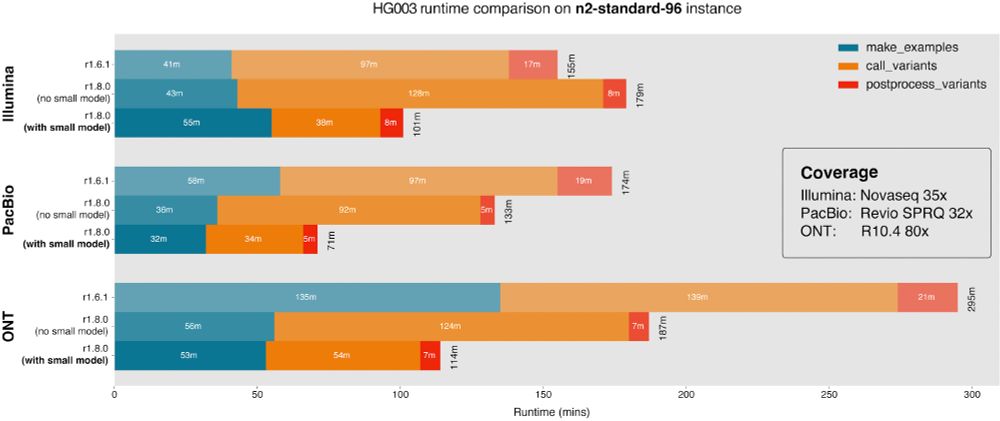
Release of DeepVariant 1.8. Large speed improvement (~67% faster) via small model for easy sites. New Pangenome-aware option. Reduces error by ~30% for vg-mapped WGS, ~10% for BWA WGS, ~5% BWA exome. New config for custom model users, see release notes.
(github.com/google/deepv...)
(github.com/google/deepv...)
December 5, 2024 at 5:57 PM
Release of DeepVariant 1.8. Large speed improvement (~67% faster) via small model for easy sites. New Pangenome-aware option. Reduces error by ~30% for vg-mapped WGS, ~10% for BWA WGS, ~5% BWA exome. New config for custom model users, see release notes.
(github.com/google/deepv...)
(github.com/google/deepv...)
Reposted by Mehrzad Samadi

Bayesian Fashion

December 1, 2024 at 10:50 PM
Bayesian Fashion