



Matt Buford
@mattbuford.bsky.social
Storage is growing pretty fast on ERCOT:

July 25, 2025 at 9:41 AM
Storage is growing pretty fast on ERCOT:
Abundance is two things: Price and availability.
If energy is cheap and large amounts of it are reasonably readily available at that price, that's abundance.
If prices are high and/or you have to wait in long queues, that's scarcity.
If energy is cheap and large amounts of it are reasonably readily available at that price, that's abundance.
If prices are high and/or you have to wait in long queues, that's scarcity.
June 6, 2025 at 7:14 AM
Abundance is two things: Price and availability.
If energy is cheap and large amounts of it are reasonably readily available at that price, that's abundance.
If prices are high and/or you have to wait in long queues, that's scarcity.
If energy is cheap and large amounts of it are reasonably readily available at that price, that's abundance.
If prices are high and/or you have to wait in long queues, that's scarcity.
Obviously energy intensive industry, especially that with lower margins, is going to go where energy is abundant and cheap vs. scarce and expensive.
If CA decarbonizes by pushing energy intensive industry to other states and then imports those products, have they really decarbonized?
If CA decarbonizes by pushing energy intensive industry to other states and then imports those products, have they really decarbonized?

June 6, 2025 at 6:55 AM
Obviously energy intensive industry, especially that with lower margins, is going to go where energy is abundant and cheap vs. scarce and expensive.
If CA decarbonizes by pushing energy intensive industry to other states and then imports those products, have they really decarbonized?
If CA decarbonizes by pushing energy intensive industry to other states and then imports those products, have they really decarbonized?
This is true, but I also think there's something to be said for decarbonizing while growing output vs. decarbonizing while just holding output steady for decades. Texas now produces 2.6x the electricity that California produces, and the difference is growing fast.

June 6, 2025 at 6:46 AM
This is true, but I also think there's something to be said for decarbonizing while growing output vs. decarbonizing while just holding output steady for decades. Texas now produces 2.6x the electricity that California produces, and the difference is growing fast.
And, it's not only population migration. Even if the population levels stay the same, if energy-hungry industries move from CA to TX, is CA really doing something to reduce pollution or are they just shifting it elsewhere?
(sorry, this chart source doesn't go back to 1990)
(sorry, this chart source doesn't go back to 1990)

May 26, 2025 at 3:41 PM
And, it's not only population migration. Even if the population levels stay the same, if energy-hungry industries move from CA to TX, is CA really doing something to reduce pollution or are they just shifting it elsewhere?
(sorry, this chart source doesn't go back to 1990)
(sorry, this chart source doesn't go back to 1990)
That's obviously a ridiculous caricatured example, yet in reality there was a dramatic difference in growth.

May 26, 2025 at 3:33 PM
That's obviously a ridiculous caricatured example, yet in reality there was a dramatic difference in growth.
IMO, migration matters too. To use an oversimplified example, if 50% of the population of CA moved to TX, and during that time CA's pollution fell by 50% and TX pollution held constant, which state actually accomplished something to reduce pollution? In that example, I'd say it would be TX.
May 26, 2025 at 3:30 PM
IMO, migration matters too. To use an oversimplified example, if 50% of the population of CA moved to TX, and during that time CA's pollution fell by 50% and TX pollution held constant, which state actually accomplished something to reduce pollution? In that example, I'd say it would be TX.
While falling pollution is obviously the goal, holding it steady while having massive growth is a pretty good step in the right direction.
Take ERCOT for example. Massive growth while FF generation is basically flat. But yes, in the long term we do want/need it to actually go down.
Take ERCOT for example. Massive growth while FF generation is basically flat. But yes, in the long term we do want/need it to actually go down.

May 26, 2025 at 6:02 AM
While falling pollution is obviously the goal, holding it steady while having massive growth is a pretty good step in the right direction.
Take ERCOT for example. Massive growth while FF generation is basically flat. But yes, in the long term we do want/need it to actually go down.
Take ERCOT for example. Massive growth while FF generation is basically flat. But yes, in the long term we do want/need it to actually go down.
Although I don't know about this specific data set, the answer is almost always that they don't. Usually people only include utility scale generation.
EIA does publish small scale solar generation estimates, but those are typically not included when discussing grid fuel mix.
EIA does publish small scale solar generation estimates, but those are typically not included when discussing grid fuel mix.
May 6, 2025 at 6:10 AM
Although I don't know about this specific data set, the answer is almost always that they don't. Usually people only include utility scale generation.
EIA does publish small scale solar generation estimates, but those are typically not included when discussing grid fuel mix.
EIA does publish small scale solar generation estimates, but those are typically not included when discussing grid fuel mix.
I did some digging on the SPR design drawdown capacity and compared it to Biden's actual drawdown rate. The design drawdown capacity lowers as the caverns empty, but even so, it looks like we never even hit 25% of the drawdown capacity.

April 30, 2025 at 12:29 AM
I did some digging on the SPR design drawdown capacity and compared it to Biden's actual drawdown rate. The design drawdown capacity lowers as the caverns empty, but even so, it looks like we never even hit 25% of the drawdown capacity.
I'm not an expert, but I'd say it likely has a lot to do with electricity prices being so cheap in TX and expensive in CA.


April 24, 2025 at 7:17 PM
I'm not an expert, but I'd say it likely has a lot to do with electricity prices being so cheap in TX and expensive in CA.
Right, this is utility scale data from ERCOT. Rooftop is relatively small in Texas though. Here's a chart I have showing how including rooftop makes a big difference in CA but a small difference in TX:

April 24, 2025 at 6:50 PM
Right, this is utility scale data from ERCOT. Rooftop is relatively small in Texas though. Here's a chart I have showing how including rooftop makes a big difference in CA but a small difference in TX:
Here is ERCOT data through March, though note that this is 12 month trailing periods (not per-month numbers):


April 24, 2025 at 6:41 PM
Here is ERCOT data through March, though note that this is 12 month trailing periods (not per-month numbers):
It's pretty standard for state EV fees to be designed to replace both state and federal fuel taxes since the state receives almost all the revenue from both taxes.
However, this specific state EV fee seems high even for both taxes. Texas showed their math, and it was $200/year per ICE.
However, this specific state EV fee seems high even for both taxes. Texas showed their math, and it was $200/year per ICE.
April 15, 2025 at 8:15 AM
It's pretty standard for state EV fees to be designed to replace both state and federal fuel taxes since the state receives almost all the revenue from both taxes.
However, this specific state EV fee seems high even for both taxes. Texas showed their math, and it was $200/year per ICE.
However, this specific state EV fee seems high even for both taxes. Texas showed their math, and it was $200/year per ICE.
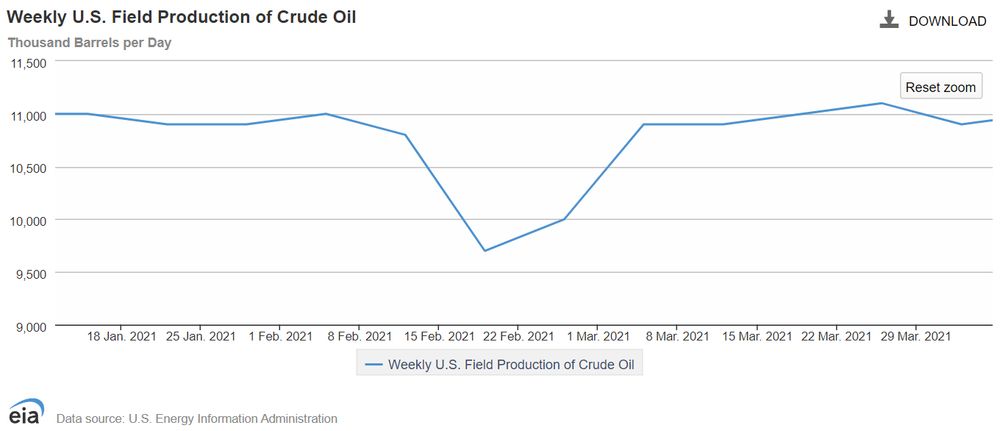
As further proof that the February 2021 oil production dip was storm related, switch to the weekly chart and zoom in. Crude production was significantly lower than pre-inauguration levels for literally only 2 weeks, starting when Uri hit, then it jumped right back to where it was even before Biden.
March 31, 2025 at 12:36 AM
As further proof that the February 2021 oil production dip was storm related, switch to the weekly chart and zoom in. Crude production was significantly lower than pre-inauguration levels for literally only 2 weeks, starting when Uri hit, then it jumped right back to where it was even before Biden.
@mrglobaltoo.bsky.social You may be interested in this.
March 6, 2025 at 6:59 PM
@mrglobaltoo.bsky.social You may be interested in this.
She apparently doesn't know that Florida hates offshore drilling so much that they amended their constitution to ban it in all state waters. They don't even specify the Gulf of Mexico. It's all state waters.
www.flsenate.gov/laws/constit...
www.flsenate.gov/laws/constit...

March 4, 2025 at 3:27 AM
She apparently doesn't know that Florida hates offshore drilling so much that they amended their constitution to ban it in all state waters. They don't even specify the Gulf of Mexico. It's all state waters.
www.flsenate.gov/laws/constit...
www.flsenate.gov/laws/constit...
For the SPR discussion, our SPR 90 day obligation is based on net imports. As a net exporter, our IEA SPR obligation is 0 barrels.
IEA obligation dashboard:
www.iea.org/data-and-sta...
Current SPR days coverage (undefined/infinite):
www.eia.gov/dnav/pet/his...
IEA obligation dashboard:
www.iea.org/data-and-sta...
Current SPR days coverage (undefined/infinite):
www.eia.gov/dnav/pet/his...

February 28, 2025 at 1:24 AM
For the SPR discussion, our SPR 90 day obligation is based on net imports. As a net exporter, our IEA SPR obligation is 0 barrels.
IEA obligation dashboard:
www.iea.org/data-and-sta...
Current SPR days coverage (undefined/infinite):
www.eia.gov/dnav/pet/his...
IEA obligation dashboard:
www.iea.org/data-and-sta...
Current SPR days coverage (undefined/infinite):
www.eia.gov/dnav/pet/his...
You can see this most clearly on days when there are low/negative prices for many hours. All the thermal gas/coal plants throttle down to their minimum and become almost flat lines with no changes, until prices rise again and they start throttling up again.

February 17, 2025 at 7:34 PM
You can see this most clearly on days when there are low/negative prices for many hours. All the thermal gas/coal plants throttle down to their minimum and become almost flat lines with no changes, until prices rise again and they start throttling up again.
I'm no expert, so take this with a grain of salt, but I think it has to do with a limited ability of thermal plants to throttle down. It's expensive and slow for them to turn all the way off then back on later. So, for short low/neg prices they throttle back as much as they can, but never to zero.
February 17, 2025 at 7:34 PM
I'm no expert, so take this with a grain of salt, but I think it has to do with a limited ability of thermal plants to throttle down. It's expensive and slow for them to turn all the way off then back on later. So, for short low/neg prices they throttle back as much as they can, but never to zero.
It did end up breaking 2 GW:

February 17, 2025 at 12:42 AM
It did end up breaking 2 GW: