



Luke Sharp
@luke-sharp.bsky.social
PhD student studying monogenic diabetes and diabetes genetics at the University of Exeter
Reposted by Luke Sharp

A reminder that MODY (and type 1 diabetes) can present in older individuals and must remain in the differential diagnosis for new onset #diabetes across the lifespan diabetesjournals.org/diabetes/art...

MODY Is Prevalent in Later-Onset Diabetes and Has Potential for Targeted Therapy but Is Challenging to Identify
Maturity onset diabetes of the young (MODY) can present after the age of 40 years, but its prevalence and clinical characteristics, and the utility of simp
diabetesjournals.org
November 25, 2025 at 9:52 PM
A reminder that MODY (and type 1 diabetes) can present in older individuals and must remain in the differential diagnosis for new onset #diabetes across the lifespan diabetesjournals.org/diabetes/art...
Our new paper “MODY is prevalent in later-onset diabetes and has potential for targeted therapy but is challenging to identify” is out now in Diabetes !!! #diabetes #MODY
doi.org/10.2337/db25...
doi.org/10.2337/db25...

MODY Is Prevalent in Later-Onset Diabetes and Has Potential for Targeted Therapy but Is Challenging to Identify
Maturity onset diabetes of the young (MODY) can present after the age of 40 years, but its prevalence and clinical characteristics, and the utility of simp
doi.org
November 26, 2025 at 9:15 AM
Our new paper “MODY is prevalent in later-onset diabetes and has potential for targeted therapy but is challenging to identify” is out now in Diabetes !!! #diabetes #MODY
doi.org/10.2337/db25...
doi.org/10.2337/db25...
Reposted by Luke Sharp

New paper on everyone’s favourite topic, QC!
We show why you should do genotype-level QC on your WGS data
www.biorxiv.org/content/10.1...
Very real quotes about this paper -
“The most exciting, mind-blowing paper of the year!”
“On a par with Fisher 1918”
“I read it every night. Just so beautiful”
We show why you should do genotype-level QC on your WGS data
www.biorxiv.org/content/10.1...
Very real quotes about this paper -
“The most exciting, mind-blowing paper of the year!”
“On a par with Fisher 1918”
“I read it every night. Just so beautiful”

Genotype-level quality control substantially reduces error rates in population-scale whole-genome sequencing
Population-scale whole-genome sequencing data will contain many individual-level genotype errors, even after allele-level quality control (QC). We establish the need for genotype-level QC using UK Bio...
www.biorxiv.org
November 8, 2025 at 9:31 AM
New paper on everyone’s favourite topic, QC!
We show why you should do genotype-level QC on your WGS data
www.biorxiv.org/content/10.1...
Very real quotes about this paper -
“The most exciting, mind-blowing paper of the year!”
“On a par with Fisher 1918”
“I read it every night. Just so beautiful”
We show why you should do genotype-level QC on your WGS data
www.biorxiv.org/content/10.1...
Very real quotes about this paper -
“The most exciting, mind-blowing paper of the year!”
“On a par with Fisher 1918”
“I read it every night. Just so beautiful”
Excited to announce the acceptance and publication of our paper titled “Population prevalence, penetrants, and mortality for genetically confirmed MODY” in JCEM: doi.org/10.1210/clin...
#MODY #monogenicdiabetes
#MODY #monogenicdiabetes

Population prevalence, penetrance, and mortality for genetically confirmed MODY
AbstractContext. Diagnosing Maturity-Onset Diabetes of the Young (MODY) is clinically important for treatment and prognosis. However, phenotype-based studi
doi.org
November 3, 2025 at 11:02 AM
Excited to announce the acceptance and publication of our paper titled “Population prevalence, penetrants, and mortality for genetically confirmed MODY” in JCEM: doi.org/10.1210/clin...
#MODY #monogenicdiabetes
#MODY #monogenicdiabetes
Reposted by Luke Sharp

Excellent autumnal away-day by the seaside with the Exeter genomics teams, organised by @drghawkes.bsky.social, discussing improvements to our whole genome sequence annotation and burden-testing pipelines - lots more exciting science to come! @exeter.ac.uk @nihrexeterbrc.bsky.social

October 29, 2025 at 11:17 AM
Excellent autumnal away-day by the seaside with the Exeter genomics teams, organised by @drghawkes.bsky.social, discussing improvements to our whole genome sequence annotation and burden-testing pipelines - lots more exciting science to come! @exeter.ac.uk @nihrexeterbrc.bsky.social
Reposted by Luke Sharp

Congratulations @luke-sharp.bsky.social for receiving the best abstract prize for early career researcher in EASD 2025 for his work on MODY in population.

September 16, 2025 at 6:58 AM
Congratulations @luke-sharp.bsky.social for receiving the best abstract prize for early career researcher in EASD 2025 for his work on MODY in population.
Reposted by Luke Sharp

I’m excited to share the 2 newest Neonatal diabetes genes: RNU4ATAC and RNU6ATAC. These genes encode snRNA components of the minor spliceosome and biallelic variants in them cause monogenic autoimmune diabetes. If you are at #EASD, come to Matt Johnson’s talk Tuesday @4pm in Milan hall to hear more.

The minor spliceosome is a master immune regulator
Pathogenic variants in non-coding genes are emerging as critical contributors to human rare diseases. We identified 19 individuals with early-onset diabetes (diagnosed <5 years) and additional clinica...
www.medrxiv.org
September 15, 2025 at 8:28 AM
I’m excited to share the 2 newest Neonatal diabetes genes: RNU4ATAC and RNU6ATAC. These genes encode snRNA components of the minor spliceosome and biallelic variants in them cause monogenic autoimmune diabetes. If you are at #EASD, come to Matt Johnson’s talk Tuesday @4pm in Milan hall to hear more.
Reposted by Luke Sharp

Reposted by Luke Sharp

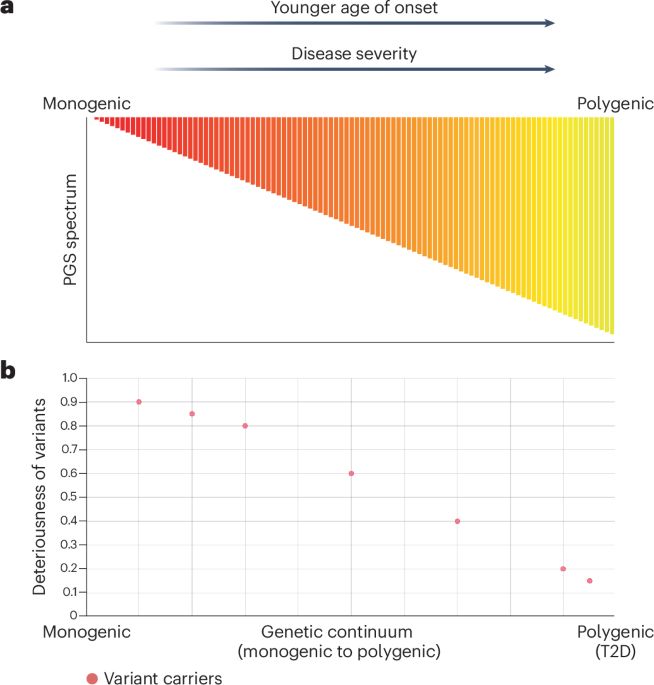
Now out in @natmetabolism.nature.com! Excited to share our work showing how common genetic changes shape how diabetes presents in MODY (Maturity-Onset Diabetes of the Young). Our findings highlight the growing overlap between monogenic and polygenic forms of diabetes.
www.nature.com/articles/s42...
www.nature.com/articles/s42...

Common genetic variants modify disease risk and clinical presentation in monogenic diabetes - Nature Metabolism
In clinical and population-based cohorts, a strong contribution of polygenic risk for type 2 diabetes (T2D) significantly modifies the onset and phenotypic variability of maturity-onset diabetes of th...
www.nature.com
September 9, 2025 at 1:25 PM
Now out in @natmetabolism.nature.com! Excited to share our work showing how common genetic changes shape how diabetes presents in MODY (Maturity-Onset Diabetes of the Young). Our findings highlight the growing overlap between monogenic and polygenic forms of diabetes.
www.nature.com/articles/s42...
www.nature.com/articles/s42...
Reposted by Luke Sharp

Our paper is now out on Diabetes!
diabetesjournals.org/diabetes/art...
diabetesjournals.org/diabetes/art...

Rare Variants in NEUROD1 and PDX1 Are Low-Penetrance Causes of MODY, Whereas Those in APPL1 and WFS1 Are Not Associated With MODY
An accurate genetic diagnosis of maturity-onset diabetes of the young (MODY) is critical for personalized treatment. To avoid misdiagnosis, only genes with
diabetesjournals.org
August 27, 2025 at 1:42 PM
Our paper is now out on Diabetes!
diabetesjournals.org/diabetes/art...
diabetesjournals.org/diabetes/art...
Reposted by Luke Sharp
New preprint out now! We show polygenic background shapes GCK-MODY clinical presentation. In >1,000 cases, higher polygenic risk increased the chance of exceeding diagnostic diabetes thresholds, highlighting how monogenic & polygenic factors jointly shape disease. #Genetics
Polygenic Background Contributes to GCK-MODY Clinical Presentation and Glycaemic Variability https://www.medrxiv.org/content/10.1101/2025.08.04.25332935v1
August 11, 2025 at 4:57 PM
New preprint out now! We show polygenic background shapes GCK-MODY clinical presentation. In >1,000 cases, higher polygenic risk increased the chance of exceeding diagnostic diabetes thresholds, highlighting how monogenic & polygenic factors jointly shape disease. #Genetics
Reposted by Luke Sharp

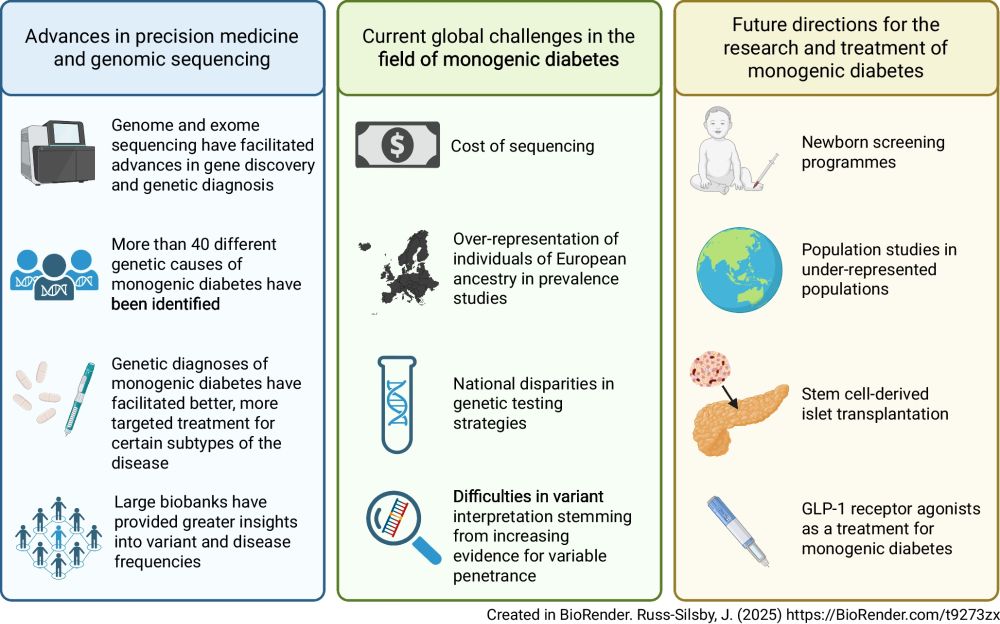
Global perspectives on #MonogenicDiabetes: review explores recent advances, global diagnostic challenges and promising future directions—from genomic equity to innovative therapies. #GlobalHealth link.springer.com/article/10.1... 🔓
Global perspectives on monogenic forms of diabetes - Diabetologia
Monogenic forms of diabetes represent an uncommon but very heterogeneous subset of the disease, with variable associated clinical features and key differences in treatment options. In this review, we ...
link.springer.com
July 22, 2025 at 5:35 PM
Global perspectives on #MonogenicDiabetes: review explores recent advances, global diagnostic challenges and promising future directions—from genomic equity to innovative therapies. #GlobalHealth link.springer.com/article/10.1... 🔓
Reposted by Luke Sharp

Population prevalence, penetrance, and mortality for genetically confirmed MODY https://www.medrxiv.org/content/10.1101/2025.06.30.25330354v1
July 1, 2025 at 1:57 AM
Population prevalence, penetrance, and mortality for genetically confirmed MODY https://www.medrxiv.org/content/10.1101/2025.06.30.25330354v1
Reposted by Luke Sharp
Really proud of this Exeter–Stanford collaboration identifying bi-allelic variants in PAX4 as a novel cause of transient neonatal diabetes—the first new genetic cause of this subtype described in over a decade. This work expands our understanding of beta cell development.
🔗 doi.org/10.1016/j.mo...
🔗 doi.org/10.1016/j.mo...
Complete Loss of PAX4 causes Transient Neonatal Diabetes in Humans
Gene discovery studies in individuals with diabetes diagnosed within 6 months of life (neonatal diabetes, NDM) can provide unique insights into the de…
www.sciencedirect.com
July 3, 2025 at 2:23 PM
Really proud of this Exeter–Stanford collaboration identifying bi-allelic variants in PAX4 as a novel cause of transient neonatal diabetes—the first new genetic cause of this subtype described in over a decade. This work expands our understanding of beta cell development.
🔗 doi.org/10.1016/j.mo...
🔗 doi.org/10.1016/j.mo...
Check out our new paper on “Medullary Thyroid Cancer Risk and Mortality in Carriers of Incidentally Identified MEN2A RET Variants” ja.ma/3I0VgsJ
July 1, 2025 at 9:41 AM
Check out our new paper on “Medullary Thyroid Cancer Risk and Mortality in Carriers of Incidentally Identified MEN2A RET Variants” ja.ma/3I0VgsJ
MODY is prevalent in later onset diabetes. Really proud to announce the release of a preprint of our paper assessing MODY in people diagnosed with diabetes later in life!!
#MonogenicDiabetes
#MonogenicDiabetes
MODY is prevalent in later-onset diabetes, has potential for targeted therapy but is challenging to identify https://www.medrxiv.org/content/10.1101/2025.06.17.25329143v1
June 19, 2025 at 12:05 PM
MODY is prevalent in later onset diabetes. Really proud to announce the release of a preprint of our paper assessing MODY in people diagnosed with diabetes later in life!!
#MonogenicDiabetes
#MonogenicDiabetes
Reposted by Luke Sharp
Excited to share the preprint of our paper (my first paper!) looking at limited evidence MODY genes. We use rare variant burden testing and one of the largest MODY cohorts to evaluate the pathogenicity of these genes. This evidence can help inform clinical guidelines in MODY genetic testing!
NEUROD1 and PDX1 are low penetrance causes of MODY while rare variants in APPL1 and WFS1 are not associated with MODY https://www.medrxiv.org/content/10.1101/2025.05.07.25327066v1
June 4, 2025 at 12:36 PM
Excited to share the preprint of our paper (my first paper!) looking at limited evidence MODY genes. We use rare variant burden testing and one of the largest MODY cohorts to evaluate the pathogenicity of these genes. This evidence can help inform clinical guidelines in MODY genetic testing!