



Ajdin Velić
@king-of-the-lab.bsky.social
PhD Candidate Meyer Group Göttingen|
MSc SynCat Wolf Group Regensburg 🐺| Catalysis |Bioinorganic Chemistry |Inorganic Synthesis |
🇧🇦
(he/him)
MSc SynCat Wolf Group Regensburg 🐺| Catalysis |Bioinorganic Chemistry |Inorganic Synthesis |
🇧🇦
(he/him)

Reposted by Ajdin Velić
P4 REDUCTION generally results in multi-nuclear Zintl anions: P8(2-), P4(2-) or P7(3-). Reaction with a soluble Mg(0) complex gave full reduction to P(3-). Latter anion serves as a triple base, a three-fold nucleophile or 3e-reducing agent. onlinelibrary.wiley.com/doi/epdf/10.10

September 2, 2025 at 10:31 AM
P4 REDUCTION generally results in multi-nuclear Zintl anions: P8(2-), P4(2-) or P7(3-). Reaction with a soluble Mg(0) complex gave full reduction to P(3-). Latter anion serves as a triple base, a three-fold nucleophile or 3e-reducing agent. onlinelibrary.wiley.com/doi/epdf/10.10
Reposted by Ajdin Velić

Excited to share our contribution to the special issue "Organometallic Chemistry Beyond the Transition Metals: Fundamentals and Applications of the P-Block" – now published @Organometallics! Check it out 👉 @pubs.acs.org #ChemSky
pubs.acs.org/doi/10.1021/...
pubs.acs.org/doi/10.1021/...
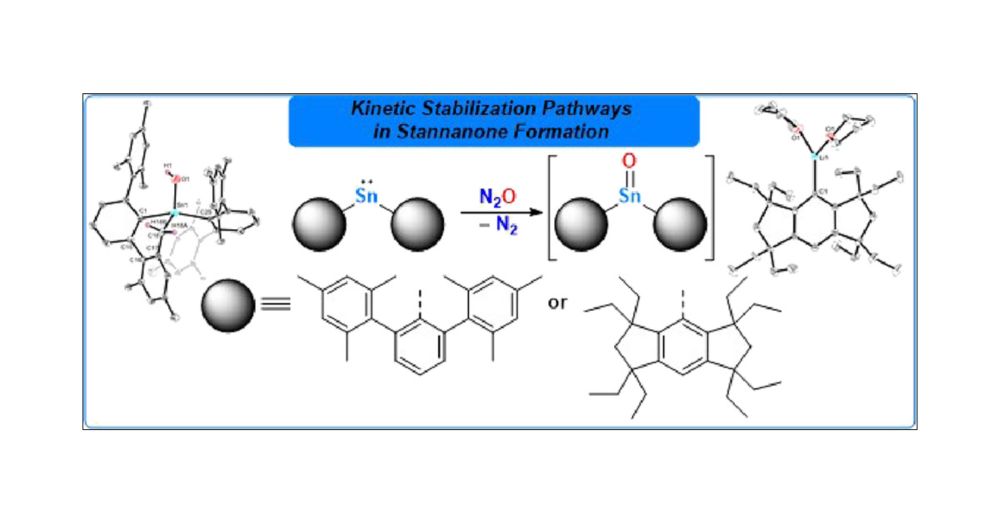
Kinetic Stabilization in Diaryl-Substituted Stannylenes: N2O Reactivity, Intramolecular C–H Activation, and Crystalline (Eind)Li(THF)2 as a Versatile Precursor in Tin Chemistry
The reactivity of the kinetically stabilized stannylene (MesTer)2Sn (1) (MesTer = –C6H3-2,6-(2,4,6-Me3-C6H2)2) toward N2O is revisited, yielding the terminal tin(IV) hydroxide 2 via formal intramolecular C(sp3)–H activation of a putative terminal stannanone intermediate. By switching to Eind ligation (Eind = 1,1,3,3,5,5,7,7-octaethyl-s-hydrindacen-4-yl) at the tin center, the synthesis and characterization of the crystalline lithium salt (Eind)Li(THF)2 (3) is reported, serving as a straightforward precursor for the clean generation of the corresponding stannylene (Eind)2Sn (4). Compound 4 can be further cleanly converted into the heteroleptic Eind/halide stannylene (Eind)SnCl (6). Both 4 and 6 serve as suitable precursors for the synthesis of the heteroleptic s-hydrindacene-/amido-substituted stannylene (Eind)Sn{N(SiMe3)2} (5).
pubs.acs.org
July 22, 2025 at 4:43 PM
Excited to share our contribution to the special issue "Organometallic Chemistry Beyond the Transition Metals: Fundamentals and Applications of the P-Block" – now published @Organometallics! Check it out 👉 @pubs.acs.org #ChemSky
pubs.acs.org/doi/10.1021/...
pubs.acs.org/doi/10.1021/...
Reposted by Ajdin Velić

Two centuries after Faraday’s landmark discovery, researchers in China have discovered that an iconoclastic duo of metal complexes can open benzene’s robust ring at room temperature. cen.acs.org/physical-che... #chemsky 🧪

Breaking benzene
Scandium and chromium compounds team up to convert iconic molecule into linear product at room temperature
cen.acs.org
July 17, 2025 at 11:58 AM
Two centuries after Faraday’s landmark discovery, researchers in China have discovered that an iconoclastic duo of metal complexes can open benzene’s robust ring at room temperature. cen.acs.org/physical-che... #chemsky 🧪
Reposted by Ajdin Velić

We show how photoredox catalysis can bypass Kasha’s rule, enabling reactions from higher excited states.
This work, led by the exceptional @bjoernpfund.bsky.social, offers new insights into photochemical reactivity.
Published in JACS @jacs.acspublications.org
bit.ly/3IysmjX
This work, led by the exceptional @bjoernpfund.bsky.social, offers new insights into photochemical reactivity.
Published in JACS @jacs.acspublications.org
bit.ly/3IysmjX
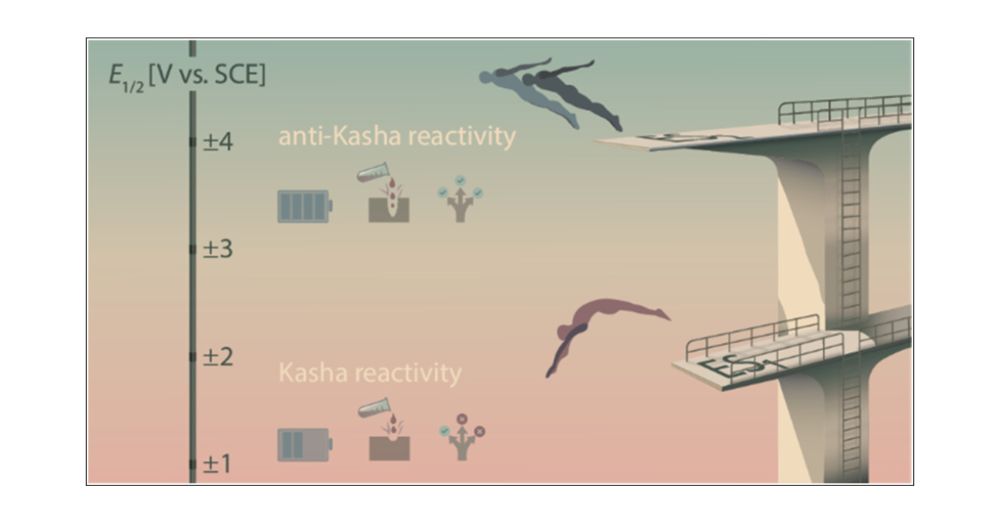
Breaking Kasha’s Rule to Enable Higher Reactivity in Photoredox Catalysis
Nearly all photochemical transformations known to date follow Kasha’s rule, implying that reactions occur only from the lowest electronically excited state of a given spin multiplicity due to the fast...
bit.ly
July 18, 2025 at 7:00 AM
We show how photoredox catalysis can bypass Kasha’s rule, enabling reactions from higher excited states.
This work, led by the exceptional @bjoernpfund.bsky.social, offers new insights into photochemical reactivity.
Published in JACS @jacs.acspublications.org
bit.ly/3IysmjX
This work, led by the exceptional @bjoernpfund.bsky.social, offers new insights into photochemical reactivity.
Published in JACS @jacs.acspublications.org
bit.ly/3IysmjX
Reposted by Ajdin Velić


Reposted by Ajdin Velić
Enzymatic Birch reduction via hydrogen atom transfer at [4Fe-4S]-OH2 and [8Fe-9S] clusters www.nature.com/articles/s41...

Enzymatic Birch reduction via hydrogen atom transfer at [4Fe-4S]-OH2 and [8Fe-9S] clusters - Nature Communications
Class I and II benzoyl-coenzyme A reductases offer a mild biological alternative to the alkali metal- and ammonia-dependent Birch reduction, a classical synthetic method for achieving dihydro addition...
www.nature.com
April 6, 2025 at 7:24 AM
Enzymatic Birch reduction via hydrogen atom transfer at [4Fe-4S]-OH2 and [8Fe-9S] clusters www.nature.com/articles/s41...
Reposted by Ajdin Velić
A simple guide to the design of metal complexes in luminescence and photoredox catalysis.
With Giacomo Morselli and Christian Reber in JACS @jacs.acspublications.org
pubs.acs.org/doi/10.1021/...
With Giacomo Morselli and Christian Reber in JACS @jacs.acspublications.org
pubs.acs.org/doi/10.1021/...
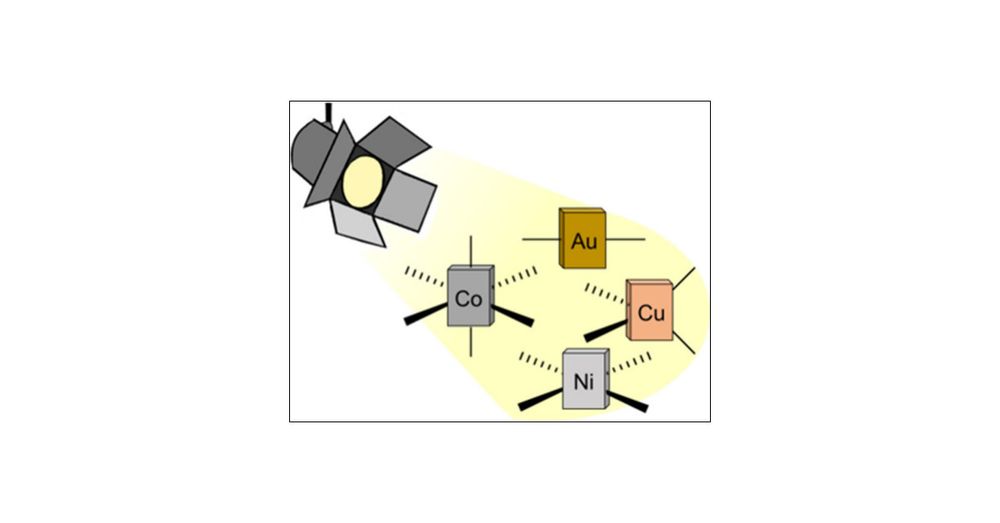
Molecular Design Principles for Photoactive Transition Metal Complexes: A Guide for “Photo-Motivated” Chemists
Luminescence and photochemistry involve electronically excited states that are inherently unstable and therefore spontaneously decay to electronic ground states, in most cases by nonradiative energy release that generates heat. This energy dissipation can occur on a time scale of 100 fs (∼10–13 s) and usually needs to be slowed down to at least the nanosecond (∼10–9 s) time scale for luminescence and intermolecular photochemistry to occur. This is a challenging task with many different factors to consider. An alternative emerging strategy is to target dissociative excited states that lead to metal–ligand bond homolysis on the subnanosecond time scale to access synthetically useful radicals. Based on a thorough review at the most recent advances in the field, this article aims to provide a concise guide to obtaining luminescent and photochemically useful coordination compounds with d-block elements. We hope to encourage “photo-motivated” chemists who have been reluctant to apply their synthetic and other knowledge to photophysics and photochemistry, and we intend to stimulate new approaches to the synthetic control of excited state behavior.
pubs.acs.org
March 27, 2025 at 10:18 PM
A simple guide to the design of metal complexes in luminescence and photoredox catalysis.
With Giacomo Morselli and Christian Reber in JACS @jacs.acspublications.org
pubs.acs.org/doi/10.1021/...
With Giacomo Morselli and Christian Reber in JACS @jacs.acspublications.org
pubs.acs.org/doi/10.1021/...
Reposted by Ajdin Velić
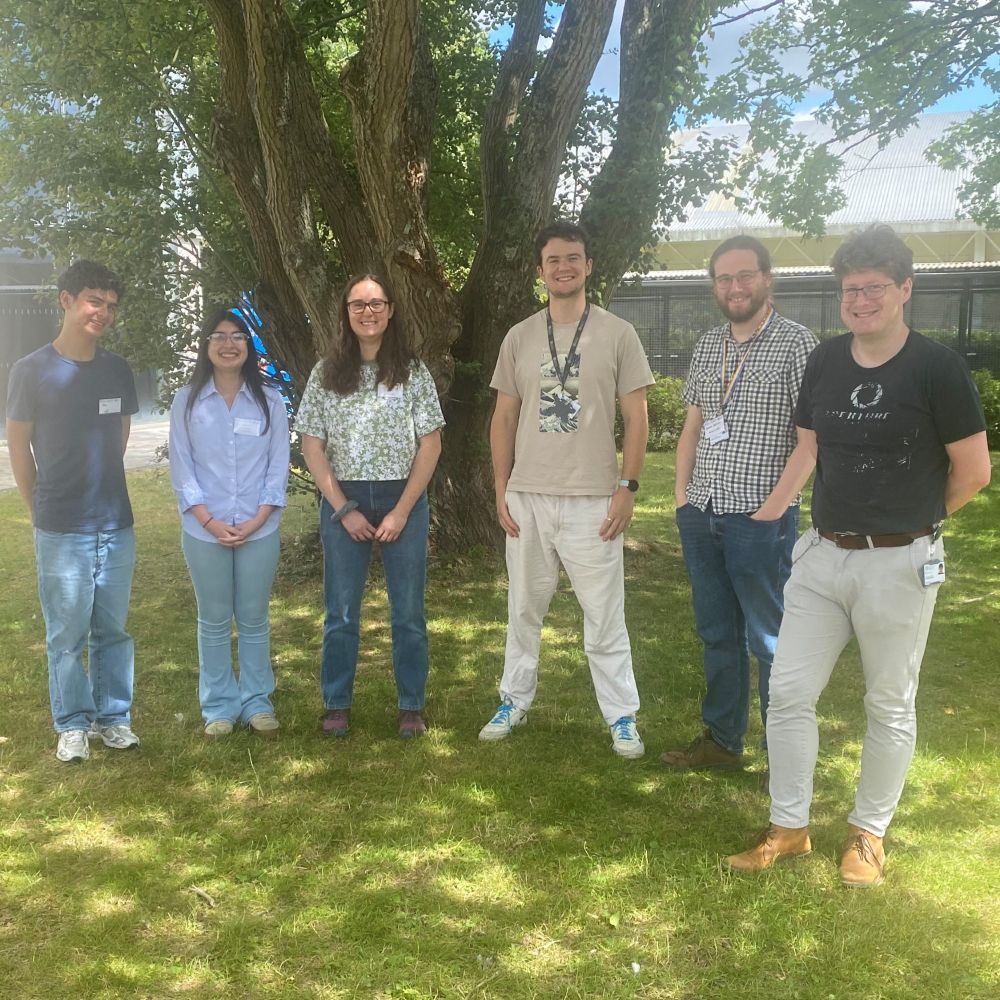
📣Upcoming postdoc position📢
Thanks to @leverhulme.bsky.social we will soon be recruiting a new PDRA to study some unusual redox-active Lewis acid chemistry.
Full advert to follow soon, but in the meantime please feel free to get in touch if interested!
Thanks to @leverhulme.bsky.social we will soon be recruiting a new PDRA to study some unusual redox-active Lewis acid chemistry.
Full advert to follow soon, but in the meantime please feel free to get in touch if interested!
March 12, 2025 at 11:56 AM
📣Upcoming postdoc position📢
Thanks to @leverhulme.bsky.social we will soon be recruiting a new PDRA to study some unusual redox-active Lewis acid chemistry.
Full advert to follow soon, but in the meantime please feel free to get in touch if interested!
Thanks to @leverhulme.bsky.social we will soon be recruiting a new PDRA to study some unusual redox-active Lewis acid chemistry.
Full advert to follow soon, but in the meantime please feel free to get in touch if interested!
Reposted by Ajdin Velić
Redox-active inverse crowns for small molecule activation, from Sjoerd Harder @harder-research.bsky.social and co-workers
www.nature.com/articles/s41...
#chemsky
www.nature.com/articles/s41...
#chemsky
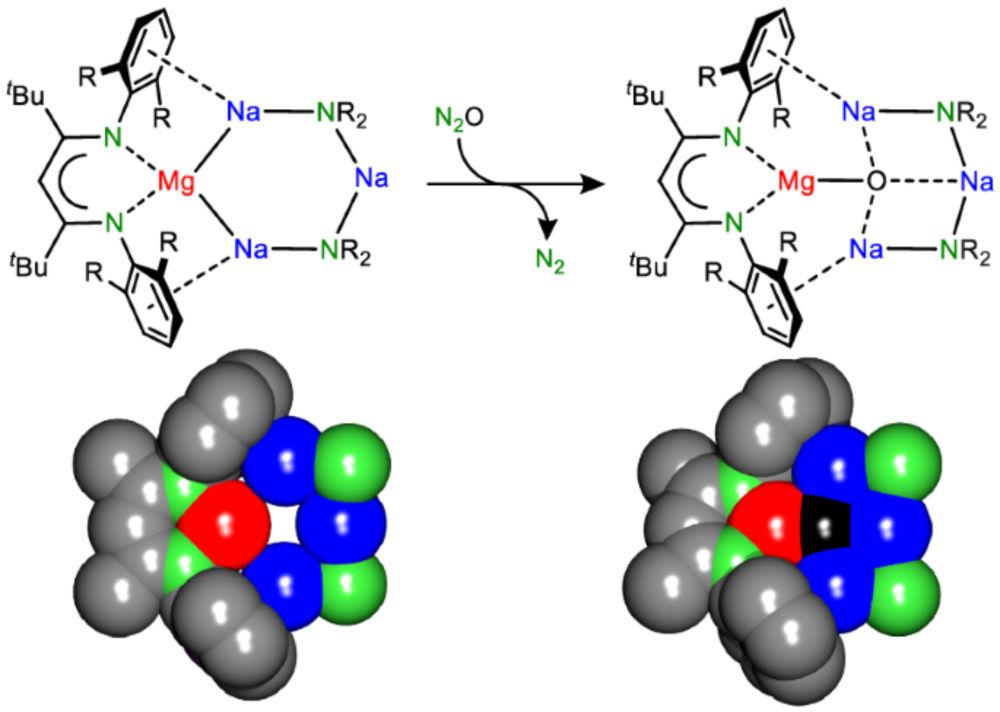
Redox-active inverse crowns for small molecule activation - Nature Chemistry
Following the building principles of crown ethers for cation encapsulation, inverse crowns are rings of metals that bind anions. Now a redox-active inverse crown ether featuring Na+ cations and Mg0 ha...
www.nature.com
February 21, 2025 at 7:21 AM
Redox-active inverse crowns for small molecule activation, from Sjoerd Harder @harder-research.bsky.social and co-workers
www.nature.com/articles/s41...
#chemsky
www.nature.com/articles/s41...
#chemsky
Reposted by Ajdin Velić
For #BlackHistoryMonth, read about modern-day Black chemists making history: C&EN's 2021 Trailblazers issue, curated by guest editor Paula Hammond, celebrates Black chemists and chemical engineers.
#BlackinChem cen.acs.org/careers/dive...
#BlackinChem cen.acs.org/careers/dive...

Trailblazers 2021: We have been here all along
Guest editor Paula Hammond, MIT drug delivery pioneer, describes her vision for this special issue of C&EN celebrating Black Trailblazers in chemistry and chemical engineering
cen.acs.org
February 18, 2025 at 3:46 PM
For #BlackHistoryMonth, read about modern-day Black chemists making history: C&EN's 2021 Trailblazers issue, curated by guest editor Paula Hammond, celebrates Black chemists and chemical engineers.
#BlackinChem cen.acs.org/careers/dive...
#BlackinChem cen.acs.org/careers/dive...
Reposted by Ajdin Velić
“There’s never been so many women in science, getting Nobel Prizes in the sciences, that we could actually have a gang,” said Frances Arnold (right), shown with Carolyn Bertozzi (center) and Jennifer Doudna (left) during Nobel Week 2022. cen.acs.org/people/award...
#WomenInScience #IDWGS
#WomenInScience #IDWGS

February 11, 2025 at 3:41 PM
“There’s never been so many women in science, getting Nobel Prizes in the sciences, that we could actually have a gang,” said Frances Arnold (right), shown with Carolyn Bertozzi (center) and Jennifer Doudna (left) during Nobel Week 2022. cen.acs.org/people/award...
#WomenInScience #IDWGS
#WomenInScience #IDWGS
Reposted by Ajdin Velić
Isolation of a planar π-aromatic Bi₅⁻ ring in a cobalt-based inverse-sandwich-type complex, from @stefaniedehnen.bsky.social and co-workers
www.nature.com/articles/s41...
#chemsky
www.nature.com/articles/s41...
#chemsky

Isolation of a planar π-aromatic Bi5− ring in a cobalt-based inverse-sandwich-type complex - Nature Chemistry
All-metal aromatic monocycles are still rare, in contrast to their ubiquitous organic counterparts, because metal atoms tend to form clusters with multiply bonded atoms instead. Now a planar aromatic ...
www.nature.com
January 21, 2025 at 1:06 PM
Isolation of a planar π-aromatic Bi₅⁻ ring in a cobalt-based inverse-sandwich-type complex, from @stefaniedehnen.bsky.social and co-workers
www.nature.com/articles/s41...
#chemsky
www.nature.com/articles/s41...
#chemsky