



Henrik Karlstrøm
@karlstrom.bsky.social
Bibliometrician, data scientist at Nordic Institute for Studies of innovation, research and education, nifu.no
Reposted by Henrik Karlstrøm

Registration for this year's Nordic Workshop on Bibliometrics and Research Policy is now OPEN: www.nifu.no/nwb2025/regi....
Hope to see you there in October!
#nwb2025
Hope to see you there in October!
#nwb2025
Registration
NWB2025Practical informationProgramRegistrationAbout NWB
Registration for NWB 2025 is now open.
Please register for the workshop using the registration form: https://form.app.uib.no/NWB2025. Not...
www.nifu.no
July 1, 2025 at 8:50 AM
Registration for this year's Nordic Workshop on Bibliometrics and Research Policy is now OPEN: www.nifu.no/nwb2025/regi....
Hope to see you there in October!
#nwb2025
Hope to see you there in October!
#nwb2025
Reposted by Henrik Karlstrøm
The 30th Nordic Workshop on Bibliometrics and Research Policy takes place in Bergen, Norway October 29-31 this year. The Call for Abstracts is now out, and submissions open March 17th. Presentations and posters alike are welcome. Hope to see you there?
Welcome to Bergen in 2025!
Welcome to the 30th Nordic Workshop on Bibliometrics and Research Policy (NWB 2025). Nordic Institute for Studies of Innovation, Research and Education are hosts together with the University Library o...
www.nifu.no
March 13, 2025 at 11:25 AM
The 30th Nordic Workshop on Bibliometrics and Research Policy takes place in Bergen, Norway October 29-31 this year. The Call for Abstracts is now out, and submissions open March 17th. Presentations and posters alike are welcome. Hope to see you there?
New article out in London Review of Education. It's sort of a conceptual piece about uses and non-uses of machine learning / AI in systematic reviews using the field of education as a lense. It's diamond open access, so give it a read if you're interested.
Uses of artificial intelligence and machine learning in systematic reviews of education research
The speed and volume of scientific publishing is accelerating, both in terms of number of authors and in terms of the number of publications by each author. At the same time, the demand for knowledge ...
doi.org
December 4, 2024 at 8:19 AM
New article out in London Review of Education. It's sort of a conceptual piece about uses and non-uses of machine learning / AI in systematic reviews using the field of education as a lense. It's diamond open access, so give it a read if you're interested.
Ceremony to welcome new users to Bluesky

November 22, 2024 at 12:54 AM
Ceremony to welcome new users to Bluesky
Wonder about the experience of being interviewed by an AI - have they transcended the uncanny valley for this sort of stuff? Does it lead to different answers when you know you're not being judged by the person on the other end?

Really interesting work. I would not have predicted that interview text + RAG was sufficient to simulate survey responses.
Also fun: how do you run 2hr interviews for 1000 people? They created an AI interviewer.
Also fun: how do you run 2hr interviews for 1000 people? They created an AI interviewer.
Simulating human behavior with AI agents promises a testbed for policy and the social sciences. We interviewed 1,000 people for two hours each to create generative agents of them. These agents replicate their source individuals’ attitudes and behaviors. 🧵
arxiv.org/abs/2411.10109
arxiv.org/abs/2411.10109
November 19, 2024 at 10:15 AM
Wonder about the experience of being interviewed by an AI - have they transcended the uncanny valley for this sort of stuff? Does it lead to different answers when you know you're not being judged by the person on the other end?
Reposted by Henrik Karlstrøm

TIL bees get drunk (but wasps don't): "Bees also show pronounced dose-dependent ethanol-induced behavioral alterations such as reduced walking time, decreased flying frequency, and loss of postural control as indicated by an increased amount of time inebriated bees spent upside down" 🧪

How to survive enormous amounts of alcohol | PNAS
How to survive enormous amounts of alcohol
doi.org
November 13, 2024 at 10:33 AM
TIL bees get drunk (but wasps don't): "Bees also show pronounced dose-dependent ethanol-induced behavioral alterations such as reduced walking time, decreased flying frequency, and loss of postural control as indicated by an increased amount of time inebriated bees spent upside down" 🧪
I'm always fascinated by the high status of journals like Nature. One thing is that Scientific Reports keeps pumping out pure gibberish papers at MDPI-level rates, but the flagship journal too. I seldom feel that their bibliometric analyses would pass muster in one of our disciplinary journals.
November 9, 2024 at 9:55 AM
I'm always fascinated by the high status of journals like Nature. One thing is that Scientific Reports keeps pumping out pure gibberish papers at MDPI-level rates, but the flagship journal too. I seldom feel that their bibliometric analyses would pass muster in one of our disciplinary journals.
Reposted by Henrik Karlstrøm

New study by @karlstrom.bsky.social, Aksnes & Piro suggests that "the emergence of OA publishing has been particularly advantageous" in lower-income countries.
Read the article to learn more about this important topic!
#scholarlypublishing #OA
Read the article to learn more about this important topic!
#scholarlypublishing #OA

Benefits of open access to researchers from lower-income countries: A global analysis of reference patterns in 1980–2020 - Henrik Karlstrøm, Dag W Aksnes, Fredrik N Piro, 2024
The main objective of the open access (OA) movement is to make scientific literature freely available to everyone. This may be of particular importance to resea...
journals.sagepub.com
April 25, 2024 at 9:11 AM
New study by @karlstrom.bsky.social, Aksnes & Piro suggests that "the emergence of OA publishing has been particularly advantageous" in lower-income countries.
Read the article to learn more about this important topic!
#scholarlypublishing #OA
Read the article to learn more about this important topic!
#scholarlypublishing #OA
New paper! Increased access to literature changes the reference lists of academic papers, particularly for research from low- and middle-income countries. There are more references, they are newer, and they come from more established sources. doi.org/10.1177/0165...
#metascience
#metascience

April 25, 2024 at 8:14 AM
New paper! Increased access to literature changes the reference lists of academic papers, particularly for research from low- and middle-income countries. There are more references, they are newer, and they come from more established sources. doi.org/10.1177/0165...
#metascience
#metascience
How long until the language models stop replying with these super-generic stock phrases? How will we even know who is using them in their research practice?
March 13, 2024 at 1:11 PM
How long until the language models stop replying with these super-generic stock phrases? How will we even know who is using them in their research practice?
Reposted by Henrik Karlstrøm

We are excited to announce that we are collaborating with
Nature Human Behaviour!! We will mass reproduce/replicate their papers from 2023 onwards. We need your help conducting computational reproducibility + sensitivity analysis OR replication with new data.
Correspondence here: rdcu.be/dwUGX
Nature Human Behaviour!! We will mass reproduce/replicate their papers from 2023 onwards. We need your help conducting computational reproducibility + sensitivity analysis OR replication with new data.
Correspondence here: rdcu.be/dwUGX
rdcu.be
January 25, 2024 at 4:36 PM
We are excited to announce that we are collaborating with
Nature Human Behaviour!! We will mass reproduce/replicate their papers from 2023 onwards. We need your help conducting computational reproducibility + sensitivity analysis OR replication with new data.
Correspondence here: rdcu.be/dwUGX
Nature Human Behaviour!! We will mass reproduce/replicate their papers from 2023 onwards. We need your help conducting computational reproducibility + sensitivity analysis OR replication with new data.
Correspondence here: rdcu.be/dwUGX
Reposted by Henrik Karlstrøm
✨New publication formats, call for special issues and a brand new data policy ✨
In this editorial 👇 we introduce editorial initiatives to improve research dissemination and facilitate exchange in sociology.
We hope you like the new opportunities and want to contribute 😊
doi.org/10.1177/0001...
In this editorial 👇 we introduce editorial initiatives to improve research dissemination and facilitate exchange in sociology.
We hope you like the new opportunities and want to contribute 😊
doi.org/10.1177/0001...
January 25, 2024 at 12:48 PM
✨New publication formats, call for special issues and a brand new data policy ✨
In this editorial 👇 we introduce editorial initiatives to improve research dissemination and facilitate exchange in sociology.
We hope you like the new opportunities and want to contribute 😊
doi.org/10.1177/0001...
In this editorial 👇 we introduce editorial initiatives to improve research dissemination and facilitate exchange in sociology.
We hope you like the new opportunities and want to contribute 😊
doi.org/10.1177/0001...
Reposted by Henrik Karlstrøm

1/2
New meta-analysis of 103 tricyclic antidepressant RCTs in n=10600 shows
➡️ all results at high risk of bias
➡️ certainty of evidence (very) low
➡️ studies lasted 12 weeks max
➡️ evidence of harmful effects compared to placebo (OR 2.78), but required information size *not* reached.
New meta-analysis of 103 tricyclic antidepressant RCTs in n=10600 shows
➡️ all results at high risk of bias
➡️ certainty of evidence (very) low
➡️ studies lasted 12 weeks max
➡️ evidence of harmful effects compared to placebo (OR 2.78), but required information size *not* reached.
January 22, 2024 at 12:27 PM
1/2
New meta-analysis of 103 tricyclic antidepressant RCTs in n=10600 shows
➡️ all results at high risk of bias
➡️ certainty of evidence (very) low
➡️ studies lasted 12 weeks max
➡️ evidence of harmful effects compared to placebo (OR 2.78), but required information size *not* reached.
New meta-analysis of 103 tricyclic antidepressant RCTs in n=10600 shows
➡️ all results at high risk of bias
➡️ certainty of evidence (very) low
➡️ studies lasted 12 weeks max
➡️ evidence of harmful effects compared to placebo (OR 2.78), but required information size *not* reached.
Reposted by Henrik Karlstrøm
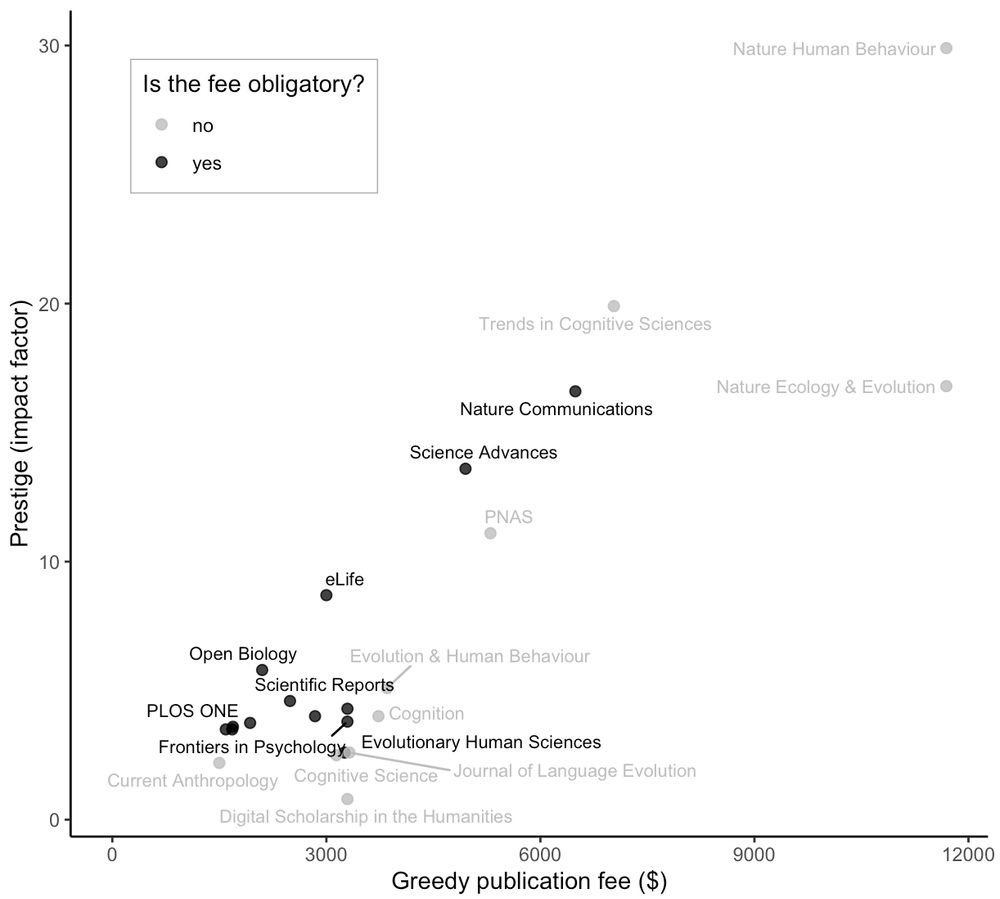
Journal fees for open access are becoming obscene. But what are we, scientists, paying for? I made a simple plot with journals in my research area(s). Clearly, we are paying for prestige: a shockingly clean correlation between the impact factor and journal fees
December 13, 2023 at 1:06 PM
Journal fees for open access are becoming obscene. But what are we, scientists, paying for? I made a simple plot with journals in my research area(s). Clearly, we are paying for prestige: a shockingly clean correlation between the impact factor and journal fees
Reposted by Henrik Karlstrøm

New preprint! How often do editors/reviewers actually compare preregistrations to the reporting in the article? Almost never. This figure sums up all of the results. Not good.

December 8, 2023 at 3:20 PM
New preprint! How often do editors/reviewers actually compare preregistrations to the reporting in the article? Almost never. This figure sums up all of the results. Not good.
Reposted by Henrik Karlstrøm

Gelman et al. on imperfect science reform
Why I continue to support the science reform movement despite its flaws | Statistical Modeling, Cau...
statmodeling.stat.columbia.edu
November 29, 2023 at 5:23 PM
Gelman et al. on imperfect science reform
OpenCitations seem to have cleaned up and simplified their somewhat messy database, and OpenAlex (openalex.org) now offers a web interface as well as a data dump. All for free. Surely the commercial value of bibliographic metadata must be approaching zero?

A new revolutionary workflow for a unified collection of citations: say hello to the OpenCitations I...
Blog post by Ivan Heibi (University of Bologna), Arianna Moretti (University of Bologna) and Chiara Di Giambattista (University of Bologna). In the past five years, the OpenCitations data has been enr...
opencitations.hypotheses.org
November 28, 2023 at 4:03 PM
OpenCitations seem to have cleaned up and simplified their somewhat messy database, and OpenAlex (openalex.org) now offers a web interface as well as a data dump. All for free. Surely the commercial value of bibliographic metadata must be approaching zero?
First time trying out F1000's publishing and open review model, and I'm positive. I like the fact that my review is not a hurdle to publication but more of a reader guidance, and I also think not being anonymous introduces some accountability on my part. Also, the paper is good!

F1000Research Article: Making science public: a review of journalists’ use of Open Science researc...
Read the latest article version by Alice Fleerackers, Natascha Chtena, Stephen Pinfield, Juan Pablo Alperin, Germana Barata, Monique Oliveira, Isabella Peters, at F1000Research.
f1000research.com
November 8, 2023 at 11:45 AM
First time trying out F1000's publishing and open review model, and I'm positive. I like the fact that my review is not a hurdle to publication but more of a reader guidance, and I also think not being anonymous introduces some accountability on my part. Also, the paper is good!
Simply pointing out egregious errors and omissions in supposedly vetted, published academic work can be costly and thankless. Those who do it are seldom in positions of power themselves, and should not have to face institutional and sociological hurdles just to be allowed to present their findings.

A Post Mortem on the Gino Case | The Organizational Plumber
My perspective on the Gino-Ariely scandal, and what we should learn from it.
www.theorgplumber.com
October 31, 2023 at 11:45 AM
Simply pointing out egregious errors and omissions in supposedly vetted, published academic work can be costly and thankless. Those who do it are seldom in positions of power themselves, and should not have to face institutional and sociological hurdles just to be allowed to present their findings.
Reposted by Henrik Karlstrøm

Great new paper from Matt Zefferman. I think this is important not just for IQ research, but for test/metric design in general.
“Greater variance in male intelligence test scores can be explained by sex-biased test design”
osf.io/83wma/
“Greater variance in male intelligence test scores can be explained by sex-biased test design”
osf.io/83wma/
osf.io
September 24, 2023 at 5:46 PM
Great new paper from Matt Zefferman. I think this is important not just for IQ research, but for test/metric design in general.
“Greater variance in male intelligence test scores can be explained by sex-biased test design”
osf.io/83wma/
“Greater variance in male intelligence test scores can be explained by sex-biased test design”
osf.io/83wma/
Reposted by Henrik Karlstrøm
I am finally putting the full stop at the end of Grimpact with the Grimpact Repository at www.Grimpact.org . Submit your own Grimpact case study to help us understand the undesirable or else unfortunate links between research and bad societal outcomes.
www.Grimpact.org
October 19, 2023 at 4:56 PM
I am finally putting the full stop at the end of Grimpact with the Grimpact Repository at www.Grimpact.org . Submit your own Grimpact case study to help us understand the undesirable or else unfortunate links between research and bad societal outcomes.

October 19, 2023 at 12:52 PM
Reposted by Henrik Karlstrøm

This looks like very cool work! Quantifying effects of similarity is one of those questions for which, depending on the analysis, we end up with replicable answers…that are simply wrong.

October 19, 2023 at 6:38 AM
This looks like very cool work! Quantifying effects of similarity is one of those questions for which, depending on the analysis, we end up with replicable answers…that are simply wrong.
Jeg har begått en bokanmeldelse, for første gang på fryktelig lenge. Her er bilder av teksten, men les den og gjerne hele Forskningspolitikk på www.fpol.no.
Det er interessante tilløp her, men det merkes at boka er selvutgitt - en redaktør ville nok ha bedt om mindre olje og mer forskning.
Det er interessante tilløp her, men det merkes at boka er selvutgitt - en redaktør ville nok ha bedt om mindre olje og mer forskning.


October 17, 2023 at 8:02 AM
Jeg har begått en bokanmeldelse, for første gang på fryktelig lenge. Her er bilder av teksten, men les den og gjerne hele Forskningspolitikk på www.fpol.no.
Det er interessante tilløp her, men det merkes at boka er selvutgitt - en redaktør ville nok ha bedt om mindre olje og mer forskning.
Det er interessante tilløp her, men det merkes at boka er selvutgitt - en redaktør ville nok ha bedt om mindre olje og mer forskning.