


huanwei.bsky.social
@huanwei.bsky.social
Reposted by huanwei.bsky.social

New preprint! My (now former) postdoc @kvastad.bsky.social led this integration of GWAS and spatial transcriptomics (ST) data to identify tissue structures with enrichment of disease-implicated genes = likely causal drivers of disease biology.
www.biorxiv.org/content/10.1...
www.biorxiv.org/content/10.1...

Spatial transcriptomics and genetically implicated genes identify putative causal tissue structures for complex traits
Spatially resolved transcriptomics is transforming our understanding of cellular and molecular diversity of tissues. Here, to identify tissue structures that are enriched for putatively causal disease...
www.biorxiv.org
May 5, 2025 at 3:40 PM
New preprint! My (now former) postdoc @kvastad.bsky.social led this integration of GWAS and spatial transcriptomics (ST) data to identify tissue structures with enrichment of disease-implicated genes = likely causal drivers of disease biology.
www.biorxiv.org/content/10.1...
www.biorxiv.org/content/10.1...
Reposted by huanwei.bsky.social

This « gruyère » software will presumably complement very well the constraint based software Gnocchi ? (I’ll see myself out)

Excited to share our first foray into (noncoding) rare variant association testing: a probabilistic model that learns functional annotation importance and finds associations missed by existing methods. Anjali did a fantastic job with model assessment and scaling! www.medrxiv.org/content/10.1...

Leveraging functional annotations to map rare variants associated with Alzheimer's disease with gruyere
The increasing availability of whole-genome sequencing (WGS) has begun to elucidate the contribution of rare variants (RVs), both coding and non-coding, to complex disease. Multiple RV association tes...
www.medrxiv.org
December 9, 2024 at 7:05 PM
This « gruyère » software will presumably complement very well the constraint based software Gnocchi ? (I’ll see myself out)
Reposted by huanwei.bsky.social
This is really horrific. These single cell reference atlases are widely used as is to train all kinds of models! This is one of the reasons I've constantly harping about uniform reprocessing & extremely careful QC of large atlases. 1/
scRNA-seq has revolutionized biology, but it’s not without challenges. We uncovered significant quality issues in widely used reference cell atlases like the Human Cell Atlas and Tabula Sapiens. Up to 85% of cells in some datasets are low-quality or misidentified!
2/8
2/8
December 4, 2024 at 7:06 AM
This is really horrific. These single cell reference atlases are widely used as is to train all kinds of models! This is one of the reasons I've constantly harping about uniform reprocessing & extremely careful QC of large atlases. 1/
Reposted by huanwei.bsky.social

Geographical distribution of myopia prevalence in China in 2014 vs 2019. The increase in prevalence over time and clustering in certain regions align with the increase in socioeconomic status (and also, likely education).
Gao et al. Sci Rep 2024
www.nature.com/articles/s41...

Analysis of the spatio-temporal evolutionary characteristics of myopia among students aged 7–18 years in China: based on panel data analysis - Scientific Reports
Scientific Reports - Analysis of the spatio-temporal evolutionary characteristics of myopia among students aged 7–18 years in China: based on panel data analysis
www.nature.com
November 28, 2024 at 7:52 AM
Geographical distribution of myopia prevalence in China in 2014 vs 2019. The increase in prevalence over time and clustering in certain regions align with the increase in socioeconomic status (and also, likely education).
Gao et al. Sci Rep 2024
www.nature.com/articles/s41...
Reposted by huanwei.bsky.social

It’s a big day for @genesandhealth.bsky.social @samcbhodgson.bsky.social @moneeza-ks.bsky.social Genes & Health, with @ Sam Hodgson, Moneeza Kalhan Siddiqui and I, as we publish our paper rdcu.be/d1vj0 on the genetic basis of #type2diabetes & #gestationaldiabetes (#T2D and #GDM) in south Asians. A🧵
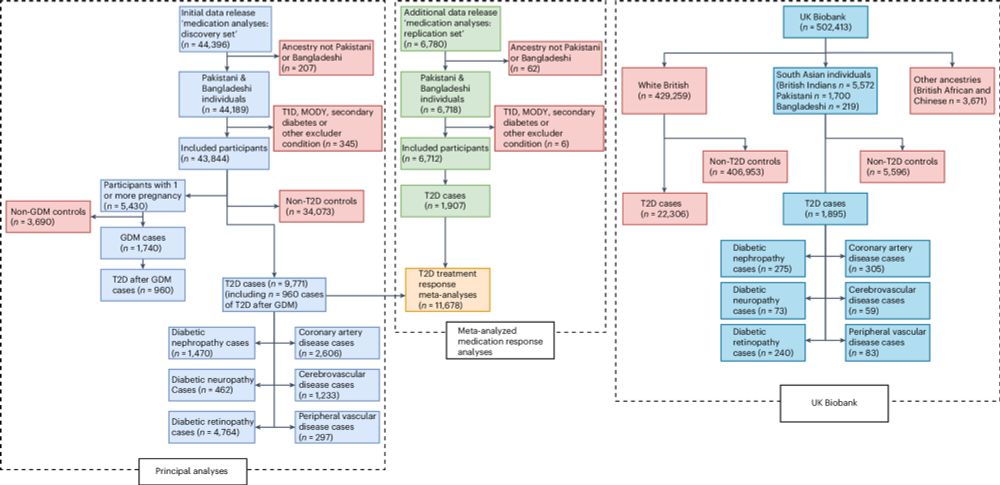
Genetic basis of early onset and progression of type 2 diabetes in South Asians
Nature Medicine - In a cohort of 50,556 South Asian individuals, partitioned polygenic scores helped identify genetic susceptibility to insulin deficiency and unfavorable fat distribution as key...
rdcu.be
November 26, 2024 at 5:52 PM
It’s a big day for @genesandhealth.bsky.social @samcbhodgson.bsky.social @moneeza-ks.bsky.social Genes & Health, with @ Sam Hodgson, Moneeza Kalhan Siddiqui and I, as we publish our paper rdcu.be/d1vj0 on the genetic basis of #type2diabetes & #gestationaldiabetes (#T2D and #GDM) in south Asians. A🧵
Reposted by huanwei.bsky.social

Great to see (COI: I am a longstanding consultant and shareholder in @nanoporetech.com) - this will give comprehensive methylC + hydroxymethylC in a long haplotype context (...and excellent SV resolution as well!) for these super-well studied humans. First 50K, then I hope 500K!

We are proud to announce a collaboration with UK Biobank to create the world’s first large-scale #epigenetic dataset of 50k participants. The dataset will unlock crucial insights into how #epigenetics drives disease & the breakthroughs to treat them.
Read more: nanoporetech.com/news/oxford-...
Read more: nanoporetech.com/news/oxford-...

November 27, 2024 at 5:44 PM
Great to see (COI: I am a longstanding consultant and shareholder in @nanoporetech.com) - this will give comprehensive methylC + hydroxymethylC in a long haplotype context (...and excellent SV resolution as well!) for these super-well studied humans. First 50K, then I hope 500K!