




GW Gant Luxton
@gwgl.bsky.social
I’m Gant. My lab studies how the structure of cells affects disease progression. Allen Distinguished Investigator in Molecular and Celular Biology at @UCDavis.
https://luxton.faculty.ucdavis.edu
https://luxton.faculty.ucdavis.edu
Lamin mutations → disrupted nucleolus → fewer ribosomes → altered cytoplasmic crowding → cellular chaos
We call this the "nucleolar-ribosomal axis" and it explains the widespread cellular defects in EDMD. (4/6)
We call this the "nucleolar-ribosomal axis" and it explains the widespread cellular defects in EDMD. (4/6)

September 23, 2025 at 6:26 PM
Lamin mutations → disrupted nucleolus → fewer ribosomes → altered cytoplasmic crowding → cellular chaos
We call this the "nucleolar-ribosomal axis" and it explains the widespread cellular defects in EDMD. (4/6)
We call this the "nucleolar-ribosomal axis" and it explains the widespread cellular defects in EDMD. (4/6)
Using nanoparticle tracking in living C. elegans, we discovered that lamin mutations do not just break nuclear mechanics, they trigger a cascade that reorganizes the entire cytoplasm. (3/6)

September 23, 2025 at 6:26 PM
Using nanoparticle tracking in living C. elegans, we discovered that lamin mutations do not just break nuclear mechanics, they trigger a cascade that reorganizes the entire cytoplasm. (3/6)
Congratulations to Dr. Gümüşderelioğlum from the Starr-Luxton Lab @ucdavis.bsky.social! 🎓 Fresh off her recent PhD defense, she gave an excellent talk this morning at the Cell Biology session of #Worm2025 on UNC-83 molecular switches in nuclear migration. So proud! 👏 #NewPhD #CellBiology

June 30, 2025 at 4:10 PM
Congratulations to Dr. Gümüşderelioğlum from the Starr-Luxton Lab @ucdavis.bsky.social! 🎓 Fresh off her recent PhD defense, she gave an excellent talk this morning at the Cell Biology session of #Worm2025 on UNC-83 molecular switches in nuclear migration. So proud! 👏 #NewPhD #CellBiology
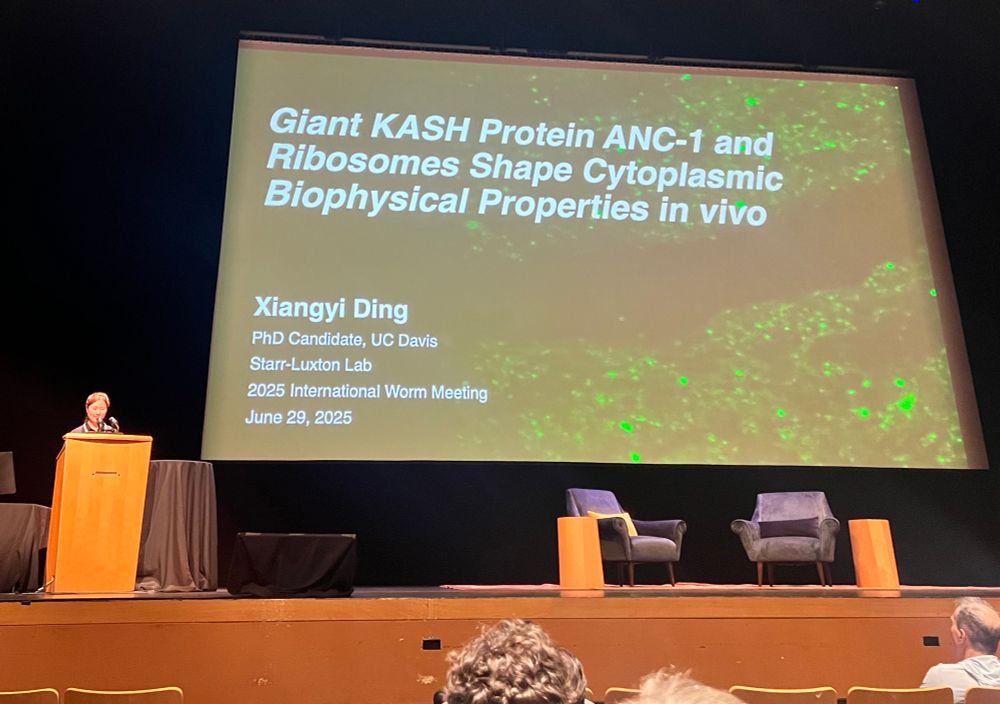
Incredible plenary presentation by Starr-Luxton Lab student @xiangyiding.bsky.social at the International Worm Meeting! Who knew C. elegans cytoplasm has the viscosity of strawberry jam? 🍓 So proud! #Worm2025 #frontierscience @danstarrucdavis.bsky.social
June 30, 2025 at 6:10 AM
Incredible plenary presentation by Starr-Luxton Lab student @xiangyiding.bsky.social at the International Worm Meeting! Who knew C. elegans cytoplasm has the viscosity of strawberry jam? 🍓 So proud! #Worm2025 #frontierscience @danstarrucdavis.bsky.social
7/8: The big takeaway: Heterochromatin anchored to the nuclear periphery mechanically supports nuclei squeezing through tight spaces, independent of gene expression. It works in parallel with other pathways to ensure successful migration.

May 9, 2025 at 6:55 PM
7/8: The big takeaway: Heterochromatin anchored to the nuclear periphery mechanically supports nuclei squeezing through tight spaces, independent of gene expression. It works in parallel with other pathways to ensure successful migration.
6/8: To further prove our point, we used a non-phosphorylatable lamin variant (lmn-1 S8A) that creates a super stable nuclear lamina. This stabilization rescued migration defects in cec-4 + unc-84 mutants!

May 9, 2025 at 6:55 PM
6/8: To further prove our point, we used a non-phosphorylatable lamin variant (lmn-1 S8A) that creates a super stable nuclear lamina. This stabilization rescued migration defects in cec-4 + unc-84 mutants!
5/8: We found that the enzyme MET-2 (which creates H3K9-methylated heterochromatin) and its demethylase counterpart JMJD-1.2 are crucial. This suggests a "sweet spot" of heterochromatin is needed - too much or too little disrupts migration!

May 9, 2025 at 6:55 PM
5/8: We found that the enzyme MET-2 (which creates H3K9-methylated heterochromatin) and its demethylase counterpart JMJD-1.2 are crucial. This suggests a "sweet spot" of heterochromatin is needed - too much or too little disrupts migration!
4/8: Our discovery: a 4th pathway involving heterochromatin anchored to the inner nuclear membrane via CEC-4! When we removed CEC-4 + the LINC complex (UNC-84), nuclei got stuck, cells died, and animals developed fewer neurons.

May 9, 2025 at 6:55 PM
4/8: Our discovery: a 4th pathway involving heterochromatin anchored to the inner nuclear membrane via CEC-4! When we removed CEC-4 + the LINC complex (UNC-84), nuclei got stuck, cells died, and animals developed fewer neurons.
3/8: We used C. elegans P-cells that naturally migrate through a super tight space (only ~200nm, ~5% of nuclear diameter!) during development. Previous work found 3 pathways that help, but disrupting all three still didn't stop all migration! 🤔

May 9, 2025 at 6:55 PM
3/8: We used C. elegans P-cells that naturally migrate through a super tight space (only ~200nm, ~5% of nuclear diameter!) during development. Previous work found 3 pathways that help, but disrupting all three still didn't stop all migration! 🤔
2/8: During development, cells often need to migrate through tight spaces. The nucleus is typically the largest and stiffest organelle, making it the rate-limiting factor. How do nuclei manage this challenging journey? 🔍 pbs.twimg.com/media/Gqh0FP...

May 9, 2025 at 6:55 PM
2/8: During development, cells often need to migrate through tight spaces. The nucleus is typically the largest and stiffest organelle, making it the rate-limiting factor. How do nuclei manage this challenging journey? 🔍 pbs.twimg.com/media/Gqh0FP...
This reveals how cells use alternative protein isoforms for bidirectional transport. By expressing different UNC-83 versions at specific developmental stages, cells precisely control nuclear positioning.

March 7, 2025 at 11:02 PM
This reveals how cells use alternative protein isoforms for bidirectional transport. By expressing different UNC-83 versions at specific developmental stages, cells precisely control nuclear positioning.
Key finding: spectrin-like repeats in the N-terminal domain are crucial. Deleting these regions disrupts dynein-mediated nuclear migration in larval P-cells.

March 7, 2025 at 11:02 PM
Key finding: spectrin-like repeats in the N-terminal domain are crucial. Deleting these regions disrupts dynein-mediated nuclear migration in larval P-cells.
Our biochemical assays revealed the N-terminal domain of long UNC-83 isoforms directly inhibits kinesin-1 motor activity - dramatically slowing microtubule movement in vitro.
March 7, 2025 at 11:02 PM
Our biochemical assays revealed the N-terminal domain of long UNC-83 isoforms directly inhibits kinesin-1 motor activity - dramatically slowing microtubule movement in vitro.
We proved this by swapping isoforms between developmental stages. When we expressed the long UNC-83a in embryos (where short isoforms normally work), nuclei couldn't move properly!

March 7, 2025 at 11:02 PM
We proved this by swapping isoforms between developmental stages. When we expressed the long UNC-83a in embryos (where short isoforms normally work), nuclei couldn't move properly!
How? Longer UNC-83 isoforms have extra segments that INHIBIT kinesin-1 motor proteins while allowing dynein to work. This creates precise directional control at different developmental stages!

March 7, 2025 at 11:02 PM
How? Longer UNC-83 isoforms have extra segments that INHIBIT kinesin-1 motor proteins while allowing dynein to work. This creates precise directional control at different developmental stages!
We found protein UNC-83 has different "versions" that act as directional switches. In embryos, short isoforms drive movement one way, while in larvae, longer isoforms reverse direction. Like switching between forward and reverse gears!

March 7, 2025 at 11:02 PM
We found protein UNC-83 has different "versions" that act as directional switches. In embryos, short isoforms drive movement one way, while in larvae, longer isoforms reverse direction. Like switching between forward and reverse gears!
The nucleus is the largest organelle - like moving a refrigerator through your house! How do cells control which direction to move it during development? Our study reveals this molecular control mechanism!

March 7, 2025 at 11:02 PM
The nucleus is the largest organelle - like moving a refrigerator through your house! How do cells control which direction to move it during development? Our study reveals this molecular control mechanism!
But Nesprin-2G doesn't work alone. We found it needs help from another protein called MAP7D3 to activate the molecular motors. This creates a precisely controlled system for moving cellular structures.

February 21, 2025 at 8:35 PM
But Nesprin-2G doesn't work alone. We found it needs help from another protein called MAP7D3 to activate the molecular motors. This creates a precisely controlled system for moving cellular structures.
Using advanced microscopy, we watched this process in real time. Nesprin-2G grabs onto actin structures and then connects to molecular motor proteins that 'walk' along microtubules, effectively creating a cellular transport system.
February 21, 2025 at 8:35 PM
Using advanced microscopy, we watched this process in real time. Nesprin-2G grabs onto actin structures and then connects to molecular motor proteins that 'walk' along microtubules, effectively creating a cellular transport system.
We discovered that a protein called Nesprin-2G actively links these systems together. It's like a molecular adapter that allows cells to move actin structures along microtubule highways - enabling precisely coordinated cellular reorganization.

February 21, 2025 at 8:35 PM
We discovered that a protein called Nesprin-2G actively links these systems together. It's like a molecular adapter that allows cells to move actin structures along microtubule highways - enabling precisely coordinated cellular reorganization.
Think of cells as tiny cities. Just as cities need roads and support structures, cells have molecular scaffolding - protein networks that provide structure and serve as transport highways. The two main systems are actin filaments and microtubules.
Image
Image

February 21, 2025 at 8:35 PM
Think of cells as tiny cities. Just as cities need roads and support structures, cells have molecular scaffolding - protein networks that provide structure and serve as transport highways. The two main systems are actin filaments and microtubules.
Image
Image
In our lab (with @danielstarr.bsky.social), we study how the physical properties of cells influence their function.
This preprint is just the start--our future work explores how tissues maintain this balance during development and when responding to challenges.
This preprint is just the start--our future work explores how tissues maintain this balance during development and when responding to challenges.
January 13, 2025 at 1:25 AM
In our lab (with @danielstarr.bsky.social), we study how the physical properties of cells influence their function.
This preprint is just the start--our future work explores how tissues maintain this balance during development and when responding to challenges.
This preprint is just the start--our future work explores how tissues maintain this balance during development and when responding to challenges.
These findings reveal how cells balance two forces—crowding and structure—to create environments where life can thrive.
This balance allows tissues to function, adapt to stress, and may even help us understand how diseases like cancer disrupt cellular order.
This balance allows tissues to function, adapt to stress, and may even help us understand how diseases like cancer disrupt cellular order.
January 13, 2025 at 1:25 AM
These findings reveal how cells balance two forces—crowding and structure—to create environments where life can thrive.
This balance allows tissues to function, adapt to stress, and may even help us understand how diseases like cancer disrupt cellular order.
This balance allows tissues to function, adapt to stress, and may even help us understand how diseases like cancer disrupt cellular order.
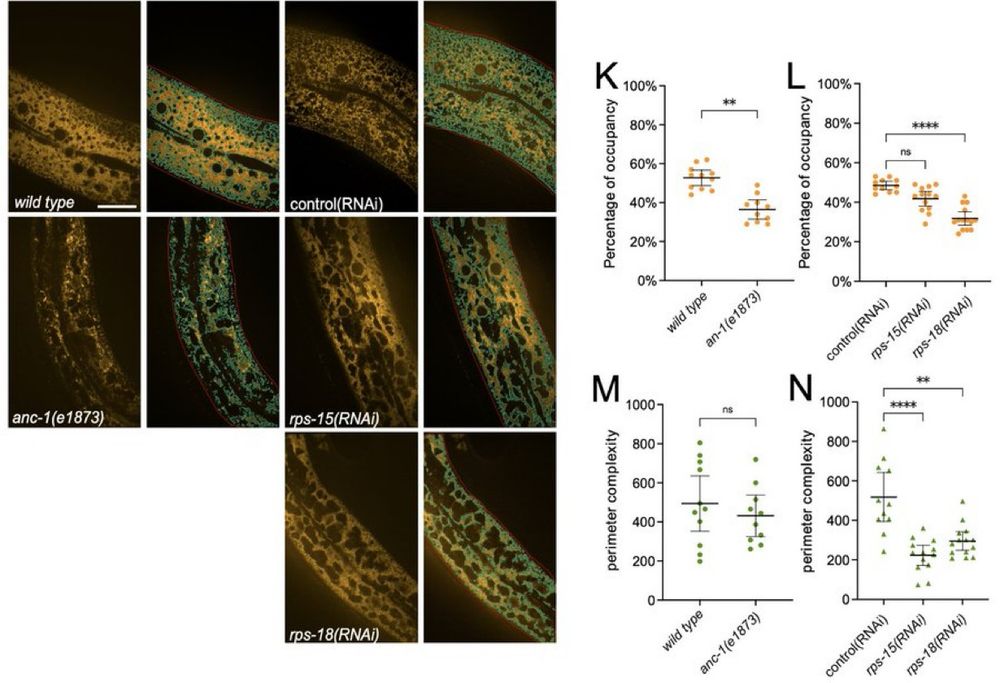
When we disrupted ANC-1, large molecules could move freely, but smaller ones weren’t affected.
Ribosome depletion made the cytoplasm less crowded overall.
When both were disrupted, molecular movement increased dramatically.
This shows how these systems work together.
Ribosome depletion made the cytoplasm less crowded overall.
When both were disrupted, molecular movement increased dramatically.
This shows how these systems work together.

January 13, 2025 at 1:25 AM
When we disrupted ANC-1, large molecules could move freely, but smaller ones weren’t affected.
Ribosome depletion made the cytoplasm less crowded overall.
When both were disrupted, molecular movement increased dramatically.
This shows how these systems work together.
Ribosome depletion made the cytoplasm less crowded overall.
When both were disrupted, molecular movement increased dramatically.
This shows how these systems work together.
The reasons for this surprised us.
Ribosomes, best known as the cell's protein factories, also contribute to the crowded environment inside cells.
A giant protein called ANC-1 interacts with the endoplasmic reticulum (ER) to act as scaffolding, imposing structural constraints.
Ribosomes, best known as the cell's protein factories, also contribute to the crowded environment inside cells.
A giant protein called ANC-1 interacts with the endoplasmic reticulum (ER) to act as scaffolding, imposing structural constraints.

January 13, 2025 at 1:25 AM
The reasons for this surprised us.
Ribosomes, best known as the cell's protein factories, also contribute to the crowded environment inside cells.
A giant protein called ANC-1 interacts with the endoplasmic reticulum (ER) to act as scaffolding, imposing structural constraints.
Ribosomes, best known as the cell's protein factories, also contribute to the crowded environment inside cells.
A giant protein called ANC-1 interacts with the endoplasmic reticulum (ER) to act as scaffolding, imposing structural constraints.