



Federica Mantica
@fedemantica.bsky.social
Reposted by Federica Mantica

Excited to share the final version of our study on Nematostella cell type regulatory programs. Part of our @erc.europa.eu StG project, this was a challenging 5-year effort extraodinarily led by @aelek.bsky.social and @martaig.bsky.social.
www.nature.com/articles/s41...
www.nature.com/articles/s41...

Decoding cnidarian cell type gene regulation - Nature Ecology & Evolution
This study reconstructs the gene regulatory networks that define cell types in the sea anemone Nematostella vectensis, providing a valuable resource for comparative regulatory genomics and the evoluti...
www.nature.com
December 22, 2025 at 10:12 AM
Excited to share the final version of our study on Nematostella cell type regulatory programs. Part of our @erc.europa.eu StG project, this was a challenging 5-year effort extraodinarily led by @aelek.bsky.social and @martaig.bsky.social.
www.nature.com/articles/s41...
www.nature.com/articles/s41...
Reposted by Federica Mantica
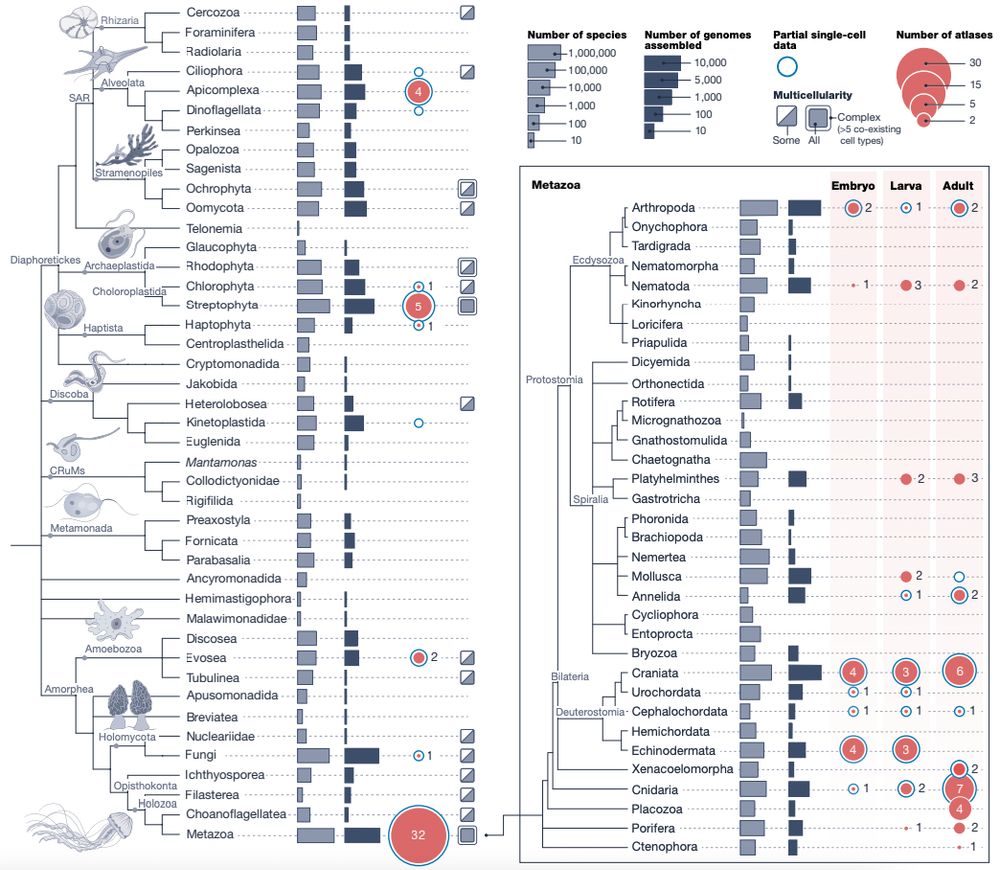
Happy to share the Biodiversity Cell Atlas white paper, out today in @nature.com. We look at the possibilities, challenges, and potential impacts of molecularly mapping cells across the tree of life.
www.nature.com/articles/s41...
www.nature.com/articles/s41...
September 24, 2025 at 3:12 PM
Happy to share the Biodiversity Cell Atlas white paper, out today in @nature.com. We look at the possibilities, challenges, and potential impacts of molecularly mapping cells across the tree of life.
www.nature.com/articles/s41...
www.nature.com/articles/s41...
Reposted by Federica Mantica
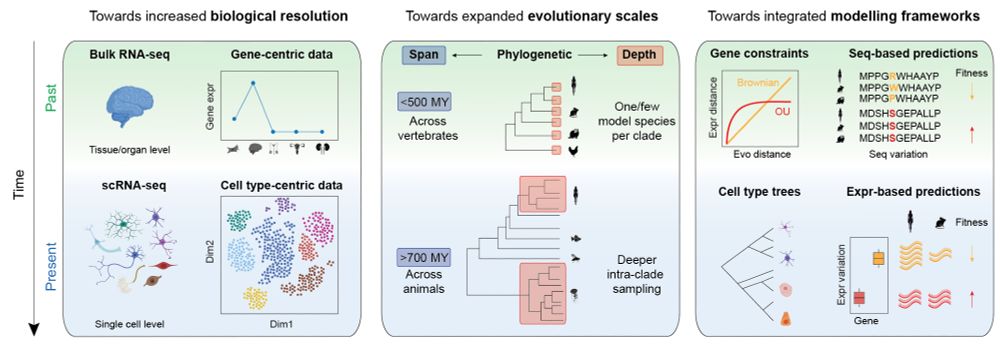
🧬🧬🧬 New review from the lab:
Evolution of comparative transcriptomics: biological scales, phylogenetic spans, and modeling frameworks
authors.elsevier.com/sd/article/S...
By @mattezambon.bsky.social & @fedemantica.bsky.social, together with @jonnyfrazer.bsky.social & Mafalda Dias.
Evolution of comparative transcriptomics: biological scales, phylogenetic spans, and modeling frameworks
authors.elsevier.com/sd/article/S...
By @mattezambon.bsky.social & @fedemantica.bsky.social, together with @jonnyfrazer.bsky.social & Mafalda Dias.
August 6, 2025 at 9:16 AM
🧬🧬🧬 New review from the lab:
Evolution of comparative transcriptomics: biological scales, phylogenetic spans, and modeling frameworks
authors.elsevier.com/sd/article/S...
By @mattezambon.bsky.social & @fedemantica.bsky.social, together with @jonnyfrazer.bsky.social & Mafalda Dias.
Evolution of comparative transcriptomics: biological scales, phylogenetic spans, and modeling frameworks
authors.elsevier.com/sd/article/S...
By @mattezambon.bsky.social & @fedemantica.bsky.social, together with @jonnyfrazer.bsky.social & Mafalda Dias.
Reposted by Federica Mantica
🐠 New pre-print from the lab! 🐠
Neural microexons fine-tune protein function - but how do they impact arousal states and underlying neuronal signaling pathways?
www.biorxiv.org/content/10.1...
Check out our latest pre-print by @tahneema.bsky.social et al, @upf.edu @crg.eu. 🧵👇 1/9
Neural microexons fine-tune protein function - but how do they impact arousal states and underlying neuronal signaling pathways?
www.biorxiv.org/content/10.1...
Check out our latest pre-print by @tahneema.bsky.social et al, @upf.edu @crg.eu. 🧵👇 1/9

Neural microexons modulate arousal states via cAMP signalling in zebrafish
Arousal states, often dysregulated in neurodevelopmental disorders, shape how organisms perceive and respond to their environment. Here, we show that srrm3, a master regulator of neural microexons, is...
www.biorxiv.org
April 28, 2025 at 9:24 AM
🐠 New pre-print from the lab! 🐠
Neural microexons fine-tune protein function - but how do they impact arousal states and underlying neuronal signaling pathways?
www.biorxiv.org/content/10.1...
Check out our latest pre-print by @tahneema.bsky.social et al, @upf.edu @crg.eu. 🧵👇 1/9
Neural microexons fine-tune protein function - but how do they impact arousal states and underlying neuronal signaling pathways?
www.biorxiv.org/content/10.1...
Check out our latest pre-print by @tahneema.bsky.social et al, @upf.edu @crg.eu. 🧵👇 1/9
Reposted by Federica Mantica

Israel Campo Bes, estudiant de doctorat de Biomedicina, guanya el primer premi del #Rin4Min 2025 amb la seva explicació en quatre minuts de "¿Cuándo los animales nos independizamos molecularmente de nuestras madres?"

May 8, 2025 at 3:50 PM
Israel Campo Bes, estudiant de doctorat de Biomedicina, guanya el primer premi del #Rin4Min 2025 amb la seva explicació en quatre minuts de "¿Cuándo los animales nos independizamos molecularmente de nuestras madres?"
Reposted by Federica Mantica
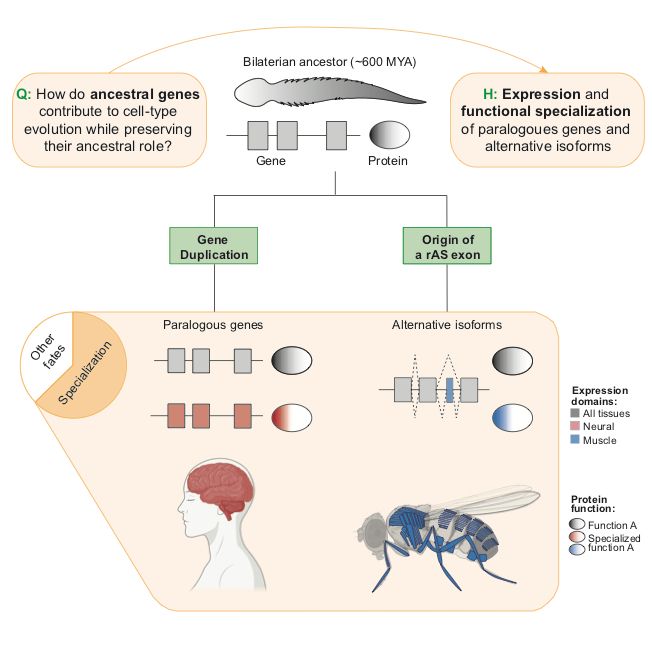
"The main fates after gene duplication are gene loss, redundancy, subfunctionalization and neofunctionalization".
In our new review, @fedemantica.bsky.social and I argue we are missing the most prevalent one: specialization. And the same applies to alternative splicing! 1/7
tinyurl.com/45k7kbmp
In our new review, @fedemantica.bsky.social and I argue we are missing the most prevalent one: specialization. And the same applies to alternative splicing! 1/7
tinyurl.com/45k7kbmp
March 18, 2025 at 1:53 PM
"The main fates after gene duplication are gene loss, redundancy, subfunctionalization and neofunctionalization".
In our new review, @fedemantica.bsky.social and I argue we are missing the most prevalent one: specialization. And the same applies to alternative splicing! 1/7
tinyurl.com/45k7kbmp
In our new review, @fedemantica.bsky.social and I argue we are missing the most prevalent one: specialization. And the same applies to alternative splicing! 1/7
tinyurl.com/45k7kbmp