



Flavio Durón
@fduron.bsky.social
PhD student (National Polytechnic Institute Mexico). Management Studies - Infrastructure Projects - Complex Systems.
Reposted by Flavio Durón
Reposted by Flavio Durón

EPJ B Topical Issue - Recent Advances in Complex Systems
EPJ B Topical Issue - Recent Advances in Complex Systems
Guest Editors: Thiago B. Murari, Marcelo A. Moret, Hernane B. de B. Pereira, Tarcísio M. Rocha Filho, José F. F. Mendes, Tiziana Di Matteo
Inspired by the Conference on Complex Systems 2023 (CCS2023) in Salvador, Brazil, this collection of EPJ B brings together 25 peer-reviewed articles covering a wide range of topics.
This collection highlights the interdisciplinary nature of the field, with contributions from physics, biology, economics, linguistics, and artificial intelligence, and serves as a reference for researchers addressing real-world challenges through systems-based thinking.
Read the full issue at: epjb.epj.org
sco.lt
December 6, 2025 at 10:27 PM
EPJ B Topical Issue - Recent Advances in Complex Systems
Reposted by Flavio Durón

ALIFE 2025's proceedings are officially published (open-access) on the MIT Press's website!
direct.mit.edu/isal/isal202...
direct.mit.edu/isal/isal202...
Volumes | ALIFE 2022: The 2022 Conference on Artificial Life | MIT Press
ALIFE 2025: Ciphers of Life: Proceedings of the Artificial Life Conference 2025 | October 2025 | Kyoto, Japan
direct.mit.edu
November 24, 2025 at 8:07 PM
ALIFE 2025's proceedings are officially published (open-access) on the MIT Press's website!
direct.mit.edu/isal/isal202...
direct.mit.edu/isal/isal202...
Reposted by Flavio Durón
It took 8 months to write up this short piece
"Updating the Complex Systems Keyword Diagram Using Collective Feedback and Latest Literature Data"
arxiv.org/abs/2509.11997
"Updating the Complex Systems Keyword Diagram Using Collective Feedback and Latest Literature Data"
arxiv.org/abs/2509.11997

Updating the Complex Systems Keyword Diagram Using Collective Feedback and Latest Literature Data
The complex systems keyword diagram generated by the author in 2010 has been used widely in a variety of educational and outreach purposes, but it definitely needs a major update and reorganization. T...
arxiv.org
September 16, 2025 at 11:21 AM
It took 8 months to write up this short piece
"Updating the Complex Systems Keyword Diagram Using Collective Feedback and Latest Literature Data"
arxiv.org/abs/2509.11997
"Updating the Complex Systems Keyword Diagram Using Collective Feedback and Latest Literature Data"
arxiv.org/abs/2509.11997
Reposted by Flavio Durón
📝 Told your writing is “too descriptive”? I got this feedback when I was a chemical engineer moving to economics of technical change.
I developed the GReDAI framework to help you write more analytically from Description to Analysis to Interpretation.
www.raulpacheco.org/2025/07/a-gu...
#RPVSky
I developed the GReDAI framework to help you write more analytically from Description to Analysis to Interpretation.
www.raulpacheco.org/2025/07/a-gu...
#RPVSky
A guiding framework to help learners write more analytically by focusing on the Description, Analysis and Interpretation stages of the research process (GReDAI)
Three of my PhD students are nearing completion of their final doctoral dissertation drafts, and
www.raulpacheco.org
September 15, 2025 at 4:17 PM
📝 Told your writing is “too descriptive”? I got this feedback when I was a chemical engineer moving to economics of technical change.
I developed the GReDAI framework to help you write more analytically from Description to Analysis to Interpretation.
www.raulpacheco.org/2025/07/a-gu...
#RPVSky
I developed the GReDAI framework to help you write more analytically from Description to Analysis to Interpretation.
www.raulpacheco.org/2025/07/a-gu...
#RPVSky
Reposted by Flavio Durón
🎯 Positioning your work starts by charting the conflicts that shape your field.
In this post, I show you how to map debates in the literature → www.raulpacheco.org/2025/09/how-...
#RPVSky
In this post, I show you how to map debates in the literature → www.raulpacheco.org/2025/09/how-...
#RPVSky
How to map out debates in the scholarly literature
I remember a few years ago when I wrote a paper on debates around water
www.raulpacheco.org
September 15, 2025 at 3:10 PM
🎯 Positioning your work starts by charting the conflicts that shape your field.
In this post, I show you how to map debates in the literature → www.raulpacheco.org/2025/09/how-...
#RPVSky
In this post, I show you how to map debates in the literature → www.raulpacheco.org/2025/09/how-...
#RPVSky
Reposted by Flavio Durón
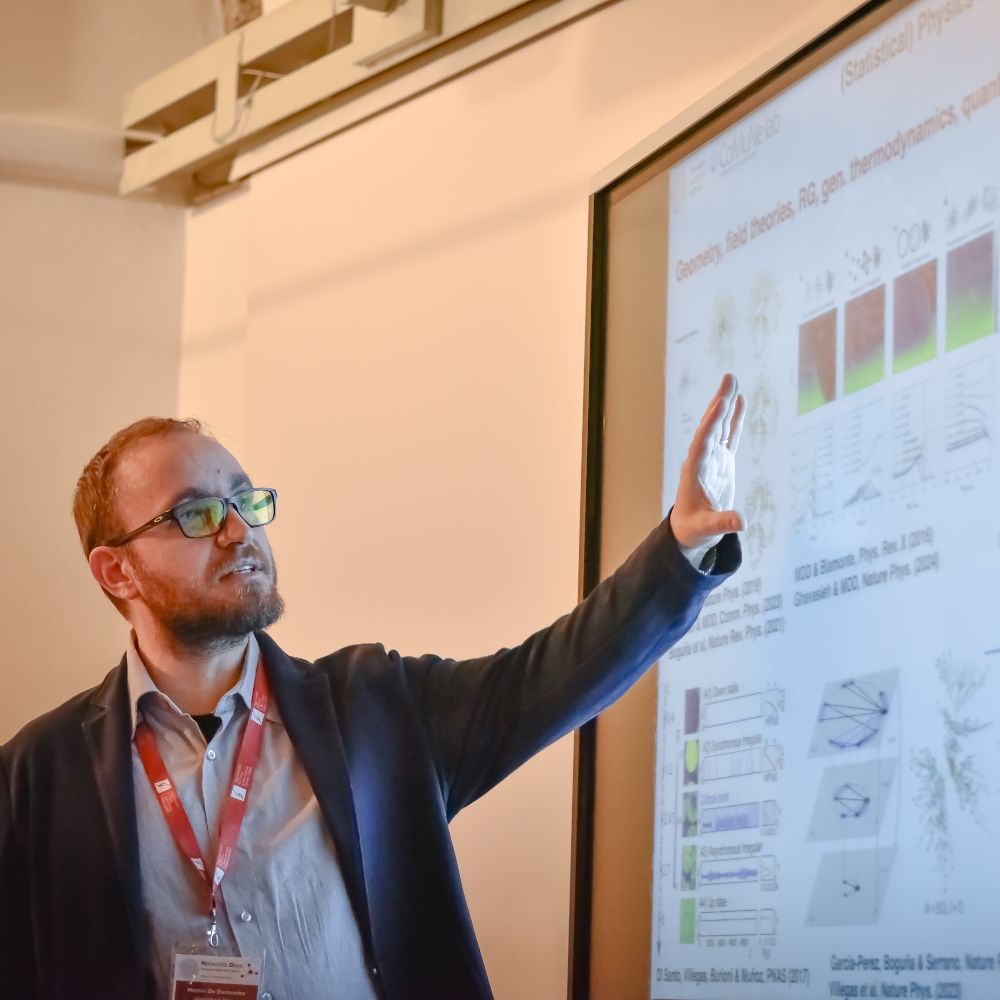
Predictions feel safe. But 8m into 2025, some of The Economist’s most confident forecasts are already wobbling.
Why? Because the world is not linear. It’s a tangled web of feedback loops, emergent patterns & path dependencies.
#Complexity isn’t optional.
manlius.substack.com/p/the-past-t...
Why? Because the world is not linear. It’s a tangled web of feedback loops, emergent patterns & path dependencies.
#Complexity isn’t optional.
manlius.substack.com/p/the-past-t...

The paths and loops we miss: complexity lessons from The World Ahead 2025
AI, trade wars and energy shifts aren’t separate stories
manlius.substack.com
September 5, 2025 at 4:13 PM
Predictions feel safe. But 8m into 2025, some of The Economist’s most confident forecasts are already wobbling.
Why? Because the world is not linear. It’s a tangled web of feedback loops, emergent patterns & path dependencies.
#Complexity isn’t optional.
manlius.substack.com/p/the-past-t...
Why? Because the world is not linear. It’s a tangled web of feedback loops, emergent patterns & path dependencies.
#Complexity isn’t optional.
manlius.substack.com/p/the-past-t...
Reposted by Flavio Durón

Life never stops inventing. Can we measure that creativity?🌱
At #CCS2025 (> 18:30) I'll present a general metric for "novelty" in discrete discrete dynamical systems. Swing by my poster if you're interested in Boolean networks, non-classical logics, and/or open-ended evolution!
At #CCS2025 (> 18:30) I'll present a general metric for "novelty" in discrete discrete dynamical systems. Swing by my poster if you're interested in Boolean networks, non-classical logics, and/or open-ended evolution!

September 1, 2025 at 4:21 PM
Life never stops inventing. Can we measure that creativity?🌱
At #CCS2025 (> 18:30) I'll present a general metric for "novelty" in discrete discrete dynamical systems. Swing by my poster if you're interested in Boolean networks, non-classical logics, and/or open-ended evolution!
At #CCS2025 (> 18:30) I'll present a general metric for "novelty" in discrete discrete dynamical systems. Swing by my poster if you're interested in Boolean networks, non-classical logics, and/or open-ended evolution!
Reposted by Flavio Durón
A Formal Definition of Scale-Dependent Complexity and the Multi-Scale Law of Requisite Variety
A Formal Definition of Scale-Dependent Complexity and the Multi-Scale Law of Requisite Variety
Alexander F. Siegenfeld and Yaneer Bar-Yam
Entropy 2025, 27(8), 835
Ashby’s law of requisite variety allows a comparison of systems with their environments, providing a necessary (but not sufficient) condition for system efficacy: A system must possess at least as much complexity as any set of environmental behaviors that require distinct responses from the system. However, to account for the dependence of a system’s complexity on the level of detail—or scale—of its description, a multi-scale generalization of Ashby’s law is needed. We define a class of complexity profiles (complexity as a function of scale) that is the first, to our knowledge, to exhibit a multi-scale law of requisite variety. This formalism provides a characterization of multi-scale complexity and generalizes the law of requisite variety’s single constraint on system behaviors to a class of multi-scale constraints. We show that these complexity profiles satisfy a sum rule, which reflects a tradeoff between smaller- and larger-scale degrees of freedom, and we extend our results to subdivided systems and systems with a continuum of components.
Read the full article at: www.mdpi.com
sco.lt
August 31, 2025 at 8:13 PM
A Formal Definition of Scale-Dependent Complexity and the Multi-Scale Law of Requisite Variety
Reposted by Flavio Durón

SFI President David Krakauer joins StarTalk with Neil deGrasse Tyson to discuss emergence and the scientific frameworks that help us search for order in the complexity of evolving worlds.
Watch the full interview: https://youtu.be/wGhRW-pJWIc?si=d_cFoKVA-Af9foBy
Watch the full interview: https://youtu.be/wGhRW-pJWIc?si=d_cFoKVA-Af9foBy

August 22, 2025 at 8:01 PM
SFI President David Krakauer joins StarTalk with Neil deGrasse Tyson to discuss emergence and the scientific frameworks that help us search for order in the complexity of evolving worlds.
Watch the full interview: https://youtu.be/wGhRW-pJWIc?si=d_cFoKVA-Af9foBy
Watch the full interview: https://youtu.be/wGhRW-pJWIc?si=d_cFoKVA-Af9foBy
Reposted by Flavio Durón
The Roman road network was one of the greatest feats of ancient engineering, with over 400,000 km (yes!) of roads connecting an empire.
Here I fused historical data with modern cities to show how Roman infrastructure still echoes in today’s Europe.
#ComplexSystems #ComplexNetworks #History 🧪
Here I fused historical data with modern cities to show how Roman infrastructure still echoes in today’s Europe.
#ComplexSystems #ComplexNetworks #History 🧪

August 22, 2025 at 8:48 AM
The Roman road network was one of the greatest feats of ancient engineering, with over 400,000 km (yes!) of roads connecting an empire.
Here I fused historical data with modern cities to show how Roman infrastructure still echoes in today’s Europe.
#ComplexSystems #ComplexNetworks #History 🧪
Here I fused historical data with modern cities to show how Roman infrastructure still echoes in today’s Europe.
#ComplexSystems #ComplexNetworks #History 🧪
Reposted by Flavio Durón

What is emergence? This is one of the most central ingredients of complexity, and a challenging one to formalize. Here's a paper by @seanmcarroll.bsky.social & Achyth Parola that attempts to classify different forms of emergence. @manlius.bsky.social @sfiscience.bsky.social arxiv.org/pdf/2410.15468

August 17, 2025 at 3:50 PM
What is emergence? This is one of the most central ingredients of complexity, and a challenging one to formalize. Here's a paper by @seanmcarroll.bsky.social & Achyth Parola that attempts to classify different forms of emergence. @manlius.bsky.social @sfiscience.bsky.social arxiv.org/pdf/2410.15468
Reposted by Flavio Durón
Carlos Gershenson - Balance: A Narrative for Complexity

Carlos Gershenson - Balance: A Narrative for Complexity
https://www.youtube.com/watch?v=Bp5aDgw9cOcWe welcome Carlos Gershenson to The Complexity Lounge. Carlos will propose that one of the main goals of science—the search for regularities in nature—points toward the concept of balance. He will discuss how complexity, evolution, criticality, and antifragility can be seen as resulting from different types of balance. The session will review specific mechanisms that promote balance, such as adaptation and self-organization, and conclude by exploring the philosophical implications of a worldview grounded in its scientific study.
Watc at: www.youtube.com
sco.lt
August 14, 2025 at 11:26 AM
Carlos Gershenson - Balance: A Narrative for Complexity
Reposted by Flavio Durón
In an essay for The New Yorker, SFI External Professor Dan Rockmore reflects on how AI is becoming a creative partner in research — not just answering prompts, but offering them — placing it in the long tradition of tools, from writing to the printing press, that have reshaped human creativity.

What It’s Like to Brainstorm with a Bot
At the frontiers of knowledge, researchers are discovering that A.I. doesn’t just take prompts—it gives them, too, sparking new forms of creativity and collaboration.
newyorker.com
August 13, 2025 at 5:53 PM
In an essay for The New Yorker, SFI External Professor Dan Rockmore reflects on how AI is becoming a creative partner in research — not just answering prompts, but offering them — placing it in the long tradition of tools, from writing to the printing press, that have reshaped human creativity.
Reposted by Flavio Durón
The Threads of Complex Networks 2025 — TCN2025 September 16–19, 2025 Palazzo Strozzi, Florence (Italy)
The Threads of Complex Networks 2025 — TCN2025 September 16–19, 2025 Palazzo Strozzi, Florence (Italy)
The aim of the school is to present methodological, computational and machine learning methods for complex networks analysis, with applications spanning a wide range of fields.
The school will present a comprehensive view of the theoretical aspects of challenging topics in network theory, including higher order networks, diffusive models on networks, probabilistic and machine learning approaches, as well as computational methods. A wide range of applications will be explored during the lectures, including socio-economic and financial applications.
A Python tutorial held by lecturers/teaching assistants will follow the lecture to show the implementation of the methods studied during the theoretical class and the proposed application.
More at: tcn2025.wordpress.com
sco.lt
August 6, 2025 at 12:35 PM
The Threads of Complex Networks 2025 — TCN2025 September 16–19, 2025 Palazzo Strozzi, Florence (Italy)
Reposted by Flavio Durón

Chic@s, no pueden faltar a esta edición de Enredando (LANET school). Preparen todo y ahi nos vemos !

O ENREDANDO 2026, a Escola Ibero-americana de Redes e Sistemas Complexos (Escuela Iberoamericana de Redes y Sistemas Complejos) do LANET (@lanetconference.bsky.social) será em Viçosa, Minas Gerais, Brasil!
📅 27 a 31 de julho de 2026
Mais informações em enredando.giscbr.org
Organização: GISC/UFV
📅 27 a 31 de julho de 2026
Mais informações em enredando.giscbr.org
Organização: GISC/UFV

August 2, 2025 at 9:50 PM
Chic@s, no pueden faltar a esta edición de Enredando (LANET school). Preparen todo y ahi nos vemos !
Cost overruns workshop construction project pubs.aip.org/aip/acp/arti...
Cost overruns workshop construction project
Every construction project implementation requires good project management, which aims to avoid or minimize project risks that may occur, including the risk of
pubs.aip.org
July 31, 2025 at 6:51 PM
Cost overruns workshop construction project pubs.aip.org/aip/acp/arti...
Reposted by Flavio Durón
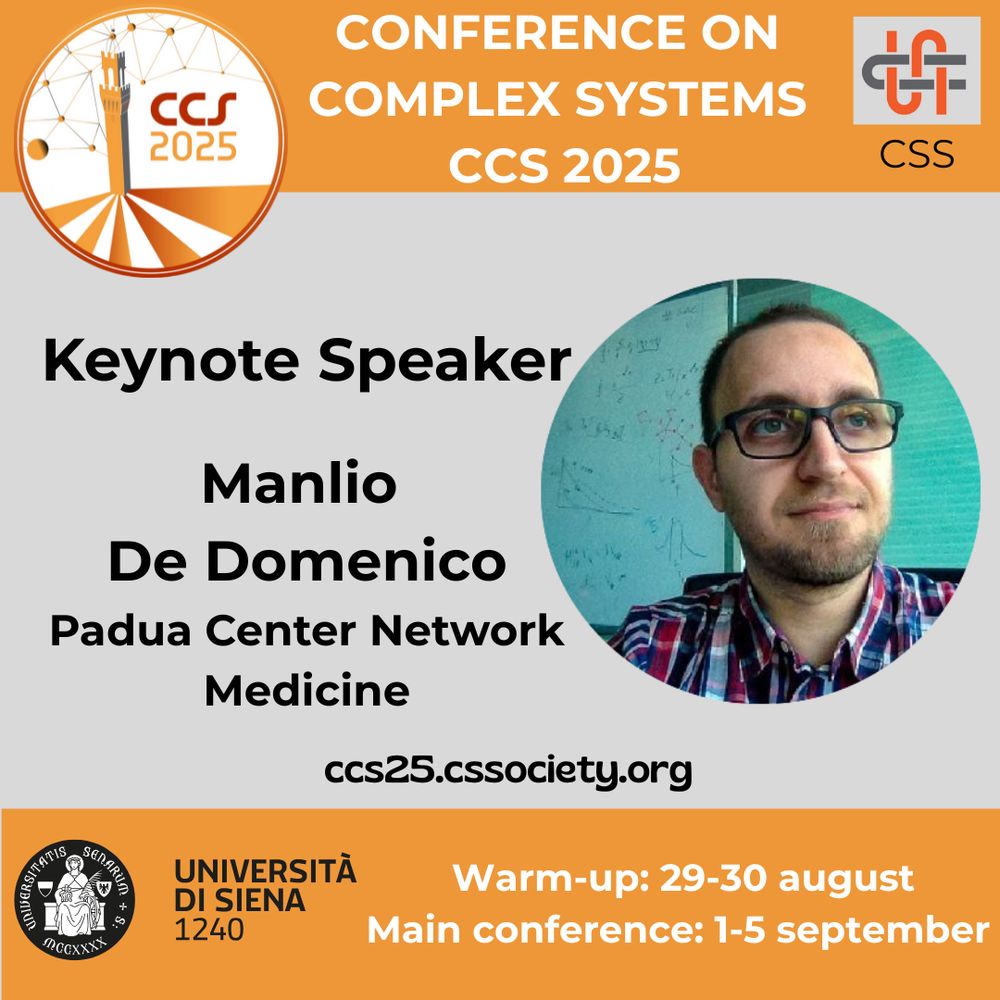
If you are curious about how to assess the emergence of network functionality in empirical systems and why modeling and first principles matter to study #ComplexSystems, let's meet at the #CCS2025 in Siena, 1st September 👇

July 28, 2025 at 7:21 AM
If you are curious about how to assess the emergence of network functionality in empirical systems and why modeling and first principles matter to study #ComplexSystems, let's meet at the #CCS2025 in Siena, 1st September 👇
Reposted by Flavio Durón
I finally had time to update PyCX to ver. 1.2! Many new models and bug fixes. Enjoy!!
github.com/hsayama/PyCX
github.com/hsayama/PyCX
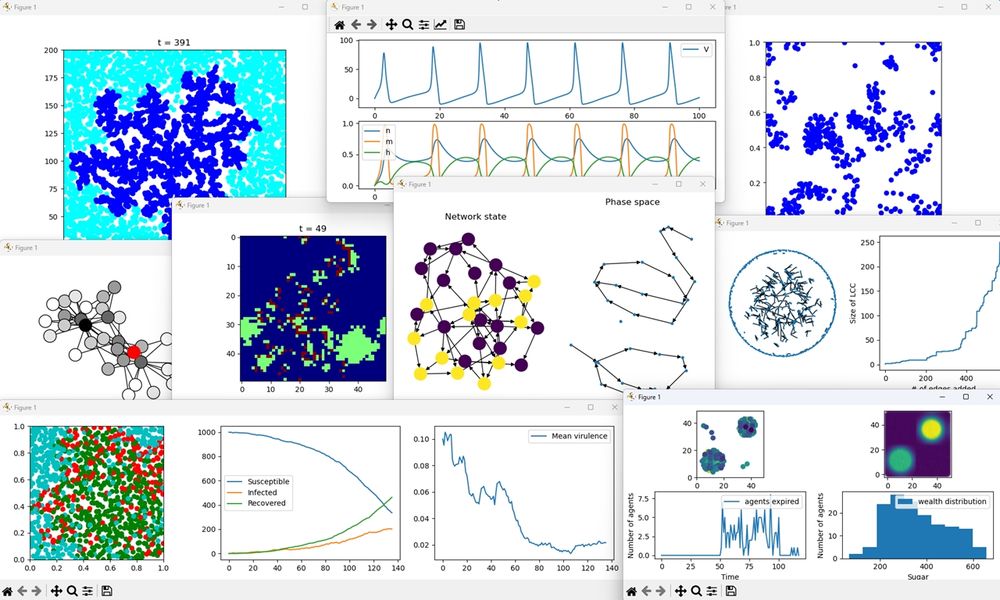
GitHub - hsayama/PyCX: PyCX is a Python-based sample code repository for complex systems research and education.
PyCX is a Python-based sample code repository for complex systems research and education. - hsayama/PyCX
github.com
July 25, 2025 at 4:15 PM
I finally had time to update PyCX to ver. 1.2! Many new models and bug fixes. Enjoy!!
github.com/hsayama/PyCX
github.com/hsayama/PyCX
Reposted by Flavio Durón
If you caught some of my summer‑conference sessions, you’ve already seen how the network density matrix and emergent latent geometry let us quantify a system's functionality.
While I finish an updated post, here's a concise #ComplexityThoughts refresher 👇
#NetworkScience #ComplexSystems
While I finish an updated post, here's a concise #ComplexityThoughts refresher 👇
#NetworkScience #ComplexSystems

Less is more, more is different and sparse is better: but why?
The answer can come from an unexpected connection with the statistical physics of quantum systems
manlius.substack.com
July 23, 2025 at 12:54 PM
If you caught some of my summer‑conference sessions, you’ve already seen how the network density matrix and emergent latent geometry let us quantify a system's functionality.
While I finish an updated post, here's a concise #ComplexityThoughts refresher 👇
#NetworkScience #ComplexSystems
While I finish an updated post, here's a concise #ComplexityThoughts refresher 👇
#NetworkScience #ComplexSystems
Reposted by Flavio Durón

My "Math, Revealed" series is freely available to anyone -- no paywall! -- in the thread below.
July 4, 2025 at 12:07 AM
My "Math, Revealed" series is freely available to anyone -- no paywall! -- in the thread below.
Reposted by Flavio Durón
Feedback. A podcast with Peter Erdi and Nicholas Golledge moderated by Carlos Gershenson.

Feedback. A podcast with Peter Erdi and Nicholas Golledge moderated by Carlos Gershenson.
Nick and Peter wrote a book with the same title (Feedback). They discuss the similarities and differences between the two books.
Feedback: How to Destroy and Save the World by Peter Erdi.
Feedback: Uncovering the Hidden Connections between Life and the Universe by Nicholas Golledge.
Watch/listen at: www.youtube.com
sco.lt
May 22, 2025 at 4:28 PM
Feedback. A podcast with Peter Erdi and Nicholas Golledge moderated by Carlos Gershenson.
Reposted by Flavio Durón
📅Save the date!
Join us next Monday (Mar 10th, 11 AM ET) for our next seminar by @emmafraxanet.bsky.social from Pompeu Fabra University, who will discuss polarization in online communities.
Don't miss out! ✨
Join us next Monday (Mar 10th, 11 AM ET) for our next seminar by @emmafraxanet.bsky.social from Pompeu Fabra University, who will discuss polarization in online communities.
Don't miss out! ✨

March 3, 2025 at 6:05 PM
📅Save the date!
Join us next Monday (Mar 10th, 11 AM ET) for our next seminar by @emmafraxanet.bsky.social from Pompeu Fabra University, who will discuss polarization in online communities.
Don't miss out! ✨
Join us next Monday (Mar 10th, 11 AM ET) for our next seminar by @emmafraxanet.bsky.social from Pompeu Fabra University, who will discuss polarization in online communities.
Don't miss out! ✨