




Ernesto Rodriguez
@ernestorcp.bsky.social
👨🔬🧪🔬
Playing to be a scientist.
#glycans #Immunology #glycotime
🇺🇾
Playing to be a scientist.
#glycans #Immunology #glycotime
🇺🇾
Reposted by Ernesto Rodriguez

Epic review on all things cell surface-ome, great resource for the community 🙏

Excited to share that our cell surface proteome review is now online on Chemical Reviews! 🥰 We highlight recent advances of techniques mapping cell surface protein expression, protein-protein interactions, extracellular PTMs and MHC complexes. @jimwellsucsf.bsky.social pubs.acs.org/doi/10.1021/...

Engineered Proteins and Chemical Tools to Probe the Cell Surface Proteome
The cell surface proteome, or surfaceome, is the hub for cells to interact and communicate with the outside world. Many disease-associated changes are hard-wired within the surfaceome, yet approved drugs target less than 50 cell surface proteins. In the past decade, the proteomics community has made significant strides in developing new technologies tailored for studying the surfaceome in all its complexity. In this review, we first dive into the unique characteristics and functions of the surfaceome, emphasizing the necessity for specialized labeling, enrichment, and proteomic approaches. An overview of surfaceomics methods is provided, detailing techniques to measure changes in protein expression and how this leads to novel target discovery. Next, we highlight advances in proximity labeling proteomics (PLP), showcasing how various enzymatic and photoaffinity proximity labeling techniques can map protein–protein interactions and membrane protein complexes on the cell surface. We then review the role of extracellular post-translational modifications, focusing on cell surface glycosylation, proteolytic remodeling, and the secretome. Finally, we discuss methods for identifying tumor-specific peptide MHC complexes and how they have shaped therapeutic development. This emerging field of neo-protein epitopes is constantly evolving, where targets are identified at the proteome level and encompass defined disease-associated PTMs, complexes, and dysregulated cellular and tissue locations. Given the functional importance of the surfaceome for biology and therapy, we view surfaceomics as a critical piece of this quest for neo-epitope target discovery.
pubs.acs.org
April 5, 2025 at 6:51 AM
Epic review on all things cell surface-ome, great resource for the community 🙏
Excited to share my new review recently published in @eurjimmunol.bsky.social !
There I discuss how glycans are critical in reshaping tumor–immune interactions.
Check out the full paper here:
onlinelibrary.wiley.com/doi/full/10....
#glycotime
There I discuss how glycans are critical in reshaping tumor–immune interactions.
Check out the full paper here:
onlinelibrary.wiley.com/doi/full/10....
#glycotime

Tumor Glycosylation: A Main Player in the Modulation of Immune Responses
Cancer cells present aberrant glycosylation patterns that contribute to the evasion of antitumor immunity by triggering lectin receptors. Therefore, tumor glycosylation represents an interesting targ...
onlinelibrary.wiley.com
March 31, 2025 at 9:29 AM
Excited to share my new review recently published in @eurjimmunol.bsky.social !
There I discuss how glycans are critical in reshaping tumor–immune interactions.
Check out the full paper here:
onlinelibrary.wiley.com/doi/full/10....
#glycotime
There I discuss how glycans are critical in reshaping tumor–immune interactions.
Check out the full paper here:
onlinelibrary.wiley.com/doi/full/10....
#glycotime
Reposted by Ernesto Rodriguez

#immunosky #microbiomesky FREE LINK @cp-immunity.bsky.social!
Fat diet, dysbiosis, inflammation & chemicals induce gut barrier disruption! Systemic dissemination of gut microbiota mediates a Mincle-dependent induction of trained immunity in myeloid bone marrow cells
www.cell.com/immunity/ful...
Fat diet, dysbiosis, inflammation & chemicals induce gut barrier disruption! Systemic dissemination of gut microbiota mediates a Mincle-dependent induction of trained immunity in myeloid bone marrow cells
www.cell.com/immunity/ful...
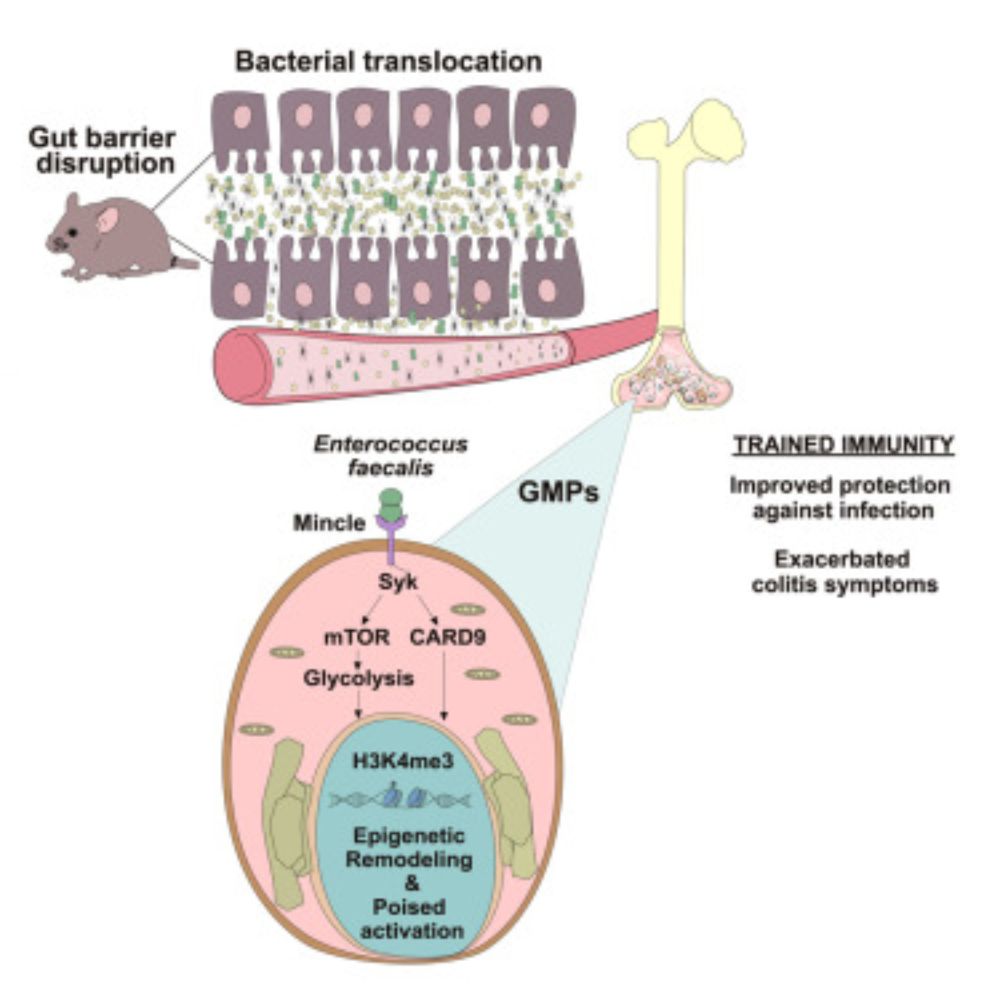
Microbiota translocation following intestinal barrier disruption promotes Mincle-mediated training of myeloid progenitors in the bone marrow
Robles-Vera et al. unveil the capacity of gut microbiota translocation, particularly
Enterococcus faecalis, to mediate a Mincle-dependent induction of trained immunity
in myeloid bone marrow progenito...
www.cell.com
January 23, 2025 at 11:04 AM
#immunosky #microbiomesky FREE LINK @cp-immunity.bsky.social!
Fat diet, dysbiosis, inflammation & chemicals induce gut barrier disruption! Systemic dissemination of gut microbiota mediates a Mincle-dependent induction of trained immunity in myeloid bone marrow cells
www.cell.com/immunity/ful...
Fat diet, dysbiosis, inflammation & chemicals induce gut barrier disruption! Systemic dissemination of gut microbiota mediates a Mincle-dependent induction of trained immunity in myeloid bone marrow cells
www.cell.com/immunity/ful...
Reposted by Ernesto Rodriguez
Antigen presentation by tumor-associated macrophages drives T cells from a progenitor exhaustion state to terminal exhaustion | @cp-immunity.bsky.social #paper
www.cell.com/immunity/ful...
www.cell.com/immunity/ful...

Antigen presentation by tumor-associated macrophages drives T cells from a progenitor exhaustion state to terminal exhaustion
The balance of T cells in a progenitor-exhausted state and those in a terminally exhausted
state is a critical determinant of anti-tumor responses. Waibl Polania, Hoyt-Miggelbrink,
et al. identify ant...
www.cell.com
January 17, 2025 at 3:17 PM
Antigen presentation by tumor-associated macrophages drives T cells from a progenitor exhaustion state to terminal exhaustion | @cp-immunity.bsky.social #paper
www.cell.com/immunity/ful...
www.cell.com/immunity/ful...