




Erin McCaffrey, PhD
@erin-mccaffrey.bsky.social
Principal Investigator of the Spatial Immunology Unit | Independent Research Scholar | NIH/NIAID Intramural Research Program
Spatially mapping the immune ecosystem of infection and inflammation
(Views are my own)
Spatially mapping the immune ecosystem of infection and inflammation
(Views are my own)
Reposted by Erin McCaffrey, PhD

You can now explore the mRNA expression of your favorite TB gene of interest in our recently published human pulmonary M.tb granuloma single-cell dataset at the Broad Single Cell PORTAL!
@broadinstitute.org
@wallacewly.bsky.social
singlecell.broadinstitute.org/single_cell/...
@broadinstitute.org
@wallacewly.bsky.social
singlecell.broadinstitute.org/single_cell/...
Paired single-cell and spatial transcriptional profiling reveals a central osteopontin macrophage response mediating tuberculous granuloma formation - Single Cell Portal
Granulomas are classic manifestations of tuberculosis pathogenesis. They result from an ensemble of immune responses to Mycobacterium tuberculosis infection, but the identities, arrangement, cellular interactions, and regulation of the cells that comprise them have thus far been incompletely understood. To better understand the composition of granulomas, we conducted spatial and single-cell RNA sequencing of granulomas in biopsy specimens from patients with tuberculosis. We found that granulomas consist of concentric transcriptional laminae surrounding areas of central necrosis. We identified distinct populations of granuloma-associated stromal cells, fibroblasts, lymphocytes, mast cells, dendritic cells, neutrophils, and macrophages. Furthermore, gene expression among these cell populations differed by location within granulomas. We used inferential analysis to predict dominant granuloma cell-cell interactions, the activity of major signaling pathways, and transcription factor activities. Using spatial deconvolution, we mapped a conserved pattern of cellular organization dominated by macrophages rich in SPP1/osteopontin expression. Trajectory analysis of macrophage subtypes mapped their differentiation and supported the importance of SPP1 to granuloma macrophage polarization. Using the Mycobacterium marinum-zebrafish model, we found that mycobacterial infection induces spp1 expression in macrophages and that spp1 ablation results in granuloma formation defects and reduced survival in adult animals. Cumulatively, we have identified a dominant macrophage granuloma population as well as its central regulatory gene in human samples and confirmed the importance of spp1 to granuloma biology in vivo.
singlecell.broadinstitute.org
September 4, 2025 at 1:38 PM
You can now explore the mRNA expression of your favorite TB gene of interest in our recently published human pulmonary M.tb granuloma single-cell dataset at the Broad Single Cell PORTAL!
@broadinstitute.org
@wallacewly.bsky.social
singlecell.broadinstitute.org/single_cell/...
@broadinstitute.org
@wallacewly.bsky.social
singlecell.broadinstitute.org/single_cell/...
Reposted by Erin McCaffrey, PhD
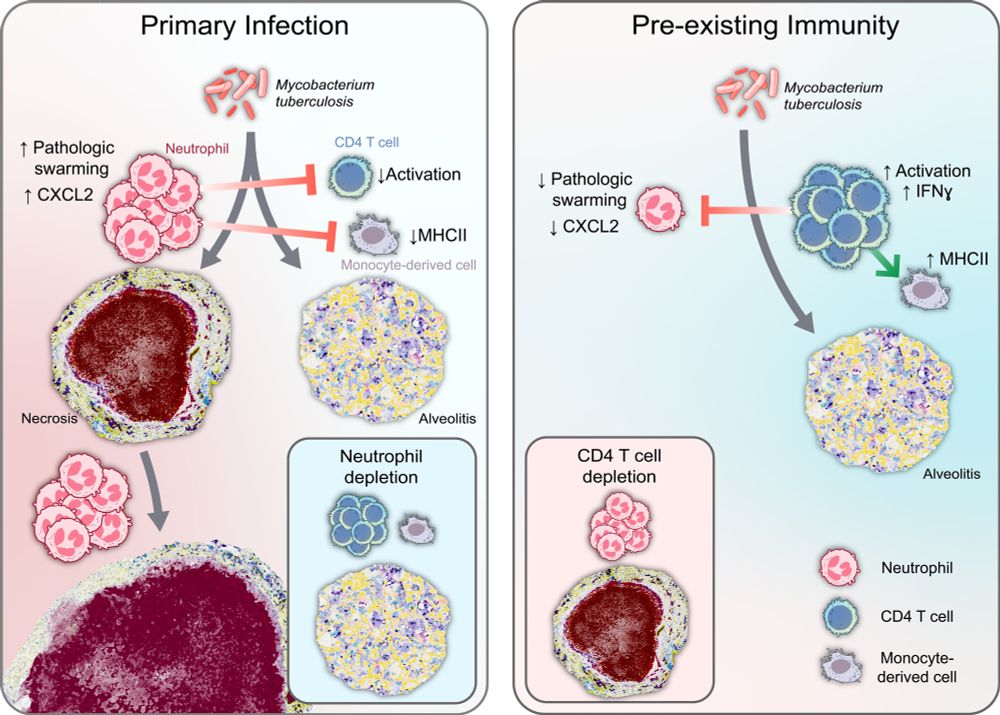
I’m excited to announce that our paper, describing early and opposing roles for neutrophils and CD4 T cells in determining #TB lesion structure, is out at @jem.org ! Huge thanks to my lab, and the Urdahl, @michael-gerner.bsky.social, and Aitchison labs who made this possible
doi.org/10.1084/jem....
doi.org/10.1084/jem....
July 30, 2025 at 1:54 PM
I’m excited to announce that our paper, describing early and opposing roles for neutrophils and CD4 T cells in determining #TB lesion structure, is out at @jem.org ! Huge thanks to my lab, and the Urdahl, @michael-gerner.bsky.social, and Aitchison labs who made this possible
doi.org/10.1084/jem....
doi.org/10.1084/jem....
Reposted by Erin McCaffrey, PhD

Newest paper from the lab out today (doi.org/10.1084/jem....)! Here, we describe PathMHC, a novel MS-based approach to identify rare pathogen-derived peptides on MHC-I and MHC-II. We apply this to a range of pathogens Mtb, SARS-CoV-2, and Listeria.

Targeting infection-specific peptides in immunopeptidomics studies for vaccine target discovery
MS-based immunopeptidomics can facilitate vaccine antigen discovery, but self-MHC peptides greatly outnumber pathogen-derived MHC peptides, presenting a ch
doi.org
July 21, 2025 at 2:19 PM
Newest paper from the lab out today (doi.org/10.1084/jem....)! Here, we describe PathMHC, a novel MS-based approach to identify rare pathogen-derived peptides on MHC-I and MHC-II. We apply this to a range of pathogens Mtb, SARS-CoV-2, and Listeria.

Thank you to @amitava-bio.bsky.social and Thomas Weichhart for this really nice summary of our preprint! www.nature.com/articles/s41...
Spatial immunometabolic zonation in tuberculosis granulomas - Nature Reviews Immunology
A preprint by McCaffrey and Delmastro et al. delineates distinct immunometabolic zones of tuberculosis granulomas and reports that hypoxia is a key driver of immune subversion.
www.nature.com
July 8, 2025 at 7:09 PM
Thank you to @amitava-bio.bsky.social and Thomas Weichhart for this really nice summary of our preprint! www.nature.com/articles/s41...
Reposted by Erin McCaffrey, PhD

We are looking for post-docs interested in studying T cell responses to M. tuberculosis infection…especially basic T cell immunologists who are interested in learning to work with BSL3 pathogens. The NIH intramural program is an amazing place to train!
May 30, 2025 at 8:47 PM
We are looking for post-docs interested in studying T cell responses to M. tuberculosis infection…especially basic T cell immunologists who are interested in learning to work with BSL3 pathogens. The NIH intramural program is an amazing place to train!
Reposted by Erin McCaffrey, PhD

It's world TB day.
The last two months have been a series of attacks on global health, infectious disease science and vulnerable populations. The damage will take decades to undo, and we are heading onto a steep global health disaster.
We can't stay quiet.
#tuberculosis #TB #WTBD2025
The last two months have been a series of attacks on global health, infectious disease science and vulnerable populations. The damage will take decades to undo, and we are heading onto a steep global health disaster.
We can't stay quiet.
#tuberculosis #TB #WTBD2025
March 24, 2025 at 2:43 PM
It's world TB day.
The last two months have been a series of attacks on global health, infectious disease science and vulnerable populations. The damage will take decades to undo, and we are heading onto a steep global health disaster.
We can't stay quiet.
#tuberculosis #TB #WTBD2025
The last two months have been a series of attacks on global health, infectious disease science and vulnerable populations. The damage will take decades to undo, and we are heading onto a steep global health disaster.
We can't stay quiet.
#tuberculosis #TB #WTBD2025
Reposted by Erin McCaffrey, PhD

Today is the 24th of March and it's World TB Day. We typically have many activities to educate and raise awareness about TB and how important it is for us all to commit to doing more to end TB! This year feels different though.
March 24, 2025 at 2:34 PM
Today is the 24th of March and it's World TB Day. We typically have many activities to educate and raise awareness about TB and how important it is for us all to commit to doing more to end TB! This year feels different though.
Reposted by Erin McCaffrey, PhD

For World TB Day, PIH is hosting a webinar at 12pm EST to discuss the repercussions of recently slashed US foreign aid and the hope that remains. #worldTBday @partnersinhealth.bsky.social
Register here:
act.pih.org/worldtbday2025
Register here:
act.pih.org/worldtbday2025

Register | Turmoil, TB Care, & Taking Action
Join experts on World TB Day to discuss the history, innovations, and social justice impact of TB, the world’s deadliest infectious disease.
act.pih.org
March 24, 2025 at 3:09 PM
For World TB Day, PIH is hosting a webinar at 12pm EST to discuss the repercussions of recently slashed US foreign aid and the hope that remains. #worldTBday @partnersinhealth.bsky.social
Register here:
act.pih.org/worldtbday2025
Register here:
act.pih.org/worldtbday2025
Reposted by Erin McCaffrey, PhD
I recommend hating tuberculosis. It has fueled me like no other hate that came before.
March 11, 2025 at 3:30 PM
I recommend hating tuberculosis. It has fueled me like no other hate that came before.
Happy to share a preprint from the Angelo lab many years in the making. Read on for a saga of multiplexed imaging, immunometabolism, and TB granulomas with some fun side quests into the realms of geographical information sciences and transcriptomics… (1/20) doi.org/10.1101/2025...

The immunometabolic topography of tuberculosis granulomas governs cellular organization and bacterial control
Despite being heavily infiltrated by immune cells, tuberculosis (TB) granulomas often subvert the host response to Mycobacterium tuberculosis (Mtb) infection and support bacterial persistence. We prev...
doi.org
February 24, 2025 at 10:16 PM
Happy to share a preprint from the Angelo lab many years in the making. Read on for a saga of multiplexed imaging, immunometabolism, and TB granulomas with some fun side quests into the realms of geographical information sciences and transcriptomics… (1/20) doi.org/10.1101/2025...
Reposted by Erin McCaffrey, PhD

I’m super excited to share what I’ve been working on for the last (many) years: a spatial + genomic + transcriptomic characterization of how the breast cancer microenvironment evolves through immunotherapy! (1/x) 🧪🧬 🖥️ #AcademicSky #MLSky #ImmunoSky www.biorxiv.org/content/10.1...

Temporal and spatial composition of the tumor microenvironment predicts response to immune checkpoint inhibition
Immune checkpoint inhibition (ICI) has fundamentally changed cancer treatment. However, only a minority of patients with metastatic triple negative breast cancer (TNBC) benefit from ICI, and the deter...
www.biorxiv.org
January 29, 2025 at 4:17 PM
I’m super excited to share what I’ve been working on for the last (many) years: a spatial + genomic + transcriptomic characterization of how the breast cancer microenvironment evolves through immunotherapy! (1/x) 🧪🧬 🖥️ #AcademicSky #MLSky #ImmunoSky www.biorxiv.org/content/10.1...