



Demetris Taliadoros
@demetristaliasoros.bsky.social
Reposted by Demetris Taliadoros

Latest research from the lab where we mapped the sex-determining gene in the red mason bee. Surprisingly it turned out to be the same gene used by ants, suggesting an ancient origin >150 million years ago. Thanks to the many people involved!

#Haplodiploid inheritance is found in all species of #Hymenoptera. @mwbstr.bsky.social &co map the #sex determining #gene of the red mason #bee to the ANTSR gene region, suggesting a shared, ancient origin of #SexDetermination in bees & ants >150 Mya ago @plosbiology.org 🧪 plos.io/47COEtH

November 4, 2025 at 1:19 PM
Latest research from the lab where we mapped the sex-determining gene in the red mason bee. Surprisingly it turned out to be the same gene used by ants, suggesting an ancient origin >150 million years ago. Thanks to the many people involved!
Reposted by Demetris Taliadoros
Happy to share our new paper OA in Genetics. We show that population genomic methods based on ARGs (ancestral recombination graphs i.e. genetic ancestry along chromosomes) for demography inference can be biased when applied to genomes with wide high-recombining regions. doi.org/10.1093/gene...
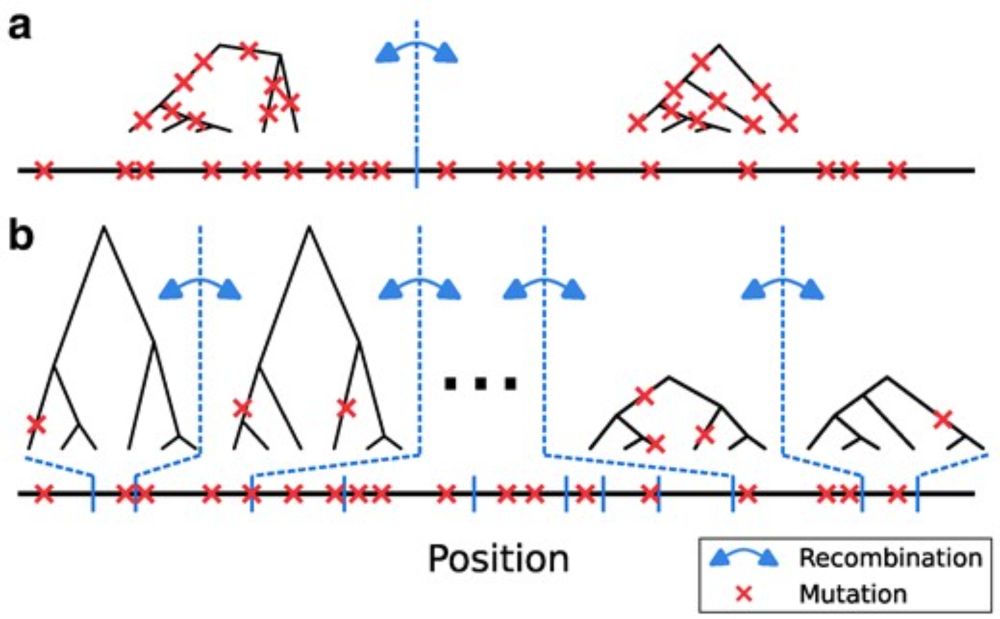
High-recombining genomic regions affect demography inference based on ancestral recombination graphs
Abstract. Multiple methods of demography inference are based on the ancestral recombination graph. This powerful approach uses observed mutations to model
doi.org
January 27, 2025 at 2:23 PM
Happy to share our new paper OA in Genetics. We show that population genomic methods based on ARGs (ancestral recombination graphs i.e. genetic ancestry along chromosomes) for demography inference can be biased when applied to genomes with wide high-recombining regions. doi.org/10.1093/gene...
Reposted by Demetris Taliadoros

Fungal pathogen Cercospora beticola, the cause of leaf spot in sugar beet, likely jumped from wild sea beet twice. Taliadoros et al. studied 326 isolates across 4 continents, uncovering rapid adaptation, host shifts, and evolution of fungicide resistance.
🔗 doi.org/10.1093/gbe/...
#genome #fungi
🔗 doi.org/10.1093/gbe/...
#genome #fungi

Genome-wide Evidence of Host Specialization in Wild and Farmland Populations of the Fungal Leaf Spot Pathogen, Cercospora beticola
Abstract. One of the most recent crop species to be domesticated is sugar beet (Beta vulgaris L. ssp. vulgaris Doell.), which was bred for high sucrose con
doi.org
April 29, 2025 at 6:11 PM
Fungal pathogen Cercospora beticola, the cause of leaf spot in sugar beet, likely jumped from wild sea beet twice. Taliadoros et al. studied 326 isolates across 4 continents, uncovering rapid adaptation, host shifts, and evolution of fungicide resistance.
🔗 doi.org/10.1093/gbe/...
#genome #fungi
🔗 doi.org/10.1093/gbe/...
#genome #fungi
Reposted by Demetris Taliadoros

Some years ago, together with Eva, we developed Blastr (βλαστάρι) 🌱 as a project — but we never got paid for it. So we decided to release it for free. 💡

June 19, 2025 at 6:57 PM
Some years ago, together with Eva, we developed Blastr (βλαστάρι) 🌱 as a project — but we never got paid for it. So we decided to release it for free. 💡
Reposted by Demetris Taliadoros
I'm happy to share our new study where we mapped the sex-determining locus in the red mason bee. It maps to the ANTSR lncRNA discovered in ants, suggesting that this gene determines sex widely in Hymenoptera.
www.biorxiv.org/content/10.1...
www.biorxiv.org/content/10.1...
Genetic mapping in the red mason bee Osmia bicornis implicates ANTSR as an ancient sex-determining locus in bees and ants
Haplodiploid inheritance, in which females are diploid and males are haploid, is found in all species of Hymenoptera. Sex in haplodiploids is commonly determined by the alleles present at a complementary sex determination (CSD) locus, with heterozygosity triggering the female developmental pathway. The identity of this locus differs among taxa and is only known in a few species. Here, we map a single CSD locus to a 2 kbp region in the genome of the red mason bee Osmia bicornis . It overlaps the long noncoding RNA ANTSR , which has been identified as the sex-determining gene in the invasive ant Linepithema humile . This locus is homozygous in diploid males and exhibits extremely high levels of haplotype diversity, consistent with the action of frequency-dependent selection. The elevated levels of heterozygosity in the CSD locus enable us to fine-map potentially functional genetic variation within it. We also identify elevated levels of genetic diversity in the ortholog of the CSD locus in other bee genera, suggesting that it may govern sex determination widely in bees. Our data are consistent with the hypothesis that ANTSR evolved a role in sex determination at least 150 million years ago and is the ancestral sex-determination locus of bees and ants. ### Competing Interest Statement The authors have declared no competing interest. Erik Philip-Sörensens Stiftelse Swedish Research Council, 2022-06725
www.biorxiv.org
July 7, 2025 at 7:17 AM
I'm happy to share our new study where we mapped the sex-determining locus in the red mason bee. It maps to the ANTSR lncRNA discovered in ants, suggesting that this gene determines sex widely in Hymenoptera.
www.biorxiv.org/content/10.1...
www.biorxiv.org/content/10.1...