



__gcui__
@darthmodel.bsky.social
A bit concerning that Drude-2019 seems to have a negative effect on protein dynamic stability and cooperativity dx.doi.org/10.1021/acs....

Impact of Force Field Polarization on Correlated Motions of Proteins
Correlated motions of proteins underpin many physiological mechanisms, such as substrate binding, signal transduction, enzymatic activity, and allostery. These motions arise from low-frequency collective movements of biomolecules and have mostly been studied using molecular dynamics simulations. Here, we present the effects of two different empirical energy force fields used for molecular dynamics simulations on correlated motions─the nonpolarizable CHARMM36m additive force field and the polarizable Drude-2019 force field. The study was conducted on two proteins, ubiquitin─a small protein with well-described dynamics─and the nuclear receptor protein─peroxisome proliferator-activated receptor gamma (PPARγ). The ligand binding domain of PPARγ was of particular interest since its function is to regulate transcription through ligand and coregulator protein binding. It has been previously shown that a dynamical network of correlated motions ensures the transmission of information related to PPARγ ligand binding. We present the results of classical MD simulations where we analyze the results in terms of residue fluctuations, residue correlation maps, community network analysis, and hydrophobic cluster analysis. We find that RMS fluctuations tend to be greater and correlated motions are less intense with the Drude-2019 force field than with the nonpolarizable all atom additive force field. Analysis of large hydrophobic clusters in the respective proteins shows a greater loss of native contacts in the simulations using the Drude-2019 force field than in the simulations using the all atom additive force field. Our results provide the first quantification of the impact of using a polarizable force field in computational studies that focus on correlated motions.
dx.doi.org
September 29, 2025 at 2:14 PM
A bit concerning that Drude-2019 seems to have a negative effect on protein dynamic stability and cooperativity dx.doi.org/10.1021/acs....
better relative pKa predictions by considering anharmonic effects with comparable computational cost, dx.doi.org/10.1021/jacs...

Reliable pKa Prediction through Efficient Incorporation of Anharmonicity within the Nuclear–Electronic Orbital Framework
Accurate pKa prediction is critical for understanding chemical reactivity and molecular properties across a wide range of applications. Computational approaches usually invoke a harmonic treatment of ...
dx.doi.org
September 29, 2025 at 2:07 PM
better relative pKa predictions by considering anharmonic effects with comparable computational cost, dx.doi.org/10.1021/jacs...
Reposted by __gcui__

Scaling down protein language modeling with MSA Pairformer https://www.biorxiv.org/content/10.1101/2025.08.02.668173v1
August 4, 2025 at 3:48 AM
Scaling down protein language modeling with MSA Pairformer https://www.biorxiv.org/content/10.1101/2025.08.02.668173v1
Reposted by __gcui__

This is wild!
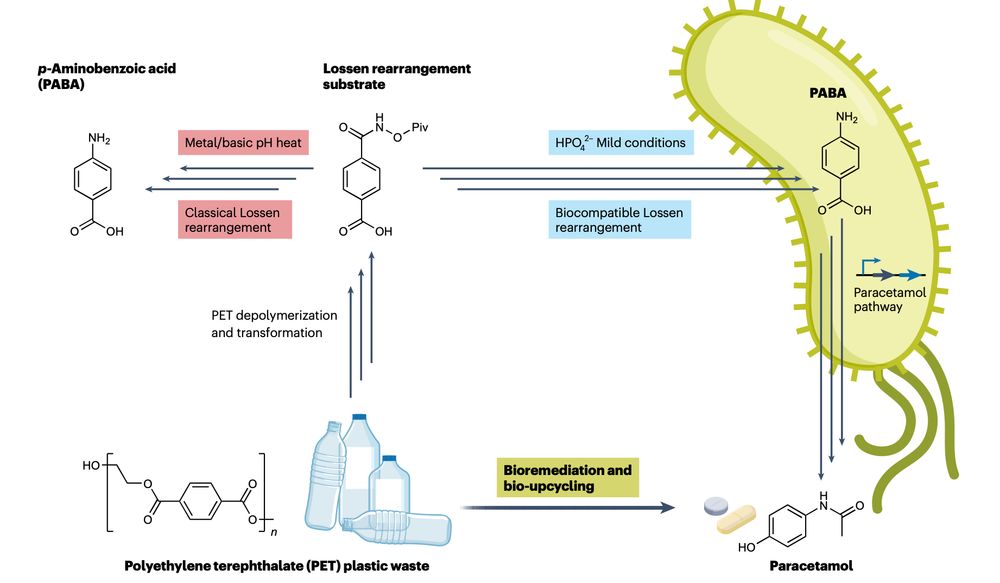
Engineering E. coli bacteria to turn plastic waste into paracetamol (Tylenol)
www.nature.com/articles/s41...
www.nature.com/articles/s41...
Engineering E. coli bacteria to turn plastic waste into paracetamol (Tylenol)
www.nature.com/articles/s41...
www.nature.com/articles/s41...
June 23, 2025 at 6:55 PM
This is wild!
Engineering E. coli bacteria to turn plastic waste into paracetamol (Tylenol)
www.nature.com/articles/s41...
www.nature.com/articles/s41...
Engineering E. coli bacteria to turn plastic waste into paracetamol (Tylenol)
www.nature.com/articles/s41...
www.nature.com/articles/s41...
Reposted by __gcui__

After years of development and preparatory works which you might have seen on this profile, a major milestone is achieved:
g-xTB marks not just an evolution, but a revolution in the capabilities of semiempirical quantum chemistry. Convince yourself! A thread.
🔗 chemrxiv.org/engage/chemr...
#compchem
g-xTB marks not just an evolution, but a revolution in the capabilities of semiempirical quantum chemistry. Convince yourself! A thread.
🔗 chemrxiv.org/engage/chemr...
#compchem
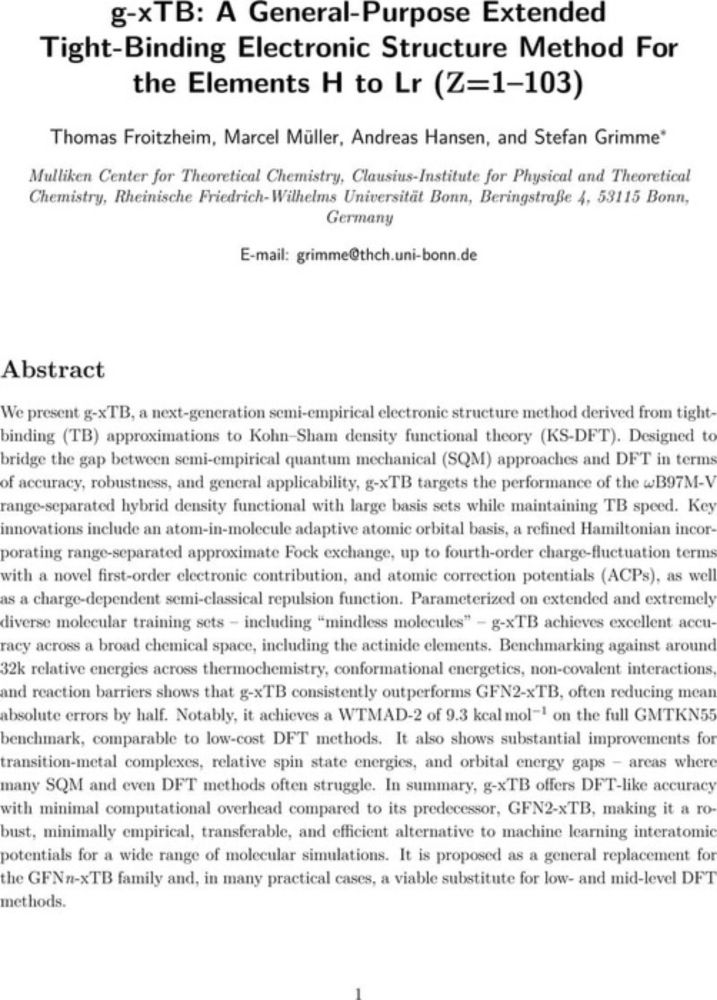
g-xTB: A General-Purpose Extended Tight-Binding Electronic Structure Method For the Elements H to Lr (Z=1–103)
We present g-xTB, a next-generation semi-empirical electronic structure method derived from tight-binding (TB) approximations to Kohn–Sham density functional theory (KS-DFT). Designed to bridge the ga...
chemrxiv.org
June 24, 2025 at 7:31 AM
After years of development and preparatory works which you might have seen on this profile, a major milestone is achieved:
g-xTB marks not just an evolution, but a revolution in the capabilities of semiempirical quantum chemistry. Convince yourself! A thread.
🔗 chemrxiv.org/engage/chemr...
#compchem
g-xTB marks not just an evolution, but a revolution in the capabilities of semiempirical quantum chemistry. Convince yourself! A thread.
🔗 chemrxiv.org/engage/chemr...
#compchem