



Daniel Zvinca
@danz68.bsky.social
A bit of everything, recreational math, mechanical engineer, programmer, statistics, dataviz.
Numbers and related fields are just a hobby for me, so hearing that any of my posts are helpful to people in dataviz is honestly very flattering.
June 21, 2025 at 3:00 PM
Numbers and related fields are just a hobby for me, so hearing that any of my posts are helpful to people in dataviz is honestly very flattering.
CSP is always useful for investigating relationships during the exploratory phase of data analysis. The reason it rarely works as an explanatory solution is that we can’t exactly say: "This hard-to-read graph shows there’s no clear relationship using this method..."
June 21, 2025 at 2:20 PM
CSP is always useful for investigating relationships during the exploratory phase of data analysis. The reason it rarely works as an explanatory solution is that we can’t exactly say: "This hard-to-read graph shows there’s no clear relationship using this method..."
Ha, glad to hear the method's been helpful. Measuring or even just describing relationships between variables has been always a tricky business.
June 21, 2025 at 2:07 PM
Ha, glad to hear the method's been helpful. Measuring or even just describing relationships between variables has been always a tricky business.
Ah, so that’s why my posts/remarks get nearly no traction...🤭
June 21, 2025 at 1:58 PM
Ah, so that’s why my posts/remarks get nearly no traction...🤭
While traditional beeswarms aim to reduce empty space through tight packing, my method focuses on frequency accuracy, with the space being used incidentally rather than as a packing objective.
May 6, 2025 at 10:03 AM
While traditional beeswarms aim to reduce empty space through tight packing, my method focuses on frequency accuracy, with the space being used incidentally rather than as a packing objective.
Here is the result of my NEW frequency dot plot, an arrangement based on data density calculation using the dot size as resolution (granularity). This result actually validates the basic beeswarm packing for this dataset. Beeswarms are often poor density estimators due to their packing artifacts.

May 6, 2025 at 9:50 AM
Here is the result of my NEW frequency dot plot, an arrangement based on data density calculation using the dot size as resolution (granularity). This result actually validates the basic beeswarm packing for this dataset. Beeswarms are often poor density estimators due to their packing artifacts.
Not really a CSP. It is a multi line/dot chart. Time and ages are just shifted variables, no chess player trajectory will have curve twists.
March 1, 2025 at 6:42 PM
Not really a CSP. It is a multi line/dot chart. Time and ages are just shifted variables, no chess player trajectory will have curve twists.
When density continuity is a fact my method uses a different idea than KDE.
KDE uses a quite large bandwidth (constant or not) to calculate each value "contribution" to the density shape.
My method finds the smoothest density shape assuming each value was measured within a given tolerance.
KDE uses a quite large bandwidth (constant or not) to calculate each value "contribution" to the density shape.
My method finds the smoothest density shape assuming each value was measured within a given tolerance.
February 20, 2025 at 6:02 PM
When density continuity is a fact my method uses a different idea than KDE.
KDE uses a quite large bandwidth (constant or not) to calculate each value "contribution" to the density shape.
My method finds the smoothest density shape assuming each value was measured within a given tolerance.
KDE uses a quite large bandwidth (constant or not) to calculate each value "contribution" to the density shape.
My method finds the smoothest density shape assuming each value was measured within a given tolerance.
My "best" guess is in the first image (truly, just a guess, no idea how good that is). Then I try to fit the dots as good as I consider is needed, starting from the optimal pack (hexagonal) to no errors at all. The final shape resemblances my "best" guess, an 0.2x error looking like this:

February 20, 2025 at 4:14 PM
My "best" guess is in the first image (truly, just a guess, no idea how good that is). Then I try to fit the dots as good as I consider is needed, starting from the optimal pack (hexagonal) to no errors at all. The final shape resemblances my "best" guess, an 0.2x error looking like this:
I think that the exploratory phase ends when we are confident enough that we found the density shape (iteratively challenging continuity, gaps, tails). Once we get there, we do our best to fit the available data by minimizing the error placement and/or overlapping, depending on the method.

February 20, 2025 at 4:06 PM
I think that the exploratory phase ends when we are confident enough that we found the density shape (iteratively challenging continuity, gaps, tails). Once we get there, we do our best to fit the available data by minimizing the error placement and/or overlapping, depending on the method.
Using the distribution word in a statistical sense for a few discrete values as those from a Likert scale is a challenge. Can you share the data?
February 20, 2025 at 1:06 PM
Using the distribution word in a statistical sense for a few discrete values as those from a Likert scale is a challenge. Can you share the data?
Any chance you can share the data?
February 20, 2025 at 12:30 PM
Any chance you can share the data?
Not sure how relevant is the rate. No idea how the system works there, but I doubt they can accommodate as many as they want. I would rather encode how many more applicants than the available places are (assuming all taken) with the following title: More and more people are interested in education.
February 20, 2025 at 12:25 PM
Not sure how relevant is the rate. No idea how the system works there, but I doubt they can accommodate as many as they want. I would rather encode how many more applicants than the available places are (assuming all taken) with the following title: More and more people are interested in education.
it looks like your display has a few bugs
February 15, 2025 at 11:47 AM
it looks like your display has a few bugs
Cant really follow these graphs, but I am not familiar with data either. I cant see an explicit functional model to study a relationship from the dots.
December 9, 2024 at 4:44 PM
Cant really follow these graphs, but I am not familiar with data either. I cant see an explicit functional model to study a relationship from the dots.
I think this example would be a fantastic exercise for people with different backgrounds, but with a bit of functional math and statistical knowledge. I am not sure how a two variable relationship dissertation would look to make it accessible to a broader audience, though.
December 9, 2024 at 10:23 AM
I think this example would be a fantastic exercise for people with different backgrounds, but with a bit of functional math and statistical knowledge. I am not sure how a two variable relationship dissertation would look to make it accessible to a broader audience, though.
As you said, I kept staring at it. I love math and the logic behind PCA, but I dont see how it would improve the practical insights for a general audience. PCA might simplify mathematical analysis by removing the correlation, yet it doesnt mean it also simplifies human sensemaking.
December 9, 2024 at 5:46 AM
As you said, I kept staring at it. I love math and the logic behind PCA, but I dont see how it would improve the practical insights for a general audience. PCA might simplify mathematical analysis by removing the correlation, yet it doesnt mean it also simplifies human sensemaking.
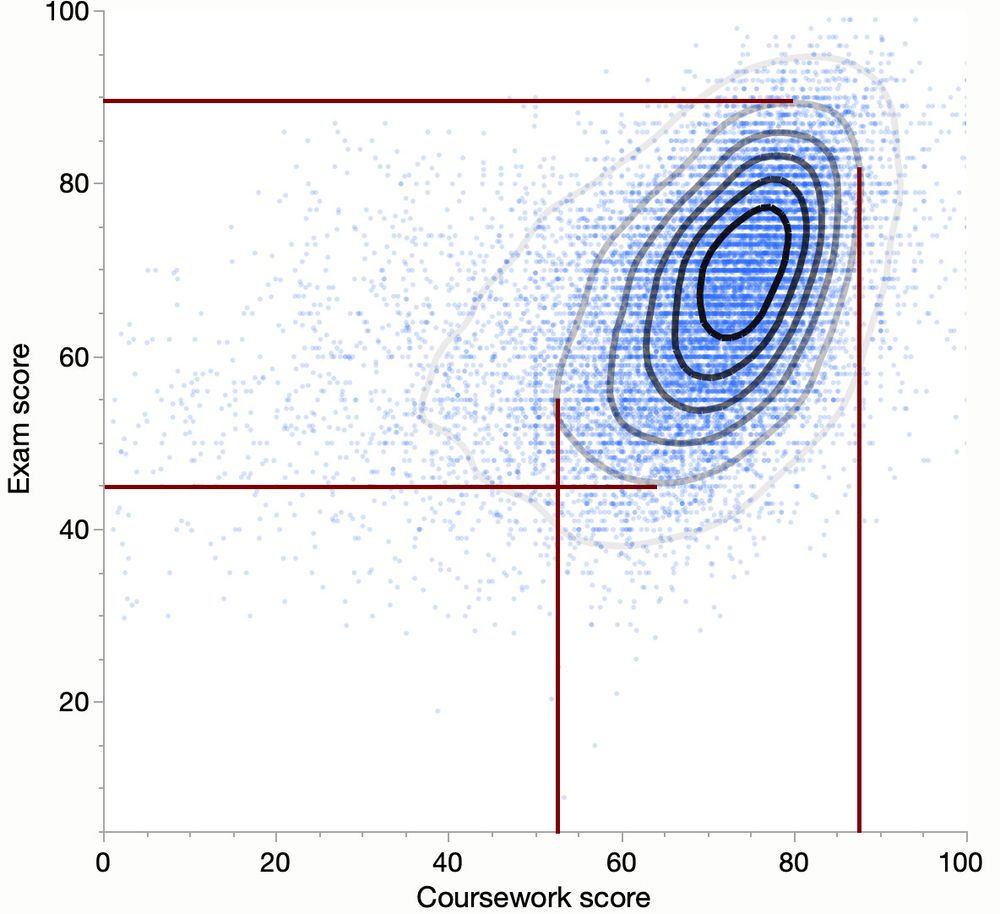
What I would conclude: 1. The concentric elliptical isolines might be the representation of a bivariate normal distribution. 2. The nearly constant orientation of the ellipses indicates also a linear relationship where values matter the most, in areas with high density.
December 8, 2024 at 7:44 PM
What I would conclude: 1. The concentric elliptical isolines might be the representation of a bivariate normal distribution. 2. The nearly constant orientation of the ellipses indicates also a linear relationship where values matter the most, in areas with high density.
It wasn't the case here, because of the orientation, but I didn't know how the isolines shapes look. The ellipsis clearly have an angle. The "rotation" spreads the variance across both axes, so rescaling any axis will not convert the ellipse into a circle.
December 8, 2024 at 7:34 PM
It wasn't the case here, because of the orientation, but I didn't know how the isolines shapes look. The ellipsis clearly have an angle. The "rotation" spreads the variance across both axes, so rescaling any axis will not convert the ellipse into a circle.
In a scatterplot, the visual shape of the distribution (ellipse or circle) is influenced by the scaling of the axes. Adjusting the scales can transform a 0 or 90deg oriented ellipse into a circle. This means the elongation might be a plotting artifact rather than a true feature of the data.
December 8, 2024 at 7:18 PM
In a scatterplot, the visual shape of the distribution (ellipse or circle) is influenced by the scaling of the axes. Adjusting the scales can transform a 0 or 90deg oriented ellipse into a circle. This means the elongation might be a plotting artifact rather than a true feature of the data.
I would love to see some isodensity or probability contours on this dataset with adjusted scales based on that. I would not filter out anything, I would just rescale the axis based on the ratio of, say, 90% probability ranges.
December 8, 2024 at 11:58 AM
I would love to see some isodensity or probability contours on this dataset with adjusted scales based on that. I would not filter out anything, I would just rescale the axis based on the ratio of, say, 90% probability ranges.