




Bruce Calvert
@brucettcalvert.bsky.social
Interested in temperature statistics and datasets.
Reposted by Bruce Calvert
The Kotz et al. paper is also quite relevant as it was ranked the #2 #climate paper of 2024 (www.carbonbrief.org/analysis-the...). The Kotz et al. damage function has also been incorporated into REMIND, the world's most used process-based integrated assessment model. While the CMIP7 scenarios...

Analysis: The climate papers most featured in the media in 2024 - Carbon Brief
Thousands of peer-reviewed journal articles were published over 2024, helping shape online discourse around climate change.
www.carbonbrief.org
December 4, 2025 at 6:04 PM
The Kotz et al. paper is also quite relevant as it was ranked the #2 #climate paper of 2024 (www.carbonbrief.org/analysis-the...). The Kotz et al. damage function has also been incorporated into REMIND, the world's most used process-based integrated assessment model. While the CMIP7 scenarios...
Reposted by Bruce Calvert
I have been following this issue for a few months. The Kotz et al. study unintentionally used faulty Uzbekistan data (e.g. some years with more than 100% gdp growth) which explained most of their results (www.nature.com/articles/s41...). Kotz et al. have since released an unpublished update...

Data anomalies and the economic commitment of climate change - Nature
Nature - Data anomalies and the economic commitment of climate change
www.nature.com
December 4, 2025 at 5:44 AM
I have been following this issue for a few months. The Kotz et al. study unintentionally used faulty Uzbekistan data (e.g. some years with more than 100% gdp growth) which explained most of their results (www.nature.com/articles/s41...). Kotz et al. have since released an unpublished update...
Reposted by Bruce Calvert
It is disappointing to learn that recent work to update the U.S. social cost of carbon, by updating the 2022 GIVE model, has been removed from the EPA's website. @climateofgavin.bsky.social or @michaelemann.bsky.social should make the link available @realclimate.bsky.social. arxiv.org/abs/2509.00212

Economic Impacts of Climate Change in the United States: Integrating and Harmonizing Evidence from Recent Studies
This paper synthesizes evidence on climate change impacts specific to U.S. populations. We develop an apples-to-apples comparison of econometric studies that empirically estimate the relationship betw...
arxiv.org
September 24, 2025 at 9:52 PM
It is disappointing to learn that recent work to update the U.S. social cost of carbon, by updating the 2022 GIVE model, has been removed from the EPA's website. @climateofgavin.bsky.social or @michaelemann.bsky.social should make the link available @realclimate.bsky.social. arxiv.org/abs/2509.00212
It is disappointing to learn that recent work to update the U.S. social cost of carbon, by updating the 2022 GIVE model, has been removed from the EPA's website. @climateofgavin.bsky.social or @michaelemann.bsky.social should make the link available @realclimate.bsky.social. arxiv.org/abs/2509.00212
Economic Impacts of Climate Change in the United States: Integrating and Harmonizing Evidence from Recent Studies
This paper synthesizes evidence on climate change impacts specific to U.S. populations. We develop an apples-to-apples comparison of econometric studies that empirically estimate the relationship betw...
arxiv.org
September 24, 2025 at 9:52 PM
It is disappointing to learn that recent work to update the U.S. social cost of carbon, by updating the 2022 GIVE model, has been removed from the EPA's website. @climateofgavin.bsky.social or @michaelemann.bsky.social should make the link available @realclimate.bsky.social. arxiv.org/abs/2509.00212
Reposted by Bruce Calvert
Interesting paper on the economic impacts of #climatechange, including the impact of #extremeweather. It's impressive to see such a rigorous methodology and robustness checks. www.aeaweb.org/articles?id=...

Estimating Macrofiscal Effects of Climate Shocks from Billions of Geospatial Weather Observations
(July 2025) - The literature studying the macroeconomics of weather has focused on temperature and precipitation annual averages, while microstudies have focused more on extreme weather measures. We c...
www.aeaweb.org
September 10, 2025 at 10:35 PM
Interesting paper on the economic impacts of #climatechange, including the impact of #extremeweather. It's impressive to see such a rigorous methodology and robustness checks. www.aeaweb.org/articles?id=...
Interesting paper on the economic impacts of #climatechange, including the impact of #extremeweather. It's impressive to see such a rigorous methodology and robustness checks. www.aeaweb.org/articles?id=...
Estimating Macrofiscal Effects of Climate Shocks from Billions of Geospatial Weather Observations
(July 2025) - The literature studying the macroeconomics of weather has focused on temperature and precipitation annual averages, while microstudies have focused more on extreme weather measures. We c...
www.aeaweb.org
September 10, 2025 at 10:35 PM
Interesting paper on the economic impacts of #climatechange, including the impact of #extremeweather. It's impressive to see such a rigorous methodology and robustness checks. www.aeaweb.org/articles?id=...
Reposted by Bruce Calvert
New paper finds that the transition from wooden to canvas buckets for sea surface temperature measurements occurred much earlier than previously though, suggesting that the early 1900s were slightly warmer than previously thought. #climatechange
doi.org/10.1029/2025...
doi.org/10.1029/2025...

Re‐Evaluating Historical Sea Surface Temperature Data Sets: Insights From the Diurnal Cycle, Coral Proxy Data, and Radiative Forcing
Changes in the diurnal cycle of ship-based sea surface temperature (SST) measurements indicate that a wooden-to-canvas bucket transition occurred by 1910
Leading SST products apply corrections fo...
doi.org
July 13, 2025 at 8:17 PM
New paper finds that the transition from wooden to canvas buckets for sea surface temperature measurements occurred much earlier than previously though, suggesting that the early 1900s were slightly warmer than previously thought. #climatechange
doi.org/10.1029/2025...
doi.org/10.1029/2025...
New paper finds that the transition from wooden to canvas buckets for sea surface temperature measurements occurred much earlier than previously though, suggesting that the early 1900s were slightly warmer than previously thought. #climatechange
doi.org/10.1029/2025...
doi.org/10.1029/2025...
Re‐Evaluating Historical Sea Surface Temperature Data Sets: Insights From the Diurnal Cycle, Coral Proxy Data, and Radiative Forcing
Changes in the diurnal cycle of ship-based sea surface temperature (SST) measurements indicate that a wooden-to-canvas bucket transition occurred by 1910
Leading SST products apply corrections fo...
doi.org
July 13, 2025 at 8:17 PM
New paper finds that the transition from wooden to canvas buckets for sea surface temperature measurements occurred much earlier than previously though, suggesting that the early 1900s were slightly warmer than previously thought. #climatechange
doi.org/10.1029/2025...
doi.org/10.1029/2025...
Reposted by Bruce Calvert
I finished processing an updated #temperature dataset (DCENT_MLE_v1.1) using data from @lizk40.bsky.social and the DCENT team. According to this dataset, 2024 was 1.71 °C warmer than the 1850-1900 average with a 95% confidence interval of [1.57,1.85] °C. #climatechange #globalwarming

July 8, 2025 at 12:59 PM
I finished processing an updated #temperature dataset (DCENT_MLE_v1.1) using data from @lizk40.bsky.social and the DCENT team. According to this dataset, 2024 was 1.71 °C warmer than the 1850-1900 average with a 95% confidence interval of [1.57,1.85] °C. #climatechange #globalwarming
I finished processing an updated #temperature dataset (DCENT_MLE_v1.1) using data from @lizk40.bsky.social and the DCENT team. According to this dataset, 2024 was 1.71 °C warmer than the 1850-1900 average with a 95% confidence interval of [1.57,1.85] °C. #climatechange #globalwarming
July 8, 2025 at 12:59 PM
I finished processing an updated #temperature dataset (DCENT_MLE_v1.1) using data from @lizk40.bsky.social and the DCENT team. According to this dataset, 2024 was 1.71 °C warmer than the 1850-1900 average with a 95% confidence interval of [1.57,1.85] °C. #climatechange #globalwarming
Reposted by Bruce Calvert
I like the new paper by @xuekeli.bsky.social and @michaelemann.bsky.social on climate change causing a reduction in temperature gradients leading to conditions more favourable to quasi-stable resonances in the Northern mid-latitudes. Although, I have some minor criticisms:

"Study finds planetary waves linked to wild summer weather have tripled since 1950" | Great piece by @borenbears.bsky.social for @apnews.com on our new @pnas.org article (w/ thoughtful comments from @jfrancisclimate.bsky.social):
vancouver.citynews.ca/2025/06/16/s...
vancouver.citynews.ca/2025/06/16/s...

Study: Climate change tripled planetary waves since 1950
Climate change has tripled the frequency of atmospheric wave events linked to extreme summer weather in the last 75 years.
vancouver.citynews.ca
June 21, 2025 at 11:36 PM
I like the new paper by @xuekeli.bsky.social and @michaelemann.bsky.social on climate change causing a reduction in temperature gradients leading to conditions more favourable to quasi-stable resonances in the Northern mid-latitudes. Although, I have some minor criticisms:
I like the new paper by @xuekeli.bsky.social and @michaelemann.bsky.social on climate change causing a reduction in temperature gradients leading to conditions more favourable to quasi-stable resonances in the Northern mid-latitudes. Although, I have some minor criticisms:
"Study finds planetary waves linked to wild summer weather have tripled since 1950" | Great piece by @borenbears.bsky.social for @apnews.com on our new @pnas.org article (w/ thoughtful comments from @jfrancisclimate.bsky.social):
vancouver.citynews.ca/2025/06/16/s...
vancouver.citynews.ca/2025/06/16/s...
Study: Climate change tripled planetary waves since 1950
Climate change has tripled the frequency of atmospheric wave events linked to extreme summer weather in the last 75 years.
vancouver.citynews.ca
June 21, 2025 at 11:36 PM
I like the new paper by @xuekeli.bsky.social and @michaelemann.bsky.social on climate change causing a reduction in temperature gradients leading to conditions more favourable to quasi-stable resonances in the Northern mid-latitudes. Although, I have some minor criticisms:
Look at all of this unnecessary traffic and waste of tax money due to the #King Charles visit in #Ottawa this morning. According to opinion polls, most Canadian's are against the #monarchy. This idea that #Canada should invite a foreign monarch to show #Trump how independent we are is crazy to me.

May 27, 2025 at 10:59 PM
Reposted by Bruce Calvert
I find it astonishing that the IEA and NGFS #climate scenarios completely exclude high-end scenarios. It's one thing to exclude the much criticized SSP5, but they don't include no mitigation scenarios such as SSP3. This is completely inconsistent with the IPCC scenarios, including the upcoming ones.
April 9, 2025 at 3:26 AM
I find it astonishing that the IEA and NGFS #climate scenarios completely exclude high-end scenarios. It's one thing to exclude the much criticized SSP5, but they don't include no mitigation scenarios such as SSP3. This is completely inconsistent with the IPCC scenarios, including the upcoming ones.
I find it astonishing that the IEA and NGFS #climate scenarios completely exclude high-end scenarios. It's one thing to exclude the much criticized SSP5, but they don't include no mitigation scenarios such as SSP3. This is completely inconsistent with the IPCC scenarios, including the upcoming ones.
April 9, 2025 at 3:26 AM
I find it astonishing that the IEA and NGFS #climate scenarios completely exclude high-end scenarios. It's one thing to exclude the much criticized SSP5, but they don't include no mitigation scenarios such as SSP3. This is completely inconsistent with the IPCC scenarios, including the upcoming ones.
Reposted by Bruce Calvert

Look at this graph. This just happened.
We have gone back to the 1800s.
We have gone back to the 1800s.

April 3, 2025 at 3:06 AM
Look at this graph. This just happened.
We have gone back to the 1800s.
We have gone back to the 1800s.
Reposted by Bruce Calvert
This article is a very good plain language explaination of the importance of sea ice when estimating the amount of #globalwarming. I am very happy to have my work highlighted. NSIDC's continuing work on improving historic sea ice reconstructions greatly benefits #science. nsidc.org/news-analyse...

The impact of sea ice on global temperature trends
A new study focuses on improving global temperature data sets in light of uneven warming across the globe. To fill gaps in historical climate records, the study relies in part on sea ice data from the...
nsidc.org
March 11, 2025 at 4:52 PM
This article is a very good plain language explaination of the importance of sea ice when estimating the amount of #globalwarming. I am very happy to have my work highlighted. NSIDC's continuing work on improving historic sea ice reconstructions greatly benefits #science. nsidc.org/news-analyse...
This article is a very good plain language explaination of the importance of sea ice when estimating the amount of #globalwarming. I am very happy to have my work highlighted. NSIDC's continuing work on improving historic sea ice reconstructions greatly benefits #science. nsidc.org/news-analyse...
The impact of sea ice on global temperature trends
A new study focuses on improving global temperature data sets in light of uneven warming across the globe. To fill gaps in historical climate records, the study relies in part on sea ice data from the...
nsidc.org
March 11, 2025 at 4:52 PM
This article is a very good plain language explaination of the importance of sea ice when estimating the amount of #globalwarming. I am very happy to have my work highlighted. NSIDC's continuing work on improving historic sea ice reconstructions greatly benefits #science. nsidc.org/news-analyse...
Reposted by Bruce Calvert
HadCRU_MLE Version 1.3 is now publicly available!
#climate #globalwarming
www.wdc-climate.de/ui/entry?acr...
#climate #globalwarming
www.wdc-climate.de/ui/entry?acr...
Metadata for 'Maximum Likelihood Estimates of Temperatures using Data from the Hadley Centre and the Climate Research Unit (Version 1.3)'
www.wdc-climate.de
February 14, 2025 at 2:57 AM
HadCRU_MLE Version 1.3 is now publicly available!
#climate #globalwarming
www.wdc-climate.de/ui/entry?acr...
#climate #globalwarming
www.wdc-climate.de/ui/entry?acr...
Reposted by Bruce Calvert
It’s embarrassing, but there was a bug in my code where I was not applying the Wallis et al. adjustments to those 149 stations (194 was a typo), so the estimate I provided previously is missing about 0.0007°C of #warming. I am currently rerunning the code.
January 28, 2025 at 1:01 AM
It’s embarrassing, but there was a bug in my code where I was not applying the Wallis et al. adjustments to those 149 stations (194 was a typo), so the estimate I provided previously is missing about 0.0007°C of #warming. I am currently rerunning the code.
Reposted by Bruce Calvert
I have finished processing HadCRU_MLE_v1.3. 2024 was 1.62°C warmer than the late 19th century, with an 95% CI of [1.53,1.71]°C. The update also includes improved bias adjustments for 194 stations (doi.org/10.1002/joc....) and a sensitivity test with COBE-SST3 sea ice. #climate #change #globalwarming

January 23, 2025 at 4:50 AM
I have finished processing HadCRU_MLE_v1.3. 2024 was 1.62°C warmer than the late 19th century, with an 95% CI of [1.53,1.71]°C. The update also includes improved bias adjustments for 194 stations (doi.org/10.1002/joc....) and a sensitivity test with COBE-SST3 sea ice. #climate #change #globalwarming
I have finished processing HadCRU_MLE_v1.3. 2024 was 1.62°C warmer than the late 19th century, with an 95% CI of [1.53,1.71]°C. The update also includes improved bias adjustments for 194 stations (doi.org/10.1002/joc....) and a sensitivity test with COBE-SST3 sea ice. #climate #change #globalwarming
January 23, 2025 at 4:50 AM
I have finished processing HadCRU_MLE_v1.3. 2024 was 1.62°C warmer than the late 19th century, with an 95% CI of [1.53,1.71]°C. The update also includes improved bias adjustments for 194 stations (doi.org/10.1002/joc....) and a sensitivity test with COBE-SST3 sea ice. #climate #change #globalwarming
Reposted by Bruce Calvert

All surface temperature products for 2024 are now live.
All show 2024 is the warmest year (very clearly).
The estimates of the change since the pre-industrial (1850-1900) are more uncertain but range from 1.46 to 1.62ºC.
It is therefore *likely* this was the first year that exceeded 1.5ºC.
All show 2024 is the warmest year (very clearly).
The estimates of the change since the pre-industrial (1850-1900) are more uncertain but range from 1.46 to 1.62ºC.
It is therefore *likely* this was the first year that exceeded 1.5ºC.
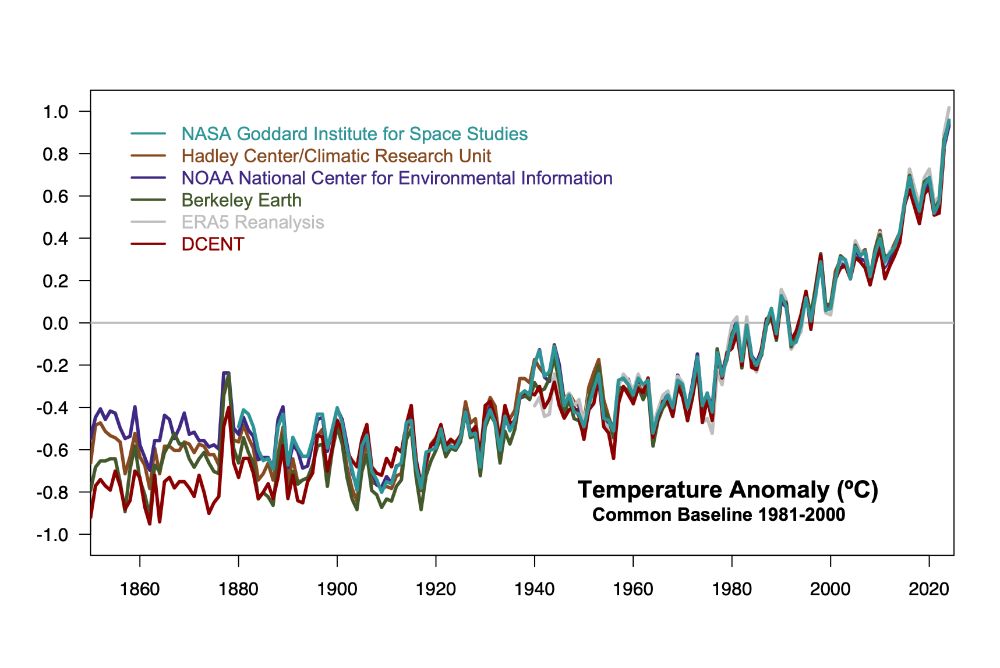
January 10, 2025 at 4:10 PM
All surface temperature products for 2024 are now live.
All show 2024 is the warmest year (very clearly).
The estimates of the change since the pre-industrial (1850-1900) are more uncertain but range from 1.46 to 1.62ºC.
It is therefore *likely* this was the first year that exceeded 1.5ºC.
All show 2024 is the warmest year (very clearly).
The estimates of the change since the pre-industrial (1850-1900) are more uncertain but range from 1.46 to 1.62ºC.
It is therefore *likely* this was the first year that exceeded 1.5ºC.
Reposted by Bruce Calvert

The release of a new NOAA sea surface temperature (SST) dataset...
+ @ametsoc.bsky.social Study: "Extended Reconstructed Sea Surface Temperature Version 6 (ERSSTv6): Part I. An Artificial Neural Network Approach" doi.org/10.1175/JCLI...
+ @ametsoc.bsky.social Study: "Extended Reconstructed Sea Surface Temperature Version 6 (ERSSTv6): Part I. An Artificial Neural Network Approach" doi.org/10.1175/JCLI...

Extended Reconstructed Sea Surface Temperature Version 6 (ERSSTv6): Part I. An Artificial Neural Network Approach
Abstract NOAA’s Extended Reconstructed Sea Surface Temperature (SST; ERSST) is operational global SST product based on in situ observations, which has been widely used monitoring and assessing global ...
doi.org
January 3, 2025 at 1:58 PM
The release of a new NOAA sea surface temperature (SST) dataset...
+ @ametsoc.bsky.social Study: "Extended Reconstructed Sea Surface Temperature Version 6 (ERSSTv6): Part I. An Artificial Neural Network Approach" doi.org/10.1175/JCLI...
+ @ametsoc.bsky.social Study: "Extended Reconstructed Sea Surface Temperature Version 6 (ERSSTv6): Part I. An Artificial Neural Network Approach" doi.org/10.1175/JCLI...
Reposted by Bruce Calvert
My first Bluesky poll: When I produce a minor update to HadCRU_MLE in early 2025, Should I use CRUTEM5 or CRUTEM5_eba (i.e., with improved exposure bias corrections from Wallis et al. (2024))?
Bluesky doesn't yet have an inbuilt poll feature, so please reply with your preference.
Bluesky doesn't yet have an inbuilt poll feature, so please reply with your preference.
December 7, 2024 at 4:47 AM
My first Bluesky poll: When I produce a minor update to HadCRU_MLE in early 2025, Should I use CRUTEM5 or CRUTEM5_eba (i.e., with improved exposure bias corrections from Wallis et al. (2024))?
Bluesky doesn't yet have an inbuilt poll feature, so please reply with your preference.
Bluesky doesn't yet have an inbuilt poll feature, so please reply with your preference.