



Bastien Lechat
@bastien-lechat.bsky.social
Senior Research Fellow at Flinders University. I want to help people sleep better.
Reposted by Bastien Lechat

New research: Obstructive sleep apnoea is being worsened by climate change
- "The findings highlight the critical need for effective strategies to mitigate the detrimental effects of extreme heat on sleep and breathing"
#climatecrisis
publications.ersnet.org/content/erj/...
- "The findings highlight the critical need for effective strategies to mitigate the detrimental effects of extreme heat on sleep and breathing"
#climatecrisis
publications.ersnet.org/content/erj/...
Home | European Respiratory Society
Welcome to the home of the ERS Monographs and ERS Handbooks online
publications.ersnet.org
October 29, 2025 at 9:48 AM
New research: Obstructive sleep apnoea is being worsened by climate change
- "The findings highlight the critical need for effective strategies to mitigate the detrimental effects of extreme heat on sleep and breathing"
#climatecrisis
publications.ersnet.org/content/erj/...
- "The findings highlight the critical need for effective strategies to mitigate the detrimental effects of extreme heat on sleep and breathing"
#climatecrisis
publications.ersnet.org/content/erj/...
New findings! 🌡️ 165M nights (317k people), we found a 40% higher risk of short sleep on the hot vs normal day.
People in lower-income countries and older adults were most affected. Global sleep health inequalities due to climate change may rise.
doi.org/10.1093/slee...
#Climate #Sleep #Medsky 🧪
People in lower-income countries and older adults were most affected. Global sleep health inequalities due to climate change may rise.
doi.org/10.1093/slee...
#Climate #Sleep #Medsky 🧪

October 22, 2025 at 12:44 AM
New findings! 🌡️ 165M nights (317k people), we found a 40% higher risk of short sleep on the hot vs normal day.
People in lower-income countries and older adults were most affected. Global sleep health inequalities due to climate change may rise.
doi.org/10.1093/slee...
#Climate #Sleep #Medsky 🧪
People in lower-income countries and older adults were most affected. Global sleep health inequalities due to climate change may rise.
doi.org/10.1093/slee...
#Climate #Sleep #Medsky 🧪
Reposted by Bastien Lechat

Research Priorities for Translating Endophenotyping of Adult Obstructive Sleep Apnea to the Clinic: An Official American Thoracic Society Research Statement
@atscommunity.bsky.social
#flindersuniversity #FHMRI #AISHSleepClinic #medsky
🔓Open Access
🔗 tinyurl.com/563beh6b
@atscommunity.bsky.social
#flindersuniversity #FHMRI #AISHSleepClinic #medsky
🔓Open Access
🔗 tinyurl.com/563beh6b

September 16, 2025 at 4:02 PM
Research Priorities for Translating Endophenotyping of Adult Obstructive Sleep Apnea to the Clinic: An Official American Thoracic Society Research Statement
@atscommunity.bsky.social
#flindersuniversity #FHMRI #AISHSleepClinic #medsky
🔓Open Access
🔗 tinyurl.com/563beh6b
@atscommunity.bsky.social
#flindersuniversity #FHMRI #AISHSleepClinic #medsky
🔓Open Access
🔗 tinyurl.com/563beh6b
Sleep apnea severity varies with seasons! Analyzing 70k+ people across 23 countries, we found OSA severity peaks in summer and winter. rdcu.be/eAEAF
Temperature and sleep variability drives much of this variation - similar to our earlier findings in Nat Comm rdcu.be/eq91v.
#Climate #medsky 🧪
Temperature and sleep variability drives much of this variation - similar to our earlier findings in Nat Comm rdcu.be/eq91v.
#Climate #medsky 🧪

Obstructive sleep apnea severity varies by season and environmental influences such as ambient temperature
Communications Medicine - Lechat et al. examines the severity of obstructive sleep apnea (OSA) using a large global dataset of users of an FDA-validated under-the-mattress sensor. These results...
rdcu.be
August 14, 2025 at 1:13 AM
Sleep apnea severity varies with seasons! Analyzing 70k+ people across 23 countries, we found OSA severity peaks in summer and winter. rdcu.be/eAEAF
Temperature and sleep variability drives much of this variation - similar to our earlier findings in Nat Comm rdcu.be/eq91v.
#Climate #medsky 🧪
Temperature and sleep variability drives much of this variation - similar to our earlier findings in Nat Comm rdcu.be/eq91v.
#Climate #medsky 🧪
Our new study reveals the "social apnoea" phenomenon - a weekend spike in sleep apnea severity. 🧪
We analysed data from 70k+ people and found 18% higher risk of moderate-severe OSA on Saturdays vs Wednesdays.
In AJRCCM: tinyurl.com/23pcfps2
@atscommunity.bsky.social @atsblueeditor.bsky.social
We analysed data from 70k+ people and found 18% higher risk of moderate-severe OSA on Saturdays vs Wednesdays.
In AJRCCM: tinyurl.com/23pcfps2
@atscommunity.bsky.social @atsblueeditor.bsky.social

August 14, 2025 at 12:55 AM
Our new study reveals the "social apnoea" phenomenon - a weekend spike in sleep apnea severity. 🧪
We analysed data from 70k+ people and found 18% higher risk of moderate-severe OSA on Saturdays vs Wednesdays.
In AJRCCM: tinyurl.com/23pcfps2
@atscommunity.bsky.social @atsblueeditor.bsky.social
We analysed data from 70k+ people and found 18% higher risk of moderate-severe OSA on Saturdays vs Wednesdays.
In AJRCCM: tinyurl.com/23pcfps2
@atscommunity.bsky.social @atsblueeditor.bsky.social
Reposted by Bastien Lechat

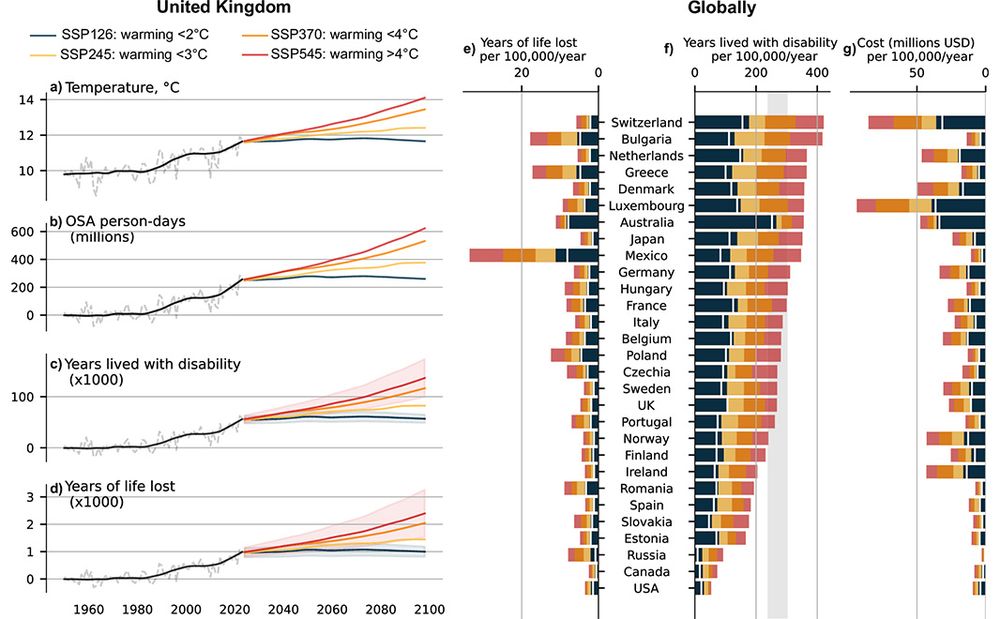
A study in Nature Communications quantifies how rising temperatures linked to climate change would increase the severity of obstructive sleep apnea (OSA) and reports projected losses of healthy life years and workplace productivity due to OSA. go.nature.com/3HMqsMg #medsky 🧪
June 22, 2025 at 7:16 PM
A study in Nature Communications quantifies how rising temperatures linked to climate change would increase the severity of obstructive sleep apnea (OSA) and reports projected losses of healthy life years and workplace productivity due to OSA. go.nature.com/3HMqsMg #medsky 🧪
Reposted by Bastien Lechat

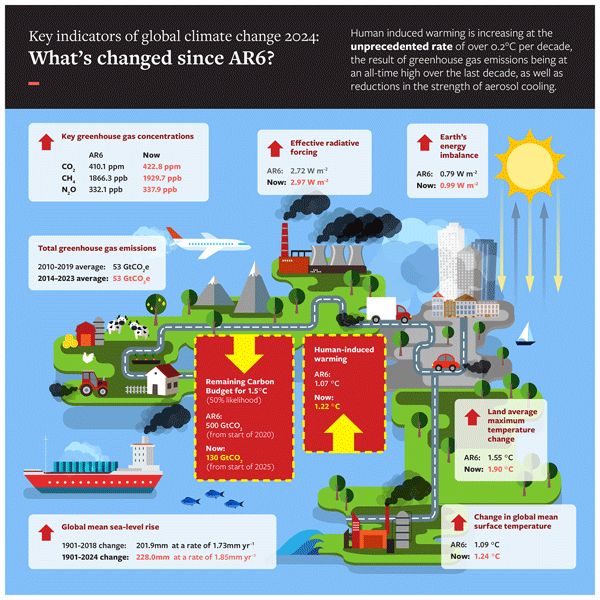
Our new paper updating key metrics in the IPCC is now out, and the news is grim:
⬆️ Human induced warming now at 1.36C
⬆️ Rate of warming now 0.27C / decade
⬆️ Sharp increase in Earth's energy imbalance
⬇️ Remaining 1.5C carbon budget only 130 GtCO2
essd.copernicus.org/...
⬆️ Human induced warming now at 1.36C
⬆️ Rate of warming now 0.27C / decade
⬆️ Sharp increase in Earth's energy imbalance
⬇️ Remaining 1.5C carbon budget only 130 GtCO2
essd.copernicus.org/...
Indicators of Global Climate Change 2024: annual update of key indicators of the state of the climate system and human influence
Abstract. In a rapidly changing climate, evidence-based decision-making benefits from up-to-date and timely information. Here we compile monitoring datasets (published at https://doi.org/10.5281/zenodo.15639576; Smith et al., 2025a) to produce updated estimates for key indicators of the state of the climate system: net emissions of greenhouse gases and short-lived climate forcers, greenhouse gas concentrations, radiative forcing, the Earth's energy imbalance, surface temperature changes, warming attributed to human activities, the remaining carbon budget, and estimates of global temperature extremes. This year, we additionally include indicators for sea-level rise and land precipitation change. We follow methods as closely as possible to those used in the IPCC Sixth Assessment Report (AR6) Working Group One report. The indicators show that human activities are increasing the Earth's energy imbalance and driving faster sea-level rise compared to the AR6 assessment. For the 2015–2024 decade average, observed warming relative to 1850–1900 was 1.24 [1.11 to 1.35] °C, of which 1.22 [1.0 to 1.5] °C was human-induced. The 2024-observed best estimate of global surface temperature (1.52 °C) is well above the best estimate of human-caused warming (1.36 °C). However, the 2024 observed warming can still be regarded as a typical year, considering the human-induced warming level and the state of internal variability associated with the phase of El Niño and Atlantic variability. Human-induced warming has been increasing at a rate that is unprecedented in the instrumental record, reaching 0.27 [0.2–0.4] °C per decade over 2015–2024. This high rate of warming is caused by a combination of greenhouse gas emissions being at an all-time high of 53.6±5.2 Gt CO2e yr−1 over the last decade (2014–2023), as well as reductions in the strength of aerosol cooling. Despite this, there is evidence that the rate of increase in CO2 emissions over the last decade has slowed compared to the 2000s, and depending on societal choices, a continued series of these annual updates over the critical 2020s decade could track decreases or increases in the rate of the climatic changes presented here.
essd.copernicus.org
June 18, 2025 at 11:10 PM
Our new paper updating key metrics in the IPCC is now out, and the news is grim:
⬆️ Human induced warming now at 1.36C
⬆️ Rate of warming now 0.27C / decade
⬆️ Sharp increase in Earth's energy imbalance
⬇️ Remaining 1.5C carbon budget only 130 GtCO2
essd.copernicus.org/...
⬆️ Human induced warming now at 1.36C
⬆️ Rate of warming now 0.27C / decade
⬆️ Sharp increase in Earth's energy imbalance
⬇️ Remaining 1.5C carbon budget only 130 GtCO2
essd.copernicus.org/...
Excited to share our latest study, just published in Nature Communications, where we show that rising global temperatures are expected to substantially increase the severity and burden of obstructive sleep apnea worldwide.
Full article here: www.nature.com/articles/s41...
Full article here: www.nature.com/articles/s41...

June 16, 2025 at 8:40 PM
Excited to share our latest study, just published in Nature Communications, where we show that rising global temperatures are expected to substantially increase the severity and burden of obstructive sleep apnea worldwide.
Full article here: www.nature.com/articles/s41...
Full article here: www.nature.com/articles/s41...