




Ani Chattaraj
@ani-chattaraj.bsky.social
Postdoc | Shakhnovich Group @Harvard | Biological Condensates & Phase Separation | Signaling and Metabolic Networks | Multiscale biophysical simulations | Systems Biology
tinyurl.com/ChattScience
tinyurl.com/ChattScience
Recently out in @jacs.acspublications.org where we provide a theoretical foundation of the solubility product framework in explaining multi- component biomolecular phase separation.
New publication! How to read the curves in biomolecular phase diagrams! A collaboration between the Schmit Group and Jonathon Ditlev, Les Loew, and @ani-chattaraj.bsky.social. 1/7 pubs.acs.org/doi/10.1021/...
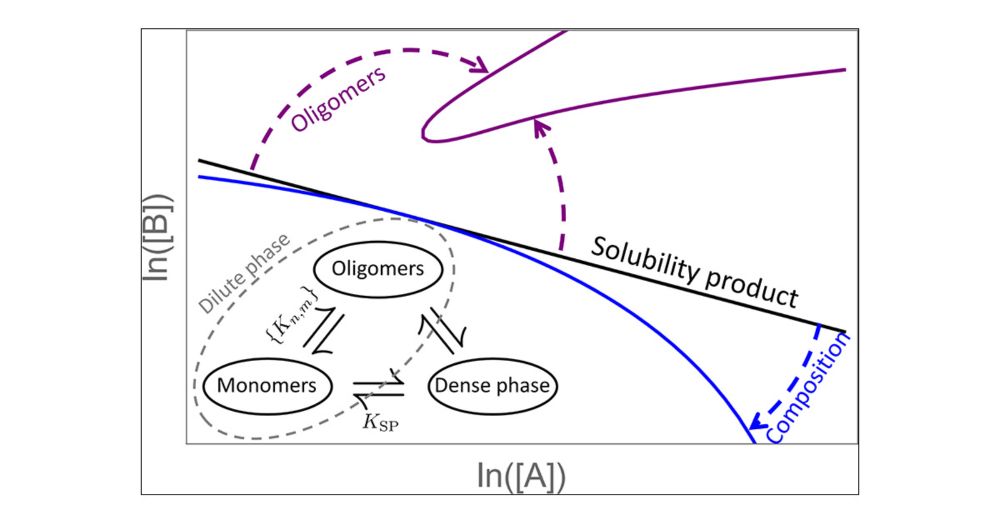
Biomolecular Phase Boundaries are Described by a Solubility Product That Accounts for Variable Stoichiometry and Soluble Oligomers
The solubility product is a rigorous description of the phase boundary for salt precipitation and has previously been shown to qualitatively describe the condensation of biomolecules. Here we present a derivation of the solubility product showing that the solubility product is also a robust description of biomolecule phase boundaries if care is taken to account for soluble oligomers and variable composition within the dense phase. Our calculation describes equilibrium between unbound monomers, the dense phase, and an ensemble of oligomer complexes with significant finite-size contributions to their free energy. The biomolecule phase boundary very nearly resembles the power law predicted by the solubility product when plotted as a function of the monomer concentrations. However, this simple form is concealed by the presence of oligomers in the dilute phase. Accounting for the oligomer ensemble introduces complexities to the power law phase boundary including re-entrant behavior and large shifts for stoichiometrically matched molecules. We show that allowing variable stoichiometry in the dense phase expands the two phase region, which appears as curvature of the phase boundary on a double-logarithmic plot. Furthermore, this curvature can be used to predict variations in the dense phase composition at different points along the phase boundary. Finally, we show how the solubility product power law can be identified in experiments by using dilute phase dissociation constants to account for the oligomer ensemble.
pubs.acs.org
December 1, 2025 at 9:34 PM
Recently out in @jacs.acspublications.org where we provide a theoretical foundation of the solubility product framework in explaining multi- component biomolecular phase separation.
Simulating sticker spacer polymers and their phase behavior? Care about the dynamics of your system? Our tool can help you do this efficiently. It is not capsule, but CASPULE :-)

November 12, 2025 at 6:01 PM
Simulating sticker spacer polymers and their phase behavior? Care about the dynamics of your system? Our tool can help you do this efficiently. It is not capsule, but CASPULE :-)
Gorgeous place for discussing science. Day 2 of Microbial energetics workshop @nitmb.bsky.social


October 29, 2025 at 2:57 AM
Gorgeous place for discussing science. Day 2 of Microbial energetics workshop @nitmb.bsky.social
Reposted by Ani Chattaraj

"What does this curved line mean?"
Like palm reading for your phase boundary.
Plus, when is your condensate actually an oligomer (or vice versa)?
A new preprint from the Schmit Group, in collaboration with Jonathon Ditlev, Les Loew, and @ani-chattaraj.bsky.social
www.biorxiv.org/content/10.1...
Like palm reading for your phase boundary.
Plus, when is your condensate actually an oligomer (or vice versa)?
A new preprint from the Schmit Group, in collaboration with Jonathon Ditlev, Les Loew, and @ani-chattaraj.bsky.social
www.biorxiv.org/content/10.1...

Biomolecular phase boundaries are described by a solubility product that accounts for variable stoichiometry and soluble oligomers
The solubility product is a rigorous description of the phase boundary for salt precipitation and has also been used to qualitatively describe the condensation of biomolecules. Here we present a deriv...
www.biorxiv.org
September 2, 2025 at 1:32 PM
"What does this curved line mean?"
Like palm reading for your phase boundary.
Plus, when is your condensate actually an oligomer (or vice versa)?
A new preprint from the Schmit Group, in collaboration with Jonathon Ditlev, Les Loew, and @ani-chattaraj.bsky.social
www.biorxiv.org/content/10.1...
Like palm reading for your phase boundary.
Plus, when is your condensate actually an oligomer (or vice versa)?
A new preprint from the Schmit Group, in collaboration with Jonathon Ditlev, Les Loew, and @ani-chattaraj.bsky.social
www.biorxiv.org/content/10.1...
Reposted by Ani Chattaraj

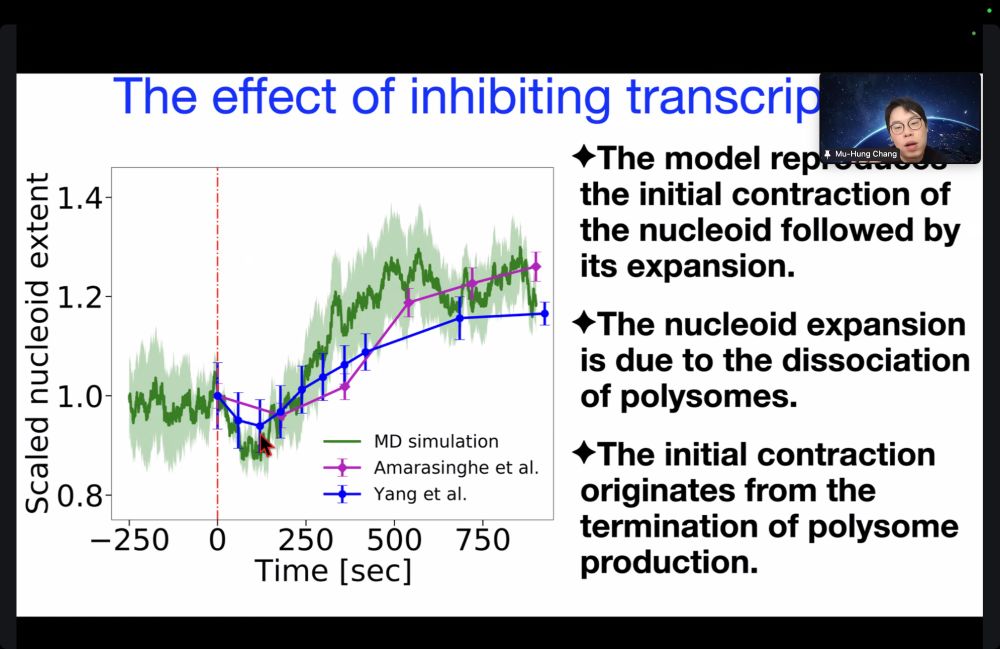
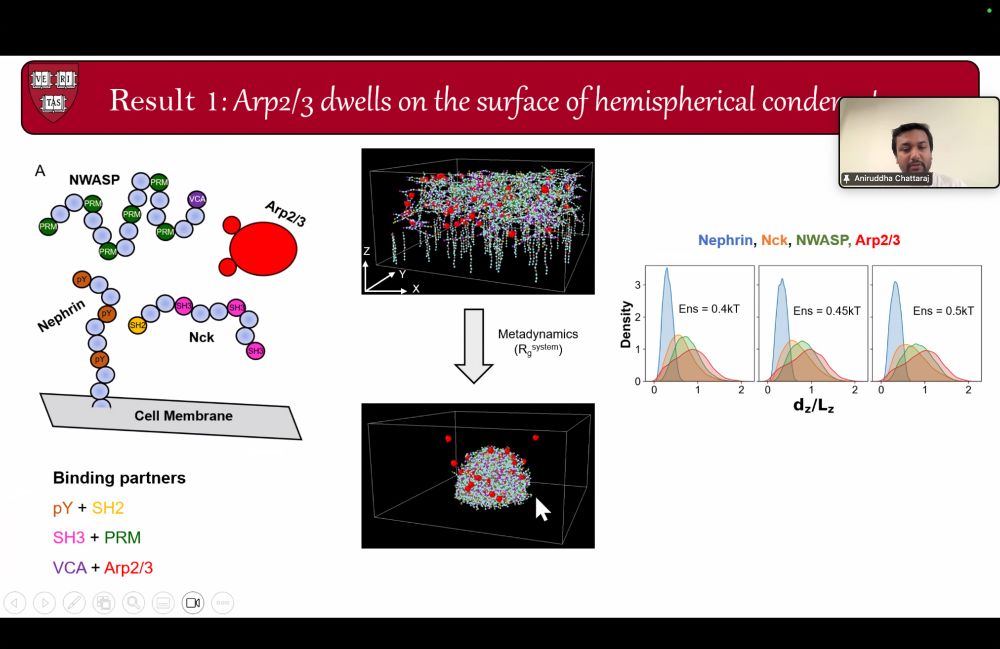
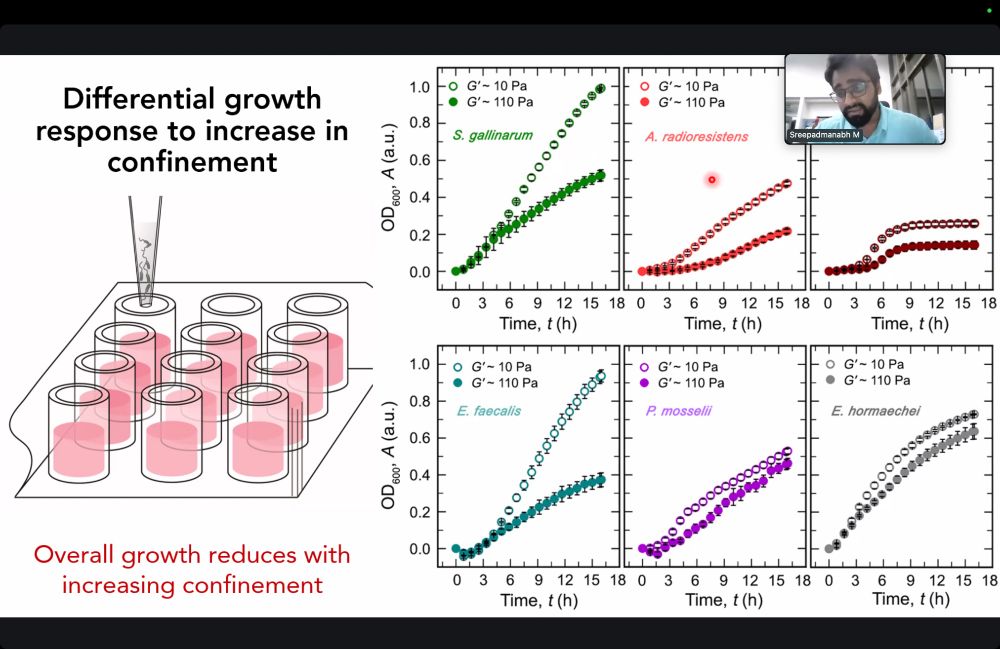
Huge thanks to all the incredible speakers who have shared their research at the Young Biophysicists Meeting so far!
Here's a glimpse.
See you in the next session!
Here's a glimpse.
See you in the next session!
May 7, 2025 at 4:52 PM
Huge thanks to all the incredible speakers who have shared their research at the Young Biophysicists Meeting so far!
Here's a glimpse.
See you in the next session!
Here's a glimpse.
See you in the next session!
Reposted by Ani Chattaraj
Mark your calendars!! 🗓️ The third Young Biophysicists Meeting will be held on the coming Monday (May 5th) from 11am - 12pm EST. We have four exciting talks lined up for you, see you all soon! Find out more : shorturl.at/4oKNe

May 2, 2025 at 5:19 PM
Mark your calendars!! 🗓️ The third Young Biophysicists Meeting will be held on the coming Monday (May 5th) from 11am - 12pm EST. We have four exciting talks lined up for you, see you all soon! Find out more : shorturl.at/4oKNe
Reposted by Ani Chattaraj

#OPENACCESS: Separation of sticker-spacer energetics governs the coalescence of metastable condensates. Aniruddha Chattaraj and Eugene I. Shakhnovich.
buff.ly
February 3, 2025 at 3:00 PM
#OPENACCESS: Separation of sticker-spacer energetics governs the coalescence of metastable condensates. Aniruddha Chattaraj and Eugene I. Shakhnovich.
What drives two liquid droplets to merge? The usual answer is surface tension. This picture is different for biological condensates. To know more, please check out our recent @biophysj.bsky.social paper:
doi.org/10.1016/j.bp...
doi.org/10.1016/j.bp...
December 26, 2024 at 9:33 PM
What drives two liquid droplets to merge? The usual answer is surface tension. This picture is different for biological condensates. To know more, please check out our recent @biophysj.bsky.social paper:
doi.org/10.1016/j.bp...
doi.org/10.1016/j.bp...