



Ahmed Negida, MD, PhD
@ahmednegida.bsky.social
Postdoctoral Scholar @VCUHealth | Formerly @HarvardMed | Global Lead @Global_Nsurg | #Neurology #Neurosurgery | Instructor @NegidaAcademy
Today, we started the 2025 mentorship program offered (for FREE) to 8751 medical students, trainees, and physicians in the MENA region. The first workshop was about Crafting a Powerful Professional CV for Medical Careers with a focus on rotations, research fellowships, and postgraduate degrees.

July 13, 2025 at 6:53 PM
Today, we started the 2025 mentorship program offered (for FREE) to 8751 medical students, trainees, and physicians in the MENA region. The first workshop was about Crafting a Powerful Professional CV for Medical Careers with a focus on rotations, research fellowships, and postgraduate degrees.
Interesting work using the ENIGMA and PPMI datasets. Four distinct subtypes of #Parkinson's disease were discovered by the SuStaIn algorithm, with good subtype stability (~70%) by visit 10 (4 years).
academic.oup.com/braincomms/a...
academic.oup.com/braincomms/a...

Neuroimaging-based data-driven subtypes of spatiotemporal atrophy due to Parkinson’s disease
Shawa et al. used a large MRI dataset and machine-learning algorithm to identify three spatiotemporal atrophy subtypes of Parkinson's, the second most comm
academic.oup.com
May 4, 2025 at 4:04 PM
Interesting work using the ENIGMA and PPMI datasets. Four distinct subtypes of #Parkinson's disease were discovered by the SuStaIn algorithm, with good subtype stability (~70%) by visit 10 (4 years).
academic.oup.com/braincomms/a...
academic.oup.com/braincomms/a...
Thanks to Ibrahim Serag, Ahmed Y Azzam, Amr K Hassan, Rehab Adel Diab, Mohamed Diab, Mahmoud Tarek Hefnawy, and Mohamed Ahmed Ali for compiling this excellent and timely review. bmcmedimaging.biomedcentral....

Multimodal diagnostic tools and advanced data models for detection of prodromal Parkinson’s disease: a scoping review - BMC Medical Imaging
Background Parkinson’s Disease (PD) is a progressive neurodegenerative disorder characterized by the loss of dopaminergic neurons in the substantia nigra pars compacta. PD is diagnosed by a combination of motor symptoms including bradykinesia, resting tremors, rigidity and postural instability. Prodromal PD is the stage preceding the onset of classic motor symptoms of PD. The diagnosis of prodromal PD remains challenging despite many available diagnostic modalities. Aim This scoping review aims to investigate and explore the current diagnostic modalities used to detect prodromal PD, focusing particularly on multimodal imaging analysis and AI-based approaches. Methods We adhered to the PRISMA-SR guidelines for scoping reviews. We conducted a comprehensive literature search at multiple databases such as PubMed, Scopus, Web of Science, and the Cochrane Library from inception to July 2024, using keywords related to prodromal PD and diagnostic modalities. We included studies based on predefined inclusion and exclusion criteria and performed data extraction using a standardized form. Results The search included 9 studies involving 567 patients with prodromal PD and 35,643 control. Studies utilized various diagnostic approaches including neuroimaging techniques and AI-driven models. sensitivity ranging from 43 to 84% and specificity up to 96%. Neuroimaging and AI technologies showed promising results in identifying early pathological changes and predicting PD onset. The highest specificity was achieved by neuromelanin-sensitive imaging model, while highest sensitivity was achieved by standard 10-s electrocardiogram (ECG) + Machine learning model. Conclusion Advanced diagnostic modalities such as AI-driven models and multimodal neuroimaging revealed promising results in early detection of prodromal PD. However, their clinical application as screening tool for prodromal PD is limited because of the lack of validation. Future research should be directed towards using Multimodal imaging in diagnosing and screening for prodromal PD. Clinical trial number Not applicable.
bmcmedimaging.biomedcentral.com
April 15, 2025 at 12:00 PM
Thanks to Ibrahim Serag, Ahmed Y Azzam, Amr K Hassan, Rehab Adel Diab, Mohamed Diab, Mahmoud Tarek Hefnawy, and Mohamed Ahmed Ali for compiling this excellent and timely review. bmcmedimaging.biomedcentral....
“It is the mark of an educated mind to be able to entertain a thought without accepting it.” ― Aristotle, Metaphysics
April 14, 2025 at 3:57 AM
“It is the mark of an educated mind to be able to entertain a thought without accepting it.” ― Aristotle, Metaphysics
Release 3.1 of the Julich Brain Atlas. The updated brain atlas gives online access to 52 new probability maps of cortical and subcortical structures in a 3D reference space. Programming interfaces for the computational neurosciences simplify the integration of the data into brain models.

New release of the Julich-Brain Atlas adds 52 new maps
Release 3.1 of the Julich Brain Atlas has been published and can be freely downloaded through the EBRAINS research infrastructure. The updated brain atlas now gives online access to 52 new probability...
www.ebrains.eu
March 17, 2025 at 4:20 AM
Release 3.1 of the Julich Brain Atlas. The updated brain atlas gives online access to 52 new probability maps of cortical and subcortical structures in a 3D reference space. Programming interfaces for the computational neurosciences simplify the integration of the data into brain models.
How do you write a case report/series? A good resource for students and junior researchers. www.americanjournalofsurgery.com/article/S000...

How to write a case report/series
Throughout our careers, many of us often experience a unique challenge regarding a
patient condition, whether surgical or not. This often leads to the question of whether
there is any literature publi...
www.americanjournalofsurgery.com
January 25, 2025 at 12:54 PM
How do you write a case report/series? A good resource for students and junior researchers. www.americanjournalofsurgery.com/article/S000...
Social inequality linked to brain volume and network dynamics, the relationship is more pronounced in AD population.
www.nature.com/articles/s43...
www.nature.com/articles/s43...

December 27, 2024 at 11:59 AM
Social inequality linked to brain volume and network dynamics, the relationship is more pronounced in AD population.
www.nature.com/articles/s43...
www.nature.com/articles/s43...
100 years from now, we will look as ignorant and unhealthy as we perceive the early 1900s humans.

Scientists: single use tea bags contain massive amounts of microplastics
Me: that sounds bad. What brands?
Scientists: we're not going to tell you. Do your own science.
Me: that sounds bad. What brands?
Scientists: we're not going to tell you. Do your own science.
December 26, 2024 at 1:58 PM
100 years from now, we will look as ignorant and unhealthy as we perceive the early 1900s humans.
Autophagy-lysosomal pathway associated protein signatures in peripheral blood mononuclear cells can differentiate PD from controls with 86% accuracy. Interesting findings but many questions ahead. Is it specific to PD? Which stage? Compared to SAA/DAT?
www.sciencedirect.com/science/arti...
www.sciencedirect.com/science/arti...

Autophagic signatures in peripheral blood mononuclear cells from Parkinson's disease patients
Parkinson's disease (PD) is a progressive neurodegenerative disorder characterized by motor impairments and the accumulation of misfolded α-synuclein.…
www.sciencedirect.com
December 26, 2024 at 1:47 PM
Autophagy-lysosomal pathway associated protein signatures in peripheral blood mononuclear cells can differentiate PD from controls with 86% accuracy. Interesting findings but many questions ahead. Is it specific to PD? Which stage? Compared to SAA/DAT?
www.sciencedirect.com/science/arti...
www.sciencedirect.com/science/arti...
Reposted by Ahmed Negida, MD, PhD

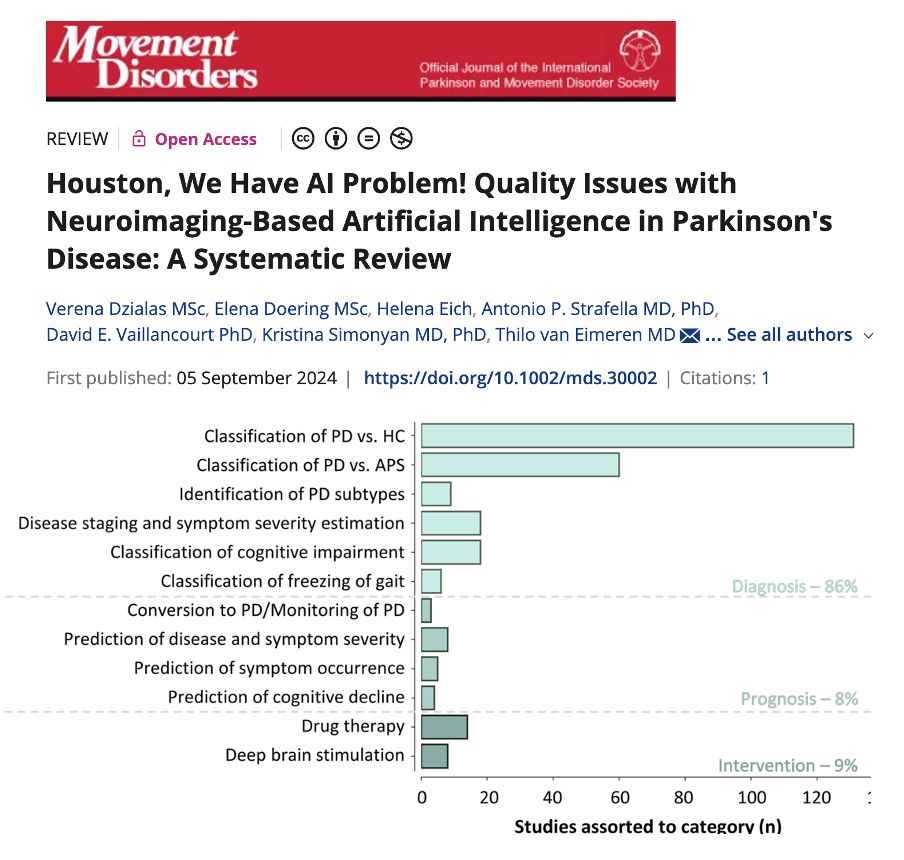
Look folks, AI is coming, however to be useful in Parkinson's disease and beyond, we don't need more publications, we need higher quality publications which will address the 5 minimal quality criteria. I love that early in our imaging journey this group of investigators has started the dialogue.
December 22, 2024 at 9:53 PM
Look folks, AI is coming, however to be useful in Parkinson's disease and beyond, we don't need more publications, we need higher quality publications which will address the 5 minimal quality criteria. I love that early in our imaging journey this group of investigators has started the dialogue.
Reposted by Ahmed Negida, MD, PhD

James Webb Telescope Captures Stunning Details of Herbig-Haro Object 797. Inspired to explore the cosmos with a telescope? Start your journey today and get your own telescope here 👉 amzn.to/49g9lvS #SpaceInspiration #AmazonAffiliate

December 25, 2024 at 11:39 PM
James Webb Telescope Captures Stunning Details of Herbig-Haro Object 797. Inspired to explore the cosmos with a telescope? Start your journey today and get your own telescope here 👉 amzn.to/49g9lvS #SpaceInspiration #AmazonAffiliate
Reposted by Ahmed Negida, MD, PhD

Is orthostatic hypotension (OH) a cause of daytime sleepiness in PD?
Our analysis shows no association in an early, treated cohort. However, in those cognitively impaired, OH has an interesting, complex expression with daytime sleepiness via depression.
Link: www.sciencedirect.com/science/arti...
Our analysis shows no association in an early, treated cohort. However, in those cognitively impaired, OH has an interesting, complex expression with daytime sleepiness via depression.
Link: www.sciencedirect.com/science/arti...

December 24, 2024 at 5:20 PM
Is orthostatic hypotension (OH) a cause of daytime sleepiness in PD?
Our analysis shows no association in an early, treated cohort. However, in those cognitively impaired, OH has an interesting, complex expression with daytime sleepiness via depression.
Link: www.sciencedirect.com/science/arti...
Our analysis shows no association in an early, treated cohort. However, in those cognitively impaired, OH has an interesting, complex expression with daytime sleepiness via depression.
Link: www.sciencedirect.com/science/arti...
Reposted by Ahmed Negida, MD, PhD

AI "hallucinations" predict the shape and folding of proteins, even if they are unknown. "Deep Network Hallucination" can help make structurally and functionally sound proteins from scratch. The next medical frontier imagined, literally. www.nytimes.com/2024/12/23/s...
www.nature.com/articles/s41...
www.nature.com/articles/s41...

De novo protein design by deep network hallucination - Nature
The trRosetta neural network was used to iteratively optimise model proteins from random 100-amino-acid sequences, resulting in ‘hallucinated’ proteins, which when expressed in bacteria closely resemb...
www.nature.com
December 24, 2024 at 8:38 PM
AI "hallucinations" predict the shape and folding of proteins, even if they are unknown. "Deep Network Hallucination" can help make structurally and functionally sound proteins from scratch. The next medical frontier imagined, literally. www.nytimes.com/2024/12/23/s...
www.nature.com/articles/s41...
www.nature.com/articles/s41...
A thought-provoking article on the biological definition of Lewy Body Disease (neuronal alpha synuclein disease).
movementdisorders.onlinelibrary.wiley.com/doi/10.1002/...
movementdisorders.onlinelibrary.wiley.com/doi/10.1002/...

Biomarker‐Based Approach to α‐Synucleinopathies: Lessons from Neuropathology
Click on the article title to read more.
movementdisorders.onlinelibrary.wiley.com
December 24, 2024 at 2:19 PM
A thought-provoking article on the biological definition of Lewy Body Disease (neuronal alpha synuclein disease).
movementdisorders.onlinelibrary.wiley.com/doi/10.1002/...
movementdisorders.onlinelibrary.wiley.com/doi/10.1002/...
The article and comments present an interesting argument about the prion hypothesis in neurodegenerative diseases.
www.j-alz.com/editors-blog...
www.j-alz.com/editors-blog...
The Prion Hypothesis at Forty: Enlightening or Deceptive? | Journal of Alzheimer's Disease
www.j-alz.com
December 22, 2024 at 8:54 PM
The article and comments present an interesting argument about the prion hypothesis in neurodegenerative diseases.
www.j-alz.com/editors-blog...
www.j-alz.com/editors-blog...
Alpha-synuclein detected in neural tissue collection of the intra-cranial instruments used in deep brain stimulation surgery for Parkinson’s disease. Creative and interesting work from the University of Florida. www.nature.com/articles/s41...

December 22, 2024 at 2:21 PM
Alpha-synuclein detected in neural tissue collection of the intra-cranial instruments used in deep brain stimulation surgery for Parkinson’s disease. Creative and interesting work from the University of Florida. www.nature.com/articles/s41...