



Patrick Murphy
@1patrickmurphy.bsky.social
Associate Professor @ UConn Medical School. Endothelial cells, RNA biology, extracellular matrix, leukocyte-endothelial interactions.
Noor can, and it was an amazing and inspirational learning experience to hear about her work. Thanks for your visit, and best of luck in continuing to develop your really exciting and powerful delivery system to cancer environment. Only afterwards did I realize I had forgotten to get a photo!
November 14, 2025 at 12:14 AM
Noor can, and it was an amazing and inspirational learning experience to hear about her work. Thanks for your visit, and best of luck in continuing to develop your really exciting and powerful delivery system to cancer environment. Only afterwards did I realize I had forgotten to get a photo!
We look forward to the next phase of this work with help from @americanheart.bsky.social @alzassociation.bsky.social @alzheimerssoc.bsky.social @alsassociation.bsky.social @cshlnews.bsky.social @navbo.bsky.social #endftd
April 17, 2025 at 2:07 AM
We look forward to the next phase of this work with help from @americanheart.bsky.social @alzassociation.bsky.social @alzheimerssoc.bsky.social @alsassociation.bsky.social @cshlnews.bsky.social @navbo.bsky.social #endftd
Congratulations to Ashok, an exceptionally talented scientist who would be a tremendous junior faculty hire. Thank you to collaborators Riqiang Yan, Cat Lutz and Aamir at JAX, members of the Murphy lab, thoughtful input from reviewers and at CSH and Gordons Brain Barriers Meetings, and the NIH.
April 17, 2025 at 1:32 AM
Congratulations to Ashok, an exceptionally talented scientist who would be a tremendous junior faculty hire. Thank you to collaborators Riqiang Yan, Cat Lutz and Aamir at JAX, members of the Murphy lab, thoughtful input from reviewers and at CSH and Gordons Brain Barriers Meetings, and the NIH.
Future questions:
- Does endothelial TDP-43 dysfunction initiate motor neuron impairment in ALS?
- Why is endothelial TDP-43 lost in AD and ALS-FTD without TDP-43 mutation (and vice versa how do some with familial mutation avoid disease)?
- How does loss of TDP-43 lead to barrier defects?
- Does endothelial TDP-43 dysfunction initiate motor neuron impairment in ALS?
- Why is endothelial TDP-43 lost in AD and ALS-FTD without TDP-43 mutation (and vice versa how do some with familial mutation avoid disease)?
- How does loss of TDP-43 lead to barrier defects?
April 17, 2025 at 1:32 AM
Future questions:
- Does endothelial TDP-43 dysfunction initiate motor neuron impairment in ALS?
- Why is endothelial TDP-43 lost in AD and ALS-FTD without TDP-43 mutation (and vice versa how do some with familial mutation avoid disease)?
- How does loss of TDP-43 lead to barrier defects?
- Does endothelial TDP-43 dysfunction initiate motor neuron impairment in ALS?
- Why is endothelial TDP-43 lost in AD and ALS-FTD without TDP-43 mutation (and vice versa how do some with familial mutation avoid disease)?
- How does loss of TDP-43 lead to barrier defects?
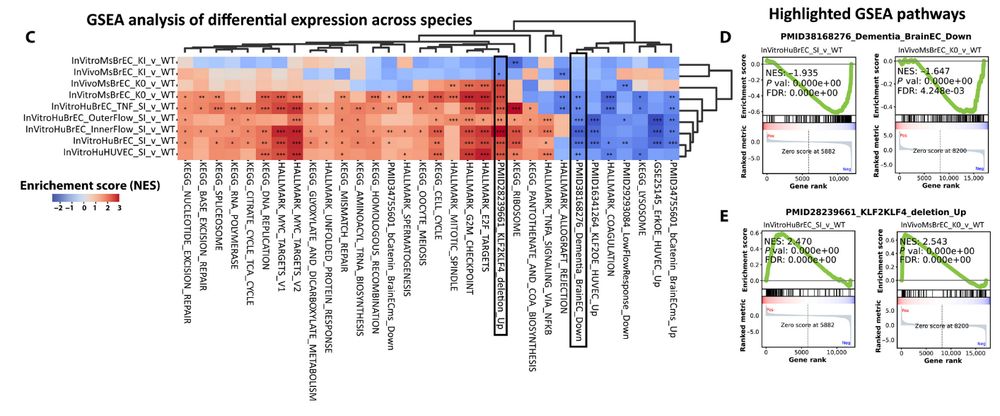
Moreover, Ashok observed changes in pathways that resembled those we had observed in capillary endothelial cells in ALS-FTD and AD of human donors. Together, this work suggests that brain endothelial TDP-43 dysfunction contributes to cognitive dysfunction.
April 17, 2025 at 1:32 AM
Moreover, Ashok observed changes in pathways that resembled those we had observed in capillary endothelial cells in ALS-FTD and AD of human donors. Together, this work suggests that brain endothelial TDP-43 dysfunction contributes to cognitive dysfunction.
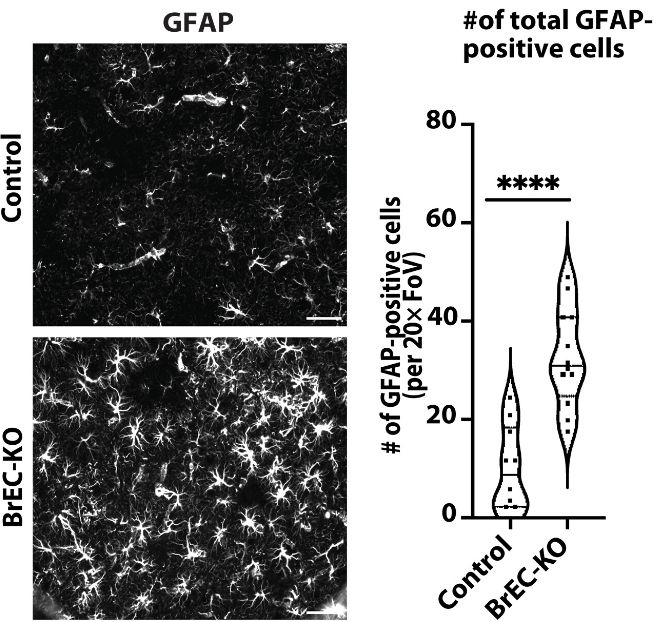
To more carefully examine brain endothelial function, Ashok used Slco1a1-CreERT2, and found acute BBB leak, and chronic fibrin deposition, basement membrane changes, gliosis, and pTau accumulation in neurons that ultimately lead to behaviors (social and memory) resembling a mouse model of FTD.
April 17, 2025 at 1:32 AM
To more carefully examine brain endothelial function, Ashok used Slco1a1-CreERT2, and found acute BBB leak, and chronic fibrin deposition, basement membrane changes, gliosis, and pTau accumulation in neurons that ultimately lead to behaviors (social and memory) resembling a mouse model of FTD.
Despite similar levels of the Tardbp mRNA, nuclear TDP-43 protein was reduced. Endothelial function was tested in Cdh5-CreERT2; Tardbp floxed mice, but systemic endothelial dysfunction limited understanding of organ specific functions.
April 17, 2025 at 1:32 AM
Despite similar levels of the Tardbp mRNA, nuclear TDP-43 protein was reduced. Endothelial function was tested in Cdh5-CreERT2; Tardbp floxed mice, but systemic endothelial dysfunction limited understanding of organ specific functions.
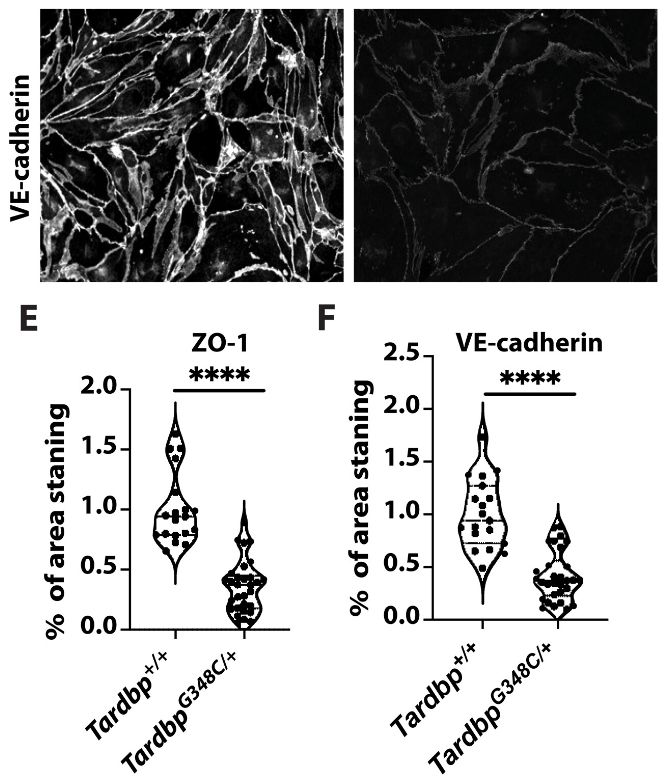
What Ashok was able to show, by isolating and culturing brain endothelial cells, is that a single allele ALS-FTD mutation in TDP-43 disrupts formation of VE-cadherin junctions, cytoskeletal organization and barrier integrity.
April 17, 2025 at 1:32 AM
What Ashok was able to show, by isolating and culturing brain endothelial cells, is that a single allele ALS-FTD mutation in TDP-43 disrupts formation of VE-cadherin junctions, cytoskeletal organization and barrier integrity.
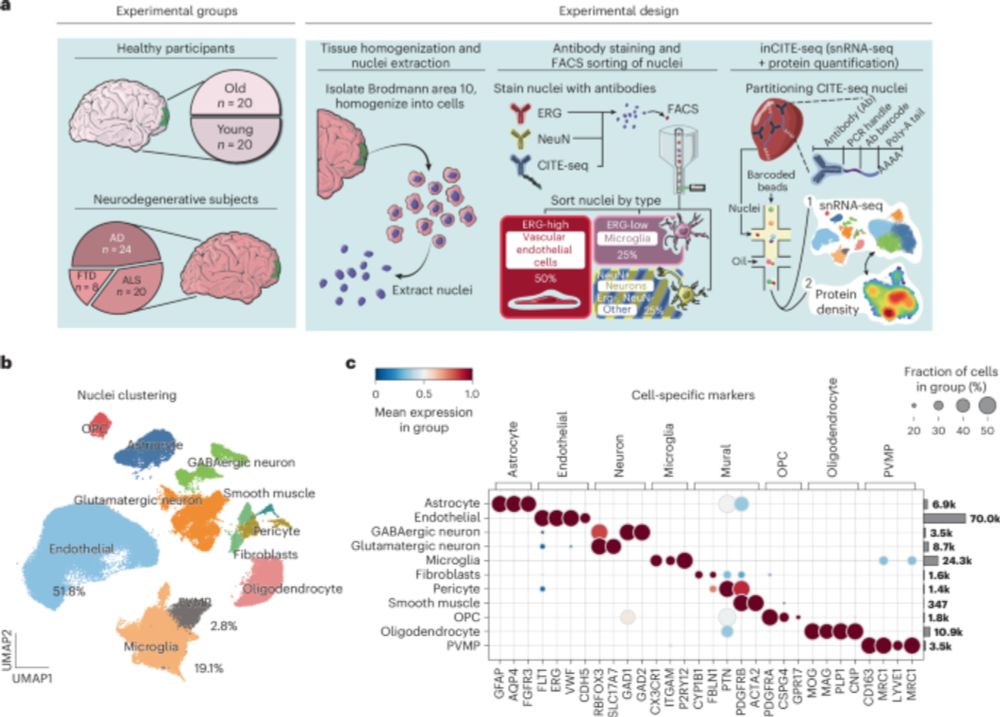
Our recent work had revealed a reduction in nuclear TDP-43 in ~40% of cerebrovascular capillaries in AD, ALS-FTD but not healthy aging www.nature.com/articles/s41... This correlated with changes in pathways critical for BBB function, but causation was unclear.
Endothelial TDP-43 depletion disrupts core blood–brain barrier pathways in neurodegeneration - Nature Neuroscience
Targeting the endothelium across ages and neurodegenerative diseases in 92 donors with single-cell inCITE-seq reveals similar alterations in ~40% of capillaries in AD, ALS and FTD. Endothelial TDP-43 ...
www.nature.com
April 17, 2025 at 1:32 AM
Our recent work had revealed a reduction in nuclear TDP-43 in ~40% of cerebrovascular capillaries in AD, ALS-FTD but not healthy aging www.nature.com/articles/s41... This correlated with changes in pathways critical for BBB function, but causation was unclear.
Congratulations @vijayrathinam.bsky.social
March 30, 2025 at 7:17 PM
Congratulations @vijayrathinam.bsky.social
It is important to recognize the many years of hard work, and continued support new insight requires. This work began many years ago (15 to be exact), with basic questions about the regulation of endothelial functions by RNA-binding proteins in Richard Hynes lab, and with the help of Chris Burge.
March 14, 2025 at 1:17 PM
It is important to recognize the many years of hard work, and continued support new insight requires. This work began many years ago (15 to be exact), with basic questions about the regulation of endothelial functions by RNA-binding proteins in Richard Hynes lab, and with the help of Chris Burge.
Many thanks to collaborator Dr. Riqiang Yan, members of the Murphy lab, our flow and sequencing facilities, our funding at NIH NINDS and earlier awards from AHA and NHLBI for contributing to this work. Most importantly, thank you to the donors who contributed to this through the NIH NeuroBioBank.
March 14, 2025 at 1:17 PM
Many thanks to collaborator Dr. Riqiang Yan, members of the Murphy lab, our flow and sequencing facilities, our funding at NIH NINDS and earlier awards from AHA and NHLBI for contributing to this work. Most importantly, thank you to the donors who contributed to this through the NIH NeuroBioBank.
In addition to well-known roles in transcriptional regulation of inflammatory responses, NF-kB(p65) is critical for epithelial and endothelial junctions and barrier maintenance. Understanding how TDP-43 bifurcates these NF-kB(p65) responses will be key to understanding brain barrier dysfunction.
March 14, 2025 at 1:17 PM
In addition to well-known roles in transcriptional regulation of inflammatory responses, NF-kB(p65) is critical for epithelial and endothelial junctions and barrier maintenance. Understanding how TDP-43 bifurcates these NF-kB(p65) responses will be key to understanding brain barrier dysfunction.
Although it is not yet clear why loss of TDP-43 affects the endothelium, an intriguing observation from our analysis of nuclear protein is that NF-kB(p65) and TDP-43 are tightly correlated in healthy endothelium - and that loss of TDP-43 in disease de-represses NF-kB mediated transcription.
March 14, 2025 at 1:17 PM
Although it is not yet clear why loss of TDP-43 affects the endothelium, an intriguing observation from our analysis of nuclear protein is that NF-kB(p65) and TDP-43 are tightly correlated in healthy endothelium - and that loss of TDP-43 in disease de-represses NF-kB mediated transcription.
Barrier dysfunction occurs early in disease development, and we observed similar but milder alterations in aged donors with Alzheimer's risk factors of diabetes and hypertension, suggesting that endothelial TDP-43 loss is an early event in disease progression.
March 14, 2025 at 1:17 PM
Barrier dysfunction occurs early in disease development, and we observed similar but milder alterations in aged donors with Alzheimer's risk factors of diabetes and hypertension, suggesting that endothelial TDP-43 loss is an early event in disease progression.
In parallel work (Science Advances next month and bioRxiv here : www.biorxiv.org/content/10.1...) we show that targeted deletion of TDP-43 in brain endothelium compromises the blood brain barrier, and leads to dysfunction of the same pathways disrupted in human capillaries with reduced TDP-43.
Loss of Endothelial TDP-43 Leads to Blood Brain Barrier Defects in Mouse Models of Amyotrophic Lateral Sclerosis and Frontotemporal Dementia
Loss of nuclear TDP-43 occurs in a wide range of neurodegenerative diseases, and specific mutations in the TARDBP gene that encodes the protein are linked to familial Frontal Temporal Lobar Dementia (...
www.biorxiv.org
March 14, 2025 at 1:17 PM
In parallel work (Science Advances next month and bioRxiv here : www.biorxiv.org/content/10.1...) we show that targeted deletion of TDP-43 in brain endothelium compromises the blood brain barrier, and leads to dysfunction of the same pathways disrupted in human capillaries with reduced TDP-43.
Why does this matter? TDP-43 mutations drive ALS-FTD, and its nuclear depletion in neurons is a hallmark of neurodegeneration. Our findings reveal TDP-43 is also lost in the capillary endothelium, where it correlates with transcriptional hallmarks of blood-brain barrier dysfunction.
March 14, 2025 at 1:17 PM
Why does this matter? TDP-43 mutations drive ALS-FTD, and its nuclear depletion in neurons is a hallmark of neurodegeneration. Our findings reveal TDP-43 is also lost in the capillary endothelium, where it correlates with transcriptional hallmarks of blood-brain barrier dysfunction.
We find a distinct transcriptional program that characterizes ~40% of the capillary endothelium in neurodegenerative diseases, including ALS-FTD, and Alzheimer’s, and is marked by nuclear loss TDP-43.
March 14, 2025 at 1:17 PM
We find a distinct transcriptional program that characterizes ~40% of the capillary endothelium in neurodegenerative diseases, including ALS-FTD, and Alzheimer’s, and is marked by nuclear loss TDP-43.
In a herculean effort led by talented MD/PhD student Omar M Omar, we use a novel approach for endothelial cell enrichment to create a massive dataset of endothelial changes in healthy aging and ALS-FTD and Alzheimer's Disease (92 donors). A data portal is here : murphylabvasculardata.cam.uchc.edu
UCHC inCITE Vascular Data
Web site created using create-react-app
murphylabvasculardata.cam.uchc.edu
March 14, 2025 at 1:17 PM
In a herculean effort led by talented MD/PhD student Omar M Omar, we use a novel approach for endothelial cell enrichment to create a massive dataset of endothelial changes in healthy aging and ALS-FTD and Alzheimer's Disease (92 donors). A data portal is here : murphylabvasculardata.cam.uchc.edu