


Zheng Wu
@zhengwu1.bsky.social
Postdoc at Ralph DeBerardinis’s lab at UT Southwestern Medical Center via Yale and Salk Institute. Recipient of NIH Pathway to Independence Award (K99/R00)
Interested in #mitochondria, #metabolism and innate immunity.
Interested in #mitochondria, #metabolism and innate immunity.
Reposted by Zheng Wu

3rd: conclusion/impact/implications
1 sentence is often enough; sometimes 2 are necessary. Provide a short, concise conclusion - what is the punchline? Do you have sth *important* to comment on regarding implications? Could be therapeutic implications or a finding that changes a dogma. Be specific.
1 sentence is often enough; sometimes 2 are necessary. Provide a short, concise conclusion - what is the punchline? Do you have sth *important* to comment on regarding implications? Could be therapeutic implications or a finding that changes a dogma. Be specific.
2nd: the findings
The longest and main part of your abstract. Here you should explain:
i) what you did and how
ii) what you found
An effective abstract doesn’t bombard the reader with details; you can’t describe all your results. Stick to major.
*Must*: use friends from other fields as beta readers
The longest and main part of your abstract. Here you should explain:
i) what you did and how
ii) what you found
An effective abstract doesn’t bombard the reader with details; you can’t describe all your results. Stick to major.
*Must*: use friends from other fields as beta readers
1st: 1-2 (max) sentences - intro
Present the known and its caveat. It can be as brief as 1 sentence (we know x, but y (somehow linked to x) is unknown) or 2 sentences. My view is that abstracts with more than 2 introductory sentences rarely work well. Specific, clear, only the absolutely necessary.
Present the known and its caveat. It can be as brief as 1 sentence (we know x, but y (somehow linked to x) is unknown) or 2 sentences. My view is that abstracts with more than 2 introductory sentences rarely work well. Specific, clear, only the absolutely necessary.
December 30, 2025 at 10:50 AM
3rd: conclusion/impact/implications
1 sentence is often enough; sometimes 2 are necessary. Provide a short, concise conclusion - what is the punchline? Do you have sth *important* to comment on regarding implications? Could be therapeutic implications or a finding that changes a dogma. Be specific.
1 sentence is often enough; sometimes 2 are necessary. Provide a short, concise conclusion - what is the punchline? Do you have sth *important* to comment on regarding implications? Could be therapeutic implications or a finding that changes a dogma. Be specific.
Reposted by Zheng Wu
2nd: the findings
The longest and main part of your abstract. Here you should explain:
i) what you did and how
ii) what you found
An effective abstract doesn’t bombard the reader with details; you can’t describe all your results. Stick to major.
*Must*: use friends from other fields as beta readers
The longest and main part of your abstract. Here you should explain:
i) what you did and how
ii) what you found
An effective abstract doesn’t bombard the reader with details; you can’t describe all your results. Stick to major.
*Must*: use friends from other fields as beta readers
1st: 1-2 (max) sentences - intro
Present the known and its caveat. It can be as brief as 1 sentence (we know x, but y (somehow linked to x) is unknown) or 2 sentences. My view is that abstracts with more than 2 introductory sentences rarely work well. Specific, clear, only the absolutely necessary.
Present the known and its caveat. It can be as brief as 1 sentence (we know x, but y (somehow linked to x) is unknown) or 2 sentences. My view is that abstracts with more than 2 introductory sentences rarely work well. Specific, clear, only the absolutely necessary.
Tip 1: Follow a tight structure
There’s not only one way, but there certainly is a “safe” and always successful recipe. Your abstract consists of 3 parts:
1st: 1-2 (max!) sentences - intro;
2nd: the longest - the findings;
3rd: 1 sentence (2 could work, but often unnecessary) - wrap it up.
There’s not only one way, but there certainly is a “safe” and always successful recipe. Your abstract consists of 3 parts:
1st: 1-2 (max!) sentences - intro;
2nd: the longest - the findings;
3rd: 1 sentence (2 could work, but often unnecessary) - wrap it up.
December 30, 2025 at 10:49 AM
2nd: the findings
The longest and main part of your abstract. Here you should explain:
i) what you did and how
ii) what you found
An effective abstract doesn’t bombard the reader with details; you can’t describe all your results. Stick to major.
*Must*: use friends from other fields as beta readers
The longest and main part of your abstract. Here you should explain:
i) what you did and how
ii) what you found
An effective abstract doesn’t bombard the reader with details; you can’t describe all your results. Stick to major.
*Must*: use friends from other fields as beta readers
Reposted by Zheng Wu
1st: 1-2 (max) sentences - intro
Present the known and its caveat. It can be as brief as 1 sentence (we know x, but y (somehow linked to x) is unknown) or 2 sentences. My view is that abstracts with more than 2 introductory sentences rarely work well. Specific, clear, only the absolutely necessary.
Present the known and its caveat. It can be as brief as 1 sentence (we know x, but y (somehow linked to x) is unknown) or 2 sentences. My view is that abstracts with more than 2 introductory sentences rarely work well. Specific, clear, only the absolutely necessary.
Tip 1: Follow a tight structure
There’s not only one way, but there certainly is a “safe” and always successful recipe. Your abstract consists of 3 parts:
1st: 1-2 (max!) sentences - intro;
2nd: the longest - the findings;
3rd: 1 sentence (2 could work, but often unnecessary) - wrap it up.
There’s not only one way, but there certainly is a “safe” and always successful recipe. Your abstract consists of 3 parts:
1st: 1-2 (max!) sentences - intro;
2nd: the longest - the findings;
3rd: 1 sentence (2 could work, but often unnecessary) - wrap it up.
December 30, 2025 at 10:48 AM
1st: 1-2 (max) sentences - intro
Present the known and its caveat. It can be as brief as 1 sentence (we know x, but y (somehow linked to x) is unknown) or 2 sentences. My view is that abstracts with more than 2 introductory sentences rarely work well. Specific, clear, only the absolutely necessary.
Present the known and its caveat. It can be as brief as 1 sentence (we know x, but y (somehow linked to x) is unknown) or 2 sentences. My view is that abstracts with more than 2 introductory sentences rarely work well. Specific, clear, only the absolutely necessary.
Reposted by Zheng Wu
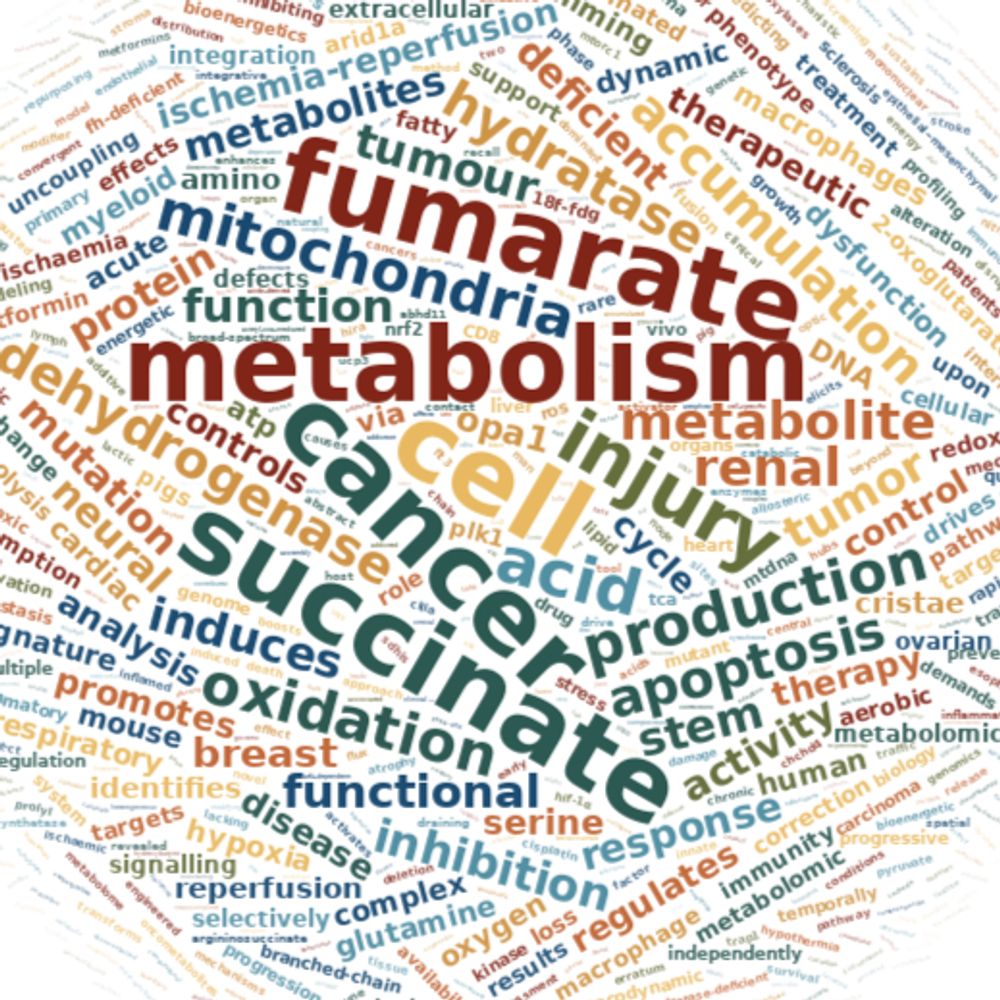
NUDT5 regulates purine metabolism and thiopurine sensitivity by interacting with PPAT | Science www.science.org/doi/10.1126/...
Great work from @rjdlab.bsky.social !!
Great work from @rjdlab.bsky.social !!

NUDT5 regulates purine metabolism and thiopurine sensitivity by interacting with PPAT
Cells generate purine nucleotides through de novo purine biosynthesis (DNPB) and purine salvage. Purine salvage represses DNPB to prevent excessive purine nucleotide synthesis through mechanisms that ...
www.science.org
November 7, 2025 at 7:35 AM
NUDT5 regulates purine metabolism and thiopurine sensitivity by interacting with PPAT | Science www.science.org/doi/10.1126/...
Great work from @rjdlab.bsky.social !!
Great work from @rjdlab.bsky.social !!
Super excited to share that my second project in the @rjdlab.bsky.social is now published in Science! Many thanks to all co-authors, especially @ptnguyen.bsky.social for his expertise in structural biology and enzymology! And big thanks to Ralph for his incredible mentorship and support!
1/New paper from Zheng Wu, Phong Nguyen et al. @cri-utsw.bsky.social shows how cells balance the two pathways that produce purine nucleotides: de novo purine biosynthesis (DNPB) and purine salvage. The surprising mechanism involves NUDT5, a Nudix hydrolase
www.science.org/doi/10.1126/...
www.science.org/doi/10.1126/...

NUDT5 regulates purine metabolism and thiopurine sensitivity by interacting with PPAT
Cells generate purine nucleotides through de novo purine biosynthesis (DNPB) and purine salvage. Purine salvage represses DNPB to prevent excessive purine nucleotide synthesis through mechanisms that ...
www.science.org
November 6, 2025 at 11:37 PM
Super excited to share that my second project in the @rjdlab.bsky.social is now published in Science! Many thanks to all co-authors, especially @ptnguyen.bsky.social for his expertise in structural biology and enzymology! And big thanks to Ralph for his incredible mentorship and support!
Reposted by Zheng Wu
Remarkable new human proteome-wide effort to predict protein-protein interactions using coevolutionary signals and deep learning. From Qian Cong in the Eugene McDermott Center at UT Southwestern.
www.science.org/doi/10.1126/...
www.science.org/doi/10.1126/...
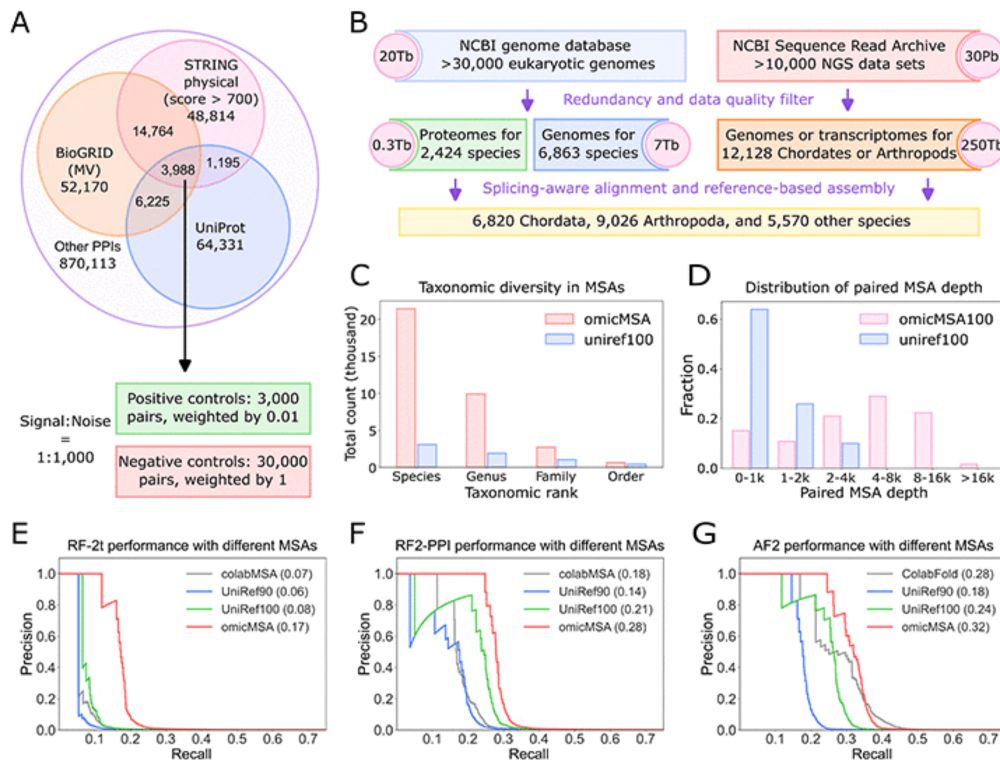
Predicting protein-protein interactions in the human proteome
Protein-protein interactions (PPI) are essential for biological function. Coevolutionary analysis and deep learning (DL) based protein structure prediction have enabled comprehensive PPI identificatio...
www.science.org
September 25, 2025 at 6:26 PM
Remarkable new human proteome-wide effort to predict protein-protein interactions using coevolutionary signals and deep learning. From Qian Cong in the Eugene McDermott Center at UT Southwestern.
www.science.org/doi/10.1126/...
www.science.org/doi/10.1126/...
I’m thrilled to share that I have been awarded an NIH/NIGMS K99 Pathway to Independence Award. I’m deeply grateful to everyone who has supported me along the way, especially
@rjdlab.bsky.social @cri-utsw.bsky.social
@rjdlab.bsky.social @cri-utsw.bsky.social
August 19, 2025 at 1:41 AM
I’m thrilled to share that I have been awarded an NIH/NIGMS K99 Pathway to Independence Award. I’m deeply grateful to everyone who has supported me along the way, especially
@rjdlab.bsky.social @cri-utsw.bsky.social
@rjdlab.bsky.social @cri-utsw.bsky.social
Reposted by Zheng Wu
Happy Holidays from the best group you’ll find!
@rjdlab.bsky.social celebrating with the McDermott Center!
@rjdlab.bsky.social celebrating with the McDermott Center!

December 12, 2024 at 2:34 PM
Happy Holidays from the best group you’ll find!
@rjdlab.bsky.social celebrating with the McDermott Center!
@rjdlab.bsky.social celebrating with the McDermott Center!
Reposted by Zheng Wu
Join us in Austin, TXm Feb 9-10 2025, for an Abcam-sponsored symposium on Cancer and Metabolism. -RJD
events.abcam.com/event/cancer...
events.abcam.com/event/cancer...
Home - Cancer and Metabolism
events.abcam.com
December 5, 2024 at 11:18 PM
Join us in Austin, TXm Feb 9-10 2025, for an Abcam-sponsored symposium on Cancer and Metabolism. -RJD
events.abcam.com/event/cancer...
events.abcam.com/event/cancer...
Reposted by Zheng Wu
New from Cold Spring Harbor Press. Available in December, 2024, just in time for the holidays! -RJD

November 15, 2024 at 7:06 PM
New from Cold Spring Harbor Press. Available in December, 2024, just in time for the holidays! -RJD