


Ella Striem-Amit
@striemamit.bsky.social
Cognitive+systems neuroscientist, studying brains/abilities in blindness, deafness or handlessness to probe brain plasticity & development. Opinions are my own.
samp-lab.facultysite.georgetown.edu
samp-lab.facultysite.georgetown.edu
Pinned
Ella Striem-Amit
@striemamit.bsky.social
· Nov 20
Apply - Interfolio
{{$ctrl.$state.data.pageTitle}} - Apply - Interfolio
apply.interfolio.com
Pls report: We're hiring! Looking for a postdoctoral research fellow to join our study of individual differences in plasticity in #blindness (+ possible extension to #deafness) using fMRI.
Details and application: apply.interfolio.com/177838
#hiring #postdoc #neurojobs #Neuroscience #NeuroTwitter
Details and application: apply.interfolio.com/177838
#hiring #postdoc #neurojobs #Neuroscience #NeuroTwitter
Reposted by Ella Striem-Amit

This was such a fun section to write! The review provides an on-ramp to further integrating DL within the developmental field. Existing DNN findings & tools, while not without caveats, open new empirical developmental questions. I'm grateful for NSF's support to my lab as we tackle some of them 👶

This paper was an awesome collaborative effort of a @fitngin.bsky.social working group. It provides a detailed review of how DNNs can be used to support dev neuro research
@lauriebayet.bsky.social and I wrote the network modeling section about how DNNs can be used to test developmental theories 🧵
@lauriebayet.bsky.social and I wrote the network modeling section about how DNNs can be used to test developmental theories 🧵

Deep learning in fetal, infant, and toddler neuroimaging research
Artificial intelligence (AI) is increasingly being integrated into everyday tasks and work environments. However, its adoption in medical image analys…
www.sciencedirect.com
January 29, 2026 at 12:22 AM
This was such a fun section to write! The review provides an on-ramp to further integrating DL within the developmental field. Existing DNN findings & tools, while not without caveats, open new empirical developmental questions. I'm grateful for NSF's support to my lab as we tackle some of them 👶
Reposted by Ella Striem-Amit

With some trepidation, I'm putting this out into the world:
gershmanlab.com/textbook.html
It's a textbook called Computational Foundations of Cognitive Neuroscience, which I wrote for my class.
My hope is that this will be a living document, continuously improved as I get feedback.
gershmanlab.com/textbook.html
It's a textbook called Computational Foundations of Cognitive Neuroscience, which I wrote for my class.
My hope is that this will be a living document, continuously improved as I get feedback.
January 9, 2026 at 1:27 AM
With some trepidation, I'm putting this out into the world:
gershmanlab.com/textbook.html
It's a textbook called Computational Foundations of Cognitive Neuroscience, which I wrote for my class.
My hope is that this will be a living document, continuously improved as I get feedback.
gershmanlab.com/textbook.html
It's a textbook called Computational Foundations of Cognitive Neuroscience, which I wrote for my class.
My hope is that this will be a living document, continuously improved as I get feedback.
Reposted by Ella Striem-Amit
🚨NEW PREPRINT🚨
www.biorxiv.org/content/10.6...
w/ Giulio Degano and Uta Noppeney
In this work, we use music to investigate how the brain extracts and integrates multisensory information in real-world environments.
🧠🧪 #psychscisky #neuroskyence
TL;DR 🧵👇
www.biorxiv.org/content/10.6...
w/ Giulio Degano and Uta Noppeney
In this work, we use music to investigate how the brain extracts and integrates multisensory information in real-world environments.
🧠🧪 #psychscisky #neuroskyence
TL;DR 🧵👇
Feeling the music: Audiotactile encoding of temporal structure in the human brain
In everyday situations, like a rock party or an organ concert, we feel music vibrating through our bodies. How do these vibrotactile signals influence music processing? How do they aid auditory scene analysis? Combining psychophysics, fMRI and time-resolved EEG decoding, this work reveals how the brain encodes the temporal structure of music (beat and envelope) across audition and touch and uses this information to guide multisensory integration and segregation in simple and more complex perceptual scenes. Participants experienced monophonic and polyphonic piano pieces through auditory, vibrotactile and audiotactile stimulation. Vibrotactile signals improved the detection of a brief target embedded in music, establishing the functional relevance of audiotactile integration in naturalistic settings. fMRI and EEG multivariate decoding revealed that auditory and tactile beat information converged in planum temporale and parietal operculum, albeit through distinct neural dynamics and representations. Superior temporal cortices reliably encoded envelope information from audition, but only weakly from touch. Nevertheless, vibrotactile signals significantly enhanced neural encoding of auditory beat as early as 100 ms, and envelope representations from 250 ms onward. These encoding benefits were associated with superadditive interactions in primary auditory cortex, where tactile signals sharpen and amplify auditory envelope representations. In complex polyphonic music, touch further amplified the segregation and encoding of temporally coherent auditory streams. Our findings highlight the important, yet largely unexplored influence of touch on auditory processing, enriching music perception and supporting auditory scene analysis in real-world environments. ### Competing Interest Statement The authors have declared no competing interest. European Research Council, 309349, 101096659
www.biorxiv.org
January 19, 2026 at 10:37 AM
🚨NEW PREPRINT🚨
www.biorxiv.org/content/10.6...
w/ Giulio Degano and Uta Noppeney
In this work, we use music to investigate how the brain extracts and integrates multisensory information in real-world environments.
🧠🧪 #psychscisky #neuroskyence
TL;DR 🧵👇
www.biorxiv.org/content/10.6...
w/ Giulio Degano and Uta Noppeney
In this work, we use music to investigate how the brain extracts and integrates multisensory information in real-world environments.
🧠🧪 #psychscisky #neuroskyence
TL;DR 🧵👇
Reposted by Ella Striem-Amit
Every day a new reason to support articles of impeachment against RFK Jr...find the tools you need to add your support and demand that your Congressperson does the same www.standupforscience.net/impeach-rfkjr
January 6, 2026 at 12:10 AM
Every day a new reason to support articles of impeachment against RFK Jr...find the tools you need to add your support and demand that your Congressperson does the same www.standupforscience.net/impeach-rfkjr
Still accepting applications!
Pls report: We're hiring! Looking for a postdoctoral research fellow to join our study of individual differences in plasticity in #blindness (+ possible extension to #deafness) using fMRI.
Details and application: apply.interfolio.com/177838
#hiring #postdoc #neurojobs #Neuroscience #NeuroTwitter
Details and application: apply.interfolio.com/177838
#hiring #postdoc #neurojobs #Neuroscience #NeuroTwitter
Apply - Interfolio
{{$ctrl.$state.data.pageTitle}} - Apply - Interfolio
apply.interfolio.com
January 5, 2026 at 11:22 PM
Still accepting applications!
Preprint alert from our lab!
@zhiqingdeng.bsky.social shows how the sensorimotor system reorganizes in people born without hands.
#neuroscience #motor #somatosensory
@zhiqingdeng.bsky.social shows how the sensorimotor system reorganizes in people born without hands.
#neuroscience #motor #somatosensory

😆Sharing our new preprint with everyone!
www.biorxiv.org/content/10.6...
👍We found a hierarchical plasticity within the somatosensory system in people born without hands.
❤️Thanks to @striemamit.bsky.social, Florencia Martinez-Addiego, and Yuqi Liu.
🌟Comments and feedback are welcome!
www.biorxiv.org/content/10.6...
👍We found a hierarchical plasticity within the somatosensory system in people born without hands.
❤️Thanks to @striemamit.bsky.social, Florencia Martinez-Addiego, and Yuqi Liu.
🌟Comments and feedback are welcome!
December 15, 2025 at 7:21 PM
Preprint alert from our lab!
@zhiqingdeng.bsky.social shows how the sensorimotor system reorganizes in people born without hands.
#neuroscience #motor #somatosensory
@zhiqingdeng.bsky.social shows how the sensorimotor system reorganizes in people born without hands.
#neuroscience #motor #somatosensory
Reposted by Ella Striem-Amit

Dimensionality reduction may be the wrong approach to understanding neural representations. Our new paper shows that across human visual cortex, dimensionality is unbounded and scales with dataset size—we show this across nearly four orders of magnitude. journals.plos.org/ploscompbiol...

December 11, 2025 at 3:32 PM
Dimensionality reduction may be the wrong approach to understanding neural representations. Our new paper shows that across human visual cortex, dimensionality is unbounded and scales with dataset size—we show this across nearly four orders of magnitude. journals.plos.org/ploscompbiol...
Reposted by Ella Striem-Amit
Hopkins Cog Sci is hiring! We have two open faculty positions: one in vision, and one language. Please repost!

December 12, 2025 at 6:18 PM
Hopkins Cog Sci is hiring! We have two open faculty positions: one in vision, and one language. Please repost!
Reposted by Ella Striem-Amit
Now out in #JNeurosci -- we found changes in medial parietal cortex after manual exploration of everyday real-world objects
doi.org/10.1523/JNEU...
with Beth Rispoli, Vinai Roopchansingh & @cibaker.bsky.social
doi.org/10.1523/JNEU...
with Beth Rispoli, Vinai Roopchansingh & @cibaker.bsky.social

December 11, 2025 at 5:13 PM
Now out in #JNeurosci -- we found changes in medial parietal cortex after manual exploration of everyday real-world objects
doi.org/10.1523/JNEU...
with Beth Rispoli, Vinai Roopchansingh & @cibaker.bsky.social
doi.org/10.1523/JNEU...
with Beth Rispoli, Vinai Roopchansingh & @cibaker.bsky.social
Reposted by Ella Striem-Amit
Investigating individual-specific topographic organization has traditionally been a resource-intensive and time-consuming process. But what if we could map visual cortex organization in thousands of brains? Here we offer the community with a toolbox that can do just that! tinyurl.com/deepretinotopy

December 1, 2025 at 11:26 AM
Investigating individual-specific topographic organization has traditionally been a resource-intensive and time-consuming process. But what if we could map visual cortex organization in thousands of brains? Here we offer the community with a toolbox that can do just that! tinyurl.com/deepretinotopy
Reposted by Ella Striem-Amit

This afternoon, I was in a meeting with Jay Bhattacharya, and I can confirm this is *exactly* what he both wants and will be doing.
THIS IS NOT HYPERBOLE.
THIS IS NOT HYPERBOLE.
I missed this from a couple of weeks ago, but if you're an NIH-funded investigator, please read.
Peer review will exist to make things look legitimate, but can, and will, be over-ruled. Funding decisions, ultimately, will be done by political appointees.
grants.nih.gov/news-events/...
Peer review will exist to make things look legitimate, but can, and will, be over-ruled. Funding decisions, ultimately, will be done by political appointees.
grants.nih.gov/news-events/...
Implementing a Unified NIH Funding Strategy to Guide Consistent and Clearer Award Decisions | Grants & Funding
grants.nih.gov
December 5, 2025 at 10:07 PM
This afternoon, I was in a meeting with Jay Bhattacharya, and I can confirm this is *exactly* what he both wants and will be doing.
THIS IS NOT HYPERBOLE.
THIS IS NOT HYPERBOLE.
Reposted by Ella Striem-Amit

Online Now: Shaping bodily self-awareness through thermosensory signals

Shaping bodily self-awareness through thermosensory signals
Skin temperature and the ability to perceive warm and cold thermal stimuli (i.e., thermoception) are fundamental to human survival, influencing both our evolutionary history and early individual development. Interestingly, recent research has also started to uncover the role of these thermosensory signals in cognition. Such signals may contribute to the construction of our bodily self-awareness, and specifically the sense of body ownership, which is defined as the feeling that the body and its parts belong to us. This review examines how thermosensory signals travel from the skin to the brain and their impact on body ownership in both healthy and clinical populations. Furthermore, we propose mechanisms that may underlie this interaction and highlight potential clinical and societal applications.
dlvr.it
December 4, 2025 at 8:04 PM
Online Now: Shaping bodily self-awareness through thermosensory signals
Reposted by Ella Striem-Amit
We recently stumbled upon a surprisingly common misunderstanding in computing noise ceilings that can be quite consequential. So if you care about noise ceilings, please check out Sander’s thread and our preprint! 👇

New preprint w/ Malin Styrnal & @martinhebart.bsky.social
Have you ever computed noise ceilings to understand how well a model performs? We wrote a clarifying note on a subtle and common misapplication that can make models appear quite a lot better than they are.
osf.io/preprints/ps...
Have you ever computed noise ceilings to understand how well a model performs? We wrote a clarifying note on a subtle and common misapplication that can make models appear quite a lot better than they are.
osf.io/preprints/ps...
OSF
osf.io
December 5, 2025 at 8:39 AM
We recently stumbled upon a surprisingly common misunderstanding in computing noise ceilings that can be quite consequential. So if you care about noise ceilings, please check out Sander’s thread and our preprint! 👇
Reposted by Ella Striem-Amit

Want to know more about Sign Languages on the Island of Ireland: Legislation, Policy and Practices? Join us at the @tlrhub.bsky.social @tcddublin.bsky.social on Friday 12 December! ISL/English, BSL/English interpreting provided. CART in process of booking.
www.eventbrite.com/e/1974799355...
www.eventbrite.com/e/1974799355...
Sign Languages on the Island of Ireland: Legislation, Policy and Practices
Join us for a timely exploration of sign language legislation, policy and practice across the island of Ireland.
www.eventbrite.com
December 1, 2025 at 6:13 PM
Want to know more about Sign Languages on the Island of Ireland: Legislation, Policy and Practices? Join us at the @tlrhub.bsky.social @tcddublin.bsky.social on Friday 12 December! ISL/English, BSL/English interpreting provided. CART in process of booking.
www.eventbrite.com/e/1974799355...
www.eventbrite.com/e/1974799355...
Reposted by Ella Striem-Amit

Excited to see this article out! Congratulations to Maria Czarnecka, @lenastroh.bsky.social, and the whole author team for this great piece of work!
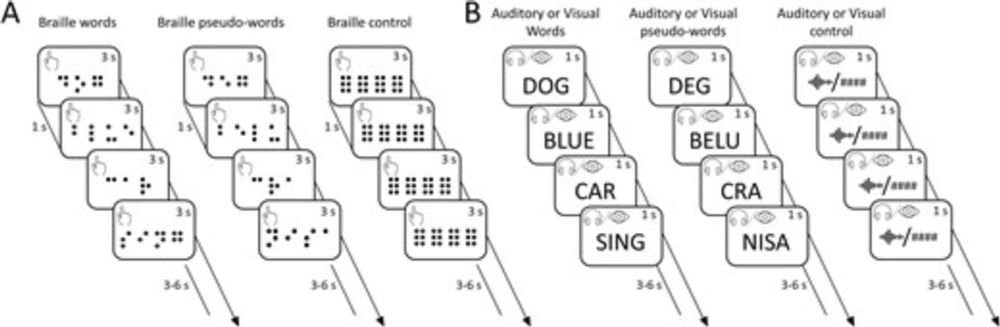
Association between cortical thickness and functional response to linguistic processing in the occipital cortex of early blind individuals
Abstract. Blindness has been shown to induce changes in the structural and functional organization of the brain. However, few studies have investigated the
academic.oup.com
November 27, 2025 at 9:43 AM
Excited to see this article out! Congratulations to Maria Czarnecka, @lenastroh.bsky.social, and the whole author team for this great piece of work!
Reposted by Ella Striem-Amit

New today in @Nature: your visual cortex contains touch-based body maps. bit.ly/VisualBodyMaps
Your brain transforms what you see into first-person, body-referenced codes: A previously unknown bridge between vision and touch.
Your brain transforms what you see into first-person, body-referenced codes: A previously unknown bridge between vision and touch.

November 26, 2025 at 4:01 PM
New today in @Nature: your visual cortex contains touch-based body maps. bit.ly/VisualBodyMaps
Your brain transforms what you see into first-person, body-referenced codes: A previously unknown bridge between vision and touch.
Your brain transforms what you see into first-person, body-referenced codes: A previously unknown bridge between vision and touch.
Reposted by Ella Striem-Amit
Reviving this account to say that the last paper from my PhD is out in final form!
Here, we look at how the timing of artificial tactile sensations (delivered via intracortical microstimulation/ICMS) is perceived relative to visual cues in two participants with spinal cord injuries. 🧠✋👀
Here, we look at how the timing of artificial tactile sensations (delivered via intracortical microstimulation/ICMS) is perceived relative to visual cues in two participants with spinal cord injuries. 🧠✋👀

Visual context affects the perceived timing of tactile sensations elicited through intracortical microstimulation: a case study of two participants | Journal of Neurophysiology | American Physiologica...
Intracortical microstimulation (ICMS) is a technique to provide tactile sensations for a somatosensory brain-machine interface (BMI). A viable BMI must function within the rich, multisensory environme...
journals.physiology.org
November 24, 2025 at 8:21 PM
Reviving this account to say that the last paper from my PhD is out in final form!
Here, we look at how the timing of artificial tactile sensations (delivered via intracortical microstimulation/ICMS) is perceived relative to visual cues in two participants with spinal cord injuries. 🧠✋👀
Here, we look at how the timing of artificial tactile sensations (delivered via intracortical microstimulation/ICMS) is perceived relative to visual cues in two participants with spinal cord injuries. 🧠✋👀
Reposted by Ella Striem-Amit
Tenure track position in motor control at Northeastern University
northeastern.wd1.myworkdayjobs.com/careers/job/...
northeastern.wd1.myworkdayjobs.com/careers/job/...
Open Rank (Professor, Associate or Assistant) AI, Sensors, and Human Movement
About the Opportunity About Northeastern Founded in 1898, Northeastern is a global research university and the recognized leader in experience-driven lifelong learning. Our world-renowned experiential...
northeastern.wd1.myworkdayjobs.com
November 22, 2025 at 4:15 PM
Tenure track position in motor control at Northeastern University
northeastern.wd1.myworkdayjobs.com/careers/job/...
northeastern.wd1.myworkdayjobs.com/careers/job/...
Reposted by Ella Striem-Amit

This week the Trump CDC attacked science — and our health, and our kids’ health — by twisting the truth on the CDC website.
There’s things to say about the playbook they used, and that’s helped by a little explanation about scientific truth in practice.
New vid explainer from me:
🧪 part 1/
There’s things to say about the playbook they used, and that’s helped by a little explanation about scientific truth in practice.
New vid explainer from me:
🧪 part 1/
November 22, 2025 at 12:04 AM
This week the Trump CDC attacked science — and our health, and our kids’ health — by twisting the truth on the CDC website.
There’s things to say about the playbook they used, and that’s helped by a little explanation about scientific truth in practice.
New vid explainer from me:
🧪 part 1/
There’s things to say about the playbook they used, and that’s helped by a little explanation about scientific truth in practice.
New vid explainer from me:
🧪 part 1/
Reposted by Ella Striem-Amit

I think almost all scientific projects should be planned carefully. And I think an app can dramatically improve that. So I wrote an app for that (free for now, if you can fund this let me know). I tested it quite a bit (>8000 users in beta so far). try it: planyourscience.com

November 20, 2025 at 3:33 PM
I think almost all scientific projects should be planned carefully. And I think an app can dramatically improve that. So I wrote an app for that (free for now, if you can fund this let me know). I tested it quite a bit (>8000 users in beta so far). try it: planyourscience.com
Reposted by Ella Striem-Amit

Much of the way we articulate words isn’t random. It reflects how the brain balances effort & clarity. Common words are shorter & more “shrunk”, confusable words are pronounced more clearly. We asked if ASL signs show similar patterns of reduction using pose-tracking on thousands of ASL signs.
November 21, 2025 at 3:14 AM
Much of the way we articulate words isn’t random. It reflects how the brain balances effort & clarity. Common words are shorter & more “shrunk”, confusable words are pronounced more clearly. We asked if ASL signs show similar patterns of reduction using pose-tracking on thousands of ASL signs.
Reposted by Ella Striem-Amit
Online Now: Hierarchical interactions between sensory cortices defy predictive coding

Hierarchical interactions between sensory cortices defy predictive coding
Perceptual experience depends on recurrent interactions between lower and higher cortices. One theory, predictive coding, posits that feedback from higher to lower brain regions decreases neuronal activity predicted by higher-level representations. Despite the widespread adoption of predictive coding in neuroscience, the correspondence to neurophysiological findings in sensory cortices remains elusive. Here, we review how the canonical patterns of intra- and inter-cortical interactions that occur during perception and shifts of attention deviate from those predicted by predictive coding. We argue that these circuit interactions are better captured by alternative theories, which we summarize under the umbrella term BELIEF. We review how BELIEF theories account for the inter-areal interactions during attentive perception.
dlvr.it
October 20, 2025 at 7:04 PM
Online Now: Hierarchical interactions between sensory cortices defy predictive coding
Pls report: We're hiring! Looking for a postdoctoral research fellow to join our study of individual differences in plasticity in #blindness (+ possible extension to #deafness) using fMRI.
Details and application: apply.interfolio.com/177838
#hiring #postdoc #neurojobs #Neuroscience #NeuroTwitter
Details and application: apply.interfolio.com/177838
#hiring #postdoc #neurojobs #Neuroscience #NeuroTwitter
Apply - Interfolio
{{$ctrl.$state.data.pageTitle}} - Apply - Interfolio
apply.interfolio.com
November 20, 2025 at 3:50 PM
Pls report: We're hiring! Looking for a postdoctoral research fellow to join our study of individual differences in plasticity in #blindness (+ possible extension to #deafness) using fMRI.
Details and application: apply.interfolio.com/177838
#hiring #postdoc #neurojobs #Neuroscience #NeuroTwitter
Details and application: apply.interfolio.com/177838
#hiring #postdoc #neurojobs #Neuroscience #NeuroTwitter
Reposted by Ella Striem-Amit

1. 🧵 Thread: What happens to the visual brain after early transient blindness?
Our new Nature Communications paper examines a rare population: people born with dense bilateral cataracts—a short blindness occurring during a critical window of visual development.
🔗 rdcu.be/eQjMH
Our new Nature Communications paper examines a rare population: people born with dense bilateral cataracts—a short blindness occurring during a critical window of visual development.
🔗 rdcu.be/eQjMH
November 19, 2025 at 9:07 AM
1. 🧵 Thread: What happens to the visual brain after early transient blindness?
Our new Nature Communications paper examines a rare population: people born with dense bilateral cataracts—a short blindness occurring during a critical window of visual development.
🔗 rdcu.be/eQjMH
Our new Nature Communications paper examines a rare population: people born with dense bilateral cataracts—a short blindness occurring during a critical window of visual development.
🔗 rdcu.be/eQjMH
At #Sfn2025?
Starting soon - Zhiqing will present about SII's reorganization in people born without hands this afternoon.
Poster session LBP077.06 /board #38, SDCC Hall B
www.abstractsonline.com/pp8/#!/21171...
#SfN25 #SocietyForNeuroscience #Neuroscience #NeuroTwitter #SciTwitter
Starting soon - Zhiqing will present about SII's reorganization in people born without hands this afternoon.
Poster session LBP077.06 /board #38, SDCC Hall B
www.abstractsonline.com/pp8/#!/21171...
#SfN25 #SocietyForNeuroscience #Neuroscience #NeuroTwitter #SciTwitter
November 18, 2025 at 7:06 PM
At #Sfn2025?
Starting soon - Zhiqing will present about SII's reorganization in people born without hands this afternoon.
Poster session LBP077.06 /board #38, SDCC Hall B
www.abstractsonline.com/pp8/#!/21171...
#SfN25 #SocietyForNeuroscience #Neuroscience #NeuroTwitter #SciTwitter
Starting soon - Zhiqing will present about SII's reorganization in people born without hands this afternoon.
Poster session LBP077.06 /board #38, SDCC Hall B
www.abstractsonline.com/pp8/#!/21171...
#SfN25 #SocietyForNeuroscience #Neuroscience #NeuroTwitter #SciTwitter