



Satpreet (Sat) Singh
@satpreetsingh.bsky.social
Postdoc @harvard.edu @kempnerinstitute.bsky.social
Homepage: http://satpreetsingh.github.io
Twitter: https://x.com/tweetsatpreet
Homepage: http://satpreetsingh.github.io
Twitter: https://x.com/tweetsatpreet
Reposted by Satpreet (Sat) Singh

What if you could train agents on a 𝗱𝗲𝗰𝗮𝗱𝗲 of driving experience in 𝘂𝗻𝗱𝗲𝗿 𝗮𝗻 𝗵𝗼𝘂𝗿, on a single GPU?
Excited to share 𝙋𝙪𝙛𝙛𝙚𝙧𝘿𝙧𝙞𝙫𝙚 2.0: A fast, friendly driving simulator with RL training via PufferLib at 𝟯𝟬𝟬𝗞 𝘀𝘁𝗲𝗽𝘀/𝘀𝗲𝗰 🐡 + 🚗
youtu.be/LfQ324R-cbE?...
Excited to share 𝙋𝙪𝙛𝙛𝙚𝙧𝘿𝙧𝙞𝙫𝙚 2.0: A fast, friendly driving simulator with RL training via PufferLib at 𝟯𝟬𝟬𝗞 𝘀𝘁𝗲𝗽𝘀/𝘀𝗲𝗰 🐡 + 🚗
youtu.be/LfQ324R-cbE?...

PufferDrive 2.0 release
YouTube video by Daphne Cornelisse
youtu.be
December 30, 2025 at 4:12 PM
What if you could train agents on a 𝗱𝗲𝗰𝗮𝗱𝗲 of driving experience in 𝘂𝗻𝗱𝗲𝗿 𝗮𝗻 𝗵𝗼𝘂𝗿, on a single GPU?
Excited to share 𝙋𝙪𝙛𝙛𝙚𝙧𝘿𝙧𝙞𝙫𝙚 2.0: A fast, friendly driving simulator with RL training via PufferLib at 𝟯𝟬𝟬𝗞 𝘀𝘁𝗲𝗽𝘀/𝘀𝗲𝗰 🐡 + 🚗
youtu.be/LfQ324R-cbE?...
Excited to share 𝙋𝙪𝙛𝙛𝙚𝙧𝘿𝙧𝙞𝙫𝙚 2.0: A fast, friendly driving simulator with RL training via PufferLib at 𝟯𝟬𝟬𝗞 𝘀𝘁𝗲𝗽𝘀/𝘀𝗲𝗰 🐡 + 🚗
youtu.be/LfQ324R-cbE?...
Reposted by Satpreet (Sat) Singh
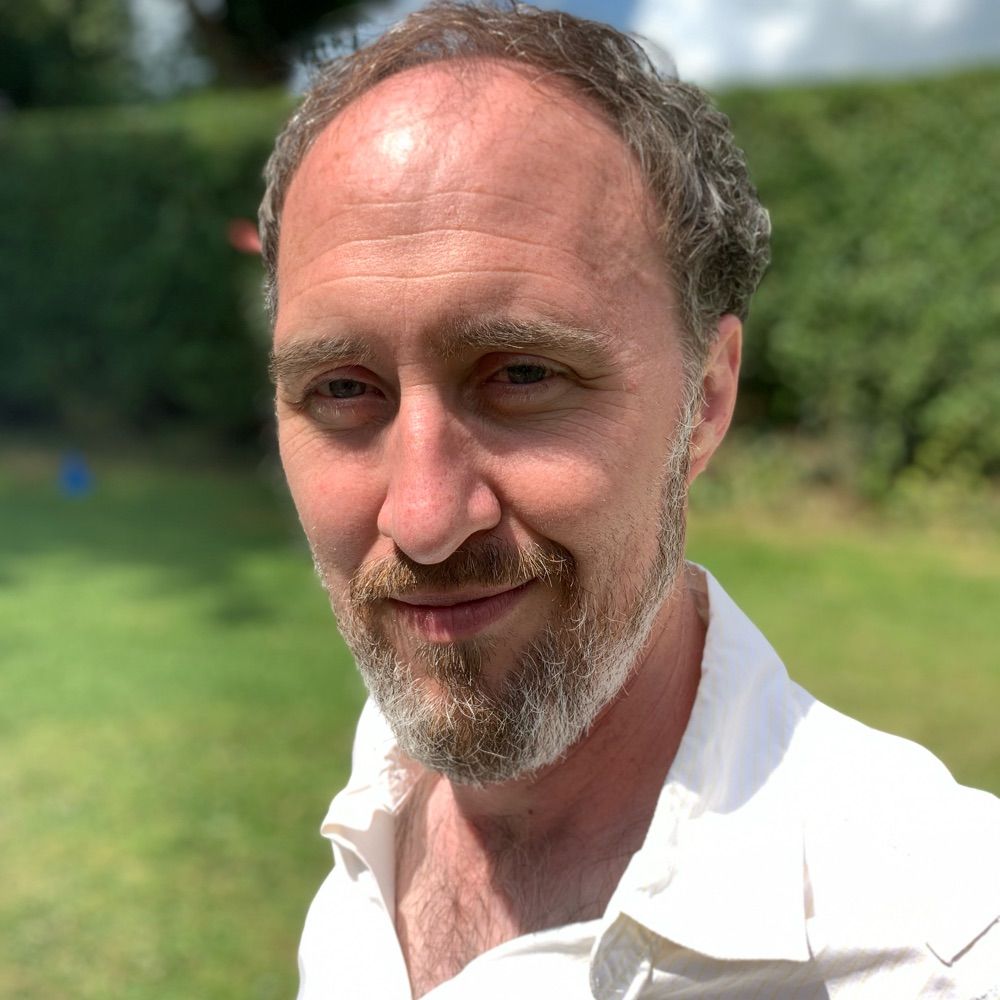
Just published my review of neuroscience in 2025, on The Spike.
The 10th of these, would you believe?
This year we have foundation models, breakthroughs in using light to understand the brain, a gene therapy, and more
Enjoy!
medium.com/the-spike/20...
The 10th of these, would you believe?
This year we have foundation models, breakthroughs in using light to understand the brain, a gene therapy, and more
Enjoy!
medium.com/the-spike/20...

2025: A Review of the Year in Neuroscience
Enlightening the brain
medium.com
December 30, 2025 at 3:52 PM
Just published my review of neuroscience in 2025, on The Spike.
The 10th of these, would you believe?
This year we have foundation models, breakthroughs in using light to understand the brain, a gene therapy, and more
Enjoy!
medium.com/the-spike/20...
The 10th of these, would you believe?
This year we have foundation models, breakthroughs in using light to understand the brain, a gene therapy, and more
Enjoy!
medium.com/the-spike/20...
Reposted by Satpreet (Sat) Singh
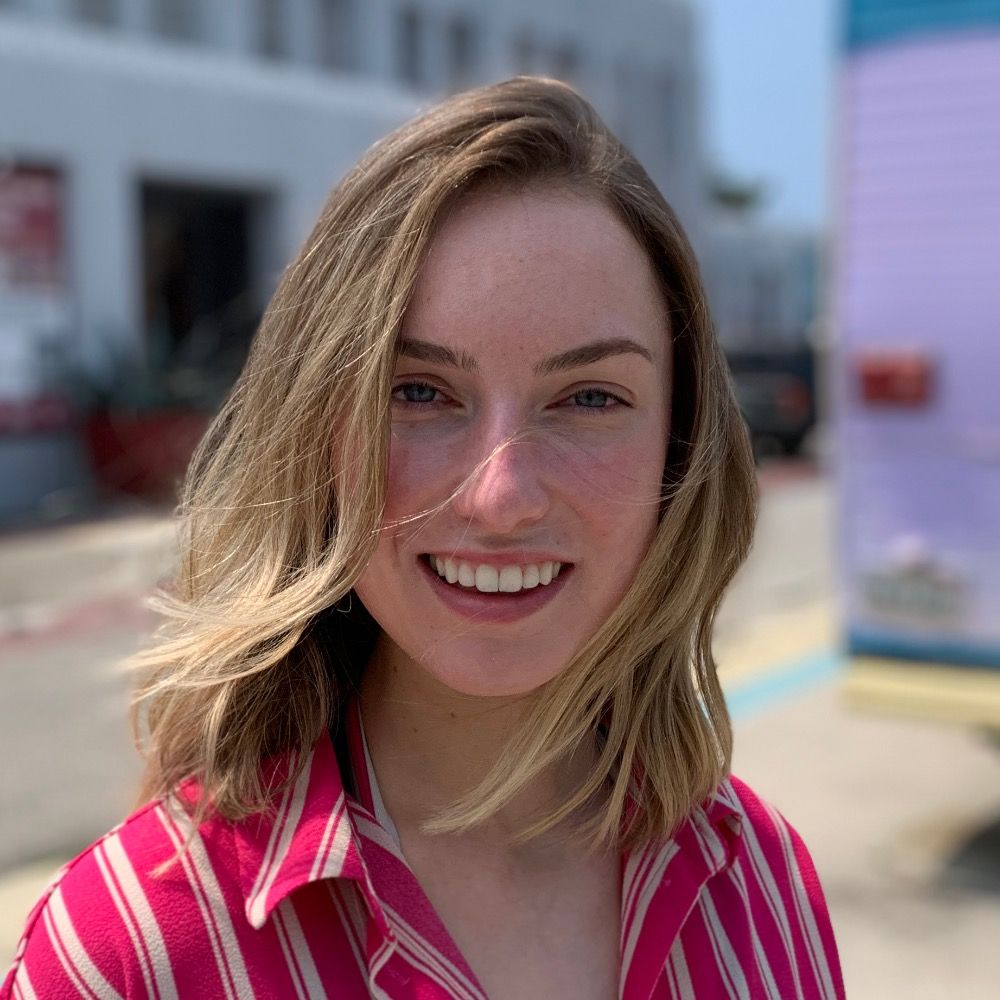
Thrilled to start 2026 as faculty in Psych & CS
@ualberta.bsky.social + Amii.ca Fellow! 🥳 Recruiting students to develop theories of cognition in natural & artificial systems 🤖💭🧠. Find me at #NeurIPS2025 workshops (speaking coginterp.github.io/neurips2025 & organising @dataonbrainmind.bsky.social)
@ualberta.bsky.social + Amii.ca Fellow! 🥳 Recruiting students to develop theories of cognition in natural & artificial systems 🤖💭🧠. Find me at #NeurIPS2025 workshops (speaking coginterp.github.io/neurips2025 & organising @dataonbrainmind.bsky.social)
December 6, 2025 at 7:26 PM
Thrilled to start 2026 as faculty in Psych & CS
@ualberta.bsky.social + Amii.ca Fellow! 🥳 Recruiting students to develop theories of cognition in natural & artificial systems 🤖💭🧠. Find me at #NeurIPS2025 workshops (speaking coginterp.github.io/neurips2025 & organising @dataonbrainmind.bsky.social)
@ualberta.bsky.social + Amii.ca Fellow! 🥳 Recruiting students to develop theories of cognition in natural & artificial systems 🤖💭🧠. Find me at #NeurIPS2025 workshops (speaking coginterp.github.io/neurips2025 & organising @dataonbrainmind.bsky.social)
Reposted by Satpreet (Sat) Singh

#NeurIPS2025 workshops are underway!
Today’s workshop presentations from the #KempnerInstitute cover a range topics, including the use of #AI in linguistics and the study of communication & sensing in electric fish.
#NeuroAI
Today’s workshop presentations from the #KempnerInstitute cover a range topics, including the use of #AI in linguistics and the study of communication & sensing in electric fish.
#NeuroAI

December 6, 2025 at 2:15 PM
#NeurIPS2025 workshops are underway!
Today’s workshop presentations from the #KempnerInstitute cover a range topics, including the use of #AI in linguistics and the study of communication & sensing in electric fish.
#NeuroAI
Today’s workshop presentations from the #KempnerInstitute cover a range topics, including the use of #AI in linguistics and the study of communication & sensing in electric fish.
#NeuroAI
Different seeds with same training loss doesn't always mean same solution. When do neural nets converge vs diverge? What are the implications for inverse problems, #AI4Science & #MechInterp?
#NeurIPS2025 poster 2001 (“a space odyssey”), 4:30–7:30pm today 12/5:
#NeurIPS2025 poster 2001 (“a space odyssey”), 4:30–7:30pm today 12/5:

📍Excited to share that our paper was selected as a Spotlight at #NeurIPS2025!
arxiv.org/pdf/2410.03972
It started from a question I kept running into:
When do RNNs trained on the same task converge/diverge in their solutions?
🧵⬇️
arxiv.org/pdf/2410.03972
It started from a question I kept running into:
When do RNNs trained on the same task converge/diverge in their solutions?
🧵⬇️

December 5, 2025 at 5:38 PM
Different seeds with same training loss doesn't always mean same solution. When do neural nets converge vs diverge? What are the implications for inverse problems, #AI4Science & #MechInterp?
#NeurIPS2025 poster 2001 (“a space odyssey”), 4:30–7:30pm today 12/5:
#NeurIPS2025 poster 2001 (“a space odyssey”), 4:30–7:30pm today 12/5:
Reposted by Satpreet (Sat) Singh
Mid-conference momentum! 🔬📈
Today’s #NeurIPS2025 presentations from the #KempnerInstitute showcase a wide variety of research projects at the frontiers of #AI and #NeuroAI.
@thomasfel.bsky.social @andykeller.bsky.social @gershbrain.bsky.social @yilundu.bsky.social @kanakarajanphd.bsky.social
Today’s #NeurIPS2025 presentations from the #KempnerInstitute showcase a wide variety of research projects at the frontiers of #AI and #NeuroAI.
@thomasfel.bsky.social @andykeller.bsky.social @gershbrain.bsky.social @yilundu.bsky.social @kanakarajanphd.bsky.social

December 5, 2025 at 2:50 PM
Mid-conference momentum! 🔬📈
Today’s #NeurIPS2025 presentations from the #KempnerInstitute showcase a wide variety of research projects at the frontiers of #AI and #NeuroAI.
@thomasfel.bsky.social @andykeller.bsky.social @gershbrain.bsky.social @yilundu.bsky.social @kanakarajanphd.bsky.social
Today’s #NeurIPS2025 presentations from the #KempnerInstitute showcase a wide variety of research projects at the frontiers of #AI and #NeuroAI.
@thomasfel.bsky.social @andykeller.bsky.social @gershbrain.bsky.social @yilundu.bsky.social @kanakarajanphd.bsky.social
Reposted by Satpreet (Sat) Singh
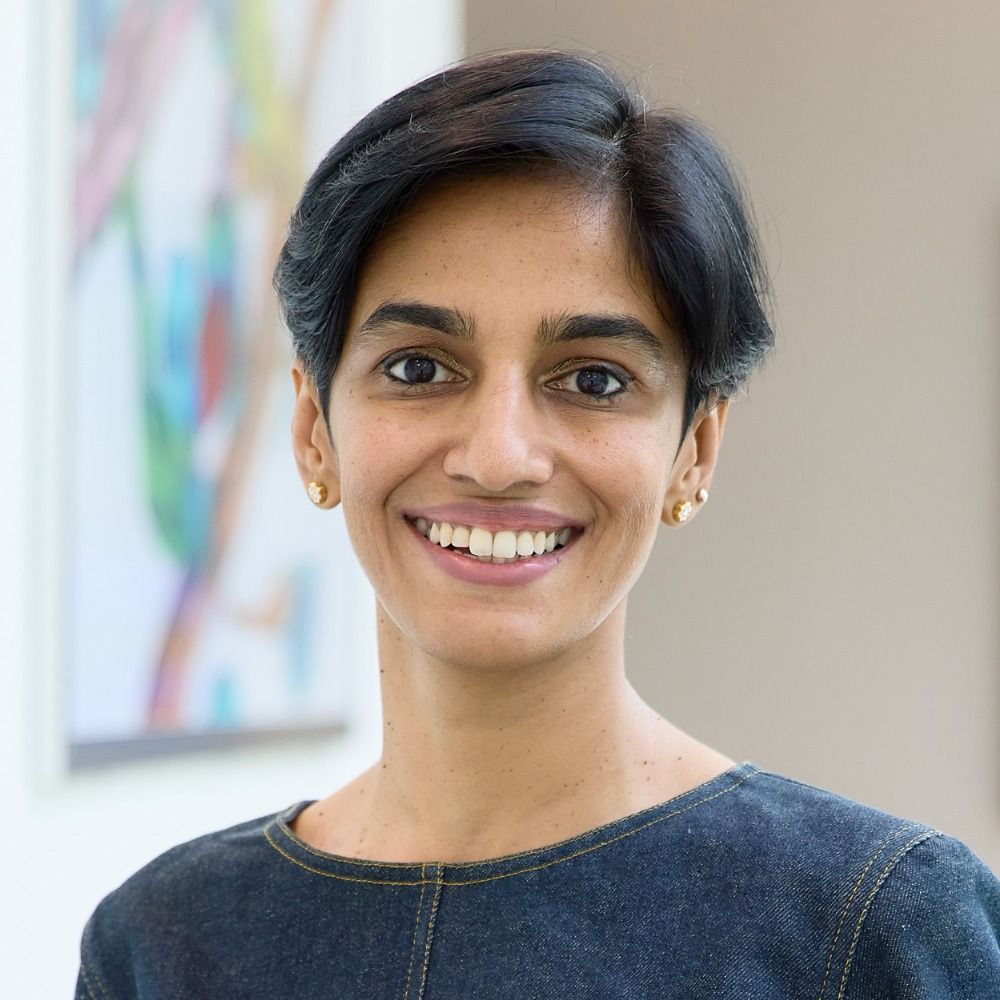
Celebrating the Rajan Lab’s papers at #NeurIPS2025! Stop by to chat with these talented students and postdocs 🎉


December 4, 2025 at 4:08 PM
Celebrating the Rajan Lab’s papers at #NeurIPS2025! Stop by to chat with these talented students and postdocs 🎉
Reposted by Satpreet (Sat) Singh

33 neuroscience researchers from across the world shared how their labs our funded, providing insight into the current state of funding and how that might shift.
By @claudia-lopez.bsky.social
#neuroskyence #StateOfNeuroscience
www.thetransmitter.org/funding/whic...
By @claudia-lopez.bsky.social
#neuroskyence #StateOfNeuroscience
www.thetransmitter.org/funding/whic...

Survey: Which sources fund your neuroscience research?
Government sources are the main contributors to neuroscience labs, but funding breakdown varies across labs, career stages and neuroscience subfields.
www.thetransmitter.org
December 2, 2025 at 6:05 PM
33 neuroscience researchers from across the world shared how their labs our funded, providing insight into the current state of funding and how that might shift.
By @claudia-lopez.bsky.social
#neuroskyence #StateOfNeuroscience
www.thetransmitter.org/funding/whic...
By @claudia-lopez.bsky.social
#neuroskyence #StateOfNeuroscience
www.thetransmitter.org/funding/whic...
Reposted by Satpreet (Sat) Singh

How do brain areas control each other? 🧠🎛️
✨In our NeurIPS 2025 Spotlight paper, we introduce a data-driven framework to answer this question using deep learning, nonlinear control, and differential geometry.🧵⬇️
✨In our NeurIPS 2025 Spotlight paper, we introduce a data-driven framework to answer this question using deep learning, nonlinear control, and differential geometry.🧵⬇️

November 26, 2025 at 7:32 PM
How do brain areas control each other? 🧠🎛️
✨In our NeurIPS 2025 Spotlight paper, we introduce a data-driven framework to answer this question using deep learning, nonlinear control, and differential geometry.🧵⬇️
✨In our NeurIPS 2025 Spotlight paper, we introduce a data-driven framework to answer this question using deep learning, nonlinear control, and differential geometry.🧵⬇️
Looking forward to sharing our work at #NeurIPS2025 next week!
Session 6 on Fri 12/5 at 4:30-7:30pm, Poster 2001 ("a space odyssey")
Details on this thread by the brilliant lead author @annhuang42.bsky.social below:
Session 6 on Fri 12/5 at 4:30-7:30pm, Poster 2001 ("a space odyssey")
Details on this thread by the brilliant lead author @annhuang42.bsky.social below:
📍Excited to share that our paper was selected as a Spotlight at #NeurIPS2025!
arxiv.org/pdf/2410.03972
It started from a question I kept running into:
When do RNNs trained on the same task converge/diverge in their solutions?
🧵⬇️
arxiv.org/pdf/2410.03972
It started from a question I kept running into:
When do RNNs trained on the same task converge/diverge in their solutions?
🧵⬇️
November 24, 2025 at 5:16 PM
Looking forward to sharing our work at #NeurIPS2025 next week!
Session 6 on Fri 12/5 at 4:30-7:30pm, Poster 2001 ("a space odyssey")
Details on this thread by the brilliant lead author @annhuang42.bsky.social below:
Session 6 on Fri 12/5 at 4:30-7:30pm, Poster 2001 ("a space odyssey")
Details on this thread by the brilliant lead author @annhuang42.bsky.social below:
Reposted by Satpreet (Sat) Singh

Controversial take: our ICLR reviews actually helped make our paper better
November 19, 2025 at 6:29 PM
Controversial take: our ICLR reviews actually helped make our paper better
Reposted by Satpreet (Sat) Singh
Our next paper on comparing dynamical systems (with special interest to artificial and biological neural networks) is out!! Joint work with @annhuang42.bsky.social , as well as @satpreetsingh.bsky.social , @leokoz8.bsky.social , Ila Fiete, and @kanakarajanphd.bsky.social : arxiv.org/pdf/2510.25943

November 10, 2025 at 4:16 PM
Our next paper on comparing dynamical systems (with special interest to artificial and biological neural networks) is out!! Joint work with @annhuang42.bsky.social , as well as @satpreetsingh.bsky.social , @leokoz8.bsky.social , Ila Fiete, and @kanakarajanphd.bsky.social : arxiv.org/pdf/2510.25943
Reposted by Satpreet (Sat) Singh
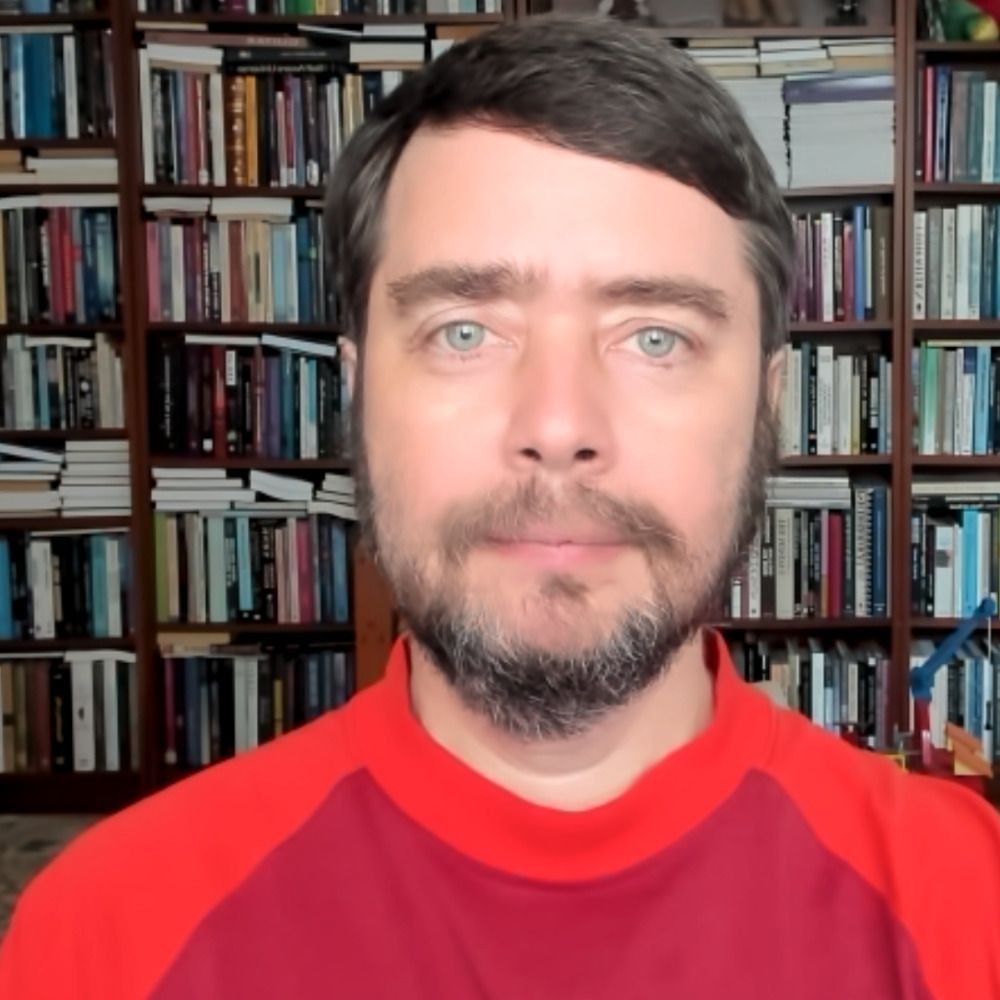
new paper with @robertchisciure.bsky.social
link.springer.com/article/10.1...
"Cognition all the way down 2.0: neuroscience beyond neurons in the diverse intelligence era"
🧪
link.springer.com/article/10.1...
"Cognition all the way down 2.0: neuroscience beyond neurons in the diverse intelligence era"
🧪

Cognition all the way down 2.0: neuroscience beyond neurons in the diverse intelligence era - Synthese
This paper formalizes biological intelligence as search efficiency in multi-scale problem spaces, aiming to resolve epistemic deadlocks in the basal “cognition wars” unfolding in the Diverse Intellige...
link.springer.com
November 7, 2025 at 12:31 AM
new paper with @robertchisciure.bsky.social
link.springer.com/article/10.1...
"Cognition all the way down 2.0: neuroscience beyond neurons in the diverse intelligence era"
🧪
link.springer.com/article/10.1...
"Cognition all the way down 2.0: neuroscience beyond neurons in the diverse intelligence era"
🧪
Reposted by Satpreet (Sat) Singh
Excited to release our new work: Petri Dish Neural Cellular Automata!
pub.sakana.ai/pdnca
We investigate how multi-agent NCAs can develop into artificial life 🦠 exhibiting complex, emergent behaviors like cyclic dynamics, territorial defense, and spontaneous cooperation.
pub.sakana.ai/pdnca
We investigate how multi-agent NCAs can develop into artificial life 🦠 exhibiting complex, emergent behaviors like cyclic dynamics, territorial defense, and spontaneous cooperation.
Introducing Petri Dish Neural Cellular Automata (PD-NCA)
pub.sakana.ai/pdnca/
In this work we explore the role of continual adaptation in artificial life, where the cellular automata in our system do not rely on a fixed set of parameters, but rather learn continuously during the simulation itself.
pub.sakana.ai/pdnca/
In this work we explore the role of continual adaptation in artificial life, where the cellular automata in our system do not rely on a fixed set of parameters, but rather learn continuously during the simulation itself.
November 5, 2025 at 12:47 AM
Excited to release our new work: Petri Dish Neural Cellular Automata!
pub.sakana.ai/pdnca
We investigate how multi-agent NCAs can develop into artificial life 🦠 exhibiting complex, emergent behaviors like cyclic dynamics, territorial defense, and spontaneous cooperation.
pub.sakana.ai/pdnca
We investigate how multi-agent NCAs can develop into artificial life 🦠 exhibiting complex, emergent behaviors like cyclic dynamics, territorial defense, and spontaneous cooperation.
Reposted by Satpreet (Sat) Singh

In case you don't know already, the journal Open Mind has a Bluesky account that automatically posts new papers:
@openmindjournal.bsky.social
The journal is diamond open access (free to read, free to publish) thanks to the support of MIT Press, Harvard Library, & MIT Library.
@openmindjournal.bsky.social
The journal is diamond open access (free to read, free to publish) thanks to the support of MIT Press, Harvard Library, & MIT Library.
October 24, 2025 at 12:03 PM
In case you don't know already, the journal Open Mind has a Bluesky account that automatically posts new papers:
@openmindjournal.bsky.social
The journal is diamond open access (free to read, free to publish) thanks to the support of MIT Press, Harvard Library, & MIT Library.
@openmindjournal.bsky.social
The journal is diamond open access (free to read, free to publish) thanks to the support of MIT Press, Harvard Library, & MIT Library.
Reposted by Satpreet (Sat) Singh
Excited to announce that my first postdoc paper is now online!
Links:
www.nature.com/articles/s41...
rdcu.be/eAcN7
In it, we examine the perennial question: what changes in the brain when learning a new motor skill?
Read more below to find out 👇
Links:
www.nature.com/articles/s41...
rdcu.be/eAcN7
In it, we examine the perennial question: what changes in the brain when learning a new motor skill?
Read more below to find out 👇
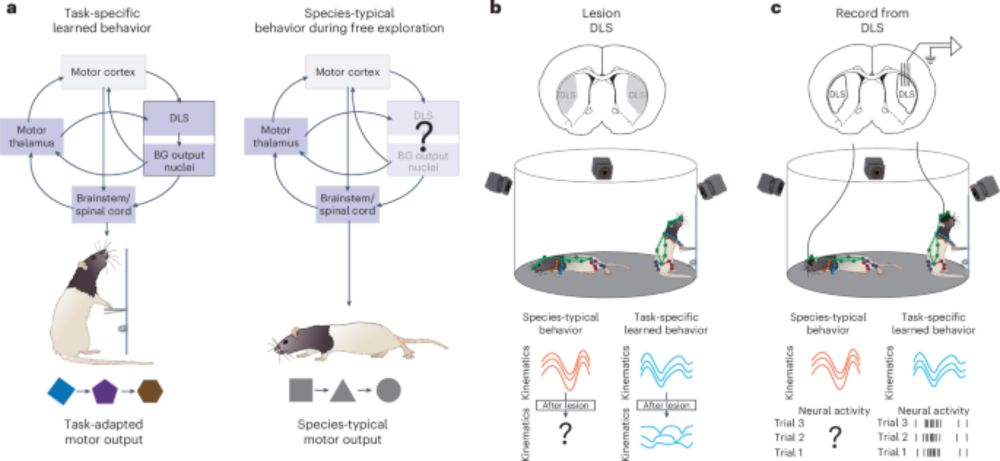
Differential kinematic coding in sensorimotor striatum across behavioral domains reflects different contributions to movement - Nature Neuroscience
Hardcastle and Marshall et al. show that striatal function is domain specific, required for task-related but not spontaneously expressed movements. This functional distinction is reflected in starkly ...
www.nature.com
August 12, 2025 at 6:26 PM
Excited to announce that my first postdoc paper is now online!
Links:
www.nature.com/articles/s41...
rdcu.be/eAcN7
In it, we examine the perennial question: what changes in the brain when learning a new motor skill?
Read more below to find out 👇
Links:
www.nature.com/articles/s41...
rdcu.be/eAcN7
In it, we examine the perennial question: what changes in the brain when learning a new motor skill?
Read more below to find out 👇
Reposted by Satpreet (Sat) Singh
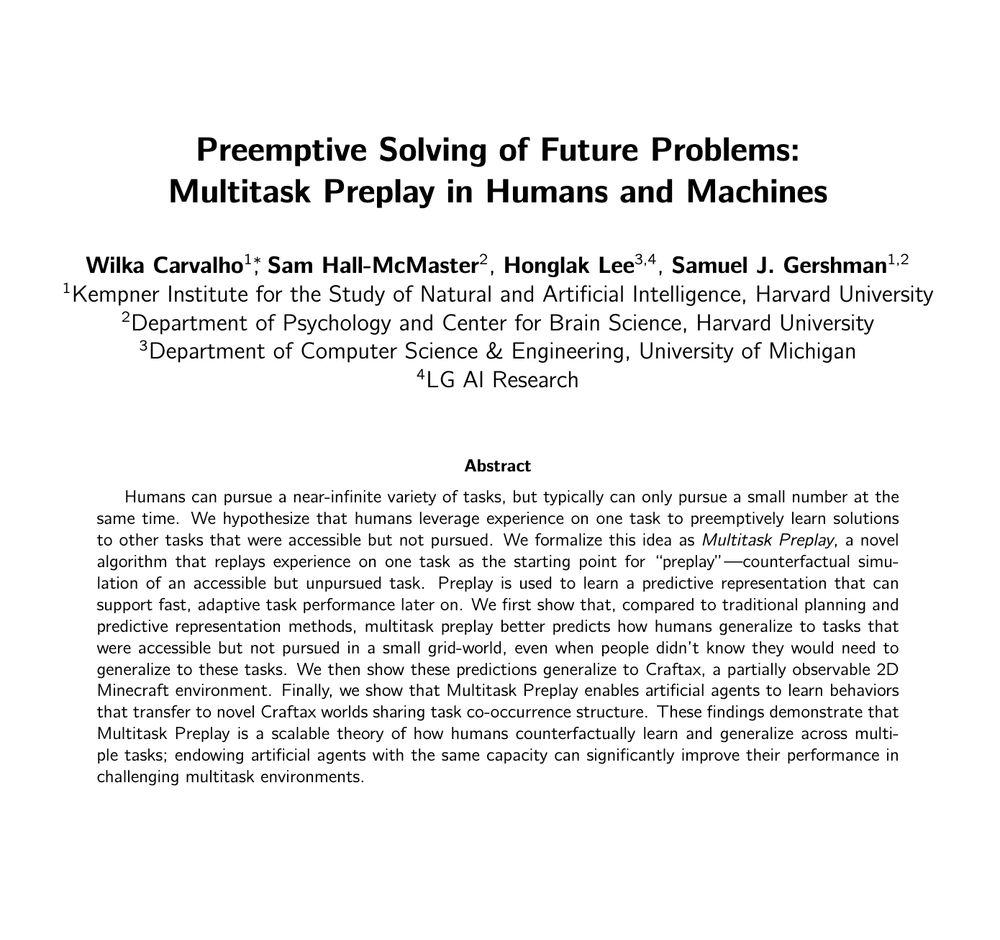
Excited to share a new project spanning cognitive science and AI where we develop a novel deep reinforcement learning model---Multitask Preplay---that explains how people generalize to new tasks that were previously accessible but unpursued.
July 12, 2025 at 4:20 PM
Excited to share a new project spanning cognitive science and AI where we develop a novel deep reinforcement learning model---Multitask Preplay---that explains how people generalize to new tasks that were previously accessible but unpursued.
Reposted by Satpreet (Sat) Singh
For the past 3 years, I've taught a course on Machine Learning for Climate Change to undergrads. At times, people have asked if the course lectures could be made available online. While I can't offer that, I have decided to start making "5 Minute Papers on AI for the Planet" videos. Hope its useful!

5 Minute Papers on AI for the Planet
AI is more than just chatbots! Learn about how AI can be used to protect biodiversity, fight climate change, and just better understand our planet through 5-minute explainers covering academic papers ...
www.youtube.com
June 20, 2025 at 1:55 AM
For the past 3 years, I've taught a course on Machine Learning for Climate Change to undergrads. At times, people have asked if the course lectures could be made available online. While I can't offer that, I have decided to start making "5 Minute Papers on AI for the Planet" videos. Hope its useful!
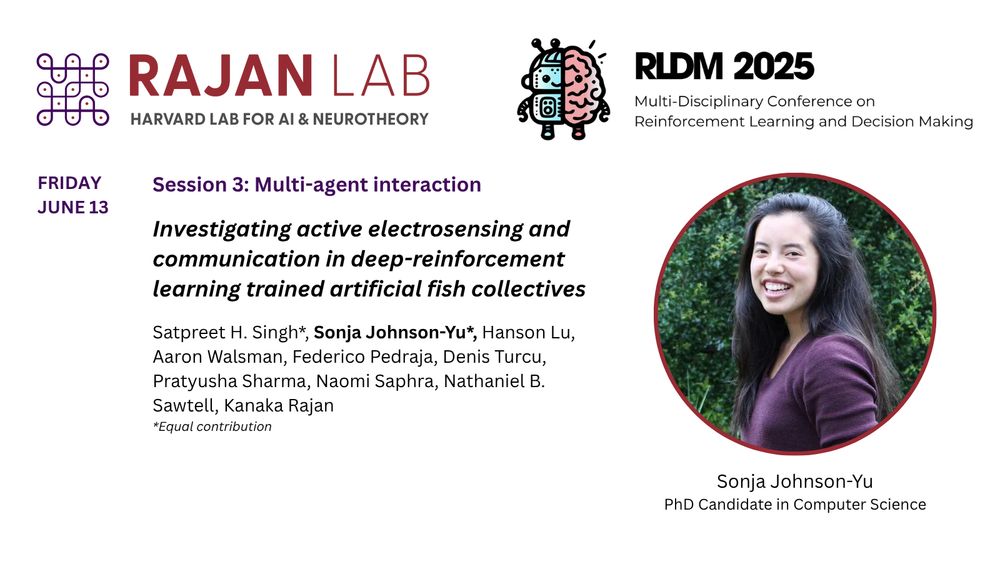
If you're at #RLDM2025, check out our contributed talk at Session 3 (Fri 6/13, 12:10pm), presented by my brilliant co-first-author on this project @sjohnsonyu.bsky.social!
Wasn't able to make it in person, but would love to hear your thoughts
@kempnerinstitute.bsky.social @harvardmed.bsky.social
Wasn't able to make it in person, but would love to hear your thoughts
@kempnerinstitute.bsky.social @harvardmed.bsky.social
New work incoming at #RLDM2025 🤖 🐟
While we look forward to sharing our research, I'm mindful that many colleagues, including the authors of our second abstract, can't attend due to funding & travel issues.
Read the extended abstracts: rldm.org/program-2025/ #neuroskyence
While we look forward to sharing our research, I'm mindful that many colleagues, including the authors of our second abstract, can't attend due to funding & travel issues.
Read the extended abstracts: rldm.org/program-2025/ #neuroskyence
June 12, 2025 at 5:51 PM
If you're at #RLDM2025, check out our contributed talk at Session 3 (Fri 6/13, 12:10pm), presented by my brilliant co-first-author on this project @sjohnsonyu.bsky.social!
Wasn't able to make it in person, but would love to hear your thoughts
@kempnerinstitute.bsky.social @harvardmed.bsky.social
Wasn't able to make it in person, but would love to hear your thoughts
@kempnerinstitute.bsky.social @harvardmed.bsky.social
Reposted by Satpreet (Sat) Singh
Check out our new work on making robots process touch more like brains!
Surprisingly, ConvRNNs best matched mouse cortex—passing the NeuroAI Turing Test. We also developed tactile-specific SSL augmentations and an Encoder-Attender-Decoder framework unifying ConvRNNs, SSMs & Transformers.
Surprisingly, ConvRNNs best matched mouse cortex—passing the NeuroAI Turing Test. We also developed tactile-specific SSL augmentations and an Encoder-Attender-Decoder framework unifying ConvRNNs, SSMs & Transformers.

1/ What if we make robots that process touch the way our brains do?
We found that Convolutional Recurrent Neural Networks (ConvRNNs) pass the NeuroAI Turing Test in currently available mouse somatosensory cortex data.
New paper by @Yuchen @Nathan @anayebi.bsky.social and me!
We found that Convolutional Recurrent Neural Networks (ConvRNNs) pass the NeuroAI Turing Test in currently available mouse somatosensory cortex data.
New paper by @Yuchen @Nathan @anayebi.bsky.social and me!

May 28, 2025 at 12:31 AM
Check out our new work on making robots process touch more like brains!
Surprisingly, ConvRNNs best matched mouse cortex—passing the NeuroAI Turing Test. We also developed tactile-specific SSL augmentations and an Encoder-Attender-Decoder framework unifying ConvRNNs, SSMs & Transformers.
Surprisingly, ConvRNNs best matched mouse cortex—passing the NeuroAI Turing Test. We also developed tactile-specific SSL augmentations and an Encoder-Attender-Decoder framework unifying ConvRNNs, SSMs & Transformers.
Reposted by Satpreet (Sat) Singh
It was an honor to speak at the
@kempnerinstitute.bsky.social
on how some of our recent works can be interpreted as an application of rational analysis to language model behaviors — seeing both their successes and failures through the lens of adaptation to the properties of their training data.
@kempnerinstitute.bsky.social
on how some of our recent works can be interpreted as an application of rational analysis to language model behaviors — seeing both their successes and failures through the lens of adaptation to the properties of their training data.
New in the Kempner Seminar Series:
Andrew Lampinen of Google DeepMind discusses how the in-context performance of language models can arise from rational adaptation to properties of the training data distribution.
bit.ly/KempnerLampi...
#ML #AI #LLMs
Andrew Lampinen of Google DeepMind discusses how the in-context performance of language models can arise from rational adaptation to properties of the training data distribution.
bit.ly/KempnerLampi...
#ML #AI #LLMs

Rational Analysis of Language Models with Andrew Lampinen
Andrew Lampinen from DeepMind visited the Kempner's Seminar Series on May 16, 2025, to discuss "Rational Analysis of Language Models." There has been substantial debate about the capabilities of language models—which aspects of language they can acquire, whether they can be said to ‘reason’, and whether they can truly ‘learn’ in context. In this talk, I will suggest that approaches from cognitive science can provide useful tools for approaching these questions. Specifically, I will focus on rational analysis: analyzing behavior as a rational adaptation to an environment. I’ll first illustrate these ideas by discussing some of our work analyzing how the in-context learning abilities of language models can emerge as a rational adaptation to simple properties of the data distribution they are trained on. I’ll then discuss how this analysis extends to suggest that many of language models broader success and failures can be interpreted as rational responses to the natural data distribution — including cases where language models exhibit some of the same patterns of content entangled reasoning that humans do. Finally, I’ll illustrate how rational analysis implies that the contextual abilities of language models can overcome failures like the “reversal curse” — and how to exploit these insights to improve generalization.
bit.ly
May 19, 2025 at 9:28 PM
It was an honor to speak at the
@kempnerinstitute.bsky.social
on how some of our recent works can be interpreted as an application of rational analysis to language model behaviors — seeing both their successes and failures through the lens of adaptation to the properties of their training data.
@kempnerinstitute.bsky.social
on how some of our recent works can be interpreted as an application of rational analysis to language model behaviors — seeing both their successes and failures through the lens of adaptation to the properties of their training data.
Reposted by Satpreet (Sat) Singh
After using electrical stimulation to activate their muscles, patients improved movement in their paralyzed limbs even when the system was turned off. The team leading the clinical trial believes new nerve connections may have begun to grow. https://cbsn.ws/43ocCrA
May 11, 2025 at 11:33 PM
After using electrical stimulation to activate their muscles, patients improved movement in their paralyzed limbs even when the system was turned off. The team leading the clinical trial believes new nerve connections may have begun to grow. https://cbsn.ws/43ocCrA
Reposted by Satpreet (Sat) Singh
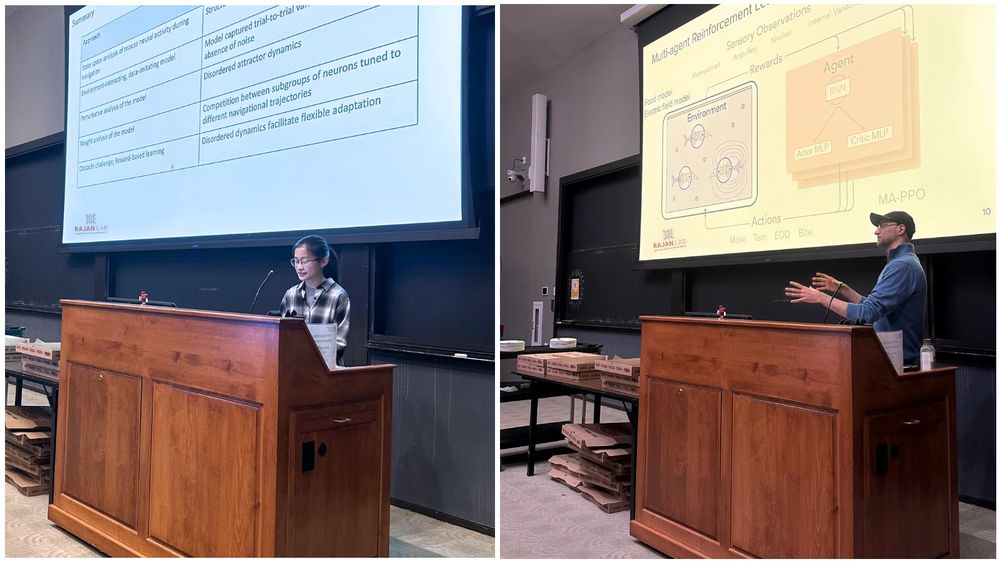
Big day for the Rajan lab at @harvardmed.bsky.social Friday Seminar Series 🌟
@satpreetsingh.bsky.social & Siyan Zhou gave outstanding talks on collective behaviors in artificial fish schools & disordered attractors in mice. I’m so proud of their work! 🤖🧠
@satpreetsingh.bsky.social & Siyan Zhou gave outstanding talks on collective behaviors in artificial fish schools & disordered attractors in mice. I’m so proud of their work! 🤖🧠
May 2, 2025 at 6:16 PM
Big day for the Rajan lab at @harvardmed.bsky.social Friday Seminar Series 🌟
@satpreetsingh.bsky.social & Siyan Zhou gave outstanding talks on collective behaviors in artificial fish schools & disordered attractors in mice. I’m so proud of their work! 🤖🧠
@satpreetsingh.bsky.social & Siyan Zhou gave outstanding talks on collective behaviors in artificial fish schools & disordered attractors in mice. I’m so proud of their work! 🤖🧠
📽️Recordings from our
@cosynemeeting.bsky.social
#COSYNE2025 workshop on “Agent-Based Models in Neuroscience: Complex Planning, Embodiment, and Beyond" are now online: neuro-agent-models.github.io
🧠🤖
@cosynemeeting.bsky.social
#COSYNE2025 workshop on “Agent-Based Models in Neuroscience: Complex Planning, Embodiment, and Beyond" are now online: neuro-agent-models.github.io
🧠🤖
April 7, 2025 at 8:58 PM
📽️Recordings from our
@cosynemeeting.bsky.social
#COSYNE2025 workshop on “Agent-Based Models in Neuroscience: Complex Planning, Embodiment, and Beyond" are now online: neuro-agent-models.github.io
🧠🤖
@cosynemeeting.bsky.social
#COSYNE2025 workshop on “Agent-Based Models in Neuroscience: Complex Planning, Embodiment, and Beyond" are now online: neuro-agent-models.github.io
🧠🤖
Reposted by Satpreet (Sat) Singh

ML/stats folks!
This might be a stupid question but my brain isn’t working. In control theory, is there a way to directly infer a system’s objective function by just observing its behavior (as opposed to doing model comparison hypothesis tests)?
This might be a stupid question but my brain isn’t working. In control theory, is there a way to directly infer a system’s objective function by just observing its behavior (as opposed to doing model comparison hypothesis tests)?
March 30, 2025 at 8:08 PM
ML/stats folks!
This might be a stupid question but my brain isn’t working. In control theory, is there a way to directly infer a system’s objective function by just observing its behavior (as opposed to doing model comparison hypothesis tests)?
This might be a stupid question but my brain isn’t working. In control theory, is there a way to directly infer a system’s objective function by just observing its behavior (as opposed to doing model comparison hypothesis tests)?