



Sandy Hetherington
@sandyheth.bsky.social
Dr Alexander J. Hetherington | Plant evolutionary biologist, University of Edinburgh UK | UKRI Future Leader Fellow |
Lab website: https://www.ed.ac.uk/biology/groups/hetherington
Lab website: https://www.ed.ac.uk/biology/groups/hetherington
Pinned

The World Tonight - President Zelensky slams Europeans for being in ‘Greenland mode’ - BBC Sounds
At Davos, the Ukrainian president attacked his European allies for their passivity.
www.bbc.co.uk
It’s been amazing to receive so much interest in the Prototaxites paper!
An absolute highlight was talking about the work last night to Jane Hill on BBC R4, The World Tonight
The Prototaxites segment starts at 33 mins 👇👇
www.bbc.co.uk/sounds/play/...
An absolute highlight was talking about the work last night to Jane Hill on BBC R4, The World Tonight
The Prototaxites segment starts at 33 mins 👇👇
www.bbc.co.uk/sounds/play/...
Reposted by Sandy Hetherington

For my pals in the UK: @waterstones.bsky.social is running a fantastic pre-order promotion this month! You can order The Story of Birds and save 25%!
Just be sure to use the code FEB26 when ordering!
Thanks as always to Waterstones and my publisher @picadorbooks.bsky.social #WPreorder
Just be sure to use the code FEB26 when ordering!
Thanks as always to Waterstones and my publisher @picadorbooks.bsky.social #WPreorder

February 17, 2026 at 8:58 AM
For my pals in the UK: @waterstones.bsky.social is running a fantastic pre-order promotion this month! You can order The Story of Birds and save 25%!
Just be sure to use the code FEB26 when ordering!
Thanks as always to Waterstones and my publisher @picadorbooks.bsky.social #WPreorder
Just be sure to use the code FEB26 when ordering!
Thanks as always to Waterstones and my publisher @picadorbooks.bsky.social #WPreorder
Reposted by Sandy Hetherington

Recruitment of bifunctional regulator thermospermine to methylated ribosomes directs xylem fate | Science www.science.org/doi/10.1126/...

Recruitment of bifunctional regulator thermospermine to methylated ribosomes directs xylem fate
Polyamines are often associated with ribosomes and are thought to stabilize their integrity. In Arabidopsis, the polyamine thermospermine (tSpm) affects xylem cell fate. tSpm induces translation of SU...
www.science.org
February 12, 2026 at 7:19 PM
Recruitment of bifunctional regulator thermospermine to methylated ribosomes directs xylem fate | Science www.science.org/doi/10.1126/...
Reposted by Sandy Hetherington
🚨 Positions available in Plant Science! Please share. We’re hiring:
1. Postdoc
2.PhD (UK applicants only)
Focus: root oxygen dynamics, developmental signalling. Come help us uncover how O2 shapes root development.
More info here-
sites.google.com/view/root-re...
#plantscijobs #plantscience
1. Postdoc
2.PhD (UK applicants only)
Focus: root oxygen dynamics, developmental signalling. Come help us uncover how O2 shapes root development.
More info here-
sites.google.com/view/root-re...
#plantscijobs #plantscience

February 11, 2026 at 3:18 PM
🚨 Positions available in Plant Science! Please share. We’re hiring:
1. Postdoc
2.PhD (UK applicants only)
Focus: root oxygen dynamics, developmental signalling. Come help us uncover how O2 shapes root development.
More info here-
sites.google.com/view/root-re...
#plantscijobs #plantscience
1. Postdoc
2.PhD (UK applicants only)
Focus: root oxygen dynamics, developmental signalling. Come help us uncover how O2 shapes root development.
More info here-
sites.google.com/view/root-re...
#plantscijobs #plantscience
Reposted by Sandy Hetherington
It was good to catch up on my reading for this dispatch in Current Biology. Sjoerd Woudenberg in the Weijers lab, Wallner et al. In the Dolan lab and Flores Sandoval et al. In the Bowman lab have done a great job! Evolution and development: What makes a merry stem?: www.cell.com/current-biol...

Evolution and development: What makes a merry stem?
From tiny mosses to giant redwoods, around 450,000 species of land plants show a huge
variety of forms, yet all land plants develop from stem cells in proliferative meristems.
What makes a meristem? T...
www.cell.com
February 2, 2026 at 4:46 PM
It was good to catch up on my reading for this dispatch in Current Biology. Sjoerd Woudenberg in the Weijers lab, Wallner et al. In the Dolan lab and Flores Sandoval et al. In the Bowman lab have done a great job! Evolution and development: What makes a merry stem?: www.cell.com/current-biol...
Reposted by Sandy Hetherington

Plant Science Research Weekly -- Not a Fungi after all: new clues to the identity of Prototaxites (Science Advances) (Summary by Katarina Kurtović, katarinakurtovic.bsky.social) @sandyheth.bsky.social @transitionalform.bsky.social buff.ly/DwgUr2f
#PlantaePSRW
#PlantaePSRW

Not a Fungi after all: New clues to the identity of Prototaxites | Plantae
The colonization of land by plants was a crucial event in Earth’s history that fundamentally transformed our planet’s surface. Early plants were small and structurally simple…
buff.ly
February 2, 2026 at 9:15 PM
Plant Science Research Weekly -- Not a Fungi after all: new clues to the identity of Prototaxites (Science Advances) (Summary by Katarina Kurtović, katarinakurtovic.bsky.social) @sandyheth.bsky.social @transitionalform.bsky.social buff.ly/DwgUr2f
#PlantaePSRW
#PlantaePSRW
Read all about Diego's hunt for lycophytes around Scotland in this post!
👇👇
👇👇
A new blog is out on our website! 📄 Go check it out! Diego Sanchez Ganfornina from @sandyheth.bsky.social's lab talks about the field work he just completed in Scotland. He is trying to generate a lycophyte living collection – likely UK’s largest! 🌿 biology.ed.ac.uk/plant-scienc...

Blog - Bringing the wilderness to IMPS: Fieldwork in Scotland to generate a lycophyte living collection – likely UK’s largest! | Molecular Plant Sciences | Biology
This blog was written by Diego Sanchez Ganfornina, of the Molecular Palaeobotany and Evolution Group (Hetherington Lab | Biology MPEG), collating considerations and reflections through his spring fiel...
biology.ed.ac.uk
February 2, 2026 at 3:54 PM
Read all about Diego's hunt for lycophytes around Scotland in this post!
👇👇
👇👇
Reposted by Sandy Hetherington

A new blog is out on our website! 📄 Go check it out! Diego Sanchez Ganfornina from @sandyheth.bsky.social's lab talks about the field work he just completed in Scotland. He is trying to generate a lycophyte living collection – likely UK’s largest! 🌿 biology.ed.ac.uk/plant-scienc...
Blog - Bringing the wilderness to IMPS: Fieldwork in Scotland to generate a lycophyte living collection – likely UK’s largest! | Molecular Plant Sciences | Biology
This blog was written by Diego Sanchez Ganfornina, of the Molecular Palaeobotany and Evolution Group (Hetherington Lab | Biology MPEG), collating considerations and reflections through his spring fiel...
biology.ed.ac.uk
February 2, 2026 at 10:13 AM
A new blog is out on our website! 📄 Go check it out! Diego Sanchez Ganfornina from @sandyheth.bsky.social's lab talks about the field work he just completed in Scotland. He is trying to generate a lycophyte living collection – likely UK’s largest! 🌿 biology.ed.ac.uk/plant-scienc...
Reposted by Sandy Hetherington
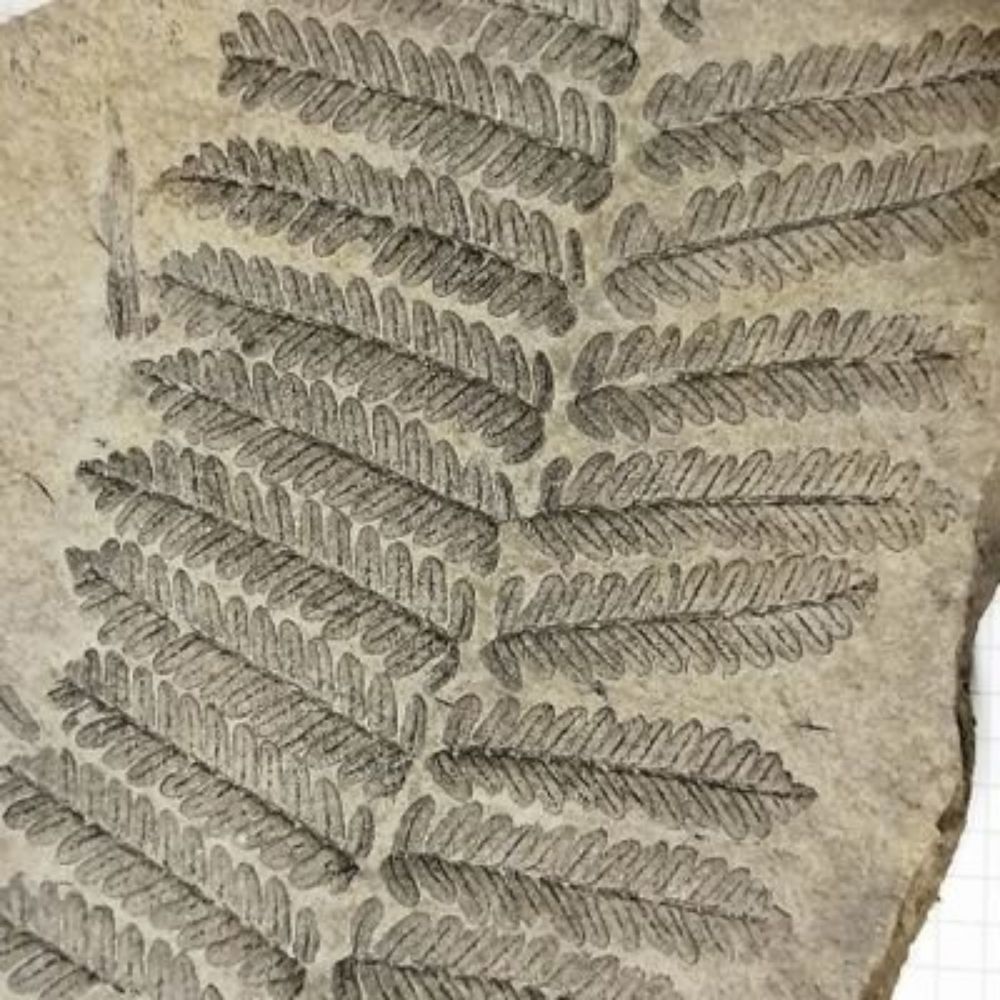
Today's lycopsids ("clubmosses") are small plants and do not produce wood but some of their Paleozoic relatives did! This is a detail of the wood cells in a stem of Sigillaria from the Carboniferous of the USA 🔬🌿⛏️ Happy #FossilFriday!
#paleobotany #botany
#paleobotany #botany

January 30, 2026 at 4:47 PM
Today's lycopsids ("clubmosses") are small plants and do not produce wood but some of their Paleozoic relatives did! This is a detail of the wood cells in a stem of Sigillaria from the Carboniferous of the USA 🔬🌿⛏️ Happy #FossilFriday!
#paleobotany #botany
#paleobotany #botany
Reposted by Sandy Hetherington

#PlantSci Res Wkly Jan 30 (2/2) plantae.org/plant-scienc...
Mechanoperception and defense signaling;
Rapid evolutionary gene expression shifts shaped angiosperms;
Intergenerational epigenetic acquired nematode resistance; That big, big fossilized organism that probably isn’t fungal after all
Mechanoperception and defense signaling;
Rapid evolutionary gene expression shifts shaped angiosperms;
Intergenerational epigenetic acquired nematode resistance; That big, big fossilized organism that probably isn’t fungal after all

January 30, 2026 at 7:27 AM
#PlantSci Res Wkly Jan 30 (2/2) plantae.org/plant-scienc...
Mechanoperception and defense signaling;
Rapid evolutionary gene expression shifts shaped angiosperms;
Intergenerational epigenetic acquired nematode resistance; That big, big fossilized organism that probably isn’t fungal after all
Mechanoperception and defense signaling;
Rapid evolutionary gene expression shifts shaped angiosperms;
Intergenerational epigenetic acquired nematode resistance; That big, big fossilized organism that probably isn’t fungal after all
Reposted by Sandy Hetherington

Interested in giving a talk? Submit your abstract by 13 March to be considered.
More Information about the event and registration here: events.vbc.ac.at/gmi_events/m...
#Mendel_ECR_26 #WhereKnowledgeGrows
More Information about the event and registration here: events.vbc.ac.at/gmi_events/m...
#Mendel_ECR_26 #WhereKnowledgeGrows

Mendel Early Career Symposium 2026
Register below for the 2026 Mendel Early Career Symposium21-22 May 2026 at the Campus-Vienna-Biocenter, AUSTRIA
Please select the events you would like to attend and add them to the cart in order ...
events.vbc.ac.at
January 27, 2026 at 11:20 AM
Interested in giving a talk? Submit your abstract by 13 March to be considered.
More Information about the event and registration here: events.vbc.ac.at/gmi_events/m...
#Mendel_ECR_26 #WhereKnowledgeGrows
More Information about the event and registration here: events.vbc.ac.at/gmi_events/m...
#Mendel_ECR_26 #WhereKnowledgeGrows
The very first Dr from the group! Congratulations Laura @transitionalform.bsky.social @instmolplantsci.bsky.social for passing your viva yesterday!! 🎉🎉
Thanks so much @seanhmcmahon.bsky.social and Paul Kenrick for acting as examiners
Thanks so much @seanhmcmahon.bsky.social and Paul Kenrick for acting as examiners


January 27, 2026 at 11:24 AM
The very first Dr from the group! Congratulations Laura @transitionalform.bsky.social @instmolplantsci.bsky.social for passing your viva yesterday!! 🎉🎉
Thanks so much @seanhmcmahon.bsky.social and Paul Kenrick for acting as examiners
Thanks so much @seanhmcmahon.bsky.social and Paul Kenrick for acting as examiners
It’s been amazing to receive so much interest in the Prototaxites paper!
An absolute highlight was talking about the work last night to Jane Hill on BBC R4, The World Tonight
The Prototaxites segment starts at 33 mins 👇👇
www.bbc.co.uk/sounds/play/...
An absolute highlight was talking about the work last night to Jane Hill on BBC R4, The World Tonight
The Prototaxites segment starts at 33 mins 👇👇
www.bbc.co.uk/sounds/play/...
The World Tonight - President Zelensky slams Europeans for being in ‘Greenland mode’ - BBC Sounds
At Davos, the Ukrainian president attacked his European allies for their passivity.
www.bbc.co.uk
January 23, 2026 at 8:05 AM
It’s been amazing to receive so much interest in the Prototaxites paper!
An absolute highlight was talking about the work last night to Jane Hill on BBC R4, The World Tonight
The Prototaxites segment starts at 33 mins 👇👇
www.bbc.co.uk/sounds/play/...
An absolute highlight was talking about the work last night to Jane Hill on BBC R4, The World Tonight
The Prototaxites segment starts at 33 mins 👇👇
www.bbc.co.uk/sounds/play/...
Reposted by Sandy Hetherington
It was a joy to contribute to this paper led by @sandyheth.bsky.social, Corentin Loron and Laura Cooper. We show the Devonian fossil, Prototaxites, is not a fungus but is in fact an organism from an as yet unknown extinct eukaryotic lineage.
www.science.org/doi/10.1126/...
@dcu-lsi.bsky.social
www.science.org/doi/10.1126/...
@dcu-lsi.bsky.social

Prototaxites fossils are structurally and chemically distinct from extinct and extant Fungi
Prototaxites fossils are distinct from Fungi, suggesting that they represent an extinct lineage of eukaryotic life.
www.science.org
January 22, 2026 at 2:26 PM
It was a joy to contribute to this paper led by @sandyheth.bsky.social, Corentin Loron and Laura Cooper. We show the Devonian fossil, Prototaxites, is not a fungus but is in fact an organism from an as yet unknown extinct eukaryotic lineage.
www.science.org/doi/10.1126/...
@dcu-lsi.bsky.social
www.science.org/doi/10.1126/...
@dcu-lsi.bsky.social
Really exciting to get some press coverage on our Prototaxites paper @instmolplantsci.bsky.social @edinburgh-uni.bsky.social
www.bbc.co.uk/news/article...
www.bbc.co.uk/news/article...

Aberdeenshire fossil dating back 410 million years joins museum collection
Researchers say the fossil found in Aberdeenshire is neither plant nor fungus as previously thought.
www.bbc.co.uk
January 22, 2026 at 9:54 AM
Really exciting to get some press coverage on our Prototaxites paper @instmolplantsci.bsky.social @edinburgh-uni.bsky.social
www.bbc.co.uk/news/article...
www.bbc.co.uk/news/article...
Reposted by Sandy Hetherington

Gorgeous #paleoart: Prototaxites towering over an expanse of early land plants. Great work @matt-humpage.bsky.social!
Our paper on the mysterious Devonian organism Prototaxites has now finally been published! See the paper here (www.science.org/doi/10.1126/...) and our explainer thread below!
Prototaxites reconstruction by Matt Humpage
Prototaxites reconstruction by Matt Humpage

January 21, 2026 at 8:44 PM
Gorgeous #paleoart: Prototaxites towering over an expanse of early land plants. Great work @matt-humpage.bsky.social!
Reposted by Sandy Hetherington

See also nice summary here in @science.org: www.science.org/content/arti...

Bizarre 400-million-year-old fossil was an unknown life form
Enigmatic organism known as Prototaxites cannot be fungus, new analysis finds
www.science.org
January 21, 2026 at 8:51 PM
See also nice summary here in @science.org: www.science.org/content/arti...
Reposted by Sandy Hetherington
22 / 23 This project was a large collaboration between research groups at Edinburgh and other institutions, with Corentin Loron and I as co-first authors (and as part of my PhD thesis!) and @sandyheth.bsky.social as corresponding author.

January 21, 2026 at 7:39 PM
22 / 23 This project was a large collaboration between research groups at Edinburgh and other institutions, with Corentin Loron and I as co-first authors (and as part of my PhD thesis!) and @sandyheth.bsky.social as corresponding author.
Reposted by Sandy Hetherington
12 / 23 Below shows us imaging through the medullary spots of Prototaxites, revealing the dense and interconnected branching of tubes that go down to one micron in diameter!
January 21, 2026 at 7:39 PM
12 / 23 Below shows us imaging through the medullary spots of Prototaxites, revealing the dense and interconnected branching of tubes that go down to one micron in diameter!
Reposted by Sandy Hetherington
4 / 23 First we used high-resolution microscopy to examine in detail the structure of the fossils, and then analysis of the molecular fingerprint of the organic matter preserved within the fossil.
January 21, 2026 at 7:39 PM
4 / 23 First we used high-resolution microscopy to examine in detail the structure of the fossils, and then analysis of the molecular fingerprint of the organic matter preserved within the fossil.
Reposted by Sandy Hetherington
3 / 23 But Prototaxites hasn’t been definitively placed in any of the groups of living fungi. In our study, we took a new approach to this question. We wanted to see if Prototaxites could fit within the fungal group as a whole, and to answer this, we used a combination of techniques.
January 21, 2026 at 7:39 PM
3 / 23 But Prototaxites hasn’t been definitively placed in any of the groups of living fungi. In our study, we took a new approach to this question. We wanted to see if Prototaxites could fit within the fungal group as a whole, and to answer this, we used a combination of techniques.
Reposted by Sandy Hetherington
2 / 23 What Prototaxites was has been debated extensively since its first description almost 170 years ago. It was originally described as a tree, but this was soon rejected. More recent researchers have described it as a fungus, due to its hypha-like structure and likely decomposer lifestyle.
January 21, 2026 at 7:39 PM
2 / 23 What Prototaxites was has been debated extensively since its first description almost 170 years ago. It was originally described as a tree, but this was soon rejected. More recent researchers have described it as a fungus, due to its hypha-like structure and likely decomposer lifestyle.
Reposted by Sandy Hetherington
1 / 23 Prototaxites is known from some very large fossils, including columns over 8m tall. These fossils date from the end of the Silurian to the Late Devonian (425–365 million years ago). This makes Prototaxites the largest organism on the Earth’s surface before the appearance of tall trees.

January 21, 2026 at 7:39 PM
1 / 23 Prototaxites is known from some very large fossils, including columns over 8m tall. These fossils date from the end of the Silurian to the Late Devonian (425–365 million years ago). This makes Prototaxites the largest organism on the Earth’s surface before the appearance of tall trees.
Reposted by Sandy Hetherington
Our paper on the mysterious Devonian organism Prototaxites has now finally been published! See the paper here (www.science.org/doi/10.1126/...) and our explainer thread below!
Prototaxites reconstruction by Matt Humpage
Prototaxites reconstruction by Matt Humpage
January 21, 2026 at 7:25 PM
Our paper on the mysterious Devonian organism Prototaxites has now finally been published! See the paper here (www.science.org/doi/10.1126/...) and our explainer thread below!
Prototaxites reconstruction by Matt Humpage
Prototaxites reconstruction by Matt Humpage
Excited to share our new investigation of Prototaxites!
We found no support for a fungal affinity and instead suggest it is best considered an entirely extinct complex eukaryotic lineage
Great team effort @transitionalform.bsky.social Corentin Loron, and many others!
www.science.org/doi/10.1126/...
We found no support for a fungal affinity and instead suggest it is best considered an entirely extinct complex eukaryotic lineage
Great team effort @transitionalform.bsky.social Corentin Loron, and many others!
www.science.org/doi/10.1126/...

January 21, 2026 at 8:01 PM
Excited to share our new investigation of Prototaxites!
We found no support for a fungal affinity and instead suggest it is best considered an entirely extinct complex eukaryotic lineage
Great team effort @transitionalform.bsky.social Corentin Loron, and many others!
www.science.org/doi/10.1126/...
We found no support for a fungal affinity and instead suggest it is best considered an entirely extinct complex eukaryotic lineage
Great team effort @transitionalform.bsky.social Corentin Loron, and many others!
www.science.org/doi/10.1126/...
Reposted by Sandy Hetherington

Happy to present our latest: Evolutionary adaptations to the hormonal regulation of vascular tissue development | PNAS www.pnas.org/doi/10.1073/.... Work by Wei Xiao and funded by @erc.europa.eu
PNAS
Proceedings of the National Academy of Sciences (PNAS), a peer reviewed journal of the National Academy of Sciences (NAS) - an authoritative source of high-impact, original research that broadly spans...
www.pnas.org
January 20, 2026 at 7:22 PM
Happy to present our latest: Evolutionary adaptations to the hormonal regulation of vascular tissue development | PNAS www.pnas.org/doi/10.1073/.... Work by Wei Xiao and funded by @erc.europa.eu