


Roux Lab, Geneva
@rouxlab.bsky.social
A mix of physics and biology, understanding shapes in biology, from molecules to tissues.
http://www.orelrouxlab.org
http://www.orelrouxlab.org
So grateful to @epimechfc.bsky.social for citing our work! It’s a classic from the lab, forever thanks to @colomlab.bsky.social
📄 The first study from @rouxlab.bsky.social in cells showed that planarizable Flipper probes report lipid composition, packing and phase state in GUVs, and respond to tension via changes in lipid order, both in model membranes and cells. @colomlab.bsky.social
🔗 bsky.app/profile/epim...
🔗 bsky.app/profile/epim...

February 8, 2026 at 6:45 PM
So grateful to @epimechfc.bsky.social for citing our work! It’s a classic from the lab, forever thanks to @colomlab.bsky.social
thanks for showing this movie! The gradients of tension reorient while migrating cells change directions.
📄 Tension gradients during migration. Using Flipper-TR FLIM, we showed that membrane tension gradients exist in all adherent cells and are actively maintained by actin and adhesion, not passively equilibrating. @rouxlab.bsky.social and Aumeier lab
🔗 bsky.app/profile/epim...
🔗 bsky.app/profile/epim...
February 8, 2026 at 10:08 AM
thanks for showing this movie! The gradients of tension reorient while migrating cells change directions.
All what you want to know about flipper probes without daring asking
Exhaustive guide about Flipper TR FLIM analysis we made with Tithi Mandal and @rouxlab.bsky.social very soon in the methods in Enzymology series edited by @jeremybaskin.bsky.social
Mandal, T., Roux, A., & García-Arcos, J. M. (2025). Fluorescence lifetime estimation: a practical approach using Flipper-TR FLIM. bioRxiv. #EpithelialMechanics
buff.ly/NAytZaR
buff.ly/NAytZaR
February 6, 2026 at 4:43 PM
All what you want to know about flipper probes without daring asking
Reposted by Roux Lab, Geneva

Exhaustive guide about Flipper TR FLIM analysis we made with Tithi Mandal and @rouxlab.bsky.social very soon in the methods in Enzymology series edited by @jeremybaskin.bsky.social
Mandal, T., Roux, A., & García-Arcos, J. M. (2025). Fluorescence lifetime estimation: a practical approach using Flipper-TR FLIM. bioRxiv. #EpithelialMechanics
buff.ly/NAytZaR
buff.ly/NAytZaR

February 6, 2026 at 1:27 PM
Exhaustive guide about Flipper TR FLIM analysis we made with Tithi Mandal and @rouxlab.bsky.social very soon in the methods in Enzymology series edited by @jeremybaskin.bsky.social
You should also read Juanma’s paper, which visualizes membrane tension gradients in migrating and non-migrating cells! rdcu.be/e2u20
It also shows that flipper truly reports tension, but that response varies with lipid composition.
It also shows that flipper truly reports tension, but that response varies with lipid composition.
February 5, 2026 at 1:14 PM
You should also read Juanma’s paper, which visualizes membrane tension gradients in migrating and non-migrating cells! rdcu.be/e2u20
It also shows that flipper truly reports tension, but that response varies with lipid composition.
It also shows that flipper truly reports tension, but that response varies with lipid composition.
Reposted by Roux Lab, Geneva

Roffay, C., Molinard, G., ..., & Roux, A. (2021). Passive coupling of membrane tension and cell volume during active response of cells to osmosis. Proceedings of the National Academy of Sciences of the United States of America, 118(47), e2103228118. #EpithelialMechanics
buff.ly/r1Hj7F6
buff.ly/r1Hj7F6

February 3, 2026 at 8:01 AM
Roffay, C., Molinard, G., ..., & Roux, A. (2021). Passive coupling of membrane tension and cell volume during active response of cells to osmosis. Proceedings of the National Academy of Sciences of the United States of America, 118(47), e2103228118. #EpithelialMechanics
buff.ly/r1Hj7F6
buff.ly/r1Hj7F6
Guillaume Pernollet shows that epithelial cells adjust their shape to locally flatten, forming scutoids for any geometry, changing our view of cell packing. Thanks to all! @clairedessalles.bsky.social @juanmagararc.bsky.social @sciencesunige.bsky.social
www.biorxiv.org/content/10.6...
www.biorxiv.org/content/10.6...

January 20, 2026 at 10:51 AM
Guillaume Pernollet shows that epithelial cells adjust their shape to locally flatten, forming scutoids for any geometry, changing our view of cell packing. Thanks to all! @clairedessalles.bsky.social @juanmagararc.bsky.social @sciencesunige.bsky.social
www.biorxiv.org/content/10.6...
www.biorxiv.org/content/10.6...
@marineluciano.bsky.social recreates intestinal Villi geometry by growing epithelial cells on wavy rolling substrates. Unexpected intrication of curvature effects is observed. Thanks to all! @caterinatomba.bsky.social @sgabriele.bsky.social @sciencesunige.bsky.social
www.biorxiv.org/content/10.6...
www.biorxiv.org/content/10.6...

January 20, 2026 at 10:24 AM
@marineluciano.bsky.social recreates intestinal Villi geometry by growing epithelial cells on wavy rolling substrates. Unexpected intrication of curvature effects is observed. Thanks to all! @caterinatomba.bsky.social @sgabriele.bsky.social @sciencesunige.bsky.social
www.biorxiv.org/content/10.6...
www.biorxiv.org/content/10.6...
Reposted by Roux Lab, Geneva
Paper alert: Our study led by @evapillai.bsky.social and @sudimukherjee.bsky.social showing that mechanical properties of the #brain actively shape the molecular landscape during development and #axonpathfinding is finally out! www.nature.com/articles/s41... @pdncambridge.bsky.social @fau.de @MPZPM

Long-range chemical signalling in vivo is regulated by mechanical signals - Nature Materials
Tissue stiffness mediated by Piezo1 is shown to regulate the expression of diffusive guidance cues in the developing Xenopus laevis brain, revealing a crosstalk between mechanical signals and long-ran...
www.nature.com
January 19, 2026 at 4:39 PM
Paper alert: Our study led by @evapillai.bsky.social and @sudimukherjee.bsky.social showing that mechanical properties of the #brain actively shape the molecular landscape during development and #axonpathfinding is finally out! www.nature.com/articles/s41... @pdncambridge.bsky.social @fau.de @MPZPM
Reposted by Roux Lab, Geneva
A great start to 2026! It was a pleasure to present my work on membrane asymmetry in the @rouxlab.bsky.social at the Geneva Chemistry and Biochemistry Days. It was also an honor to receive the Best Oral Presentation in Life Science!


January 17, 2026 at 4:25 PM
A great start to 2026! It was a pleasure to present my work on membrane asymmetry in the @rouxlab.bsky.social at the Geneva Chemistry and Biochemistry Days. It was also an honor to receive the Best Oral Presentation in Life Science!
A fantastic opportunity to work in Geneva if you are in the field of origins of life!

📢 Open faculty position – Origins of Life
We have an opening in our section at the University of Geneva! 🧬🚀
SPREAD THE WORD
Apply here: jobs.unige.ch/www/wd_porta...
We have an opening in our section at the University of Geneva! 🧬🚀
SPREAD THE WORD
Apply here: jobs.unige.ch/www/wd_porta...

a woman says " would you like to join us " with her eyes closed
ALT: a woman says " would you like to join us " with her eyes closed
media.tenor.com
January 16, 2026 at 5:52 PM
A fantastic opportunity to work in Geneva if you are in the field of origins of life!
Reposted by Roux Lab, Geneva
Today, our animation synthesizing decades of research on actin-mediated endocytosis in budding yeast was published:
journals.biologists.com/jcs/article/...
The result of a fantastic Iwasa-Drubin lab collaboration.
@margotriggi.bsky.social @jiwasa.bsky.social
movie.biologists.com/video/10.124...
journals.biologists.com/jcs/article/...
The result of a fantastic Iwasa-Drubin lab collaboration.
@margotriggi.bsky.social @jiwasa.bsky.social
movie.biologists.com/video/10.124...

December 2, 2025 at 9:02 PM
Today, our animation synthesizing decades of research on actin-mediated endocytosis in budding yeast was published:
journals.biologists.com/jcs/article/...
The result of a fantastic Iwasa-Drubin lab collaboration.
@margotriggi.bsky.social @jiwasa.bsky.social
movie.biologists.com/video/10.124...
journals.biologists.com/jcs/article/...
The result of a fantastic Iwasa-Drubin lab collaboration.
@margotriggi.bsky.social @jiwasa.bsky.social
movie.biologists.com/video/10.124...
Reposted by Roux Lab, Geneva

Un très grand plaisir d'avoir pu enfin (après 5 ans) voir @elisabethbik.bsky.social en face à face à l'UNIL.
Elle y donne en plus un séminaire aujourd'hui.
Elle y donne en plus un séminaire aujourd'hui.

December 1, 2025 at 9:57 AM
Un très grand plaisir d'avoir pu enfin (après 5 ans) voir @elisabethbik.bsky.social en face à face à l'UNIL.
Elle y donne en plus un séminaire aujourd'hui.
Elle y donne en plus un séminaire aujourd'hui.
Reposted by Roux Lab, Geneva
All credits to the dreamteam that made this possible! what a pleasure and honor working with these people! 🥰
@diorgeps.bsky.social @mhakala.bsky.social @juanmagararc.bsky.social @joshuatran.bsky.social @mudgal17.bsky.social @Carlos Marcuello @Andrea Merino
@diorgeps.bsky.social @mhakala.bsky.social @juanmagararc.bsky.social @joshuatran.bsky.social @mudgal17.bsky.social @Carlos Marcuello @Andrea Merino
December 1, 2025 at 9:27 AM
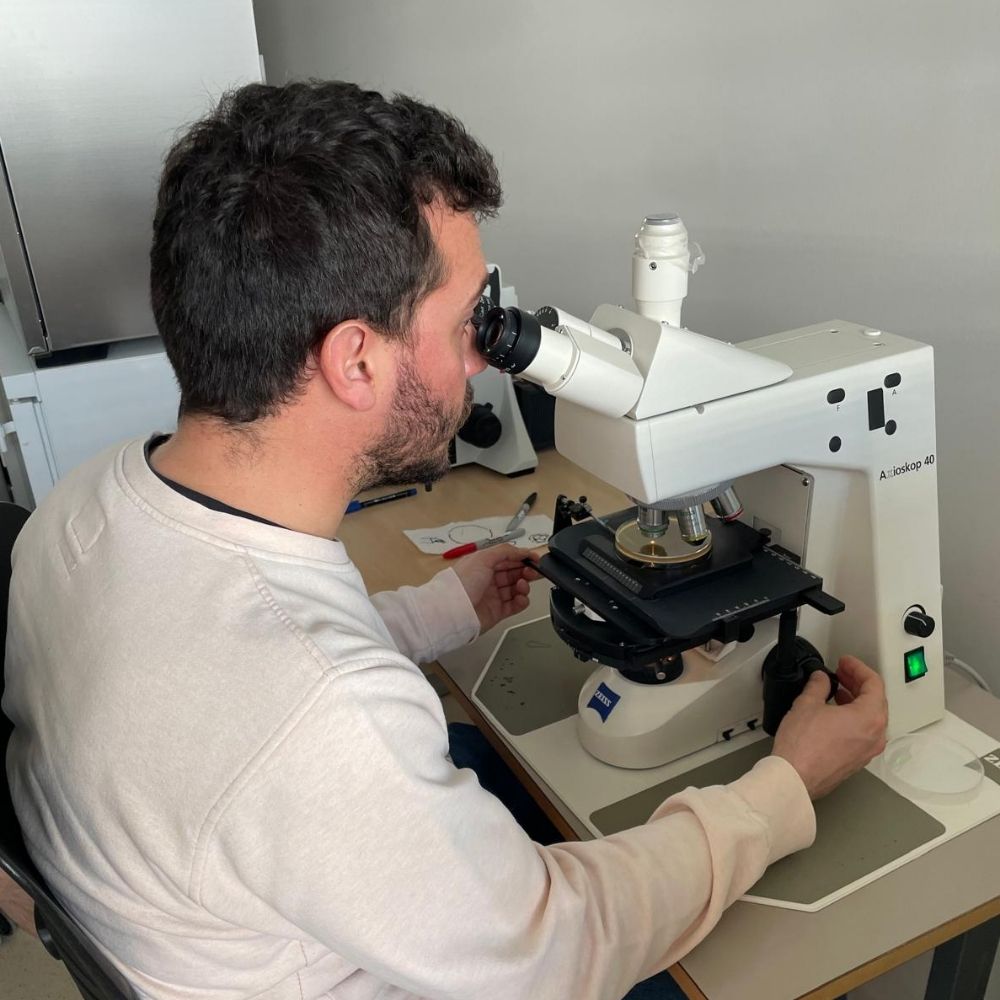
All credits to the dreamteam that made this possible! what a pleasure and honor working with these people! 🥰
@diorgeps.bsky.social @mhakala.bsky.social @juanmagararc.bsky.social @joshuatran.bsky.social @mudgal17.bsky.social @Carlos Marcuello @Andrea Merino
@diorgeps.bsky.social @mhakala.bsky.social @juanmagararc.bsky.social @joshuatran.bsky.social @mudgal17.bsky.social @Carlos Marcuello @Andrea Merino
Reposted by Roux Lab, Geneva
The crucial test: We fused Heimdall Hofund to a fission-defective yeast ESCRT-III protein (Did2). This chimera restored Mup1 trafficking to vacuoles back to wt! A short amphipathic helix, present in Asgard and retained as fragments in eukaryotes, acts as a minimal membrane fission trigger!

December 1, 2025 at 9:24 AM
The crucial test: We fused Heimdall Hofund to a fission-defective yeast ESCRT-III protein (Did2). This chimera restored Mup1 trafficking to vacuoles back to wt! A short amphipathic helix, present in Asgard and retained as fragments in eukaryotes, acts as a minimal membrane fission trigger!
Reposted by Roux Lab, Geneva
Eukaryotic ESCRT-IIIA paralogs, known to form heteropolymers, retain Hofund elements at their N-termini.
In yeast, mutating these elements blocks ESCRT-III-dependent Mup1 transport to vacuoles.
So these elements matter in eukaryotes too.
In yeast, mutating these elements blocks ESCRT-III-dependent Mup1 transport to vacuoles.
So these elements matter in eukaryotes too.

December 1, 2025 at 9:21 AM
Eukaryotic ESCRT-IIIA paralogs, known to form heteropolymers, retain Hofund elements at their N-termini.
In yeast, mutating these elements blocks ESCRT-III-dependent Mup1 transport to vacuoles.
So these elements matter in eukaryotes too.
In yeast, mutating these elements blocks ESCRT-III-dependent Mup1 transport to vacuoles.
So these elements matter in eukaryotes too.
Reposted by Roux Lab, Geneva
Is this Asgard-specific, or conserved with their eukaryotic paralogs?
Hard to tell, since the exact molecular mechanism of fission by eukaryotic ESCRT-III remains blurry, probably due to its complexity.
Let’s figure it out!
Hard to tell, since the exact molecular mechanism of fission by eukaryotic ESCRT-III remains blurry, probably due to its complexity.
Let’s figure it out!
December 1, 2025 at 9:20 AM
Is this Asgard-specific, or conserved with their eukaryotic paralogs?
Hard to tell, since the exact molecular mechanism of fission by eukaryotic ESCRT-III remains blurry, probably due to its complexity.
Let’s figure it out!
Hard to tell, since the exact molecular mechanism of fission by eukaryotic ESCRT-III remains blurry, probably due to its complexity.
Let’s figure it out!
Reposted by Roux Lab, Geneva
Meet Hofund, the N-terminal amphipathic helix of 15 aa in Heimdall ESCRT-IIIA (named after Heimdall’s sword).
How do we know Hofund is the molecular trigger for fission?
Remove Hofund → ESCRT-IIIA loses fission activity.
Add Hofund alone → uncontrolled fission.
How do we know Hofund is the molecular trigger for fission?
Remove Hofund → ESCRT-IIIA loses fission activity.
Add Hofund alone → uncontrolled fission.

December 1, 2025 at 9:16 AM
Meet Hofund, the N-terminal amphipathic helix of 15 aa in Heimdall ESCRT-IIIA (named after Heimdall’s sword).
How do we know Hofund is the molecular trigger for fission?
Remove Hofund → ESCRT-IIIA loses fission activity.
Add Hofund alone → uncontrolled fission.
How do we know Hofund is the molecular trigger for fission?
Remove Hofund → ESCRT-IIIA loses fission activity.
Add Hofund alone → uncontrolled fission.
Reposted by Roux Lab, Geneva
Through membrane fission! We show in vitro that the Asgard Heimdallarchaeota (Heimdall) ESCRT-IIIA subunit is inherently capable of triggering fission upon subunit turnover driven by ATP hydrolysis by Vps4.
And the key question: what actually destabilizes the membrane when ESCRT-IIIA turns over?
And the key question: what actually destabilizes the membrane when ESCRT-IIIA turns over?

December 1, 2025 at 9:15 AM
Through membrane fission! We show in vitro that the Asgard Heimdallarchaeota (Heimdall) ESCRT-IIIA subunit is inherently capable of triggering fission upon subunit turnover driven by ATP hydrolysis by Vps4.
And the key question: what actually destabilizes the membrane when ESCRT-IIIA turns over?
And the key question: what actually destabilizes the membrane when ESCRT-IIIA turns over?
Reposted by Roux Lab, Geneva
In a recent work, @buzzbaum.bsky.social and colleagues showed an Asgard archaeon with internal vesicles.
www.biorxiv.org/content/10.1...
How might Asgard ESCRT-III have contributed to compartmentalization?
www.biorxiv.org/content/10.1...
How might Asgard ESCRT-III have contributed to compartmentalization?

An Asgard archaeon with internal membrane compartments
The emergence of eukaryotes from a merger between an archaeon and a bacterial cell ∼two billion years ago involved a profound change in cellular organisation. While the order in which different featur...
www.biorxiv.org
December 1, 2025 at 9:11 AM
In a recent work, @buzzbaum.bsky.social and colleagues showed an Asgard archaeon with internal vesicles.
www.biorxiv.org/content/10.1...
How might Asgard ESCRT-III have contributed to compartmentalization?
www.biorxiv.org/content/10.1...
How might Asgard ESCRT-III have contributed to compartmentalization?
Fantastic work from Javier @javierespadas.bsky.social in collaboration with @buzzbaum.bsky.social and @kaksonen.bsky.social labs, thank you Chris Toret, thank you Diorge @diorgeps.bsky.social!
New preprint from the lab!!🎉
We show that Asgard archaea ESCRT-III proteins can trigger membrane fission and reveal its molecular mechanism, offering clues to how these cells may have built internal compartments. But do these organisms even have these compartments?
www.biorxiv.org/content/10.1...
We show that Asgard archaea ESCRT-III proteins can trigger membrane fission and reveal its molecular mechanism, offering clues to how these cells may have built internal compartments. But do these organisms even have these compartments?
www.biorxiv.org/content/10.1...
Molecular basis for cellular compartmentalization by an ancient membrane fission mechanism
The emergence of cell compartmentalization depends on membrane fission to create the endomembrane compartments. In eukaryotes, membrane fission is commonly executed by ESCRT-III, a protein complex con...
www.biorxiv.org
December 1, 2025 at 1:44 PM
Fantastic work from Javier @javierespadas.bsky.social in collaboration with @buzzbaum.bsky.social and @kaksonen.bsky.social labs, thank you Chris Toret, thank you Diorge @diorgeps.bsky.social!
Reposted by Roux Lab, Geneva
Thanks to all the team at @rouxlab.bsky.social and abroad: @pauguillamat.bsky.social @caterinatomba.bsky.social @giodang.bsky.social @colomlab.bsky.social @lizhinde.bsky.social @javierespadas.bsky.social and many more
November 27, 2025 at 2:14 PM
Thanks to all the team at @rouxlab.bsky.social and abroad: @pauguillamat.bsky.social @caterinatomba.bsky.social @giodang.bsky.social @colomlab.bsky.social @lizhinde.bsky.social @javierespadas.bsky.social and many more
Reposted by Roux Lab, Geneva
Overall, the work shows that tension gradients arise from the combination of actin dynamics and strong cell–substrate adhesion, rather than from migration itself.
Link: rdcu.be/eRTQA
Link: rdcu.be/eRTQA
Adherent cells sustain membrane tension gradients independently of migration
Nature Communications - This study shows that adherent cells maintain membrane tension gradients even without moving. Using a fluorescent probe, the authors reveal that actin and adhesion forces...
rdcu.be
November 27, 2025 at 2:14 PM
Overall, the work shows that tension gradients arise from the combination of actin dynamics and strong cell–substrate adhesion, rather than from migration itself.
Link: rdcu.be/eRTQA
Link: rdcu.be/eRTQA
Reposted by Roux Lab, Geneva
We accompanied this dynamic live Flipper-TR FLIM imaging with lipid diffusion analysis, spatial lipidomics (shown below), and cool in vitro reconstitutions of tension gradients using supported lipid bilayers that are expanding

November 27, 2025 at 2:14 PM
We accompanied this dynamic live Flipper-TR FLIM imaging with lipid diffusion analysis, spatial lipidomics (shown below), and cool in vitro reconstitutions of tension gradients using supported lipid bilayers that are expanding
Reposted by Roux Lab, Geneva
A key result: adherent cells maintain long-range membrane tension gradients even when they are not migrating! (micropatterned cells below)
In contrast, non-adherent migrating cells *do not* show these gradients.
In contrast, non-adherent migrating cells *do not* show these gradients.

November 27, 2025 at 2:14 PM
A key result: adherent cells maintain long-range membrane tension gradients even when they are not migrating! (micropatterned cells below)
In contrast, non-adherent migrating cells *do not* show these gradients.
In contrast, non-adherent migrating cells *do not* show these gradients.