



Robin Journot 🔬| 🎾
@robinjournot.bsky.social
PhD student in the Fre lab at @institutcurie.bsky.social
Tissue morphogenesis & Fate specification in epithelia.
Organoid and live imaging.
Alumni AgroParisTech & ENS Ulm
Tissue morphogenesis & Fate specification in epithelia.
Organoid and live imaging.
Alumni AgroParisTech & ENS Ulm
Pinned
🚨 New preprint!
We built a single-cell atlas of 14 multilayered epithelia and revealed a conserved transcriptomic program guiding tissue architecture and fate composition. Our work brings decades of tissue-specific studies together into a unified evo-devo framework.
www.biorxiv.org/content/10.1...
We built a single-cell atlas of 14 multilayered epithelia and revealed a conserved transcriptomic program guiding tissue architecture and fate composition. Our work brings decades of tissue-specific studies together into a unified evo-devo framework.
www.biorxiv.org/content/10.1...
Glad to receive a PhD prize from the @gensocuk.bsky.social for the work I lead on the origin and diversification of stratified epithelia.
Thanks to @frelab.bsky.social , the lab, and all collaborators involved.
Special thanks to @candice-merle.bsky.social for her help throughout the project.
Thanks to @frelab.bsky.social , the lab, and all collaborators involved.
Special thanks to @candice-merle.bsky.social for her help throughout the project.

Congratulations to Dr @robinjournot.bsky.social, the winner of our 2026 Bruce Cattanach Prize for his PhD research into the genetic and evolutionary basis of epithelial stratification!
genetics.org.uk/medals-and-p...
genetics.org.uk/medals-and-p...

January 26, 2026 at 2:34 PM
Glad to receive a PhD prize from the @gensocuk.bsky.social for the work I lead on the origin and diversification of stratified epithelia.
Thanks to @frelab.bsky.social , the lab, and all collaborators involved.
Special thanks to @candice-merle.bsky.social for her help throughout the project.
Thanks to @frelab.bsky.social , the lab, and all collaborators involved.
Special thanks to @candice-merle.bsky.social for her help throughout the project.
My time at @institutcurie.bsky.social is done! Over the past months, I completed my PhD, published my first first-author paper in DevCell (www.cell.com/developmenta..., and submitted my first last-author manuscript to bioRxiv (www.biorxiv.org/content/10.1...).


January 14, 2026 at 3:50 PM
My time at @institutcurie.bsky.social is done! Over the past months, I completed my PhD, published my first first-author paper in DevCell (www.cell.com/developmenta..., and submitted my first last-author manuscript to bioRxiv (www.biorxiv.org/content/10.1...).
Reposted by Robin Journot 🔬| 🎾

1. Excited to share CONCORD, out in @NatureBiotech, an ML framework for single-cell analysis addressing integration, dimensionality reduction, and denoising in one go by @qinzhu1.🔗 www.nature.com/articles/s41... Check out this CONCORD model of worm development resolving differentiation trajectories:
January 13, 2026 at 1:10 PM
1. Excited to share CONCORD, out in @NatureBiotech, an ML framework for single-cell analysis addressing integration, dimensionality reduction, and denoising in one go by @qinzhu1.🔗 www.nature.com/articles/s41... Check out this CONCORD model of worm development resolving differentiation trajectories:
Reposted by Robin Journot 🔬| 🎾
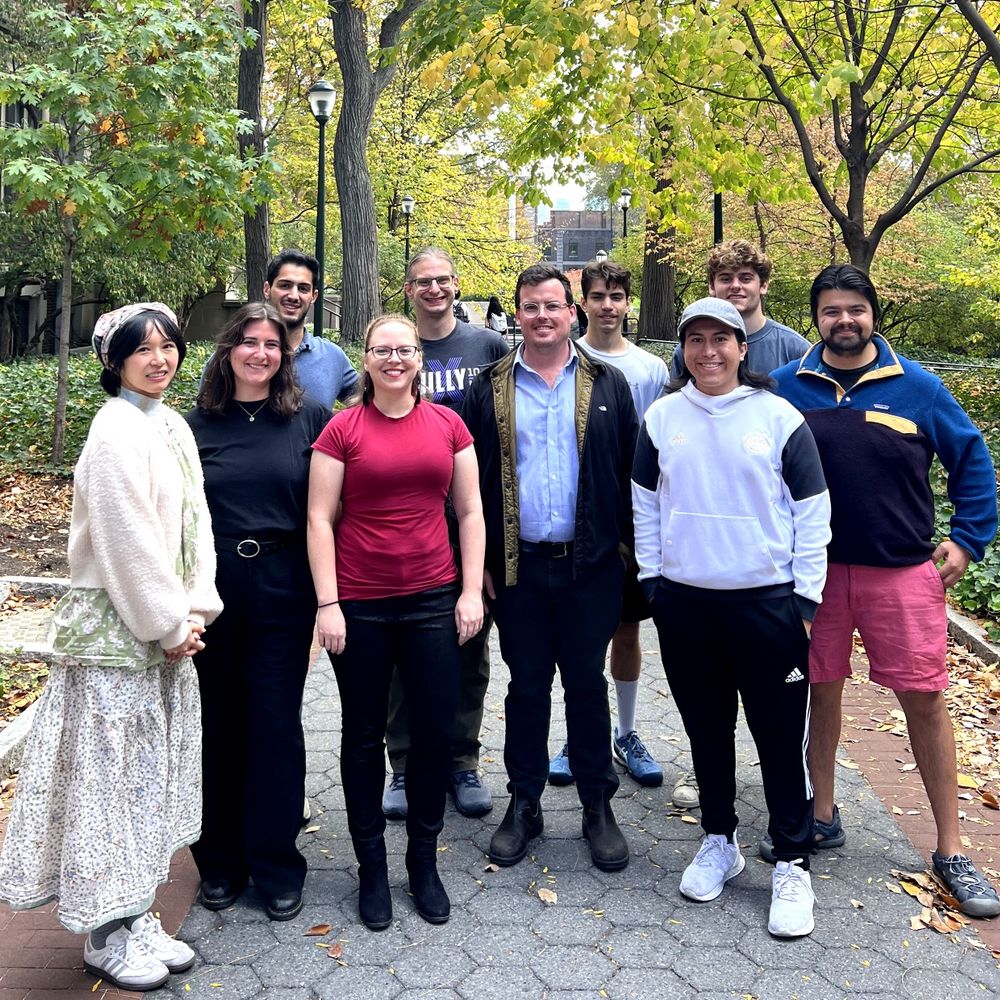
*New preprint alert* uncovering a mechanical pacemaker that synchronizes nephron formation with branching of the kidney's epithelial tubule tree. Read below to learn about this twisty journey lead by Sam Grindel and Sachin Davis in the lab. [Movie by Nils Lindstrom]
www.biorxiv.org/content/10.1...
www.biorxiv.org/content/10.1...
December 13, 2025 at 12:08 AM
*New preprint alert* uncovering a mechanical pacemaker that synchronizes nephron formation with branching of the kidney's epithelial tubule tree. Read below to learn about this twisty journey lead by Sam Grindel and Sachin Davis in the lab. [Movie by Nils Lindstrom]
www.biorxiv.org/content/10.1...
www.biorxiv.org/content/10.1...
Reposted by Robin Journot 🔬| 🎾
Check out our beautiful story on tumour clonal dynamics with barcodes, performed in the @frelab.bsky.social by my super talented post-doc @candice-merle.bsky.social and @ivanditerlizzi.bsky.social from @rulands.bsky.social lab!
#barcodes #plasticity
#barcodes #plasticity

Genetic barcoding of individual cells links cancer evolutionary trajectories and prognostic outcomes https://www.biorxiv.org/content/10.64898/2025.12.01.691488v1
December 3, 2025 at 8:55 AM
Check out our beautiful story on tumour clonal dynamics with barcodes, performed in the @frelab.bsky.social by my super talented post-doc @candice-merle.bsky.social and @ivanditerlizzi.bsky.social from @rulands.bsky.social lab!
#barcodes #plasticity
#barcodes #plasticity
Reposted by Robin Journot 🔬| 🎾
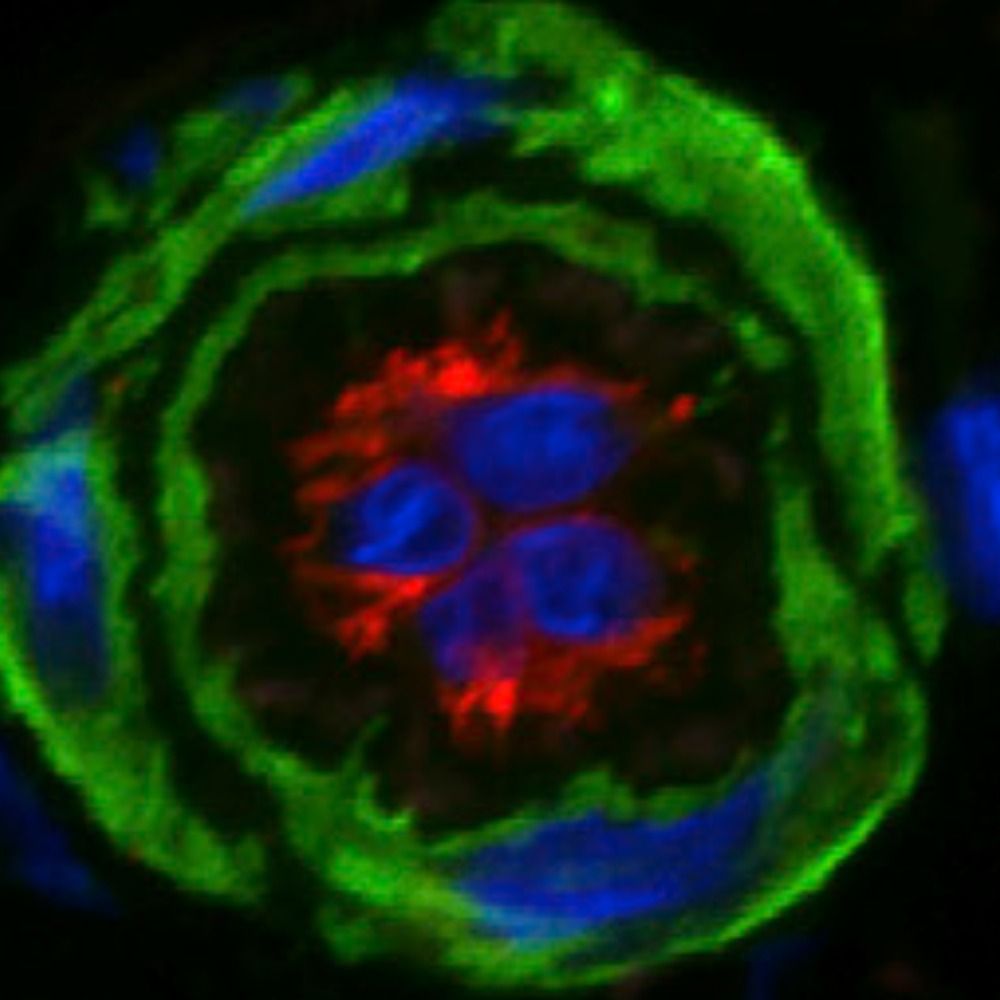
An amazing preprint on molecular evolution (p63-Notch) of Epithelial Multilayering
Cross-organ (14 in🐭), Cross-species (7🪰🐟x2🐸🐥🐭👤) single-cell transcriptomics
p63+Jag2+ basal signal sendor▶️ p63-Hes1+ suprabasal receivers🐭
bioRxiv 2025
www.biorxiv.org/content/10.1...
Cross-organ (14 in🐭), Cross-species (7🪰🐟x2🐸🐥🐭👤) single-cell transcriptomics
p63+Jag2+ basal signal sendor▶️ p63-Hes1+ suprabasal receivers🐭
bioRxiv 2025
www.biorxiv.org/content/10.1...

December 3, 2025 at 12:35 PM
An amazing preprint on molecular evolution (p63-Notch) of Epithelial Multilayering
Cross-organ (14 in🐭), Cross-species (7🪰🐟x2🐸🐥🐭👤) single-cell transcriptomics
p63+Jag2+ basal signal sendor▶️ p63-Hes1+ suprabasal receivers🐭
bioRxiv 2025
www.biorxiv.org/content/10.1...
Cross-organ (14 in🐭), Cross-species (7🪰🐟x2🐸🐥🐭👤) single-cell transcriptomics
p63+Jag2+ basal signal sendor▶️ p63-Hes1+ suprabasal receivers🐭
bioRxiv 2025
www.biorxiv.org/content/10.1...
🚨 New preprint!
We built a single-cell atlas of 14 multilayered epithelia and revealed a conserved transcriptomic program guiding tissue architecture and fate composition. Our work brings decades of tissue-specific studies together into a unified evo-devo framework.
www.biorxiv.org/content/10.1...
We built a single-cell atlas of 14 multilayered epithelia and revealed a conserved transcriptomic program guiding tissue architecture and fate composition. Our work brings decades of tissue-specific studies together into a unified evo-devo framework.
www.biorxiv.org/content/10.1...
November 17, 2025 at 12:33 PM
🚨 New preprint!
We built a single-cell atlas of 14 multilayered epithelia and revealed a conserved transcriptomic program guiding tissue architecture and fate composition. Our work brings decades of tissue-specific studies together into a unified evo-devo framework.
www.biorxiv.org/content/10.1...
We built a single-cell atlas of 14 multilayered epithelia and revealed a conserved transcriptomic program guiding tissue architecture and fate composition. Our work brings decades of tissue-specific studies together into a unified evo-devo framework.
www.biorxiv.org/content/10.1...
Reposted by Robin Journot 🔬| 🎾
The PhD work of @bboumard.bsky.social officially out in print! Happy to share this issue with our downstairs colleagues in the BDD @frelab.bsky.social @robinjournot.bsky.social
www.cell.com/developmenta...
www.cell.com/developmenta...

Cell-type-specific nucleotide sharing through gap junctions impacts sensitivity to replication stress in Drosophila
Boumard et al. demonstrate gap-junction-dependent tissue-scale nucleotide sharing,
which impacts cellular sensitivity to perturbation of nucleotide homeostasis and replication
stress. Drosophila wing ...
www.cell.com
October 7, 2025 at 6:43 AM
The PhD work of @bboumard.bsky.social officially out in print! Happy to share this issue with our downstairs colleagues in the BDD @frelab.bsky.social @robinjournot.bsky.social
www.cell.com/developmenta...
www.cell.com/developmenta...
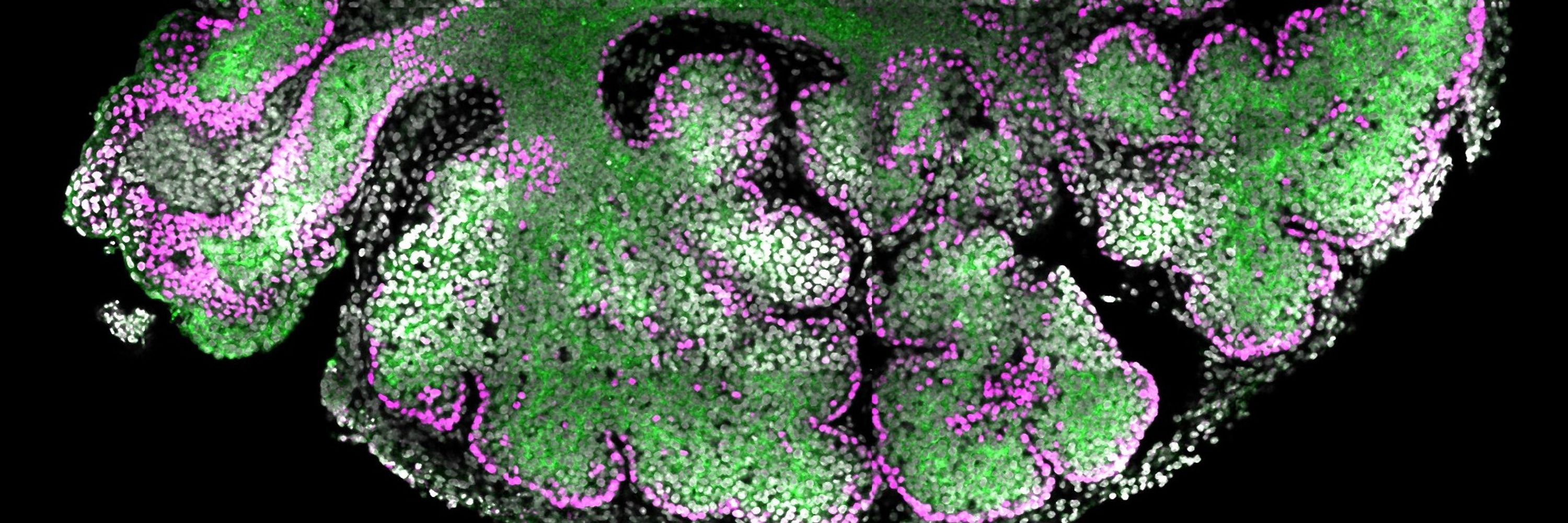
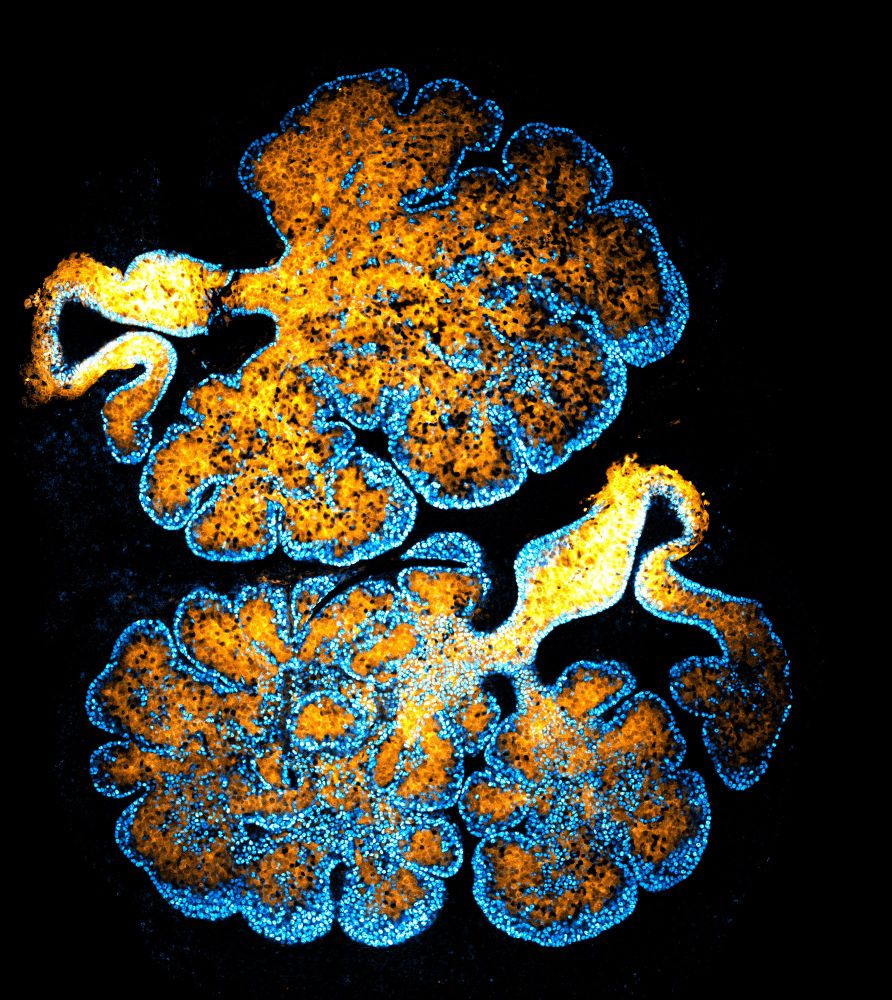
Our paper is on the cover of @cp-devcell.bsky.social . Image: embryonic murine salivary-gland explants stained for fate determinants; p63 (cyan) and HES1 (yellow). Thanks to everyone involved.
doi.org/10.1016/j.de...
doi.org/10.1016/j.de...

October 6, 2025 at 7:38 PM
Our paper is on the cover of @cp-devcell.bsky.social . Image: embryonic murine salivary-gland explants stained for fate determinants; p63 (cyan) and HES1 (yellow). Thanks to everyone involved.
doi.org/10.1016/j.de...
doi.org/10.1016/j.de...
Reposted by Robin Journot 🔬| 🎾
🧵1/ Excited to share our new paper introducing a new #singlecell assay: scTF-seq, a high-throughput single-cell approach to explore how transcription factor (TF) dose shapes cell identity and reprogramming outcomes. 🔗 www.nature.com/articles/s41... Big congrats to the entire team @EPFL & @SIAT_China

Dissecting the impact of transcription factor dose on cell reprogramming heterogeneity using scTF-seq - Nature Genetics
This study introduces single-cell transcription factor (TF) sequencing, a single-cell barcoded and doxycycline-inducible TF overexpression approach that reveals dose-sensitive functional classes of TFs and cellular heterogeneity by mapping TF dose-dependent transcriptomic changes during the reprogramming of mouse embryonic multipotent stromal cells.
www.nature.com
October 6, 2025 at 6:57 AM
🧵1/ Excited to share our new paper introducing a new #singlecell assay: scTF-seq, a high-throughput single-cell approach to explore how transcription factor (TF) dose shapes cell identity and reprogramming outcomes. 🔗 www.nature.com/articles/s41... Big congrats to the entire team @EPFL & @SIAT_China
"Contractile fibroblasts form a transient niche for the branching mammary epithelium."
Now out: rdcu.be/eIIKD
A great contribution from Jakub Sumbal, showing how stromal cells, and diverse fibroblast subsets, regulate branching morphogenesis.
@sumbalovakoledova.bsky.social @frelab.bsky.social
Now out: rdcu.be/eIIKD
A great contribution from Jakub Sumbal, showing how stromal cells, and diverse fibroblast subsets, regulate branching morphogenesis.
@sumbalovakoledova.bsky.social @frelab.bsky.social

September 30, 2025 at 6:16 AM
"Contractile fibroblasts form a transient niche for the branching mammary epithelium."
Now out: rdcu.be/eIIKD
A great contribution from Jakub Sumbal, showing how stromal cells, and diverse fibroblast subsets, regulate branching morphogenesis.
@sumbalovakoledova.bsky.social @frelab.bsky.social
Now out: rdcu.be/eIIKD
A great contribution from Jakub Sumbal, showing how stromal cells, and diverse fibroblast subsets, regulate branching morphogenesis.
@sumbalovakoledova.bsky.social @frelab.bsky.social
From a FACS-contaminating cell population to a multi-organ project — learn the Behind the Story of our work on conserved signals in epithelial organogenesis 👉 www.sciencedirect.com/science/arti...
September 8, 2025 at 6:25 AM
From a FACS-contaminating cell population to a multi-organ project — learn the Behind the Story of our work on conserved signals in epithelial organogenesis 👉 www.sciencedirect.com/science/arti...
Reposted by Robin Journot 🔬| 🎾
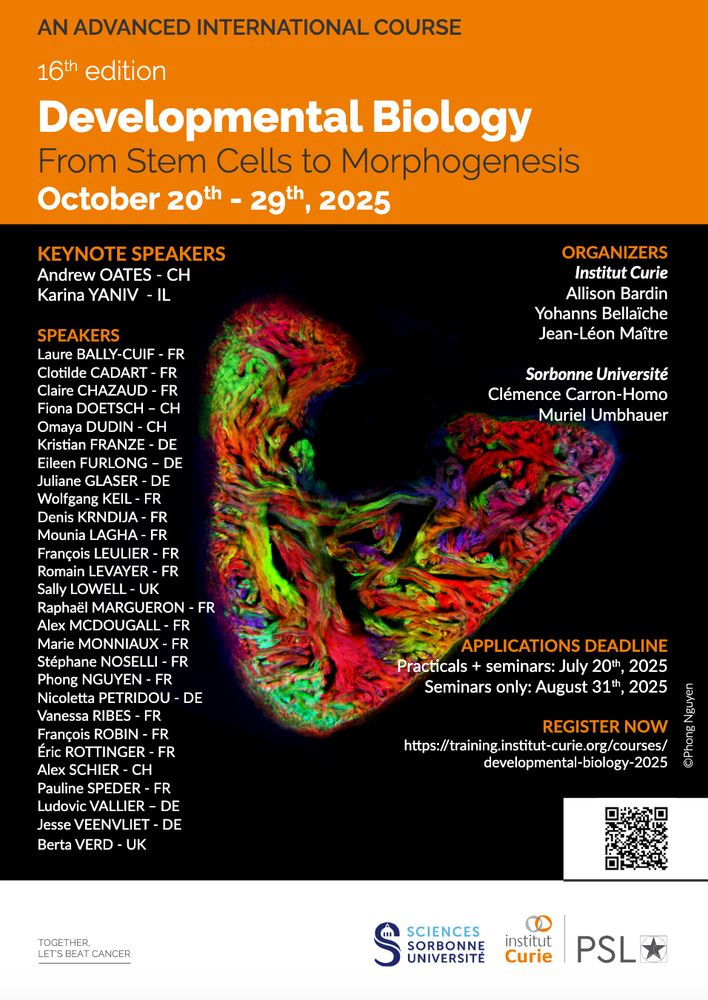
Students (Master's/PhD), do not miss this fantastic Developmental Biology course of @sorbonne-universite.fr and @institutcurie.bsky.social - It is FREE and open to international students, however, room and board + travel are not included.
training.institut-curie.org/courses/deve...
training.institut-curie.org/courses/deve...
June 13, 2025 at 4:55 PM
Students (Master's/PhD), do not miss this fantastic Developmental Biology course of @sorbonne-universite.fr and @institutcurie.bsky.social - It is FREE and open to international students, however, room and board + travel are not included.
training.institut-curie.org/courses/deve...
training.institut-curie.org/courses/deve...
🧵Just out !
We reveal how 4 branched epithelia—mammary, lacrimal, salivary & prostate—use a conserved YAP–Notch–p63 circuit to self-organize during development & regeneration.
Here’s the story👇
authors.elsevier.com/c/1lM285Sx5g...
Work done in @frelab.bsky.social at
@institutcurie.bsky.social
We reveal how 4 branched epithelia—mammary, lacrimal, salivary & prostate—use a conserved YAP–Notch–p63 circuit to self-organize during development & regeneration.
Here’s the story👇
authors.elsevier.com/c/1lM285Sx5g...
Work done in @frelab.bsky.social at
@institutcurie.bsky.social
July 1, 2025 at 6:39 AM
🧵Just out !
We reveal how 4 branched epithelia—mammary, lacrimal, salivary & prostate—use a conserved YAP–Notch–p63 circuit to self-organize during development & regeneration.
Here’s the story👇
authors.elsevier.com/c/1lM285Sx5g...
Work done in @frelab.bsky.social at
@institutcurie.bsky.social
We reveal how 4 branched epithelia—mammary, lacrimal, salivary & prostate—use a conserved YAP–Notch–p63 circuit to self-organize during development & regeneration.
Here’s the story👇
authors.elsevier.com/c/1lM285Sx5g...
Work done in @frelab.bsky.social at
@institutcurie.bsky.social
Reposted by Robin Journot 🔬| 🎾

Notch1 activation in basal cells triggers a progressive basal-to-luminal cell-fate switch in the mouse mammary gland but also in adult cells of the lacrimal, salivary and prostatic glands
Silvia Fre and coworkers @frelab.bsky.social @institutcurie.bsky.social
www.embopress.org/doi/full/10....
Silvia Fre and coworkers @frelab.bsky.social @institutcurie.bsky.social
www.embopress.org/doi/full/10....

April 7, 2025 at 11:05 AM
Notch1 activation in basal cells triggers a progressive basal-to-luminal cell-fate switch in the mouse mammary gland but also in adult cells of the lacrimal, salivary and prostatic glands
Silvia Fre and coworkers @frelab.bsky.social @institutcurie.bsky.social
www.embopress.org/doi/full/10....
Silvia Fre and coworkers @frelab.bsky.social @institutcurie.bsky.social
www.embopress.org/doi/full/10....
Reposted by Robin Journot 🔬| 🎾
I am very excited to share our most recent work on how ‘Cell heterogeneity and fate bistability drive tissue patterning during intestinal regeneration’ ☺️ Thanks a lot to @silviabarbiero.bsky.social @davidbrueckner.bsky.social @priscaliberali.bsky.social
@ehannezo.bsky.social and all the co-authors!
@ehannezo.bsky.social and all the co-authors!
A perfect start in the new year! 🌱 Regenerating tissues are just an amazing spatio temporal controlled process! Our new manuscript explores how cell heterogeneity and bistability orchestrate intestinal regeneration. 🧵 biorxiv.org/cgi/content/...

Cell heterogeneity and fate bistability drive tissue patterning during intestinal regeneration
Tissue regeneration relies on the ability of cells to undergo de novo patterning. While tissue patterning has been viewed as the transition from initially identical un-patterned cells to an arrangemen...
biorxiv.org
January 15, 2025 at 6:26 PM
I am very excited to share our most recent work on how ‘Cell heterogeneity and fate bistability drive tissue patterning during intestinal regeneration’ ☺️ Thanks a lot to @silviabarbiero.bsky.social @davidbrueckner.bsky.social @priscaliberali.bsky.social
@ehannezo.bsky.social and all the co-authors!
@ehannezo.bsky.social and all the co-authors!
Reposted by Robin Journot 🔬| 🎾
@thejohnnyyu.bsky.social, @therealnima.bsky.social
, Kevan Shokat, and I are excited to announce a historic achievement by our team at @vevotherapeutics.bsky.social: tinyurl.com/4rrvap3t
, Kevan Shokat, and I are excited to announce a historic achievement by our team at @vevotherapeutics.bsky.social: tinyurl.com/4rrvap3t
Vevo Therapeutics to Release World's Largest Atlas of Single-Cell Transcriptomic Data, Tahoe-100M, to Map How Drugs Impact Patient Cells and Accelerate Discovery of New Drugs
/PRNewswire/ -- Vevo Therapeutics, a biotechnology company using its Mosaic technology and next generation AI to uncover better drugs for more patients,...
www.prnewswire.com
December 5, 2024 at 2:25 PM
@thejohnnyyu.bsky.social, @therealnima.bsky.social
, Kevan Shokat, and I are excited to announce a historic achievement by our team at @vevotherapeutics.bsky.social: tinyurl.com/4rrvap3t
, Kevan Shokat, and I are excited to announce a historic achievement by our team at @vevotherapeutics.bsky.social: tinyurl.com/4rrvap3t
A new platform, a new post!
Our #Stemcell #DevBio and #Regeneration
story by Silvia Fre's lab at InstitutCurie is on biorXiv.
Link: tinyurl.com/2uspcd3u
We reveal how 4 epithelia self-organize during embryonic development and regeneration.
Our #Stemcell #DevBio and #Regeneration
story by Silvia Fre's lab at InstitutCurie is on biorXiv.
Link: tinyurl.com/2uspcd3u
We reveal how 4 epithelia self-organize during embryonic development and regeneration.
November 19, 2024 at 7:30 AM
A new platform, a new post!
Our #Stemcell #DevBio and #Regeneration
story by Silvia Fre's lab at InstitutCurie is on biorXiv.
Link: tinyurl.com/2uspcd3u
We reveal how 4 epithelia self-organize during embryonic development and regeneration.
Our #Stemcell #DevBio and #Regeneration
story by Silvia Fre's lab at InstitutCurie is on biorXiv.
Link: tinyurl.com/2uspcd3u
We reveal how 4 epithelia self-organize during embryonic development and regeneration.