



Ricardo Reis
@r2rsquared.bsky.social
AW Phillips Professor of Economics at the LSE
References:
-- gregmankiw.blogspot.com/2009/10/valu...
-- project-syndicate.org/commentary/b...
-- pubs.aeaweb.org/doi/pdfplus/...
-- hoover.org/research/fla...
-- heritage.org/taxes/commen...
-- taxpolicycenter.org/briefing-boo...
-- gregmankiw.blogspot.com/2009/10/valu...
-- project-syndicate.org/commentary/b...
-- pubs.aeaweb.org/doi/pdfplus/...
-- hoover.org/research/fla...
-- heritage.org/taxes/commen...
-- taxpolicycenter.org/briefing-boo...
Greg Mankiw's Blog: The Value Added Tax
gregmankiw.blogspot.com
April 13, 2025 at 11:24 AM
From tariffs to consumption taxes? Probably not.
But in every storm there is a ray of light.
The team of economists around President Trump has been heavily criticized by their peers. Here is a suggestion for them to rally around and come out on top.
But in every storm there is a ray of light.
The team of economists around President Trump has been heavily criticized by their peers. Here is a suggestion for them to rally around and come out on top.
April 13, 2025 at 11:24 AM
From tariffs to consumption taxes? Probably not.
But in every storm there is a ray of light.
The team of economists around President Trump has been heavily criticized by their peers. Here is a suggestion for them to rally around and come out on top.
But in every storm there is a ray of light.
The team of economists around President Trump has been heavily criticized by their peers. Here is a suggestion for them to rally around and come out on top.
Supporters of President Trump have argued that the tariffs were just the starting point.
What if the end point is a flat-rate consumption tax with a universal transfer?
(You can call it an X-tax, FairTax, business transfer tax, or flat tax, in case VAT sounds too European.)
What if the end point is a flat-rate consumption tax with a universal transfer?
(You can call it an X-tax, FairTax, business transfer tax, or flat tax, in case VAT sounds too European.)
April 13, 2025 at 11:24 AM
Supporters of President Trump have argued that the tariffs were just the starting point.
What if the end point is a flat-rate consumption tax with a universal transfer?
(You can call it an X-tax, FairTax, business transfer tax, or flat tax, in case VAT sounds too European.)
What if the end point is a flat-rate consumption tax with a universal transfer?
(You can call it an X-tax, FairTax, business transfer tax, or flat tax, in case VAT sounds too European.)
6. Send every patriotic working American a beautiful big check with the same amount, just like you did in 2020. But do it every year, not just when there is a pandemic.
You have achieved progressivity, helping the poor ✅🏆
You have achieved progressivity, helping the poor ✅🏆
April 13, 2025 at 11:24 AM
6. Send every patriotic working American a beautiful big check with the same amount, just like you did in 2020. But do it every year, not just when there is a pandemic.
You have achieved progressivity, helping the poor ✅🏆
You have achieved progressivity, helping the poor ✅🏆
5. Then, let each sector and industry leader come to you to bargain for their rate. They can give you lump-sum gifts to convince you.
There are some grounds to suggest that you will end up with the same tax rate for every good. That is production efficiency ✅🏆
There are some grounds to suggest that you will end up with the same tax rate for every good. That is production efficiency ✅🏆
April 13, 2025 at 11:24 AM
5. Then, let each sector and industry leader come to you to bargain for their rate. They can give you lump-sum gifts to convince you.
There are some grounds to suggest that you will end up with the same tax rate for every good. That is production efficiency ✅🏆
There are some grounds to suggest that you will end up with the same tax rate for every good. That is production efficiency ✅🏆
4. Set the rates across sectors and products between 10% and 50%. Follow a "commodity formula" from some Ramsey guy with some Greek letters standing for "demand elasticities".
Fentanyl (from Canada) or luxury cars (from Europe) will get taxed more ✅🏆
Fentanyl (from Canada) or luxury cars (from Europe) will get taxed more ✅🏆
April 13, 2025 at 11:24 AM
4. Set the rates across sectors and products between 10% and 50%. Follow a "commodity formula" from some Ramsey guy with some Greek letters standing for "demand elasticities".
Fentanyl (from Canada) or luxury cars (from Europe) will get taxed more ✅🏆
Fentanyl (from Canada) or luxury cars (from Europe) will get taxed more ✅🏆
3. Set a minimum 10% rate on all goods and services. Use most of the new revenue to pay down the national debt.
I'm quite confident that Treasury yields will go down. ✅🏆
I'm quite confident that Treasury yields will go down. ✅🏆
April 13, 2025 at 11:24 AM
3. Set a minimum 10% rate on all goods and services. Use most of the new revenue to pay down the national debt.
I'm quite confident that Treasury yields will go down. ✅🏆
I'm quite confident that Treasury yields will go down. ✅🏆
2. Set up a VAT. Over-ride Congress's power over taxation because of the current under-saving over-consumption emergency. We’ve learned recently the House will go along.
If this makes Americans consume less and save more then no more current account deficit. ✅🏆
If this makes Americans consume less and save more then no more current account deficit. ✅🏆
April 13, 2025 at 11:24 AM
2. Set up a VAT. Over-ride Congress's power over taxation because of the current under-saving over-consumption emergency. We’ve learned recently the House will go along.
If this makes Americans consume less and save more then no more current account deficit. ✅🏆
If this makes Americans consume less and save more then no more current account deficit. ✅🏆
1. Most goods with a "made in US" label were made with significant foreign inputs.
You may call this "cheating" by other countries, hiding under that US label.
A tax over all consumption goods, as opposed to only those labelled “imported", gets to all. No more cheating. ✅🏆
You may call this "cheating" by other countries, hiding under that US label.
A tax over all consumption goods, as opposed to only those labelled “imported", gets to all. No more cheating. ✅🏆
April 13, 2025 at 11:24 AM
1. Most goods with a "made in US" label were made with significant foreign inputs.
You may call this "cheating" by other countries, hiding under that US label.
A tax over all consumption goods, as opposed to only those labelled “imported", gets to all. No more cheating. ✅🏆
You may call this "cheating" by other countries, hiding under that US label.
A tax over all consumption goods, as opposed to only those labelled “imported", gets to all. No more cheating. ✅🏆
*** The next step for Trump's economic policy ***
President Tump loves tariffs.
Tariffs are taxes on the consumption of imported goods.
What about boldly following through and... extending his favorite policy tool to all goods?
Hear me out…
President Tump loves tariffs.
Tariffs are taxes on the consumption of imported goods.
What about boldly following through and... extending his favorite policy tool to all goods?
Hear me out…
April 13, 2025 at 11:24 AM
*** The next step for Trump's economic policy ***
President Tump loves tariffs.
Tariffs are taxes on the consumption of imported goods.
What about boldly following through and... extending his favorite policy tool to all goods?
Hear me out…
President Tump loves tariffs.
Tariffs are taxes on the consumption of imported goods.
What about boldly following through and... extending his favorite policy tool to all goods?
Hear me out…
Reposted by Ricardo Reis

Required reading from @r2rsquared.bsky.social on what lies behind r* personal.lse.ac.uk/reisr/papers... "This paper first documents the differing trends of these four R-stars in the quarter-century before the pandemic. Then, it proposes a general framework to make sense of their joint evolution"
personal.lse.ac.uk
March 29, 2025 at 5:00 PM
Required reading from @r2rsquared.bsky.social on what lies behind r* personal.lse.ac.uk/reisr/papers... "This paper first documents the differing trends of these four R-stars in the quarter-century before the pandemic. Then, it proposes a general framework to make sense of their joint evolution"
The direct, fast, and large impact of the tariff hike is to raise US inflation. The hike may also cause a recession. There is too much focus on the latter and neglect of the former.
April 11, 2025 at 9:16 AM
The direct, fast, and large impact of the tariff hike is to raise US inflation. The hike may also cause a recession. There is too much focus on the latter and neglect of the former.
This "partisan bias" in the data mattered during Covid in 2021-22:
"...had all expectations become as unanchored as those of Republicans, average inflation would have been two to four percentage points higher for much of the pandemic period"
www.sciencedirect.com/science/arti...
"...had all expectations become as unanchored as those of Republicans, average inflation would have been two to four percentage points higher for much of the pandemic period"
www.sciencedirect.com/science/arti...
January 25, 2025 at 10:52 AM
This "partisan bias" in the data mattered during Covid in 2021-22:
"...had all expectations become as unanchored as those of Republicans, average inflation would have been two to four percentage points higher for much of the pandemic period"
www.sciencedirect.com/science/arti...
"...had all expectations become as unanchored as those of Republicans, average inflation would have been two to four percentage points higher for much of the pandemic period"
www.sciencedirect.com/science/arti...
There is *a lot* of useful information in the disagreement that we see in the expectations data. Which of it is useful depends on the question you are asking.
Recent references for those interested:
-- bfi.uchicago.edu/wp-content/u...
-- personal.lse.ac.uk/reisr/papers...
Recent references for those interested:
-- bfi.uchicago.edu/wp-content/u...
-- personal.lse.ac.uk/reisr/papers...
January 25, 2025 at 10:50 AM
There is *a lot* of useful information in the disagreement that we see in the expectations data. Which of it is useful depends on the question you are asking.
Recent references for those interested:
-- bfi.uchicago.edu/wp-content/u...
-- personal.lse.ac.uk/reisr/papers...
Recent references for those interested:
-- bfi.uchicago.edu/wp-content/u...
-- personal.lse.ac.uk/reisr/papers...
Measuring inflation expectations would be futile" *if* there was FIRE. Because people do not have RE, these measurements are potentially very valuable, and it turns out indeed they are very useful data for modeling and forecasting inflation.
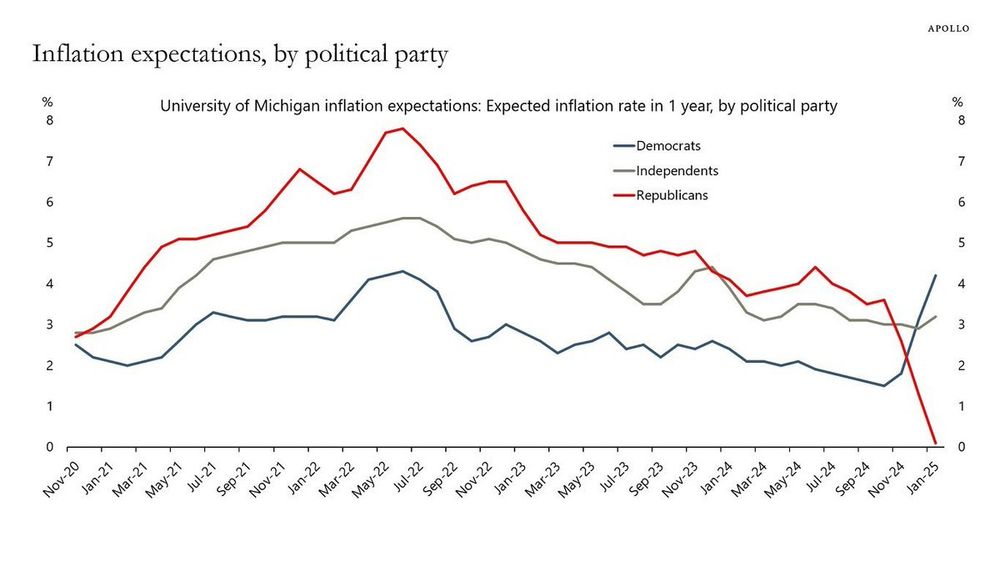
Under full information rational expectations (FIRE), these data would be "solely a mirror of the outcomes that we could measure in the aggregate data. Measuring expectations was as futile as measuring utility." A picture like this suggests a rejection of FIRE.
Making an effort to migrate into there from X, this figure sent by Torsten Slok made the rounds yesterday:
January 25, 2025 at 10:49 AM
Measuring inflation expectations would be futile" *if* there was FIRE. Because people do not have RE, these measurements are potentially very valuable, and it turns out indeed they are very useful data for modeling and forecasting inflation.
Under full information rational expectations (FIRE), these data would be "solely a mirror of the outcomes that we could measure in the aggregate data. Measuring expectations was as futile as measuring utility." A picture like this suggests a rejection of FIRE.
Making an effort to migrate into there from X, this figure sent by Torsten Slok made the rounds yesterday:
January 25, 2025 at 10:47 AM
Under full information rational expectations (FIRE), these data would be "solely a mirror of the outcomes that we could measure in the aggregate data. Measuring expectations was as futile as measuring utility." A picture like this suggests a rejection of FIRE.
Making an effort to migrate into there from X, this figure sent by Torsten Slok made the rounds yesterday:
January 25, 2025 at 10:45 AM
Making an effort to migrate into there from X, this figure sent by Torsten Slok made the rounds yesterday:
I see you have €1 saved earning interest.
That's right.
Please give it to me and I'll pay you the same interest.
Ok.
Actually, paying you interest is subsidising you, forget about it.
Uh?
I'm the govt, I could require you to give it to me.
🤔
cepr.org/voxeu/column...
That's right.
Please give it to me and I'll pay you the same interest.
Ok.
Actually, paying you interest is subsidising you, forget about it.
Uh?
I'm the govt, I could require you to give it to me.
🤔
cepr.org/voxeu/column...

Monetary policies that do not subsidise banks
Central banks pay interest on commercial banks’ holdings of cash reserves at the central bank. Thus, recent rate increases imply larger interest payments to commercial banks and loss of revenue for na...
cepr.org
February 21, 2024 at 11:27 AM
I see you have €1 saved earning interest.
That's right.
Please give it to me and I'll pay you the same interest.
Ok.
Actually, paying you interest is subsidising you, forget about it.
Uh?
I'm the govt, I could require you to give it to me.
🤔
cepr.org/voxeu/column...
That's right.
Please give it to me and I'll pay you the same interest.
Ok.
Actually, paying you interest is subsidising you, forget about it.
Uh?
I'm the govt, I could require you to give it to me.
🤔
cepr.org/voxeu/column...