



neurosock
@neurosock.bsky.social
#BrainChips monthly recap. I make #neuro papers easy to understand. To make #Neuralink possible. Neuro PhD. AI🤖ML👾Data Sci 📊 Monkeys🐵Future🚀Cyberpunk⚡🦾🌌
Pinned
neurosock
@neurosock.bsky.social
· Nov 28


The hippocampus is not a library, it is a simulation engine.
HPC is known for storing maps of the environment but not so known for generating planned trajectories.
This paper proposes that recurrence in CA3 is crucial for planning.
A🧵with my toy model and notes:
#neuroskyence #compneuro #NeuroAI
HPC is known for storing maps of the environment but not so known for generating planned trajectories.
This paper proposes that recurrence in CA3 is crucial for planning.
A🧵with my toy model and notes:
#neuroskyence #compneuro #NeuroAI
Reposted by neurosock
Every year, I put together a year's review of what's going on in the crazily evolving world of brain chips, #Neuralink and #BCI's.
2025 was huge for BCIs, but we saw many other trends.
Here are my top-10 trends of the year and what to watch for in 2026:
#neuroskyence #NeuroAI #NeuroTech
2025 was huge for BCIs, but we saw many other trends.
Here are my top-10 trends of the year and what to watch for in 2026:
#neuroskyence #NeuroAI #NeuroTech

December 18, 2025 at 1:51 PM
Every year, I put together a year's review of what's going on in the crazily evolving world of brain chips, #Neuralink and #BCI's.
2025 was huge for BCIs, but we saw many other trends.
Here are my top-10 trends of the year and what to watch for in 2026:
#neuroskyence #NeuroAI #NeuroTech
2025 was huge for BCIs, but we saw many other trends.
Here are my top-10 trends of the year and what to watch for in 2026:
#neuroskyence #NeuroAI #NeuroTech
Every year, I put together a year's review of what's going on in the crazily evolving world of brain chips, #Neuralink and #BCI's.
2025 was huge for BCIs, but we saw many other trends.
Here are my top-10 trends of the year and what to watch for in 2026:
#neuroskyence #NeuroAI #NeuroTech
2025 was huge for BCIs, but we saw many other trends.
Here are my top-10 trends of the year and what to watch for in 2026:
#neuroskyence #NeuroAI #NeuroTech
December 18, 2025 at 1:51 PM
Every year, I put together a year's review of what's going on in the crazily evolving world of brain chips, #Neuralink and #BCI's.
2025 was huge for BCIs, but we saw many other trends.
Here are my top-10 trends of the year and what to watch for in 2026:
#neuroskyence #NeuroAI #NeuroTech
2025 was huge for BCIs, but we saw many other trends.
Here are my top-10 trends of the year and what to watch for in 2026:
#neuroskyence #NeuroAI #NeuroTech
Reposted by neurosock
The new Titans architecture shows how badly Google wants to go back to recurrence.
Why? Recurrence is damn cheap.
This paper shows how the brain does it.
Striatum, cortex, HPC, BG, and thalamus, in recurrent loops with shortcuts.
A🧵with my toy model and notes:
#neuroskyence #compneuro #NeuroAI
Why? Recurrence is damn cheap.
This paper shows how the brain does it.
Striatum, cortex, HPC, BG, and thalamus, in recurrent loops with shortcuts.
A🧵with my toy model and notes:
#neuroskyence #compneuro #NeuroAI

December 11, 2025 at 12:14 PM
The new Titans architecture shows how badly Google wants to go back to recurrence.
Why? Recurrence is damn cheap.
This paper shows how the brain does it.
Striatum, cortex, HPC, BG, and thalamus, in recurrent loops with shortcuts.
A🧵with my toy model and notes:
#neuroskyence #compneuro #NeuroAI
Why? Recurrence is damn cheap.
This paper shows how the brain does it.
Striatum, cortex, HPC, BG, and thalamus, in recurrent loops with shortcuts.
A🧵with my toy model and notes:
#neuroskyence #compneuro #NeuroAI
The new Titans architecture shows how badly Google wants to go back to recurrence.
Why? Recurrence is damn cheap.
This paper shows how the brain does it.
Striatum, cortex, HPC, BG, and thalamus, in recurrent loops with shortcuts.
A🧵with my toy model and notes:
#neuroskyence #compneuro #NeuroAI
Why? Recurrence is damn cheap.
This paper shows how the brain does it.
Striatum, cortex, HPC, BG, and thalamus, in recurrent loops with shortcuts.
A🧵with my toy model and notes:
#neuroskyence #compneuro #NeuroAI
December 11, 2025 at 12:14 PM
The new Titans architecture shows how badly Google wants to go back to recurrence.
Why? Recurrence is damn cheap.
This paper shows how the brain does it.
Striatum, cortex, HPC, BG, and thalamus, in recurrent loops with shortcuts.
A🧵with my toy model and notes:
#neuroskyence #compneuro #NeuroAI
Why? Recurrence is damn cheap.
This paper shows how the brain does it.
Striatum, cortex, HPC, BG, and thalamus, in recurrent loops with shortcuts.
A🧵with my toy model and notes:
#neuroskyence #compneuro #NeuroAI
The hippocampus is not a library, it is a simulation engine.
HPC is known for storing maps of the environment but not so known for generating planned trajectories.
This paper proposes that recurrence in CA3 is crucial for planning.
A🧵with my toy model and notes:
#neuroskyence #compneuro #NeuroAI
HPC is known for storing maps of the environment but not so known for generating planned trajectories.
This paper proposes that recurrence in CA3 is crucial for planning.
A🧵with my toy model and notes:
#neuroskyence #compneuro #NeuroAI
November 28, 2025 at 3:02 AM
The hippocampus is not a library, it is a simulation engine.
HPC is known for storing maps of the environment but not so known for generating planned trajectories.
This paper proposes that recurrence in CA3 is crucial for planning.
A🧵with my toy model and notes:
#neuroskyence #compneuro #NeuroAI
HPC is known for storing maps of the environment but not so known for generating planned trajectories.
This paper proposes that recurrence in CA3 is crucial for planning.
A🧵with my toy model and notes:
#neuroskyence #compneuro #NeuroAI
Finishing a new paper notes post. Should be ready in a few hours. Here a little preview 🚀.
November 27, 2025 at 10:07 PM
Finishing a new paper notes post. Should be ready in a few hours. Here a little preview 🚀.
Decisions under uncertainty are a coordinated action of PFC, pre/motor, BG, and thalamus.
This model tries to explain decision impairments by hyperactive D2 receptors
We can clarify the paper by building a mouse with schizophrenia.
A🧵with my toy model and notes:
#neuroskyence #compneuro #NeuroAI
This model tries to explain decision impairments by hyperactive D2 receptors
We can clarify the paper by building a mouse with schizophrenia.
A🧵with my toy model and notes:
#neuroskyence #compneuro #NeuroAI

November 13, 2025 at 11:58 AM
Decisions under uncertainty are a coordinated action of PFC, pre/motor, BG, and thalamus.
This model tries to explain decision impairments by hyperactive D2 receptors
We can clarify the paper by building a mouse with schizophrenia.
A🧵with my toy model and notes:
#neuroskyence #compneuro #NeuroAI
This model tries to explain decision impairments by hyperactive D2 receptors
We can clarify the paper by building a mouse with schizophrenia.
A🧵with my toy model and notes:
#neuroskyence #compneuro #NeuroAI
Dopamine ≠ reward but turns out, also not the learning molecule we thought.
If DA RPE is the emperor, this work SCREAMS it was running naked all the time.
This paper got quite some attention recently. Let's simplify it a bit.
A🧵with my toy model and notes:
#neuroskyence #compneuro #NeuroAI
If DA RPE is the emperor, this work SCREAMS it was running naked all the time.
This paper got quite some attention recently. Let's simplify it a bit.
A🧵with my toy model and notes:
#neuroskyence #compneuro #NeuroAI

October 30, 2025 at 11:36 AM
Dopamine ≠ reward but turns out, also not the learning molecule we thought.
If DA RPE is the emperor, this work SCREAMS it was running naked all the time.
This paper got quite some attention recently. Let's simplify it a bit.
A🧵with my toy model and notes:
#neuroskyence #compneuro #NeuroAI
If DA RPE is the emperor, this work SCREAMS it was running naked all the time.
This paper got quite some attention recently. Let's simplify it a bit.
A🧵with my toy model and notes:
#neuroskyence #compneuro #NeuroAI
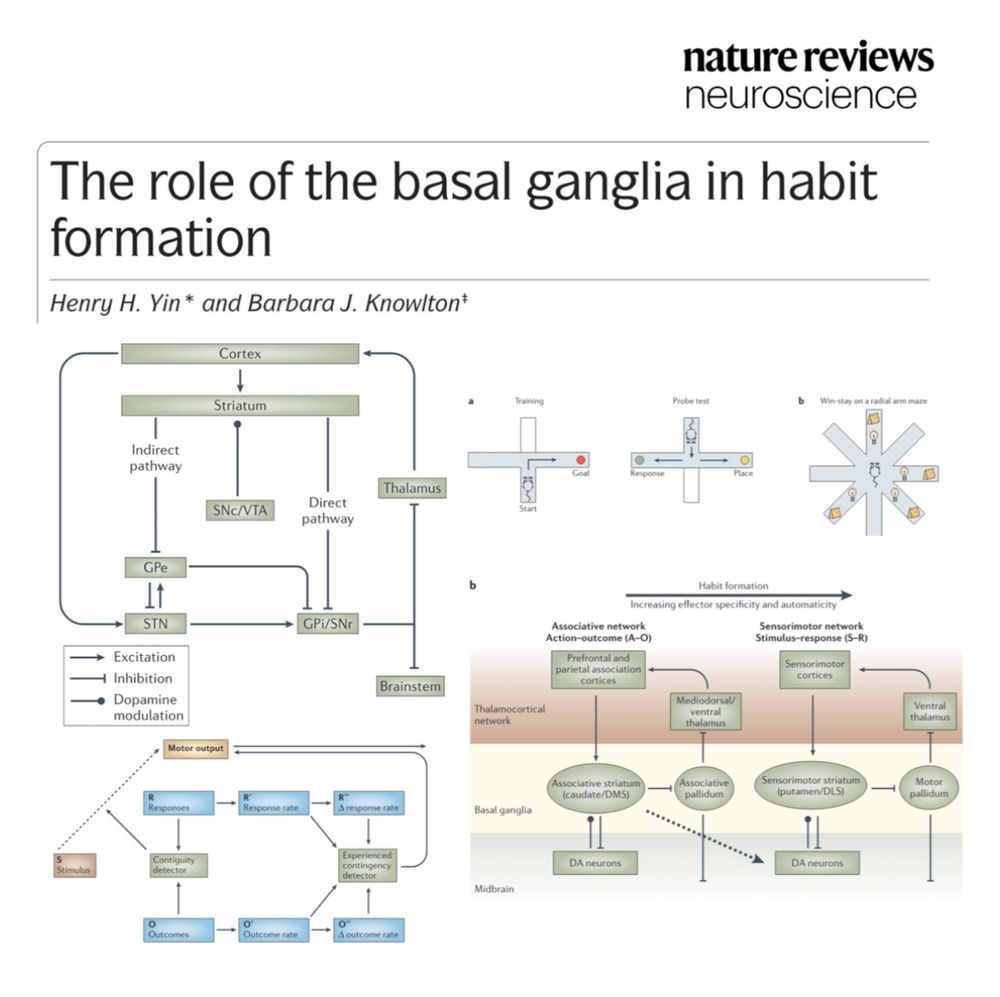
New habits move from the Prefrontal Cortex (conscious effort) to the Basal Ganglia (habit loop). A trick is to automate the first 30 seconds of a habit, minimizing the PFC's required 'energy' for initiation until the Basal Ganglia takes over. #LifeHacks #SelfImprovement #Brain
October 25, 2025 at 3:32 PM
New habits move from the Prefrontal Cortex (conscious effort) to the Basal Ganglia (habit loop). A trick is to automate the first 30 seconds of a habit, minimizing the PFC's required 'energy' for initiation until the Basal Ganglia takes over. #LifeHacks #SelfImprovement #Brain
Reposted by neurosock
To plan the future, the PFC represents a step-by-step map of actions, and at every step, this plan moves to the past like a conveyor belt.
This proposes a simple subspace architecture for planning.
A toy environment can clarify it.
A🧵with my toy model and notes:
#neuroskyence #compneuro #NeuroAI
This proposes a simple subspace architecture for planning.
A toy environment can clarify it.
A🧵with my toy model and notes:
#neuroskyence #compneuro #NeuroAI

October 22, 2025 at 9:16 PM
To plan the future, the PFC represents a step-by-step map of actions, and at every step, this plan moves to the past like a conveyor belt.
This proposes a simple subspace architecture for planning.
A toy environment can clarify it.
A🧵with my toy model and notes:
#neuroskyence #compneuro #NeuroAI
This proposes a simple subspace architecture for planning.
A toy environment can clarify it.
A🧵with my toy model and notes:
#neuroskyence #compneuro #NeuroAI
To plan the future, the PFC represents a step-by-step map of actions, and at every step, this plan moves to the past like a conveyor belt.
This proposes a simple subspace architecture for planning.
A toy environment can clarify it.
A🧵with my toy model and notes:
#neuroskyence #compneuro #NeuroAI
This proposes a simple subspace architecture for planning.
A toy environment can clarify it.
A🧵with my toy model and notes:
#neuroskyence #compneuro #NeuroAI
October 22, 2025 at 9:16 PM
To plan the future, the PFC represents a step-by-step map of actions, and at every step, this plan moves to the past like a conveyor belt.
This proposes a simple subspace architecture for planning.
A toy environment can clarify it.
A🧵with my toy model and notes:
#neuroskyence #compneuro #NeuroAI
This proposes a simple subspace architecture for planning.
A toy environment can clarify it.
A🧵with my toy model and notes:
#neuroskyence #compneuro #NeuroAI
To stop unwanted thoughts, the PFC sends a control signal to the hippocampus (brain's memory retrieval center). This activates local inhibitory interneurons (GABA), which then suppresses retrieval. Difficulties in this pathway may underlie #PTSD, #OCD, anxiety, and #depression.

October 18, 2025 at 9:49 AM
To stop unwanted thoughts, the PFC sends a control signal to the hippocampus (brain's memory retrieval center). This activates local inhibitory interneurons (GABA), which then suppresses retrieval. Difficulties in this pathway may underlie #PTSD, #OCD, anxiety, and #depression.
Impressive (200+ bps) BCI decoding speeds by Paradromics reported this month.
Plus BCIs updates from:
- E11 Bio
- Morgan Stanley
- Neuralink
- New England Journal of Medicine
- Precision
- Figure
- Stanford, China and more.
Here's everything you need to know and my opinions:
Plus BCIs updates from:
- E11 Bio
- Morgan Stanley
- Neuralink
- New England Journal of Medicine
- Precision
- Figure
- Stanford, China and more.
Here's everything you need to know and my opinions:

October 15, 2025 at 3:39 PM
Impressive (200+ bps) BCI decoding speeds by Paradromics reported this month.
Plus BCIs updates from:
- E11 Bio
- Morgan Stanley
- Neuralink
- New England Journal of Medicine
- Precision
- Figure
- Stanford, China and more.
Here's everything you need to know and my opinions:
Plus BCIs updates from:
- E11 Bio
- Morgan Stanley
- Neuralink
- New England Journal of Medicine
- Precision
- Figure
- Stanford, China and more.
Here's everything you need to know and my opinions:
A core function of cortex is predicting what happens next given the world's state.
This recent paper from Oxford shows how cortical layers may use a delay trick to learn to predict.
A simple illustration can explain the idea.
A🧵with my toy model and notes:
#neuroskyence #compneuro #NeuroAI
This recent paper from Oxford shows how cortical layers may use a delay trick to learn to predict.
A simple illustration can explain the idea.
A🧵with my toy model and notes:
#neuroskyence #compneuro #NeuroAI

October 9, 2025 at 8:03 AM
A core function of cortex is predicting what happens next given the world's state.
This recent paper from Oxford shows how cortical layers may use a delay trick to learn to predict.
A simple illustration can explain the idea.
A🧵with my toy model and notes:
#neuroskyence #compneuro #NeuroAI
This recent paper from Oxford shows how cortical layers may use a delay trick to learn to predict.
A simple illustration can explain the idea.
A🧵with my toy model and notes:
#neuroskyence #compneuro #NeuroAI
A core function of cortex is predicting what happens next given the world's state.
This great recent paper from Oxford shows how cortical layers may use a clever delay trick to learn to predict.
A simple illustration can explain the main idea.
Here is my toy model and notes:
This great recent paper from Oxford shows how cortical layers may use a clever delay trick to learn to predict.
A simple illustration can explain the main idea.
Here is my toy model and notes:
October 8, 2025 at 12:48 PM
A core function of cortex is predicting what happens next given the world's state.
This great recent paper from Oxford shows how cortical layers may use a clever delay trick to learn to predict.
A simple illustration can explain the main idea.
Here is my toy model and notes:
This great recent paper from Oxford shows how cortical layers may use a clever delay trick to learn to predict.
A simple illustration can explain the main idea.
Here is my toy model and notes:
Reposted by neurosock
The mammalian cortex acts as tutor, keeping the job of striatum simple.
This totally changes our knowledge of how RL works in the brain.
Instead of a new paper, I will dig in what could be the mysterious new mechanism of my last post.
Let's deep dive into theories of cortex:
This totally changes our knowledge of how RL works in the brain.
Instead of a new paper, I will dig in what could be the mysterious new mechanism of my last post.
Let's deep dive into theories of cortex:

October 2, 2025 at 8:37 AM
The mammalian cortex acts as tutor, keeping the job of striatum simple.
This totally changes our knowledge of how RL works in the brain.
Instead of a new paper, I will dig in what could be the mysterious new mechanism of my last post.
Let's deep dive into theories of cortex:
This totally changes our knowledge of how RL works in the brain.
Instead of a new paper, I will dig in what could be the mysterious new mechanism of my last post.
Let's deep dive into theories of cortex:
The mammalian cortex acts as tutor, keeping the job of striatum simple.
This totally changes our knowledge of how RL works in the brain.
Instead of a new paper, I will dig in what could be the mysterious new mechanism of my last post.
Let's deep dive into theories of cortex:
This totally changes our knowledge of how RL works in the brain.
Instead of a new paper, I will dig in what could be the mysterious new mechanism of my last post.
Let's deep dive into theories of cortex:
October 2, 2025 at 8:37 AM
The mammalian cortex acts as tutor, keeping the job of striatum simple.
This totally changes our knowledge of how RL works in the brain.
Instead of a new paper, I will dig in what could be the mysterious new mechanism of my last post.
Let's deep dive into theories of cortex:
This totally changes our knowledge of how RL works in the brain.
Instead of a new paper, I will dig in what could be the mysterious new mechanism of my last post.
Let's deep dive into theories of cortex:
Dopamine (DA) in the dorsolat. striatum (DLS) is a teaching signal that shapes learning.
DA in DLS ≠ RPE but = to stimulus-choice associations relevant to a learning strategy.
This can be beautifully explained as saddles in a loss landscape.
Here is my toy model and notes:
DA in DLS ≠ RPE but = to stimulus-choice associations relevant to a learning strategy.
This can be beautifully explained as saddles in a loss landscape.
Here is my toy model and notes:

September 25, 2025 at 2:03 AM
Dopamine (DA) in the dorsolat. striatum (DLS) is a teaching signal that shapes learning.
DA in DLS ≠ RPE but = to stimulus-choice associations relevant to a learning strategy.
This can be beautifully explained as saddles in a loss landscape.
Here is my toy model and notes:
DA in DLS ≠ RPE but = to stimulus-choice associations relevant to a learning strategy.
This can be beautifully explained as saddles in a loss landscape.
Here is my toy model and notes:
Reposted by neurosock
This paper may solve a core neuroscience question of the last decades: What is the cortical code?
Cognitive cortex also uses tuning, and latent variable span a non-linear manifold.
Unlocking this work requires understanding why PSTHs are bad.
Here is my toy model and notes:
Cognitive cortex also uses tuning, and latent variable span a non-linear manifold.
Unlocking this work requires understanding why PSTHs are bad.
Here is my toy model and notes:


September 17, 2025 at 11:12 PM
This paper may solve a core neuroscience question of the last decades: What is the cortical code?
Cognitive cortex also uses tuning, and latent variable span a non-linear manifold.
Unlocking this work requires understanding why PSTHs are bad.
Here is my toy model and notes:
Cognitive cortex also uses tuning, and latent variable span a non-linear manifold.
Unlocking this work requires understanding why PSTHs are bad.
Here is my toy model and notes:
Reposted by neurosock
Significant progress in Brain Chips this month:
I summarized everything from Paradromics, MIT Technology Review, UCL, Nature, Alterego, Meta, Neuralink, World Economic Forum, Duke University and more.
Here's everything you need to know and my opinions:
I summarized everything from Paradromics, MIT Technology Review, UCL, Nature, Alterego, Meta, Neuralink, World Economic Forum, Duke University and more.
Here's everything you need to know and my opinions:

September 10, 2025 at 9:54 AM
Significant progress in Brain Chips this month:
I summarized everything from Paradromics, MIT Technology Review, UCL, Nature, Alterego, Meta, Neuralink, World Economic Forum, Duke University and more.
Here's everything you need to know and my opinions:
I summarized everything from Paradromics, MIT Technology Review, UCL, Nature, Alterego, Meta, Neuralink, World Economic Forum, Duke University and more.
Here's everything you need to know and my opinions:
This paper may solve a core neuroscience question of the last decades: What is the cortical code?
Cognitive cortex also uses tuning, and latent variable span a non-linear manifold.
Unlocking this work requires understanding why PSTHs are bad.
Here is my toy model and notes:
Cognitive cortex also uses tuning, and latent variable span a non-linear manifold.
Unlocking this work requires understanding why PSTHs are bad.
Here is my toy model and notes:
September 17, 2025 at 11:12 PM
This paper may solve a core neuroscience question of the last decades: What is the cortical code?
Cognitive cortex also uses tuning, and latent variable span a non-linear manifold.
Unlocking this work requires understanding why PSTHs are bad.
Here is my toy model and notes:
Cognitive cortex also uses tuning, and latent variable span a non-linear manifold.
Unlocking this work requires understanding why PSTHs are bad.
Here is my toy model and notes:
I saw this recently as Fig. 1 of an AI paper that got quite some attention on X.
Green-washing is a form of advertising that deceptively uses green PR to persuade the public that an organization's product is environmentally friendly.
Can we call this Brain-washing? 🤦🏾♀️
Green-washing is a form of advertising that deceptively uses green PR to persuade the public that an organization's product is environmentally friendly.
Can we call this Brain-washing? 🤦🏾♀️

September 16, 2025 at 3:36 PM
I saw this recently as Fig. 1 of an AI paper that got quite some attention on X.
Green-washing is a form of advertising that deceptively uses green PR to persuade the public that an organization's product is environmentally friendly.
Can we call this Brain-washing? 🤦🏾♀️
Green-washing is a form of advertising that deceptively uses green PR to persuade the public that an organization's product is environmentally friendly.
Can we call this Brain-washing? 🤦🏾♀️
Significant progress in Brain Chips this month:
I summarized everything from Paradromics, MIT Technology Review, UCL, Nature, Alterego, Meta, Neuralink, World Economic Forum, Duke University and more.
Here's everything you need to know and my opinions:
I summarized everything from Paradromics, MIT Technology Review, UCL, Nature, Alterego, Meta, Neuralink, World Economic Forum, Duke University and more.
Here's everything you need to know and my opinions:
September 10, 2025 at 9:54 AM
Significant progress in Brain Chips this month:
I summarized everything from Paradromics, MIT Technology Review, UCL, Nature, Alterego, Meta, Neuralink, World Economic Forum, Duke University and more.
Here's everything you need to know and my opinions:
I summarized everything from Paradromics, MIT Technology Review, UCL, Nature, Alterego, Meta, Neuralink, World Economic Forum, Duke University and more.
Here's everything you need to know and my opinions:
Reposted by neurosock
Researchers were able to freeze learning in mice.
This great recent work shows the striatum is required for skill learning but not skill use (through optogenetics).
Understanding the memory-making mechanism helps understand the core idea.
Here is my toy model and notes:
This great recent work shows the striatum is required for skill learning but not skill use (through optogenetics).
Understanding the memory-making mechanism helps understand the core idea.
Here is my toy model and notes:

September 4, 2025 at 11:15 PM
Researchers were able to freeze learning in mice.
This great recent work shows the striatum is required for skill learning but not skill use (through optogenetics).
Understanding the memory-making mechanism helps understand the core idea.
Here is my toy model and notes:
This great recent work shows the striatum is required for skill learning but not skill use (through optogenetics).
Understanding the memory-making mechanism helps understand the core idea.
Here is my toy model and notes:
Researchers were able to freeze learning in mice.
This great recent work shows the striatum is required for skill learning but not skill use (through optogenetics).
Understanding the memory-making mechanism helps understand the core idea.
Here is my toy model and notes:
This great recent work shows the striatum is required for skill learning but not skill use (through optogenetics).
Understanding the memory-making mechanism helps understand the core idea.
Here is my toy model and notes:
September 4, 2025 at 11:15 PM
Researchers were able to freeze learning in mice.
This great recent work shows the striatum is required for skill learning but not skill use (through optogenetics).
Understanding the memory-making mechanism helps understand the core idea.
Here is my toy model and notes:
This great recent work shows the striatum is required for skill learning but not skill use (through optogenetics).
Understanding the memory-making mechanism helps understand the core idea.
Here is my toy model and notes: