



Matt DeVerna
@matthewdeverna.com
Postdoc with Stanford's Tech Impact and Policy Center
(@techimpactpolicy.bsky.social). Formerly IU / Observatory on Social Media.
Computational social science, human-AI interaction, social media, trust and safety, etc.
🧨 matthewdeverna.com
(@techimpactpolicy.bsky.social). Formerly IU / Observatory on Social Media.
Computational social science, human-AI interaction, social media, trust and safety, etc.
🧨 matthewdeverna.com
Pinned
Matt DeVerna
@matthewdeverna.com
· Nov 29

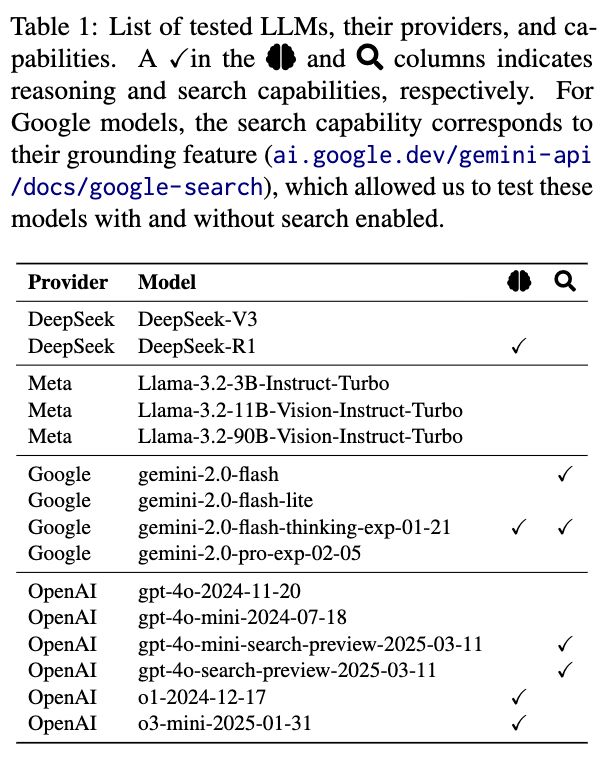
🚨 New working paper 🚨
Can LLMs with reasoning + web search reliably fact-check political claims?
We evaluated 15 models from OpenAI, Google, Meta, and DeepSeek on 6,000+ PolitiFact claims (2007–2024).
Short answer: Not reliably—unless you give them curated evidence.
arxiv.org/abs/2511.18749
Can LLMs with reasoning + web search reliably fact-check political claims?
We evaluated 15 models from OpenAI, Google, Meta, and DeepSeek on 6,000+ PolitiFact claims (2007–2024).
Short answer: Not reliably—unless you give them curated evidence.
arxiv.org/abs/2511.18749
Reposted by Matt DeVerna

🚨New WP "@Grok is this true?"
We analyze 1.6M factcheck requests on X (grok & Perplexity)
📌Usage is polarized, Grok users more likely to be Reps
📌BUT Rep posts rated as false more often—even by Grok
📌Bot agreement with factchecks is OK but not great; APIs match fact-checkers
osf.io/preprints/ps...
We analyze 1.6M factcheck requests on X (grok & Perplexity)
📌Usage is polarized, Grok users more likely to be Reps
📌BUT Rep posts rated as false more often—even by Grok
📌Bot agreement with factchecks is OK but not great; APIs match fact-checkers
osf.io/preprints/ps...

February 3, 2026 at 9:55 PM
🚨New WP "@Grok is this true?"
We analyze 1.6M factcheck requests on X (grok & Perplexity)
📌Usage is polarized, Grok users more likely to be Reps
📌BUT Rep posts rated as false more often—even by Grok
📌Bot agreement with factchecks is OK but not great; APIs match fact-checkers
osf.io/preprints/ps...
We analyze 1.6M factcheck requests on X (grok & Perplexity)
📌Usage is polarized, Grok users more likely to be Reps
📌BUT Rep posts rated as false more often—even by Grok
📌Bot agreement with factchecks is OK but not great; APIs match fact-checkers
osf.io/preprints/ps...
Reposted by Matt DeVerna

Neither Civitai nor a16z responded to requests for comment. Study led by @matthewdeverna.com and Shalmoli Ghosh. Full story in @technologyreview.com here www.technologyreview.com/2026/01/30/1...

Inside the marketplace powering bespoke AI deepfakes of real women
New research details how Civitai lets users buy and sell tools to fine-tune deepfakes the company says are banned.
www.technologyreview.com
January 30, 2026 at 5:15 PM
Neither Civitai nor a16z responded to requests for comment. Study led by @matthewdeverna.com and Shalmoli Ghosh. Full story in @technologyreview.com here www.technologyreview.com/2026/01/30/1...
Reposted by Matt DeVerna
Inside the marketplace powering bespoke AI deepfakes of real women 🧵
January 30, 2026 at 5:15 PM
Inside the marketplace powering bespoke AI deepfakes of real women 🧵
Reposted by Matt DeVerna
Congrats to @matthewdeverna.com and @shalmoli-ghosh.bsky.social for coverage of their important research on deepfakes of real women:
www.technologyreview.com/2026/01/30/1...
www.technologyreview.com/2026/01/30/1...

Inside the marketplace powering bespoke AI deepfakes of real women
New research details how Civitai lets users buy and sell tools to fine-tune deepfakes the company says are banned.
www.technologyreview.com
January 30, 2026 at 5:28 PM
Congrats to @matthewdeverna.com and @shalmoli-ghosh.bsky.social for coverage of their important research on deepfakes of real women:
www.technologyreview.com/2026/01/30/1...
www.technologyreview.com/2026/01/30/1...
Reposted by Matt DeVerna
Latest working paper 🧪 w/ @shalmoli-ghosh.bsky.social and @matthewdeverna.com shows that AI porn and NSFW deepfakes targeting women are being commoditized
A Marketplace for AI-Generated Adult Content and Deepfakes
Preprint: doi.org/10.48550/arX...
A Marketplace for AI-Generated Adult Content and Deepfakes
Preprint: doi.org/10.48550/arX...

January 28, 2026 at 11:21 PM
Latest working paper 🧪 w/ @shalmoli-ghosh.bsky.social and @matthewdeverna.com shows that AI porn and NSFW deepfakes targeting women are being commoditized
A Marketplace for AI-Generated Adult Content and Deepfakes
Preprint: doi.org/10.48550/arX...
A Marketplace for AI-Generated Adult Content and Deepfakes
Preprint: doi.org/10.48550/arX...
Reposted by Matt DeVerna
Our latest paper in @science.org warns about malicious AI swarms, agents capable of adaptive influence campaigns at scale. We already observed some in the wild (picture). AI is a real threat to democracy.
#SciencePolicyForum #ScienceResearch 🧪
Paper: doi.org/10.1126/scie...
#SciencePolicyForum #ScienceResearch 🧪
Paper: doi.org/10.1126/scie...

January 26, 2026 at 1:09 AM
Our latest paper in @science.org warns about malicious AI swarms, agents capable of adaptive influence campaigns at scale. We already observed some in the wild (picture). AI is a real threat to democracy.
#SciencePolicyForum #ScienceResearch 🧪
Paper: doi.org/10.1126/scie...
#SciencePolicyForum #ScienceResearch 🧪
Paper: doi.org/10.1126/scie...


Reposted by Matt DeVerna
Great job available at @odissei.bsky.social: Chief Technology Officer. This position provides an opportunity to help create the future of computational social science: www.eur.nl/en/working-a...

January 23, 2026 at 12:34 AM
Great job available at @odissei.bsky.social: Chief Technology Officer. This position provides an opportunity to help create the future of computational social science: www.eur.nl/en/working-a...
Reposted by Matt DeVerna

Consider submitting an ICWSM workshop proposal! It’s a great opportunity to create space for discussions around emerging research threads, new methods, or even old but exciting topics. Deadline: Jan 30.
📢 Reminder: The deadline for #ICWSM 2026 workshop proposals is Jan 30th, don’t miss your chance!
Find all the details here 👉 icwsm.org/2026/submit....
@lespin.bsky.social @msaveski.bsky.social
Find all the details here 👉 icwsm.org/2026/submit....
@lespin.bsky.social @msaveski.bsky.social
January 23, 2026 at 1:18 AM
Consider submitting an ICWSM workshop proposal! It’s a great opportunity to create space for discussions around emerging research threads, new methods, or even old but exciting topics. Deadline: Jan 30.
Reposted by Matt DeVerna

Yeah. Civit bounties featured prominently in our last Crimes Against Children conference presentation. It’s quite the collection of requests.
January 23, 2026 at 2:14 AM
Yeah. Civit bounties featured prominently in our last Crimes Against Children conference presentation. It’s quite the collection of requests.
🚨 New working paper 🚨
What happens when you add money + competition to generative AI creation?
On Civitai—a prominent platform for gen-AI content/tools w. millions of users—you get a growing marketplace for NSFW requests and a nontrivial stream of deepfakes.
Preprint: arxiv.org/abs/2601.09117 🧪
What happens when you add money + competition to generative AI creation?
On Civitai—a prominent platform for gen-AI content/tools w. millions of users—you get a growing marketplace for NSFW requests and a nontrivial stream of deepfakes.
Preprint: arxiv.org/abs/2601.09117 🧪


January 23, 2026 at 2:06 AM
🚨 New working paper 🚨
What happens when you add money + competition to generative AI creation?
On Civitai—a prominent platform for gen-AI content/tools w. millions of users—you get a growing marketplace for NSFW requests and a nontrivial stream of deepfakes.
Preprint: arxiv.org/abs/2601.09117 🧪
What happens when you add money + competition to generative AI creation?
On Civitai—a prominent platform for gen-AI content/tools w. millions of users—you get a growing marketplace for NSFW requests and a nontrivial stream of deepfakes.
Preprint: arxiv.org/abs/2601.09117 🧪
Reposted by Matt DeVerna

Jan Eiẞfeldt will be a keynote speaker for IC2S2 2026!
Jan is an external fellow at @sfiscience.bsky.social and serves as Director, Global Head of Trust & Safety at the Wikimedia Foundation @wikimediafoundation.org, the non-profit hosting Wikipedia, Wikidata, and other free knowledge projects.
Jan is an external fellow at @sfiscience.bsky.social and serves as Director, Global Head of Trust & Safety at the Wikimedia Foundation @wikimediafoundation.org, the non-profit hosting Wikipedia, Wikidata, and other free knowledge projects.

January 20, 2026 at 3:18 PM
Jan Eiẞfeldt will be a keynote speaker for IC2S2 2026!
Jan is an external fellow at @sfiscience.bsky.social and serves as Director, Global Head of Trust & Safety at the Wikimedia Foundation @wikimediafoundation.org, the non-profit hosting Wikipedia, Wikidata, and other free knowledge projects.
Jan is an external fellow at @sfiscience.bsky.social and serves as Director, Global Head of Trust & Safety at the Wikimedia Foundation @wikimediafoundation.org, the non-profit hosting Wikipedia, Wikidata, and other free knowledge projects.
Reposted by Matt DeVerna

But where platforms locked users in through network effects, these are weaker for AI.
Instead, AI creates cognitive and social dependencies—which may be even harder to escape. 🧠🔗
AI represents the infrastructuralization of cognition itself, concentrating unprecedented levels of private power.
Instead, AI creates cognitive and social dependencies—which may be even harder to escape. 🧠🔗
AI represents the infrastructuralization of cognition itself, concentrating unprecedented levels of private power.
January 16, 2026 at 8:21 PM
But where platforms locked users in through network effects, these are weaker for AI.
Instead, AI creates cognitive and social dependencies—which may be even harder to escape. 🧠🔗
AI represents the infrastructuralization of cognition itself, concentrating unprecedented levels of private power.
Instead, AI creates cognitive and social dependencies—which may be even harder to escape. 🧠🔗
AI represents the infrastructuralization of cognition itself, concentrating unprecedented levels of private power.
Reposted by Matt DeVerna
🚨 We are entering the AI society.
After two decades of platforms reshaping markets, communication, and governance, a new shift is underway: AI is transforming society.
What should we expect from the 'AI society'? 🧵
📄 Our new paper faces this question:
osf.io/preprints/so...
After two decades of platforms reshaping markets, communication, and governance, a new shift is underway: AI is transforming society.
What should we expect from the 'AI society'? 🧵
📄 Our new paper faces this question:
osf.io/preprints/so...

January 16, 2026 at 8:21 PM
🚨 We are entering the AI society.
After two decades of platforms reshaping markets, communication, and governance, a new shift is underway: AI is transforming society.
What should we expect from the 'AI society'? 🧵
📄 Our new paper faces this question:
osf.io/preprints/so...
After two decades of platforms reshaping markets, communication, and governance, a new shift is underway: AI is transforming society.
What should we expect from the 'AI society'? 🧵
📄 Our new paper faces this question:
osf.io/preprints/so...
love this idea

every big data paper with a bold story that is impossible to comprehend, evaluate, and independently verify reminds me of DOPRA. i've come to increasingly appreciate small, unassuming papers with humble conclusions that you can track word for word, data point by data point, assumption by assumption.

January 16, 2026 at 11:57 PM
love this idea
Reposted by Matt DeVerna

📢 Updated deadline: Jan 23rd!
Submit a project idea, get matched with a mentor, present virtually at ICWSM’26, and prepare a Sept 2026 submission.
💥 Apply with a max 2-page proposal
More details: icwsm.org/2026/submit....
#icwsm @journalqd.bsky.social
Submit a project idea, get matched with a mentor, present virtually at ICWSM’26, and prepare a Sept 2026 submission.
💥 Apply with a max 2-page proposal
More details: icwsm.org/2026/submit....
#icwsm @journalqd.bsky.social
🌍 Are you new to #icwsm or @journalqd.bsky.social and based in a low- or middle-income country?
🚨 There are only 10 days left to apply to ICWSM/JQD Global Initiative!
🚀 Apply by Jan 15: www.icwsm.org/2026/submit....
🚨 There are only 10 days left to apply to ICWSM/JQD Global Initiative!
🚀 Apply by Jan 15: www.icwsm.org/2026/submit....
ICWSM 2026: Submit
ICWSM 2026: Submit
www.icwsm.org
January 15, 2026 at 8:40 AM
📢 Updated deadline: Jan 23rd!
Submit a project idea, get matched with a mentor, present virtually at ICWSM’26, and prepare a Sept 2026 submission.
💥 Apply with a max 2-page proposal
More details: icwsm.org/2026/submit....
#icwsm @journalqd.bsky.social
Submit a project idea, get matched with a mentor, present virtually at ICWSM’26, and prepare a Sept 2026 submission.
💥 Apply with a max 2-page proposal
More details: icwsm.org/2026/submit....
#icwsm @journalqd.bsky.social
Reposted by Matt DeVerna
Today’s the day! Remember to submit your work by Jan 15th, 23:59 AoE. Good luck, everyone 🤞
Happy 2026! 🎉
📅 The ICWSM January submission deadline is just ten days away (Jan 15)
Find all the information to submit your full paper, poster, demo, dataset, and tutorial proposal here: www.icwsm.org/2026/submit....
🔔 Note that the deadline for workshop proposals is Jan 30!
📅 The ICWSM January submission deadline is just ten days away (Jan 15)
Find all the information to submit your full paper, poster, demo, dataset, and tutorial proposal here: www.icwsm.org/2026/submit....
🔔 Note that the deadline for workshop proposals is Jan 30!
January 15, 2026 at 8:30 AM
Today’s the day! Remember to submit your work by Jan 15th, 23:59 AoE. Good luck, everyone 🤞
Interested in @ic2s2.bsky.social but unsure if you would visit the US? Make sure you fill out this form.
"we invite your input as we consider hosting a virtual day to enable participation from people who cannot (or do not feel comfortable) traveling to the US."
"we invite your input as we consider hosting a virtual day to enable participation from people who cannot (or do not feel comfortable) traveling to the US."
Please take a moment to fill out our survey here 4/6: forms.gle/TMAXn63g2sgB...

IC2S2 2026 One Day Virtual Option
Exploration of inclusive options for those who cannot travel to the US
forms.gle
January 15, 2026 at 11:06 PM
Interested in @ic2s2.bsky.social but unsure if you would visit the US? Make sure you fill out this form.
"we invite your input as we consider hosting a virtual day to enable participation from people who cannot (or do not feel comfortable) traveling to the US."
"we invite your input as we consider hosting a virtual day to enable participation from people who cannot (or do not feel comfortable) traveling to the US."
Reposted by Matt DeVerna
Conference update: IC2S2 Virtual Day. While Vermont is an incredibly kind and welcoming state, national policies and federal actions have a real impact on conference access, particularly for people from countries who cannot enter the US due to federally enacted travel bans. 1/6
January 14, 2026 at 10:13 PM
Conference update: IC2S2 Virtual Day. While Vermont is an incredibly kind and welcoming state, national policies and federal actions have a real impact on conference access, particularly for people from countries who cannot enter the US due to federally enacted travel bans. 1/6
Only a few days left!
🌍 Are you new to #icwsm or @journalqd.bsky.social and based in a low- or middle-income country?
🚨 There are only 10 days left to apply to ICWSM/JQD Global Initiative!
🚀 Apply by Jan 15: www.icwsm.org/2026/submit....
🚨 There are only 10 days left to apply to ICWSM/JQD Global Initiative!
🚀 Apply by Jan 15: www.icwsm.org/2026/submit....
ICWSM 2026: Submit
ICWSM 2026: Submit
www.icwsm.org
January 12, 2026 at 10:43 PM
Only a few days left!
Reposted by Matt DeVerna
We are thrilled to announce that @katymilkman.bsky.social will be a keynote speaker at IC2S2 2026.
Milkman is best known for her award-winning research on to identify and overcome barriers that prevent positive behavioral change.
Milkman is best known for her award-winning research on to identify and overcome barriers that prevent positive behavioral change.

January 12, 2026 at 4:19 PM
We are thrilled to announce that @katymilkman.bsky.social will be a keynote speaker at IC2S2 2026.
Milkman is best known for her award-winning research on to identify and overcome barriers that prevent positive behavioral change.
Milkman is best known for her award-winning research on to identify and overcome barriers that prevent positive behavioral change.


Worth following: This morning, X restricted the Grok image-editing feature to paying users. (Meanwhile, as Wired reported, the web version of Grok continues to generate extremely graphic nonconsensual sexual and pornographic imagery — including of apparent children — for free.)

Live Coverage: Is Grok Still Being Used to Create Nonconsensual Sexual Images of Women and Girls?
X users continue to use Grok to generate nonconsensual porn of women and literal children. Will X or xAI stop it?
futurism.com
January 9, 2026 at 4:38 PM
Worth following: This morning, X restricted the Grok image-editing feature to paying users. (Meanwhile, as Wired reported, the web version of Grok continues to generate extremely graphic nonconsensual sexual and pornographic imagery — including of apparent children — for free.)