



Martin Saveski
@msaveski.bsky.social
Assistant Professor @ UW iSchool. Interested in computational social science, social networks & causal inference.
http://martinsaveski.com
http://martinsaveski.com
Pinned
Martin Saveski
@msaveski.bsky.social
· Dec 1

New paper in Science:
In a platform-independent field experiment, we show that reranking content expressing antidemocratic attitudes and partisan animosity in social media feeds alters affective polarization.
🧵
In a platform-independent field experiment, we show that reranking content expressing antidemocratic attitudes and partisan animosity in social media feeds alters affective polarization.
🧵
Consider submitting an ICWSM workshop proposal! It’s a great opportunity to create space for discussions around emerging research threads, new methods, or even old but exciting topics. Deadline: Jan 30.

📢 Reminder: The deadline for #ICWSM 2026 workshop proposals is Jan 30th, don’t miss your chance!
Find all the details here 👉 icwsm.org/2026/submit....
@lespin.bsky.social @msaveski.bsky.social
Find all the details here 👉 icwsm.org/2026/submit....
@lespin.bsky.social @msaveski.bsky.social
January 23, 2026 at 1:18 AM
Consider submitting an ICWSM workshop proposal! It’s a great opportunity to create space for discussions around emerging research threads, new methods, or even old but exciting topics. Deadline: Jan 30.
Reposted by Martin Saveski
The Center for Information Technology Policy at Princeton invites applications for a Postdoctoral Fellow to work with Andy Guess (Politics/SPIA), Brandon Stewart (Sociology), and me (CS).
puwebp.princeton.edu/AcadHire/app...
Please apply before Sunday, the 13th of December!
puwebp.princeton.edu/AcadHire/app...
Please apply before Sunday, the 13th of December!

December 9, 2025 at 8:51 PM
The Center for Information Technology Policy at Princeton invites applications for a Postdoctoral Fellow to work with Andy Guess (Politics/SPIA), Brandon Stewart (Sociology), and me (CS).
puwebp.princeton.edu/AcadHire/app...
Please apply before Sunday, the 13th of December!
puwebp.princeton.edu/AcadHire/app...
Please apply before Sunday, the 13th of December!
Reposted by Martin Saveski
Some social media algorithms are feeding us antidemocratic attitudes and intergroup hostility.
But a new field experiment finds that an algorithmic feed can reduce out-group animosity & affective polarization by down-ranking this hostile political content.
www.science.org/doi/10.1126/...
But a new field experiment finds that an algorithmic feed can reduce out-group animosity & affective polarization by down-ranking this hostile political content.
www.science.org/doi/10.1126/...

December 9, 2025 at 4:10 PM
Some social media algorithms are feeding us antidemocratic attitudes and intergroup hostility.
But a new field experiment finds that an algorithmic feed can reduce out-group animosity & affective polarization by down-ranking this hostile political content.
www.science.org/doi/10.1126/...
But a new field experiment finds that an algorithmic feed can reduce out-group animosity & affective polarization by down-ranking this hostile political content.
www.science.org/doi/10.1126/...
Reposted by Martin Saveski

What if you could see fewer hostile political posts on social media? A new paper out in Science by Martin Saveski @msaveski.bsky.social of the iSchool, along with @tiziano.bsky.social, @jiachenyan.bsky.social, Jeff Hancock, Jeanne Tsai and @mbernst.bsky.social, explores this: doi.org/10.1126/scie...

December 4, 2025 at 10:14 PM
What if you could see fewer hostile political posts on social media? A new paper out in Science by Martin Saveski @msaveski.bsky.social of the iSchool, along with @tiziano.bsky.social, @jiachenyan.bsky.social, Jeff Hancock, Jeanne Tsai and @mbernst.bsky.social, explores this: doi.org/10.1126/scie...
New paper in Science:
In a platform-independent field experiment, we show that reranking content expressing antidemocratic attitudes and partisan animosity in social media feeds alters affective polarization.
🧵
In a platform-independent field experiment, we show that reranking content expressing antidemocratic attitudes and partisan animosity in social media feeds alters affective polarization.
🧵
December 1, 2025 at 7:59 AM
New paper in Science:
In a platform-independent field experiment, we show that reranking content expressing antidemocratic attitudes and partisan animosity in social media feeds alters affective polarization.
🧵
In a platform-independent field experiment, we show that reranking content expressing antidemocratic attitudes and partisan animosity in social media feeds alters affective polarization.
🧵
Reposted by Martin Saveski

📣 Postdocs at Yale FDS! 📣 Tremendous freedom to work on data science problems with faculty across campus, multi-year, great salary. Deadline 12/15. Spread the word! Application: academicjobsonline.org/ajo/jobs/31114 More about Yale FDS: fds.yale.edu
Yale University, Institute for the Foundations of Data Science
Job #AJO31114, Postdoc in Foundations of Data Science, Institute for the Foundations of Data Science, Yale University, New Haven, Connecticut, US
academicjobsonline.org
November 18, 2025 at 3:54 AM
📣 Postdocs at Yale FDS! 📣 Tremendous freedom to work on data science problems with faculty across campus, multi-year, great salary. Deadline 12/15. Spread the word! Application: academicjobsonline.org/ajo/jobs/31114 More about Yale FDS: fds.yale.edu
Reposted by Martin Saveski

🚨 New paper! 🔍
“Question the Questions: Auditing Representation in Online Deliberative Processes”
In deliberative polls, participants propose questions for experts but only a few make it to the panel. How representative are those chosen questions of everyone’s interests? 🧵👇
“Question the Questions: Auditing Representation in Online Deliberative Processes”
In deliberative polls, participants propose questions for experts but only a few make it to the panel. How representative are those chosen questions of everyone’s interests? 🧵👇

November 7, 2025 at 7:00 PM
🚨 New paper! 🔍
“Question the Questions: Auditing Representation in Online Deliberative Processes”
In deliberative polls, participants propose questions for experts but only a few make it to the panel. How representative are those chosen questions of everyone’s interests? 🧵👇
“Question the Questions: Auditing Representation in Online Deliberative Processes”
In deliberative polls, participants propose questions for experts but only a few make it to the panel. How representative are those chosen questions of everyone’s interests? 🧵👇
Reposted by Martin Saveski
🚨 Study alert!
We've developed a prototype that enables you to create personalized social media feeds using natural language rules and import them into Bluesky.
Join our study to try out the tool, give us your feedback, and earn a $50 gift card!
Sign up: forms.gle/MkSGKzxDfBEc...
Please share :)
We've developed a prototype that enables you to create personalized social media feeds using natural language rules and import them into Bluesky.
Join our study to try out the tool, give us your feedback, and earn a $50 gift card!
Sign up: forms.gle/MkSGKzxDfBEc...
Please share :)

July 22, 2025 at 1:23 PM
🚨 Study alert!
We've developed a prototype that enables you to create personalized social media feeds using natural language rules and import them into Bluesky.
Join our study to try out the tool, give us your feedback, and earn a $50 gift card!
Sign up: forms.gle/MkSGKzxDfBEc...
Please share :)
We've developed a prototype that enables you to create personalized social media feeds using natural language rules and import them into Bluesky.
Join our study to try out the tool, give us your feedback, and earn a $50 gift card!
Sign up: forms.gle/MkSGKzxDfBEc...
Please share :)
Looking forward to giving a tutorial on Social Media Feed Ranking Algorithms with @tiziano.bsky.social at @icwsm.bsky.social today! Come join us at AAU, Room 2.1.083.

June 23, 2025 at 7:58 AM
Looking forward to giving a tutorial on Social Media Feed Ranking Algorithms with @tiziano.bsky.social at @icwsm.bsky.social today! Come join us at AAU, Room 2.1.083.
Reposted by Martin Saveski
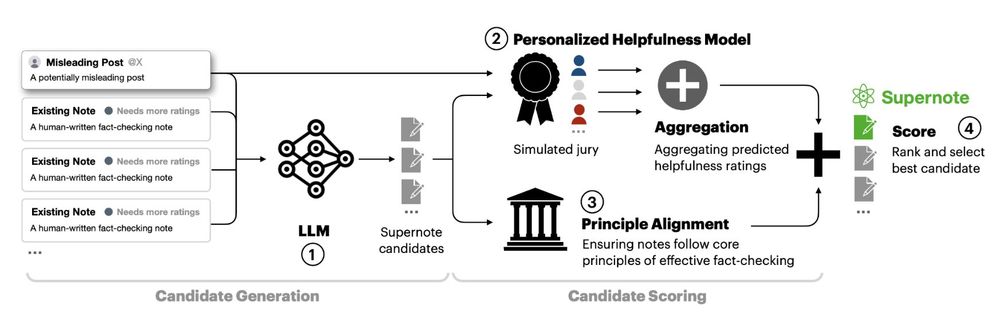
I'll be in Sydney presenting ✨Supernotes✨ at the ACM WebConf 🚀 (WWW'25). Incase you missed it, here's a very short thread about it: 🧵
Full paper: dl.acm.org/doi/10.1145/...
#www2025 #thewebconf2025
Full paper: dl.acm.org/doi/10.1145/...
#www2025 #thewebconf2025
April 24, 2025 at 10:45 PM
I'll be in Sydney presenting ✨Supernotes✨ at the ACM WebConf 🚀 (WWW'25). Incase you missed it, here's a very short thread about it: 🧵
Full paper: dl.acm.org/doi/10.1145/...
#www2025 #thewebconf2025
Full paper: dl.acm.org/doi/10.1145/...
#www2025 #thewebconf2025
Reposted by Martin Saveski
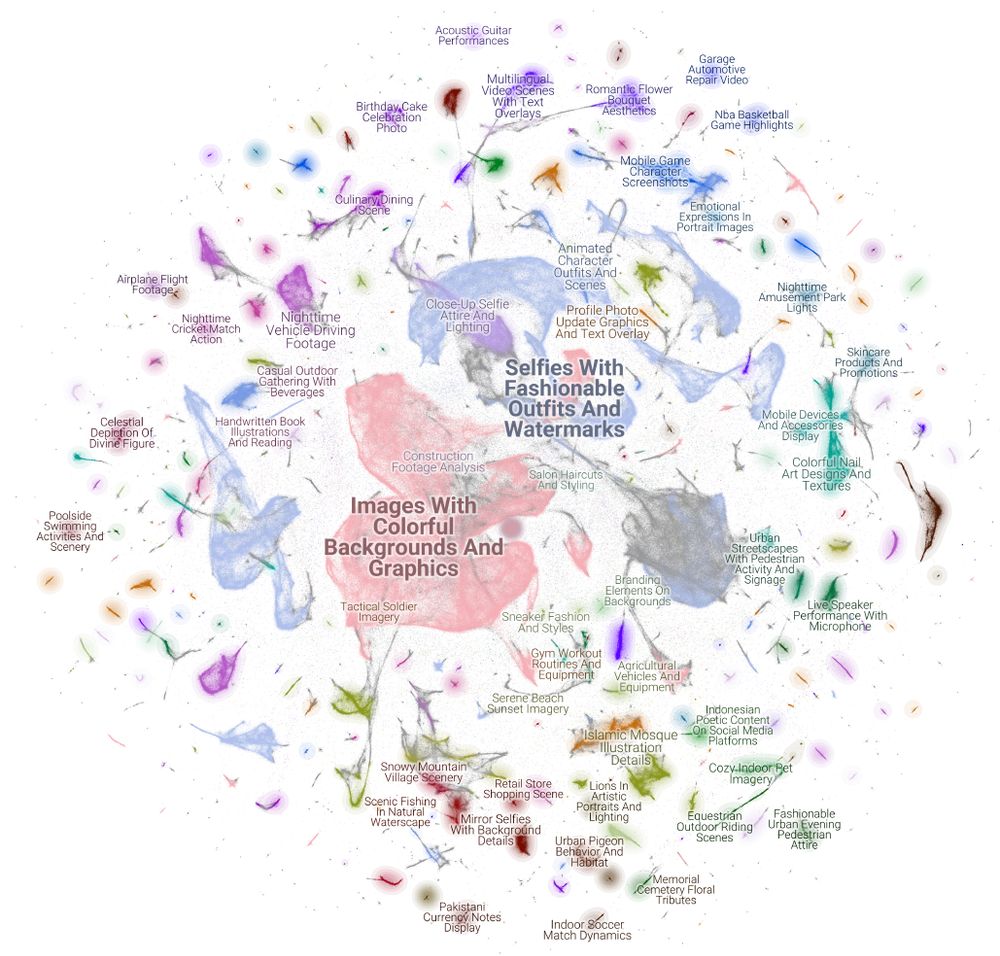
Have you ever asked yourself about the overall extent of TikTok? Here some numbers from "Just Another Hour on TikTok" - Great compliment to @bendavidsteel.bsky.social for this data collection effort!
w/ @miriamschirmer.bsky.social & Derek Ruths
arxiv.org/abs/2504.13279
w/ @miriamschirmer.bsky.social & Derek Ruths
arxiv.org/abs/2504.13279
April 21, 2025 at 5:09 PM
Have you ever asked yourself about the overall extent of TikTok? Here some numbers from "Just Another Hour on TikTok" - Great compliment to @bendavidsteel.bsky.social for this data collection effort!
w/ @miriamschirmer.bsky.social & Derek Ruths
arxiv.org/abs/2504.13279
w/ @miriamschirmer.bsky.social & Derek Ruths
arxiv.org/abs/2504.13279
Reposted by Martin Saveski
*Please repost* @sjgreenwood.bsky.social and I just launched a new personalized feed (*please pin*) that we hope will become a "must use" for #academicsky. The feed shows posts about papers filtered by *your* follower network. It's become my default Bluesky experience bsky.app/profile/pape...
March 10, 2025 at 6:14 PM
*Please repost* @sjgreenwood.bsky.social and I just launched a new personalized feed (*please pin*) that we hope will become a "must use" for #academicsky. The feed shows posts about papers filtered by *your* follower network. It's become my default Bluesky experience bsky.app/profile/pape...
Reposted by Martin Saveski

We're currently seeking applications for up to two @cip.uw.edu postdoctoral fellows who will be hired as postdoctoral scholars.
Learn more: www.cip.uw.edu/2024/12/03/c...
Learn more: www.cip.uw.edu/2024/12/03/c...

CIP seeks applications for up to 2 postdoctoral fellows
The University of Washington Center for an Informed Public (CIP) invites applications for up to two CIP Postdoctoral Fellows who will be hired as Postdoctoral Scholars.
www.cip.uw.edu
December 3, 2024 at 10:56 PM
We're currently seeking applications for up to two @cip.uw.edu postdoctoral fellows who will be hired as postdoctoral scholars.
Learn more: www.cip.uw.edu/2024/12/03/c...
Learn more: www.cip.uw.edu/2024/12/03/c...
Thanksgiving staples: turkey, cranberry sauce, and WWW reviews.
December 1, 2024 at 8:42 AM
Thanksgiving staples: turkey, cranberry sauce, and WWW reviews.
Reposted by Martin Saveski

Realtime LLM social media reranking enables field experiments demonstrating how we can depolarize. Congratulations @tiziano.bsky.social, @msaveski.bsky.social, and @jiachenyan.bsky.social!

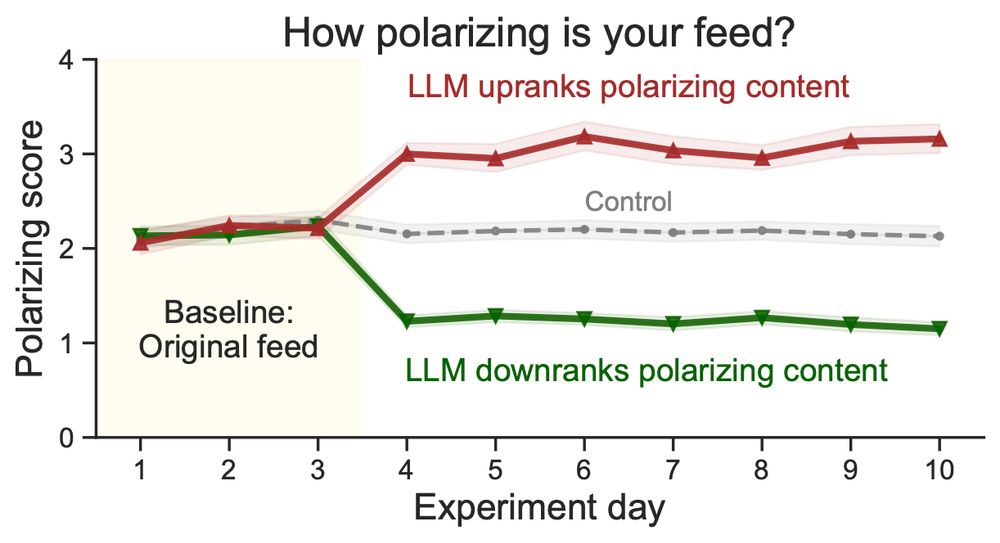
New paper: Do social media algorithms shape affective polarization?
We ran a field experiment on X/Twitter (N=1,256) using LLMs to rerank content in real-time, adjusting exposure to polarizing posts. Result: Algorithmic ranking impacts feelings toward the political outgroup! 🧵⬇️
We ran a field experiment on X/Twitter (N=1,256) using LLMs to rerank content in real-time, adjusting exposure to polarizing posts. Result: Algorithmic ranking impacts feelings toward the political outgroup! 🧵⬇️
November 26, 2024 at 12:08 AM
Realtime LLM social media reranking enables field experiments demonstrating how we can depolarize. Congratulations @tiziano.bsky.social, @msaveski.bsky.social, and @jiachenyan.bsky.social!
📢 We ran a field experiment reranking the feeds of 1000+ participants and found that modulating the exposure to antidemocratic attitudes and partisan animosity significantly impacts affective polarization.
More below ⤵️
More below ⤵️
New paper: Do social media algorithms shape affective polarization?
We ran a field experiment on X/Twitter (N=1,256) using LLMs to rerank content in real-time, adjusting exposure to polarizing posts. Result: Algorithmic ranking impacts feelings toward the political outgroup! 🧵⬇️
We ran a field experiment on X/Twitter (N=1,256) using LLMs to rerank content in real-time, adjusting exposure to polarizing posts. Result: Algorithmic ranking impacts feelings toward the political outgroup! 🧵⬇️
November 26, 2024 at 5:30 PM
📢 We ran a field experiment reranking the feeds of 1000+ participants and found that modulating the exposure to antidemocratic attitudes and partisan animosity significantly impacts affective polarization.
More below ⤵️
More below ⤵️
[Please reshare]
I’m recruiting PhD students to work with me at UW!
I’m looking for students passionate about developing new *social media algorithms*, both broadly and within the scope of this NSF grant: tinyurl.com/395yfphd
More info: faculty.washington.edu/msaveski/
cc @uwischool.bsky.social
I’m recruiting PhD students to work with me at UW!
I’m looking for students passionate about developing new *social media algorithms*, both broadly and within the scope of this NSF grant: tinyurl.com/395yfphd
More info: faculty.washington.edu/msaveski/
cc @uwischool.bsky.social

November 13, 2024 at 9:10 AM
[Please reshare]
I’m recruiting PhD students to work with me at UW!
I’m looking for students passionate about developing new *social media algorithms*, both broadly and within the scope of this NSF grant: tinyurl.com/395yfphd
More info: faculty.washington.edu/msaveski/
cc @uwischool.bsky.social
I’m recruiting PhD students to work with me at UW!
I’m looking for students passionate about developing new *social media algorithms*, both broadly and within the scope of this NSF grant: tinyurl.com/395yfphd
More info: faculty.washington.edu/msaveski/
cc @uwischool.bsky.social
Reposted by Martin Saveski
Talks from CODE@MIT are up! My plenary on off-policy evaluation in peer review matching, from ~7 min: www.youtube.com/watch?v=gkbv... Covers two papers (w/ @msaveski.bsky.social, Steven Jecmen, Samir Khan, and Nihar Shah) from NeurIPS'23 arxiv.org/abs/2305.17339 & ICML'24 arxiv.org/abs/2305.11812
MIT CODE 2024 Plenary Session 1: Johan Ugander and Sida Peng
YouTube video by MIT Initiative on the Digital Economy
www.youtube.com
November 12, 2024 at 9:16 PM
Talks from CODE@MIT are up! My plenary on off-policy evaluation in peer review matching, from ~7 min: www.youtube.com/watch?v=gkbv... Covers two papers (w/ @msaveski.bsky.social, Steven Jecmen, Samir Khan, and Nihar Shah) from NeurIPS'23 arxiv.org/abs/2305.17339 & ICML'24 arxiv.org/abs/2305.11812
Reposted by Martin Saveski
Deb Roy explains how the erosion of “trust networks” contributes to “truth decay”. From this researcher’s perspective studying social media for a decade plus… networks of influence (formed through attention dynamics) have replaced networks of trust.
www.theatlantic.com/ideas/archiv...
www.theatlantic.com/ideas/archiv...

How to Tackle Truth Decay
The social contract of trust between experts and society is in danger of dissolving. We need to start putting it back together.
www.theatlantic.com
March 4, 2024 at 2:45 PM
Deb Roy explains how the erosion of “trust networks” contributes to “truth decay”. From this researcher’s perspective studying social media for a decade plus… networks of influence (formed through attention dynamics) have replaced networks of trust.
www.theatlantic.com/ideas/archiv...
www.theatlantic.com/ideas/archiv...
Reposted by Martin Saveski

Hi! I (+ @axz.bsky.social and a couple others) am conducting a study on new tools for content curation in social media feeds, esp Bluesky! We’d love to have you participate. It’ll take around 45 minutes and you’ll get a $20 USD gift card. More details + sign up here: forms.gle/yrAzteTqFqMP....
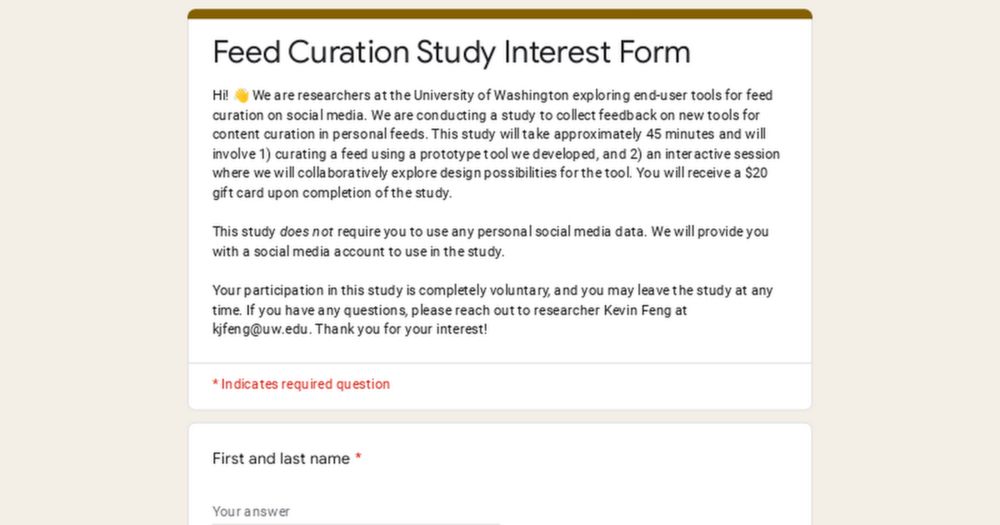
Feed Curation Study Interest Form
Hi! 👋 We are researchers at the University of Washington exploring end-user tools for feed curation on social media. We are conducting a study to collect feedback on new tools for content curation ...
forms.gle
February 1, 2024 at 1:21 AM
Hi! I (+ @axz.bsky.social and a couple others) am conducting a study on new tools for content curation in social media feeds, esp Bluesky! We’d love to have you participate. It’ll take around 45 minutes and you’ll get a $20 USD gift card. More details + sign up here: forms.gle/yrAzteTqFqMP....
Reposted by Martin Saveski
If you're interested in AI and social media, apply for this postdoc position at
@Stanford: hci.stanford.edu/postdoc.php
@Stanford: hci.stanford.edu/postdoc.php
Stanford Postdoc Opening
Encoding Societal Values into Social Media AIs: Call for Postdoctoral Fellows
hci.stanford.edu
January 11, 2024 at 4:35 AM
If you're interested in AI and social media, apply for this postdoc position at
@Stanford: hci.stanford.edu/postdoc.php
@Stanford: hci.stanford.edu/postdoc.php
I’m recruiting PhD students to work with me at UW!
I’m looking for students passionate about using computational methods to study how social platforms can be reimagined to enable better conversations, bridge political divides, and reduce the spread of misinfo.
>>
I’m looking for students passionate about using computational methods to study how social platforms can be reimagined to enable better conversations, bridge political divides, and reduce the spread of misinfo.
>>
November 17, 2023 at 8:44 AM
I’m recruiting PhD students to work with me at UW!
I’m looking for students passionate about using computational methods to study how social platforms can be reimagined to enable better conversations, bridge political divides, and reduce the spread of misinfo.
>>
I’m looking for students passionate about using computational methods to study how social platforms can be reimagined to enable better conversations, bridge political divides, and reduce the spread of misinfo.
>>