




Liam Dougherty
@liamdougherty.bsky.social
Evolutionary biologist | Research Fellow at The University of Liverpool | Studies sexual selection, reproduction and environmental change | Uses moths, micro-CT, and (mostly) meta-analysis
Amazing! Replication studies will now be accepted by Behavioral Ecology.

How do we know our research results are REAL? We replicate them! Most folks agree but lament on how hard it is to publish these replications.
My dearest gentle reader, lament no more! Delighted to unveil: Replication Studies, a new section of Behavioral Ecology 1/
academic.oup.com/beheco/artic...
My dearest gentle reader, lament no more! Delighted to unveil: Replication Studies, a new section of Behavioral Ecology 1/
academic.oup.com/beheco/artic...

Replication studies: a win-win for early-career training and behavioral ecology
Replicating previous research builds confidence that results are real and meaningful. But close replications are rare due to limitations in resources and d
academic.oup.com
February 11, 2026 at 4:05 PM
Amazing! Replication studies will now be accepted by Behavioral Ecology.
Reposted by Liam Dougherty

Happy to see our paper out now in the January edition of #Evolution 🧪 !
Using #drosophila in outdoor mesocosms, we found evidence for adaptation over a winter period and for putative trade-offs between resistance evolution and overwintering performance
doi.org/10.1093/evol...
Using #drosophila in outdoor mesocosms, we found evidence for adaptation over a winter period and for putative trade-offs between resistance evolution and overwintering performance
doi.org/10.1093/evol...

Overwintering drives rapid adaptation in Drosophila with potential costs to insecticide resistance
Abstract. Winter is a formidable challenge for ectotherms that inhabit temperate climates. The extent to which winter conditions drive rapid adaptation, an
doi.org
January 29, 2026 at 4:35 AM
Happy to see our paper out now in the January edition of #Evolution 🧪 !
Using #drosophila in outdoor mesocosms, we found evidence for adaptation over a winter period and for putative trade-offs between resistance evolution and overwintering performance
doi.org/10.1093/evol...
Using #drosophila in outdoor mesocosms, we found evidence for adaptation over a winter period and for putative trade-offs between resistance evolution and overwintering performance
doi.org/10.1093/evol...
Reposted by Liam Dougherty


Reposted by Liam Dougherty
We're advertising a PhD project on how social isolation influences aggression in flies. Based at Durham, co-supervised by @clarahowcroft.bsky.social . Despite what the ad says, this is also open to international applicants! Any questions, shoot me a msg! www.findaphd.com/phds/project...

Angry and Alone: How Social Experience Shapes Female Aggression in Flies at Newcastle University on FindAPhD.com
PhD Project - Angry and Alone: How Social Experience Shapes Female Aggression in Flies at Newcastle University, listed on FindAPhD.com
www.findaphd.com
January 26, 2026 at 10:02 AM
We're advertising a PhD project on how social isolation influences aggression in flies. Based at Durham, co-supervised by @clarahowcroft.bsky.social . Despite what the ad says, this is also open to international applicants! Any questions, shoot me a msg! www.findaphd.com/phds/project...
Reposted by Liam Dougherty

📢Out now in @jevbio.bsky.social, we tried to work out whether heat limits of survival or fertility are reflected in heat shock protein expression across Drosophila 🪰 species. The answer is, well, a bit. With the wonderful @chsmithson.bsky.social @ejduncan.bsky.social doi.org/10.1093/jeb/...

Expression of heat shock proteins and thermal sensitivity of male fertility across six Drosophila species
Abstract. Understanding the mechanisms that confer resilience to thermal stress is crucial in the context of climate change. Recently there has been increa
doi.org
January 13, 2026 at 11:29 AM
📢Out now in @jevbio.bsky.social, we tried to work out whether heat limits of survival or fertility are reflected in heat shock protein expression across Drosophila 🪰 species. The answer is, well, a bit. With the wonderful @chsmithson.bsky.social @ejduncan.bsky.social doi.org/10.1093/jeb/...
Reposted by Liam Dougherty

We've got ISSUES. Literally.
We scraped >100k special issues & over 1 million articles to bring you a PISS-poor paper. We quantify just how many excess papers are published by guest editors abusing special issues to boost their CVs. How bad is it & what can we do?
arxiv.org/abs/2601.07563
A 🧵 1/n
We scraped >100k special issues & over 1 million articles to bring you a PISS-poor paper. We quantify just how many excess papers are published by guest editors abusing special issues to boost their CVs. How bad is it & what can we do?
arxiv.org/abs/2601.07563
A 🧵 1/n


January 13, 2026 at 8:27 AM
We've got ISSUES. Literally.
We scraped >100k special issues & over 1 million articles to bring you a PISS-poor paper. We quantify just how many excess papers are published by guest editors abusing special issues to boost their CVs. How bad is it & what can we do?
arxiv.org/abs/2601.07563
A 🧵 1/n
We scraped >100k special issues & over 1 million articles to bring you a PISS-poor paper. We quantify just how many excess papers are published by guest editors abusing special issues to boost their CVs. How bad is it & what can we do?
arxiv.org/abs/2601.07563
A 🧵 1/n
Reposted by Liam Dougherty

📣 PhD opportunity in my lab 📣
We're looking for a motivated student interested in the effects of thermal stress on animal survival and reproduction: www.findaphd.com/phds/project...
Project is open-ended to allow student to define its direction depending on their interests
Please share widely!
We're looking for a motivated student interested in the effects of thermal stress on animal survival and reproduction: www.findaphd.com/phds/project...
Project is open-ended to allow student to define its direction depending on their interests
Please share widely!

December 18, 2025 at 11:09 AM
📣 PhD opportunity in my lab 📣
We're looking for a motivated student interested in the effects of thermal stress on animal survival and reproduction: www.findaphd.com/phds/project...
Project is open-ended to allow student to define its direction depending on their interests
Please share widely!
We're looking for a motivated student interested in the effects of thermal stress on animal survival and reproduction: www.findaphd.com/phds/project...
Project is open-ended to allow student to define its direction depending on their interests
Please share widely!
Reposted by Liam Dougherty

Wow! Our long-term collaborator and friend Martín Ramírez is the winner of the @royalsocietypublishing.org photo competition, with a SEM image from our joint research on spider silk!!
royalsociety.org/journals/pub...
royalsociety.org/journals/pub...

Royal Society Publishing Photography Competition | Royal Society
Celebrating the power of photography to communicate science.
royalsociety.org
December 4, 2025 at 6:39 AM
Wow! Our long-term collaborator and friend Martín Ramírez is the winner of the @royalsocietypublishing.org photo competition, with a SEM image from our joint research on spider silk!!
royalsociety.org/journals/pub...
royalsociety.org/journals/pub...
Reposted by Liam Dougherty

📢Out in the NEW issue of @animalecology.bsky.social is our hugely #collaborative paper:
An integrative, peer-reviewed and open-source cooperative-breeding database (Co-BreeD)
#mammals #birds #cooperation #openscience #datasets #alloparents
Led by @benmocha.bsky.social
doi.org/10.1111/1365...
An integrative, peer-reviewed and open-source cooperative-breeding database (Co-BreeD)
#mammals #birds #cooperation #openscience #datasets #alloparents
Led by @benmocha.bsky.social
doi.org/10.1111/1365...
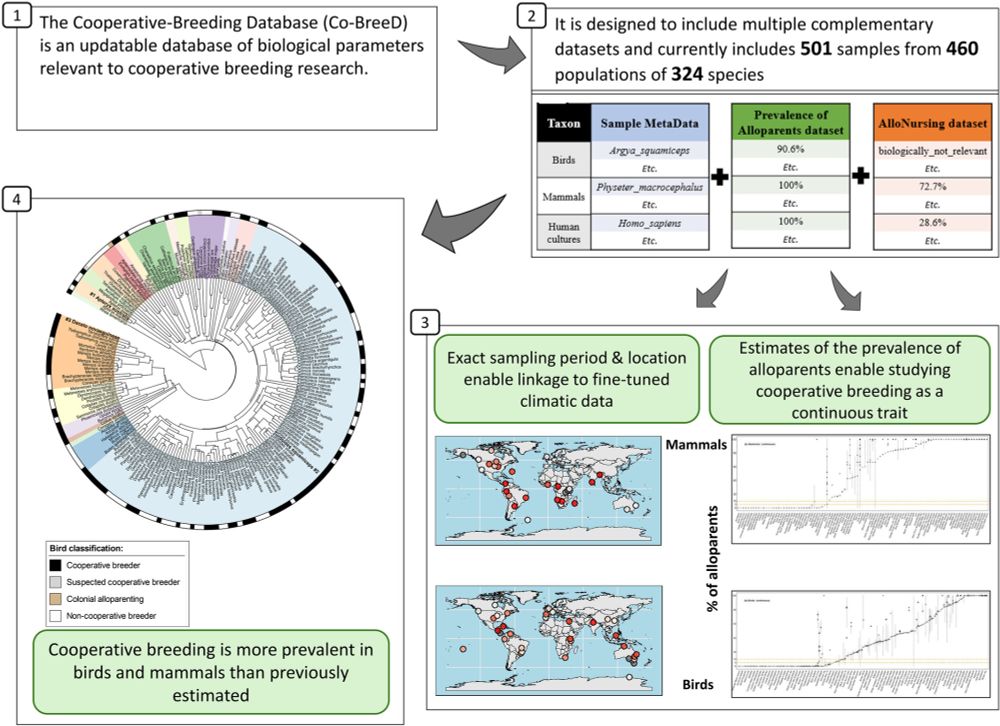
An integrative, peer‐reviewed and open‐source cooperative‐breeding database (Co‐BreeD)
Co-BreeD is the first updatable and open-source database dedicated to cooperative breeding. It enables continuous, non-binary measurement of cooperative breeding, transforming how we study breeding s...
doi.org
December 3, 2025 at 3:22 PM
📢Out in the NEW issue of @animalecology.bsky.social is our hugely #collaborative paper:
An integrative, peer-reviewed and open-source cooperative-breeding database (Co-BreeD)
#mammals #birds #cooperation #openscience #datasets #alloparents
Led by @benmocha.bsky.social
doi.org/10.1111/1365...
An integrative, peer-reviewed and open-source cooperative-breeding database (Co-BreeD)
#mammals #birds #cooperation #openscience #datasets #alloparents
Led by @benmocha.bsky.social
doi.org/10.1111/1365...
Reposted by Liam Dougherty
Cool paper suggesting that naturally higher body T˚ in birds leads to flu viruses originating in birds being pre-adapted to resist mammalian fever as a defence mechanism...
Avian-origin influenza A viruses tolerate elevated pyrexic temperatures in mammals | Science www.science.org/doi/10.1126/...
Avian-origin influenza A viruses tolerate elevated pyrexic temperatures in mammals | Science www.science.org/doi/10.1126/...

Avian-origin influenza A viruses tolerate elevated pyrexic temperatures in mammals
Host body temperature can define a virus’s replicative profile—influenza A viruses (IAVs) adapted to 40° to 42°C in birds are less temperature sensitive in vitro compared with human isolates adapted t...
www.science.org
December 3, 2025 at 3:43 PM
Cool paper suggesting that naturally higher body T˚ in birds leads to flu viruses originating in birds being pre-adapted to resist mammalian fever as a defence mechanism...
Avian-origin influenza A viruses tolerate elevated pyrexic temperatures in mammals | Science www.science.org/doi/10.1126/...
Avian-origin influenza A viruses tolerate elevated pyrexic temperatures in mammals | Science www.science.org/doi/10.1126/...
Reposted by Liam Dougherty

Since AI slop is again all over Scientific Reports, a thread on the economics of grey-zone publishing.
Why does slop keep getting published? What does it mean for science? How can we stop this?
Background readings:
Understand the strain: tinyurl.com/2b6wxx5r
Stop the drain: tinyurl.com/3jfscscy
Why does slop keep getting published? What does it mean for science? How can we stop this?
Background readings:
Understand the strain: tinyurl.com/2b6wxx5r
Stop the drain: tinyurl.com/3jfscscy

November 30, 2025 at 11:10 AM
Since AI slop is again all over Scientific Reports, a thread on the economics of grey-zone publishing.
Why does slop keep getting published? What does it mean for science? How can we stop this?
Background readings:
Understand the strain: tinyurl.com/2b6wxx5r
Stop the drain: tinyurl.com/3jfscscy
Why does slop keep getting published? What does it mean for science? How can we stop this?
Background readings:
Understand the strain: tinyurl.com/2b6wxx5r
Stop the drain: tinyurl.com/3jfscscy
Reposted by Liam Dougherty

We are happy to announce that registration for ISBE2026 is now open! We encourage you to register as soon as possible to take advantage of reduced fees and to plan your trip and accommodation in advance.
Please read the information on www.isbe2026.com before proceeding with your registration.
Please read the information on www.isbe2026.com before proceeding with your registration.

November 28, 2025 at 6:57 AM
We are happy to announce that registration for ISBE2026 is now open! We encourage you to register as soon as possible to take advantage of reduced fees and to plan your trip and accommodation in advance.
Please read the information on www.isbe2026.com before proceeding with your registration.
Please read the information on www.isbe2026.com before proceeding with your registration.
Reposted by Liam Dougherty

Behavioural ecology in the 21st century..... www.nature.com/articles/s41... @asgriffin.bsky.social

Behavioural ecology in the twenty-first century - Nature Ecology & Evolution
This Perspective discusses how the field of behavioural ecology has contributed to fundamental science and tackling global challenges, ranging from understanding how natural selection leads to adaptat...
www.nature.com
November 25, 2025 at 11:15 AM
Behavioural ecology in the 21st century..... www.nature.com/articles/s41... @asgriffin.bsky.social
Reposted by Liam Dougherty
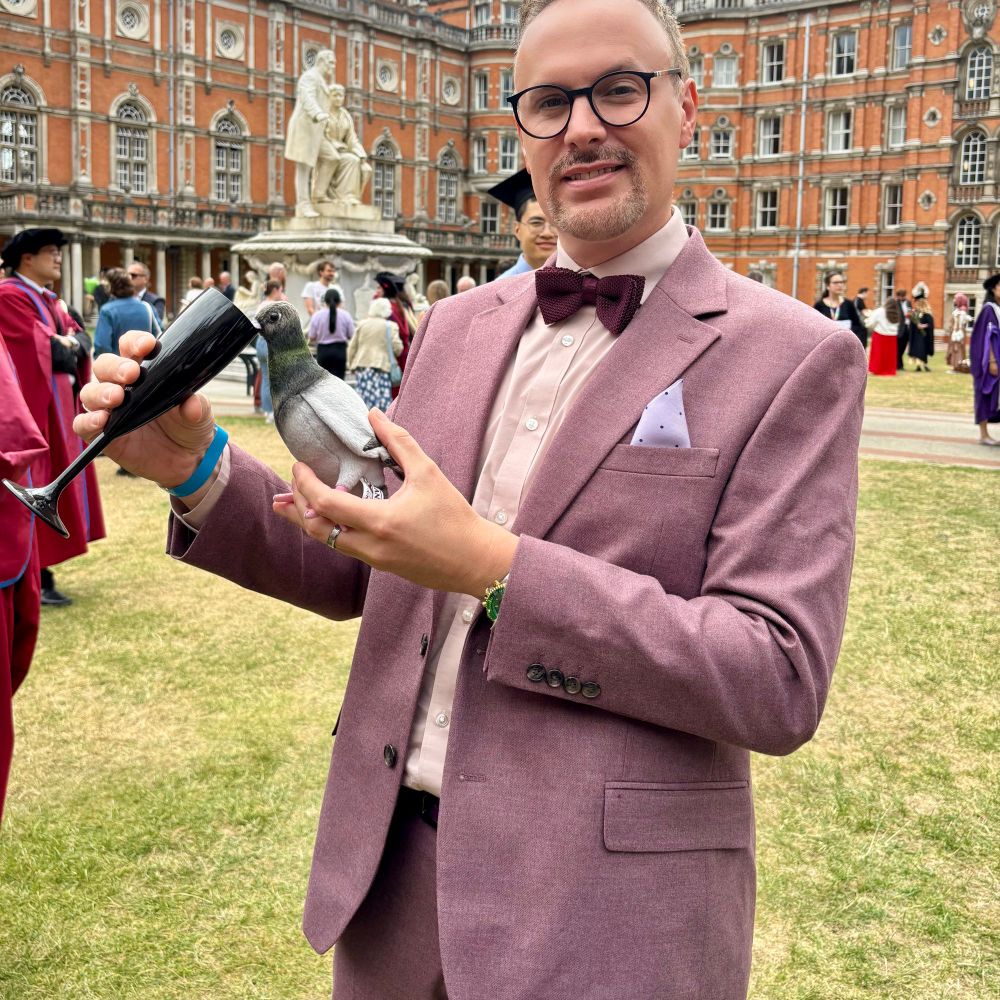
We had a new paper out yesterday in @royalsocietypublishing.org Biology Letters. About how the cranial feathers of male Golden and Lady Amherst’s Pheasants affect their visual fields. Nice to see it picked up The New York Times and Science. Paper link below.


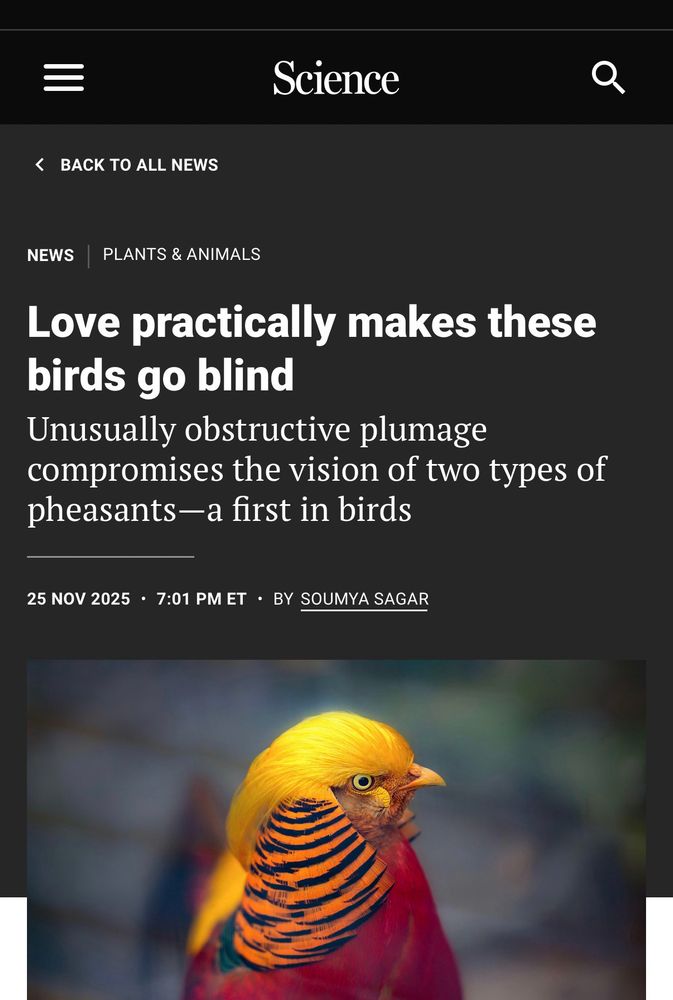
November 27, 2025 at 7:18 AM
We had a new paper out yesterday in @royalsocietypublishing.org Biology Letters. About how the cranial feathers of male Golden and Lady Amherst’s Pheasants affect their visual fields. Nice to see it picked up The New York Times and Science. Paper link below.
Reposted by Liam Dougherty

The Thermal Ecology Alliance is growing rapidly and we are now at 51 countries! Join here: www.thermalecologyalliance.org/participation

November 26, 2025 at 9:04 AM
The Thermal Ecology Alliance is growing rapidly and we are now at 51 countries! Join here: www.thermalecologyalliance.org/participation
Reposted by Liam Dougherty

New paper out in @behavecol.bsky.social!
Multiple studies show that sexually selected traits such as colours can reflect the presence of pathogens/parasites, but, can defensive coloration do the same? L. Schlippe Justicia, @carodittrich.bsky.social, O. Nokelainen & I tackled that question (1/3)
Multiple studies show that sexually selected traits such as colours can reflect the presence of pathogens/parasites, but, can defensive coloration do the same? L. Schlippe Justicia, @carodittrich.bsky.social, O. Nokelainen & I tackled that question (1/3)

November 24, 2025 at 11:01 AM
New paper out in @behavecol.bsky.social!
Multiple studies show that sexually selected traits such as colours can reflect the presence of pathogens/parasites, but, can defensive coloration do the same? L. Schlippe Justicia, @carodittrich.bsky.social, O. Nokelainen & I tackled that question (1/3)
Multiple studies show that sexually selected traits such as colours can reflect the presence of pathogens/parasites, but, can defensive coloration do the same? L. Schlippe Justicia, @carodittrich.bsky.social, O. Nokelainen & I tackled that question (1/3)
Reposted by Liam Dougherty

Join us! 🧬🪰🎉🔬
We are currently advertising two #PhD projects to study the #evolution, #development and #genomics of sexual traits in stalk-eyed flies.
Deadline for applying is Wednesday, January 7, 2026. Get in touch for more info!
We are currently advertising two #PhD projects to study the #evolution, #development and #genomics of sexual traits in stalk-eyed flies.
Deadline for applying is Wednesday, January 7, 2026. Get in touch for more info!

November 17, 2025 at 3:58 PM
Join us! 🧬🪰🎉🔬
We are currently advertising two #PhD projects to study the #evolution, #development and #genomics of sexual traits in stalk-eyed flies.
Deadline for applying is Wednesday, January 7, 2026. Get in touch for more info!
We are currently advertising two #PhD projects to study the #evolution, #development and #genomics of sexual traits in stalk-eyed flies.
Deadline for applying is Wednesday, January 7, 2026. Get in touch for more info!
Interested in pursuing a PhD in animal mating behaviour and zoo conservation? Want to help understand whether mate choice can improve conservation breeding outcomes? I'm advertising a project with colleagues at the amazing Chester Zoo, see: tinyurl.com/47zjtj8e
Please share!
Please share!

ACCE+ DLA Programme: Harnessing the power of mate choice to improve conservation breeding outcomes at University of Liverpool on FindAPhD.com
PhD Project - ACCE+ DLA Programme: Harnessing the power of mate choice to improve conservation breeding outcomes at University of Liverpool, listed on FindAPhD.com
www.findaphd.com
November 4, 2025 at 2:15 PM
Interested in pursuing a PhD in animal mating behaviour and zoo conservation? Want to help understand whether mate choice can improve conservation breeding outcomes? I'm advertising a project with colleagues at the amazing Chester Zoo, see: tinyurl.com/47zjtj8e
Please share!
Please share!
Reposted by Liam Dougherty
🦋 How will #insects respond to #climatechange? A global review of 351 studies shows no consistent pattern. Some species expand, others shrink, partly due to varied #methodologies. Standardised approaches are crucial to predict future insect ranges. 🌐
🔗 doi.org/10.1111/ddi....
🔗 doi.org/10.1111/ddi....

November 4, 2025 at 12:55 PM
🦋 How will #insects respond to #climatechange? A global review of 351 studies shows no consistent pattern. Some species expand, others shrink, partly due to varied #methodologies. Standardised approaches are crucial to predict future insect ranges. 🌐
🔗 doi.org/10.1111/ddi....
🔗 doi.org/10.1111/ddi....
Reposted by Liam Dougherty

Do you get confused when reading meta-analyses? Our new paper offers a practical guide to help researchers understand, interpret, and use them properly. We also show that the insights meta-analyses provide are often overlooked by those who cite them.

New research from #RSOS: Harnessing meta-analyses' insights in ecology and evolution research buff.ly/KgahjlP | #Ecology #Evolution #ImpactFactor

October 21, 2025 at 3:45 AM
Do you get confused when reading meta-analyses? Our new paper offers a practical guide to help researchers understand, interpret, and use them properly. We also show that the insights meta-analyses provide are often overlooked by those who cite them.
Reposted by Liam Dougherty

I have a job opening in my lab. If you are interested in bird behaviour and predator prey interactions please take a look! werkenbij.uva.nl/en/vacancies...

Vacancy — Postdoc Position in Decision Making in Birds
Are you an expert in animal behavior? Do you have experience working with birds? The Institute of Biodiversity and Ecosystem Dynamics (IBED) is looking for a motivated researcher to investigate the ro...
werkenbij.uva.nl
September 25, 2025 at 10:10 AM
I have a job opening in my lab. If you are interested in bird behaviour and predator prey interactions please take a look! werkenbij.uva.nl/en/vacancies...
Reposted by Liam Dougherty

Wa hoo! Our paper in Science is out today, revealing why some prey use conspicuous warning colouration while others use camouflaging colours. A huge global collaboration under incredible leadership by Iliana Medina and @wlallen.bsky.social
www.science.org/doi/10.1126/...
www.science.org/doi/10.1126/...

Global selection on insect antipredator coloration
Natural selection has repeatedly led to the evolution of two alternative antipredator color strategies—camouflage to avoid detection and aposematism to advertise unprofitability—but we lack understand...
www.science.org
September 26, 2025 at 1:43 AM
Wa hoo! Our paper in Science is out today, revealing why some prey use conspicuous warning colouration while others use camouflaging colours. A huge global collaboration under incredible leadership by Iliana Medina and @wlallen.bsky.social
www.science.org/doi/10.1126/...
www.science.org/doi/10.1126/...
Reposted by Liam Dougherty

I get that the news cycle is packed right now, but I just heard from a colleague at the Smithsonian that this is fully a GIANT SQUID BEING EATEN BY A SPERM WHALE and it’s possibly the first ever confirmed video according to a friend at NOAA
10 YEAR OLD ME IS LOSING HER MIND (a thread 🧵)
10 YEAR OLD ME IS LOSING HER MIND (a thread 🧵)
September 24, 2025 at 8:30 PM
I get that the news cycle is packed right now, but I just heard from a colleague at the Smithsonian that this is fully a GIANT SQUID BEING EATEN BY A SPERM WHALE and it’s possibly the first ever confirmed video according to a friend at NOAA
10 YEAR OLD ME IS LOSING HER MIND (a thread 🧵)
10 YEAR OLD ME IS LOSING HER MIND (a thread 🧵)
Reposted by Liam Dougherty

Interested in evolutionary ecology and genetics? Check out this PhD position in Pau Carazo's lab in Valencia - we look forward to your application!

We’re offering a fully funded 4 yr PhD position to work on Sexual selection in complex environments at the @uv.es. Co-supervised by @dbergerbiol.bsky.social. Find details below 👇

September 2, 2025 at 8:14 AM
Interested in evolutionary ecology and genetics? Check out this PhD position in Pau Carazo's lab in Valencia - we look forward to your application!
Reposted by Liam Dougherty
Perfectly timed to coincide with our Thermal Fertility Limit Special Topic Network meeting we’ve received a further 2 years of funding, thank you @eseb.bsky.social! And great work fellow leads @rhondasnook.bsky.social, @liamdougherty.bsky.social and Claudia Fricke.
August 20, 2025 at 3:21 PM
Perfectly timed to coincide with our Thermal Fertility Limit Special Topic Network meeting we’ve received a further 2 years of funding, thank you @eseb.bsky.social! And great work fellow leads @rhondasnook.bsky.social, @liamdougherty.bsky.social and Claudia Fricke.