



Laura Murray
@lauramurrayphd.bsky.social
Our paper was selected as the paper of the month for the NIDA IRP! Check it out! irp.nida.nih.gov/featured-pap...

Brain reactivity to nicotine cues mediates the link between resting-state connectivity and cue-induced craving in individuals who smoke or vape nicotine
Brain reactivity to nicotine cues mediates the link between resting-state connectivity and cue-induced craving in individuals who smoke or vape nicotine
irp.nida.nih.gov
November 14, 2025 at 3:18 PM
Our paper was selected as the paper of the month for the NIDA IRP! Check it out! irp.nida.nih.gov/featured-pap...
Reposted by Laura Murray

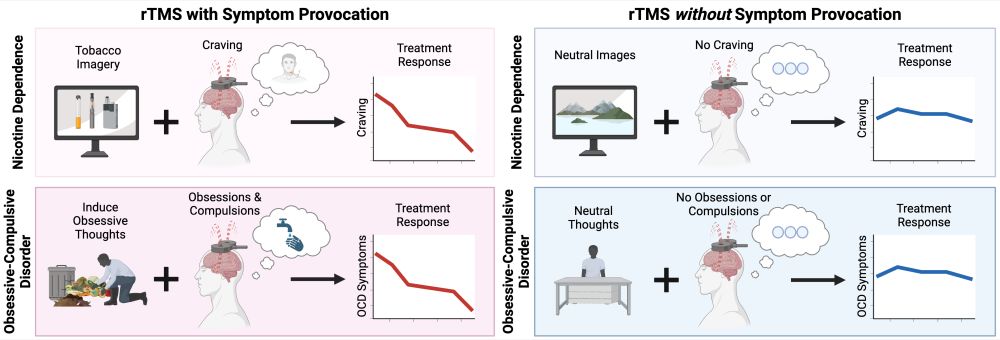
1. Our new @JAMAPsych publication shows that provoking symptoms before administering TMS for OCD and nicotine dependence may enhance clinical response. Read more here & tweetorial below: jamanetwork.com/journals/jam...
June 9, 2025 at 12:45 PM
1. Our new @JAMAPsych publication shows that provoking symptoms before administering TMS for OCD and nicotine dependence may enhance clinical response. Read more here & tweetorial below: jamanetwork.com/journals/jam...
Is it possible to estimate a full Hierarchical SEM CFA for something like HiTOP (eg with five levels, starting at p and working down to lower order constructs?). I’m at the end of my MPlus knowledge here!
May 22, 2025 at 3:16 PM
Is it possible to estimate a full Hierarchical SEM CFA for something like HiTOP (eg with five levels, starting at p and working down to lower order constructs?). I’m at the end of my MPlus knowledge here!
I’m so honored to receive a mentorship award from NIDA! I’m so grateful for the opportunity to mentor trainees through their career and personal development! One of the best parts of my job 🥰
Congrats to the amazing @lauramurrayphd.bsky.social for receiving a well deserved mentoring award for all the support she gives our trainees at NIDA.
May 6, 2025 at 12:14 AM
I’m so honored to receive a mentorship award from NIDA! I’m so grateful for the opportunity to mentor trainees through their career and personal development! One of the best parts of my job 🥰
Thanks Amy!! I’ve learned from the best! 🥰
May 6, 2025 at 12:12 AM
Thanks Amy!! I’ve learned from the best! 🥰
Reposted by Laura Murray
I'm happy to announce that rapidtide 3.0 has finally escaped from its development dungeon and has been released! rapidtide.readthedocs.io/en/stable/wh...
What's new — rapidtide 3.0 documentation
rapidtide.readthedocs.io
April 22, 2025 at 10:14 PM
I'm happy to announce that rapidtide 3.0 has finally escaped from its development dungeon and has been released! rapidtide.readthedocs.io/en/stable/wh...
Reposted by Laura Murray

‼️ New paper @ Child Development discussing why it is inappropriate to use traditional common factor models to model adverse childhood experienced (ACEs) and other stressor inventories ‼️
Read full (brief) paper at srcd.onlinelibrary.wiley.com/doi/full/10....
@srcdorg.bsky.social #PsychSciSky
1/9
Read full (brief) paper at srcd.onlinelibrary.wiley.com/doi/full/10....
@srcdorg.bsky.social #PsychSciSky
1/9
<em>Child Development</em> | SRCD Journal | Wiley Online Library
Adverse childhood experiences (ACEs) are highly impactful stressors that increase individuals' risk for a plethora of negative developmental and health outcomes. Furthermore, minoritized groups and u...
srcd.onlinelibrary.wiley.com
April 22, 2025 at 2:24 PM
‼️ New paper @ Child Development discussing why it is inappropriate to use traditional common factor models to model adverse childhood experienced (ACEs) and other stressor inventories ‼️
Read full (brief) paper at srcd.onlinelibrary.wiley.com/doi/full/10....
@srcdorg.bsky.social #PsychSciSky
1/9
Read full (brief) paper at srcd.onlinelibrary.wiley.com/doi/full/10....
@srcdorg.bsky.social #PsychSciSky
1/9
Reposted by Laura Murray

I want to talk about the Dialectical Behavior Therapy (DBT) concept of "Opposite Action", how it applies to our current moment in time, and how liberals need to embrace this concept to bring about change.
WHAT IS OPPOSITE ACTION?
💫 Acting in a way opposite of your emotional urge 💫
A thread 🧵
WHAT IS OPPOSITE ACTION?
💫 Acting in a way opposite of your emotional urge 💫
A thread 🧵
April 7, 2025 at 6:49 PM
I want to talk about the Dialectical Behavior Therapy (DBT) concept of "Opposite Action", how it applies to our current moment in time, and how liberals need to embrace this concept to bring about change.
WHAT IS OPPOSITE ACTION?
💫 Acting in a way opposite of your emotional urge 💫
A thread 🧵
WHAT IS OPPOSITE ACTION?
💫 Acting in a way opposite of your emotional urge 💫
A thread 🧵
Reposted by Laura Murray

FYI, if you want to be prepared to apply for the next ABCD Study data release, prepare for these new NIST security requirements 🧠: @ohbmofficial.bsky.social abcdstudy.org/scientists/d...

Data Sharing - ABCD Study
abcdstudy.org
March 31, 2025 at 5:53 PM
FYI, if you want to be prepared to apply for the next ABCD Study data release, prepare for these new NIST security requirements 🧠: @ohbmofficial.bsky.social abcdstudy.org/scientists/d...
Reposted by Laura Murray
New pre-print! Just submitted the R&R for this collab with @keananjoyner.bsky.social + @emilyrperkins.bsky.social on using techniques to test biology as predictors of multiple levels of psychopathology (e.g., syndrome + symptom) as a path forward for precision psychiatry
osf.io/preprints/ps...
osf.io/preprints/ps...

March 27, 2025 at 1:51 PM
New pre-print! Just submitted the R&R for this collab with @keananjoyner.bsky.social + @emilyrperkins.bsky.social on using techniques to test biology as predictors of multiple levels of psychopathology (e.g., syndrome + symptom) as a path forward for precision psychiatry
osf.io/preprints/ps...
osf.io/preprints/ps...
Reposted by Laura Murray

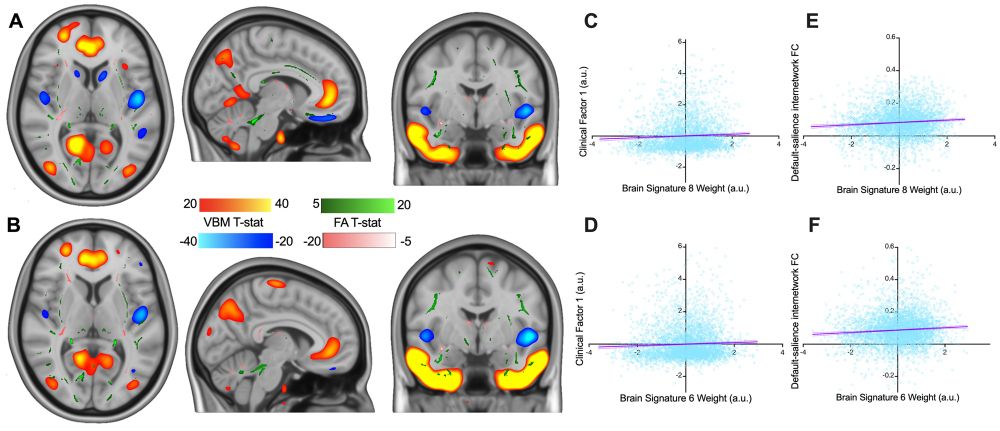
This paper is a huge one for me, taking years and years to get right. I can’t believe it’s finally out and I am so proud of the way it came together. Thank you to Dr Lebel for her unwavering support!
www.biologicalpsychiatrycnni.org/article/S245...
www.biologicalpsychiatrycnni.org/article/S245...
March 17, 2025 at 5:54 PM
This paper is a huge one for me, taking years and years to get right. I can’t believe it’s finally out and I am so proud of the way it came together. Thank you to Dr Lebel for her unwavering support!
www.biologicalpsychiatrycnni.org/article/S245...
www.biologicalpsychiatrycnni.org/article/S245...
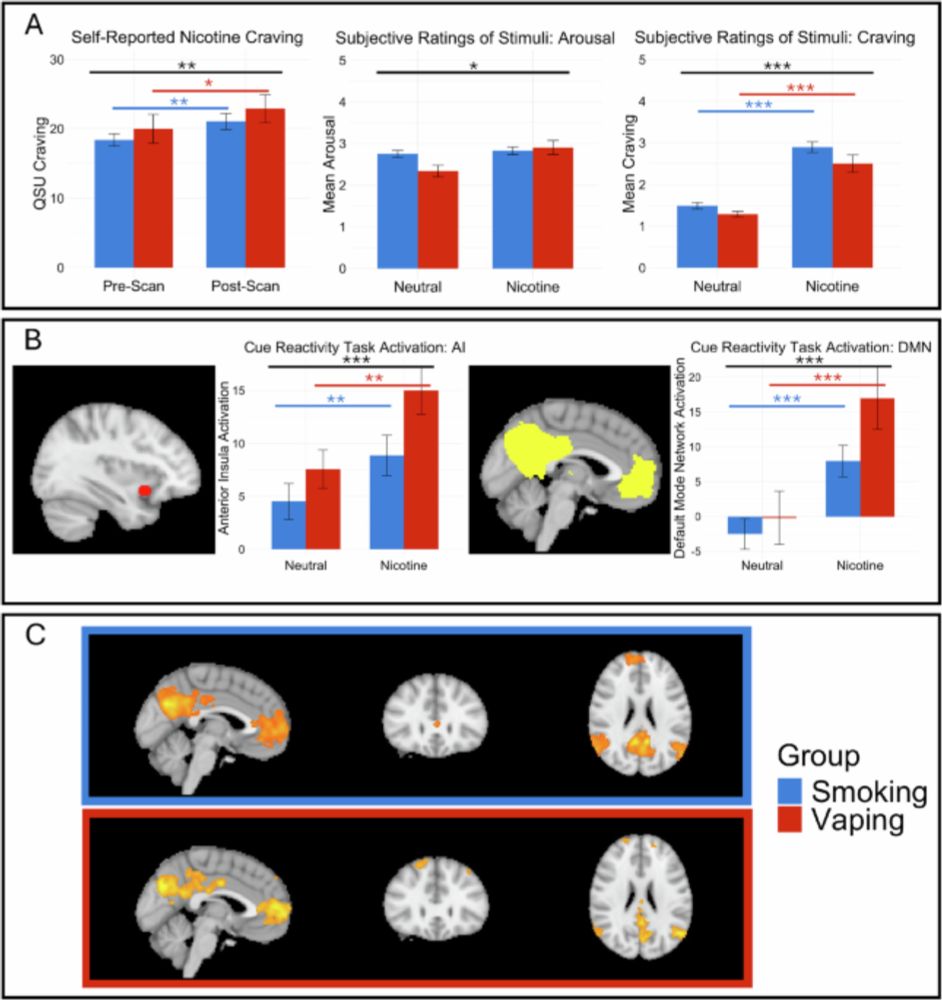
So, in both smoking and vaping groups, higher SN-DMN rsFC places people at risk for cue-induced craving, potentially via the impaired recruitment of the medial PFC when exposed to nicotine cues, while lateral PFC activation to nicotine cues may buffer the impact of cues on subjective craving!
March 13, 2025 at 7:10 PM
So, in both smoking and vaping groups, higher SN-DMN rsFC places people at risk for cue-induced craving, potentially via the impaired recruitment of the medial PFC when exposed to nicotine cues, while lateral PFC activation to nicotine cues may buffer the impact of cues on subjective craving!
4) Putting it all together, we found that lower medial PFC (specifically the superior frontal gyrus) activation to cues mediated the link between SN-DMN rsFC and craving (i.e., lower SFG activation to cues is a mechanism by which higher PCC-dACC rsFC is linked to higher craving)

March 13, 2025 at 7:10 PM
4) Putting it all together, we found that lower medial PFC (specifically the superior frontal gyrus) activation to cues mediated the link between SN-DMN rsFC and craving (i.e., lower SFG activation to cues is a mechanism by which higher PCC-dACC rsFC is linked to higher craving)
3) Higher rsFC between the SN and DMN (specifically the dACC and PCC) was linked to higher cue-induced subjective craving, and more PFC activation during cue-reactivity (nicotine>neutral) was linked to lower craving

March 13, 2025 at 7:10 PM
3) Higher rsFC between the SN and DMN (specifically the dACC and PCC) was linked to higher cue-induced subjective craving, and more PFC activation during cue-reactivity (nicotine>neutral) was linked to lower craving
2) Brain responses were consistently higher for nicotine cues versus neutral images throughout the cue-reactivity task (i.e., NO habituation to nicotine cues)

March 13, 2025 at 7:10 PM
2) Brain responses were consistently higher for nicotine cues versus neutral images throughout the cue-reactivity task (i.e., NO habituation to nicotine cues)
1) The brain (DMN & AI) and subjective responses to smoking/vaping cues were the same for people who smoke or vape nicotine (i.e., vaping cues elicit the same responses in people who vape as smoking cues do for people who smoke)

March 13, 2025 at 7:10 PM
1) The brain (DMN & AI) and subjective responses to smoking/vaping cues were the same for people who smoke or vape nicotine (i.e., vaping cues elicit the same responses in people who vape as smoking cues do for people who smoke)
I'm happy to share our paper in @npp-journal.bsky.social on rsFC, cue-reactivity, and craving in nicotine smoking AND vaping! Thanks to coauthors, @amy.janeslab.org @blaisefrederick.bsky.social @ckorponay.bsky.social @mariascavnicky.bsky.social Here's what we found 🧵 www.nature.com/articles/s41...
Brain reactivity to nicotine cues mediates the link between resting-state connectivity and cue-induced craving in individuals who smoke or vape nicotine - Neuropsychopharmacology
Neuropsychopharmacology - Brain reactivity to nicotine cues mediates the link between resting-state connectivity and cue-induced craving in individuals who smoke or vape nicotine
www.nature.com
March 13, 2025 at 7:10 PM
I'm happy to share our paper in @npp-journal.bsky.social on rsFC, cue-reactivity, and craving in nicotine smoking AND vaping! Thanks to coauthors, @amy.janeslab.org @blaisefrederick.bsky.social @ckorponay.bsky.social @mariascavnicky.bsky.social Here's what we found 🧵 www.nature.com/articles/s41...
Reposted by Laura Murray
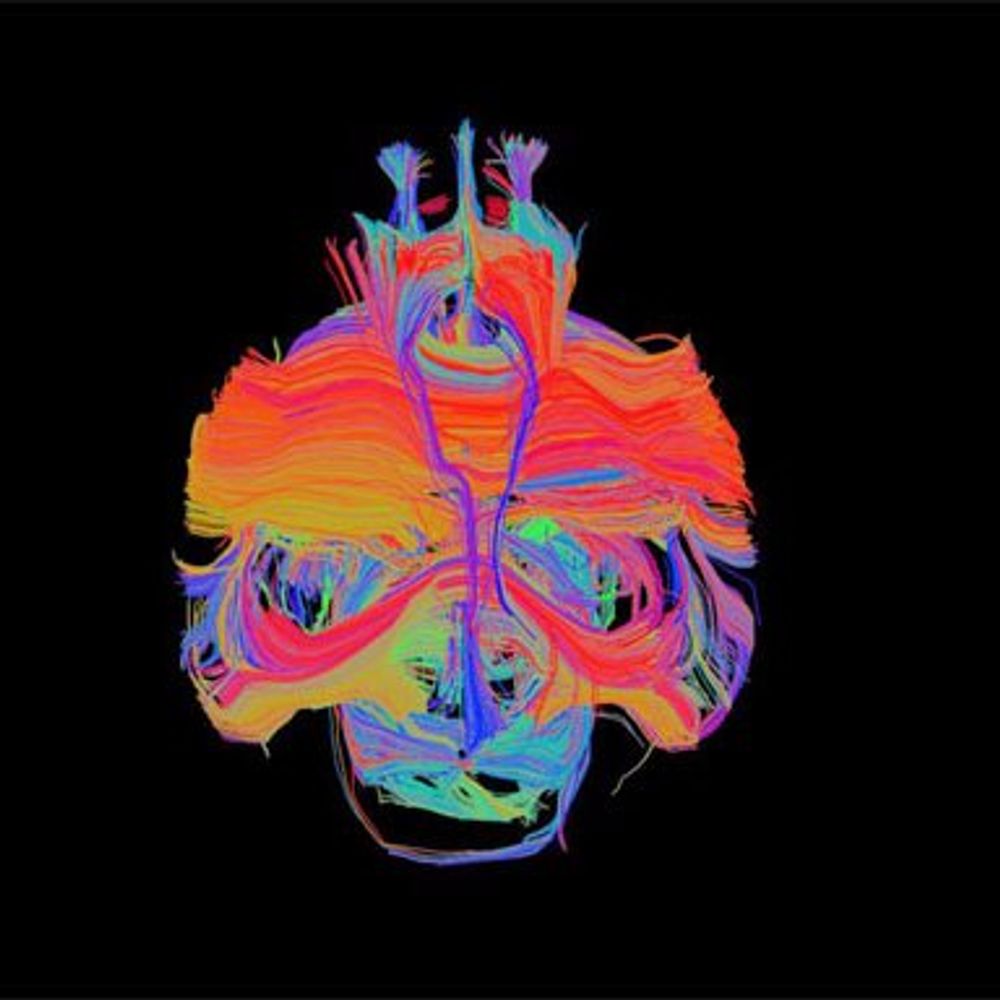
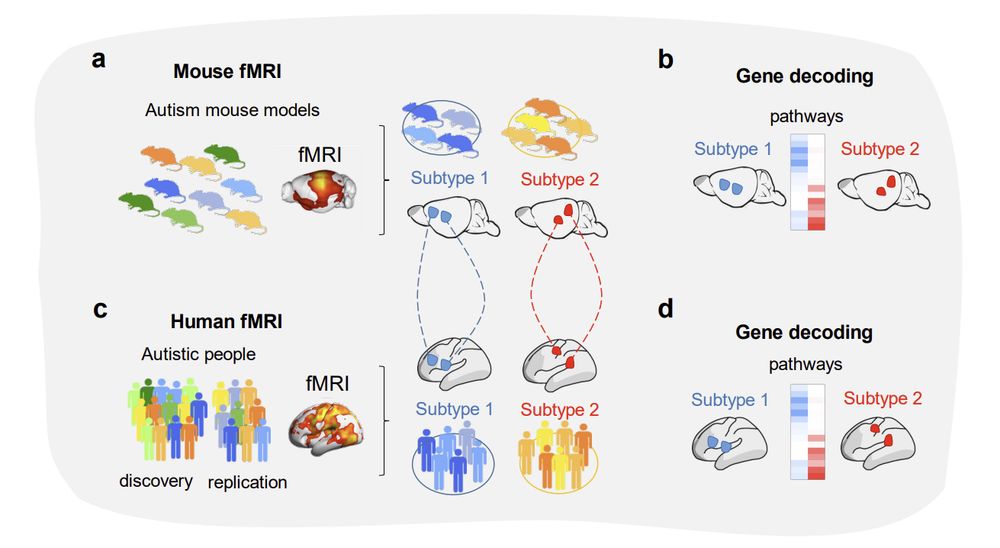
Can we use brain scans to identify biologically distinct "autisms"? And If so, how?
In our latest cross-species study 🐭👨 with @iitalk.bsky.social we dive into these questions!
Find out more here 👇👇
www.biorxiv.org/content/10.1...
Thread below 🧵 1/n
In our latest cross-species study 🐭👨 with @iitalk.bsky.social we dive into these questions!
Find out more here 👇👇
www.biorxiv.org/content/10.1...
Thread below 🧵 1/n
March 6, 2025 at 11:18 AM
Can we use brain scans to identify biologically distinct "autisms"? And If so, how?
In our latest cross-species study 🐭👨 with @iitalk.bsky.social we dive into these questions!
Find out more here 👇👇
www.biorxiv.org/content/10.1...
Thread below 🧵 1/n
In our latest cross-species study 🐭👨 with @iitalk.bsky.social we dive into these questions!
Find out more here 👇👇
www.biorxiv.org/content/10.1...
Thread below 🧵 1/n
Justine is an absolute rockstar and this work is just the tip of the iceberg of the awesome things she is working on! 💫💫💫

honored and excited to share that our work was chosen as NIDA’s Featured Paper of the Month for March! ☘️🥳
@amy.janeslab.org @ckorponay.bsky.social
check it out here:
irp.nida.nih.gov/featured-pap...
@amy.janeslab.org @ckorponay.bsky.social
check it out here:
irp.nida.nih.gov/featured-pap...

Catecholaminergic Modulation of Large-Scale Network Dynamics Is Tied to the Reconfiguration of Corticostriatal Connectivity
Catecholaminergic Modulation of Large-Scale Network Dynamics Is Tied to the Reconfiguration of Corticostriatal Connectivity
irp.nida.nih.gov
March 5, 2025 at 7:24 PM
Justine is an absolute rockstar and this work is just the tip of the iceberg of the awesome things she is working on! 💫💫💫