



Kozo Nishida | 西田孝三
@kozo2.bsky.social
PyData Osaka Organizer,
Bioconductor Community Advisory Board,
Software Carpentry Japanese Team,
無連想式2ストローク漢字入力方式T-codeユーザー
Bioconductor Community Advisory Board,
Software Carpentry Japanese Team,
無連想式2ストローク漢字入力方式T-codeユーザー
Perspectives in computational mass spectrometry: recent developments and key challenges url: academic.oup.com/bioinformati...

Perspectives in computational mass spectrometry: recent developments and key challenges
Abstract. Summary: Mass spectrometry (MS) is a cornerstone technology in modern molecular biology, powering diverse applications across proteomics, metabol
academic.oup.com
January 23, 2026 at 1:18 AM
Perspectives in computational mass spectrometry: recent developments and key challenges url: academic.oup.com/bioinformati...
Hacking for Metabolomics & Mass Spectrometry format interoperability
www.nfdi4chem.de/metabolomics...
www.nfdi4chem.de/metabolomics...

Hacking for Metabolomics & Mass Spectrometry format interoperability - NFDI4Chem
The ELIXIR BioHackathon Europe took place 3–7 November 2025 in Bad Saarow near Berlin. Among the ~30 Projects was the “Metabolomics and proteomics file format interoperability fest”, co-organised by S...
www.nfdi4chem.de
December 9, 2025 at 7:56 AM
Hacking for Metabolomics & Mass Spectrometry format interoperability
www.nfdi4chem.de/metabolomics...
www.nfdi4chem.de/metabolomics...
Reposted by Kozo Nishida | 西田孝三

Out now! xcms in Peak Form: Now Anchoring a Complete Metabolomics Data Preprocessing and Analysis Software Ecosystem doi.org/10.1021/acs....
with Phillipine and @jorainer.bsky.social (EURAC), @metabomichael.bsky.social, Hendrik and Norman from @ipbhalle.bsky.social, @janstanstrup.bsky.social, et al.
with Phillipine and @jorainer.bsky.social (EURAC), @metabomichael.bsky.social, Hendrik and Norman from @ipbhalle.bsky.social, @janstanstrup.bsky.social, et al.

xcms in Peak Form: Now Anchoring a Complete Metabolomics Data Preprocessing and Analysis Software Ecosystem
High-quality data preprocessing is essential for untargeted metabolomics experiments, where increasing data set scale and complexity demand adaptable, robust, and reproducible software solutions. Modern preprocessing tools must evolve to integrate seamlessly with downstream analysis platforms, ensuring efficient and streamlined workflows. Since its introduction in 2005, the xcms R package has become one of the most widely used tools for LC-MS data preprocessing. Developed through an open-source, community-driven approach, xcms maintains long-term stability while continuously expanding its capabilities and accessibility. We present recent advancements that position xcms as a central component of a modular and interoperable software ecosystem for metabolomics data analysis. Key improvements include enhanced scalability, enabling the processing of large-scale experiments with thousands of samples on standard computing hardware. These developments empower users to build comprehensive, customizable, and reproducible workflows tailored to diverse experimental designs and analytical needs. An expanding collection of tutorials, documentation, and teaching materials further supports both new and experienced users in leveraging broader R and Bioconductor ecosystems. These resources facilitate the integration of statistical modeling, visualization tools, and domain-specific packages, extending the reach and impact of xcms workflows. Together, these enhancements solidify xcms as a cornerstone of modern metabolomics research.
doi.org
December 8, 2025 at 8:26 PM
Out now! xcms in Peak Form: Now Anchoring a Complete Metabolomics Data Preprocessing and Analysis Software Ecosystem doi.org/10.1021/acs....
with Phillipine and @jorainer.bsky.social (EURAC), @metabomichael.bsky.social, Hendrik and Norman from @ipbhalle.bsky.social, @janstanstrup.bsky.social, et al.
with Phillipine and @jorainer.bsky.social (EURAC), @metabomichael.bsky.social, Hendrik and Norman from @ipbhalle.bsky.social, @janstanstrup.bsky.social, et al.
Reposted by Kozo Nishida | 西田孝三

Great work from @philouail.bsky.social 🙌
#xcms now fully integrated into @bioconductor.bsky.social 💪
👉 #metabolomics #MassSpectrometry #rstats
#xcms now fully integrated into @bioconductor.bsky.social 💪
👉 #metabolomics #MassSpectrometry #rstats
Out now! xcms in Peak Form: Now Anchoring a Complete Metabolomics Data Preprocessing and Analysis Software Ecosystem doi.org/10.1021/acs....
with Phillipine and @jorainer.bsky.social (EURAC), @metabomichael.bsky.social, Hendrik and Norman from @ipbhalle.bsky.social, @janstanstrup.bsky.social, et al.
with Phillipine and @jorainer.bsky.social (EURAC), @metabomichael.bsky.social, Hendrik and Norman from @ipbhalle.bsky.social, @janstanstrup.bsky.social, et al.
xcms in Peak Form: Now Anchoring a Complete Metabolomics Data Preprocessing and Analysis Software Ecosystem
High-quality data preprocessing is essential for untargeted metabolomics experiments, where increasing data set scale and complexity demand adaptable, robust, and reproducible software solutions. Modern preprocessing tools must evolve to integrate seamlessly with downstream analysis platforms, ensuring efficient and streamlined workflows. Since its introduction in 2005, the xcms R package has become one of the most widely used tools for LC-MS data preprocessing. Developed through an open-source, community-driven approach, xcms maintains long-term stability while continuously expanding its capabilities and accessibility. We present recent advancements that position xcms as a central component of a modular and interoperable software ecosystem for metabolomics data analysis. Key improvements include enhanced scalability, enabling the processing of large-scale experiments with thousands of samples on standard computing hardware. These developments empower users to build comprehensive, customizable, and reproducible workflows tailored to diverse experimental designs and analytical needs. An expanding collection of tutorials, documentation, and teaching materials further supports both new and experienced users in leveraging broader R and Bioconductor ecosystems. These resources facilitate the integration of statistical modeling, visualization tools, and domain-specific packages, extending the reach and impact of xcms workflows. Together, these enhancements solidify xcms as a cornerstone of modern metabolomics research.
doi.org
December 9, 2025 at 7:11 AM
Great work from @philouail.bsky.social 🙌
#xcms now fully integrated into @bioconductor.bsky.social 💪
👉 #metabolomics #MassSpectrometry #rstats
#xcms now fully integrated into @bioconductor.bsky.social 💪
👉 #metabolomics #MassSpectrometry #rstats
Reposted by Kozo Nishida | 西田孝三


Reposted by Kozo Nishida | 西田孝三

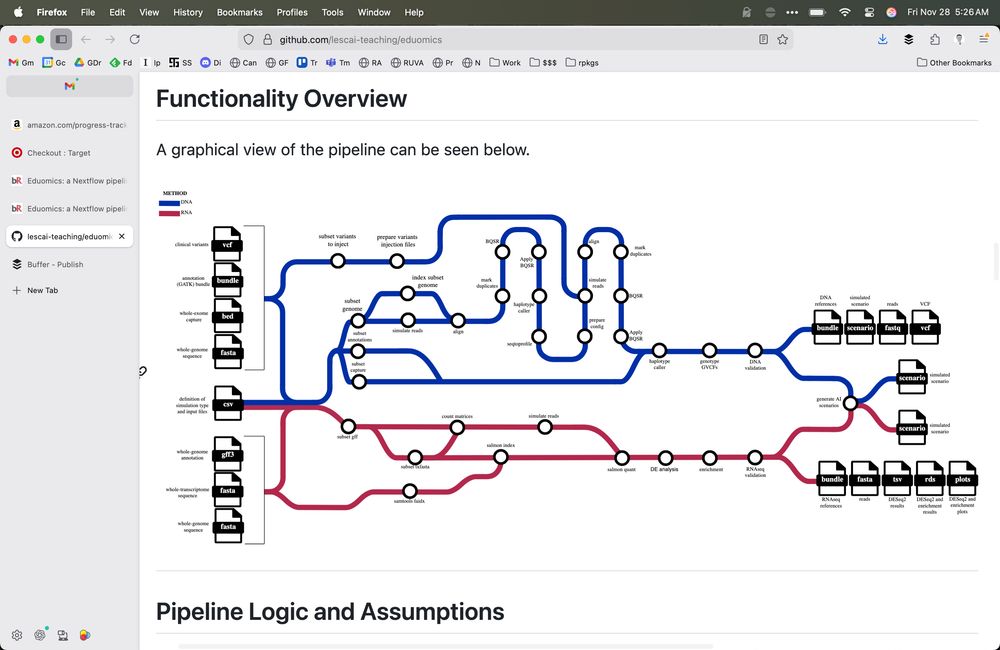
Eduomics: a Nextflow pipeline to simulate -omics data for education www.biorxiv.org/content/10.1... 🧬🖥️🧪 github.com/lescai-teach...

December 1, 2025 at 7:02 PM
Eduomics: a Nextflow pipeline to simulate -omics data for education www.biorxiv.org/content/10.1... 🧬🖥️🧪 github.com/lescai-teach...
Reposted by Kozo Nishida | 西田孝三

Upcoming community sessions this week
carpentries.org/community/ev...
Events are in UTC Time :
📣 Workbench Transition Coworking
24 Nov 09:00 & 19:00
📣 👋 Welcome Session with The Carpentries
24 Nov 12:00
🇬🇧 UK Carpentries Community Call
24 Nov 16:00
🕸️ Creating a workshop website
25 Nov 09:00
carpentries.org/community/ev...
Events are in UTC Time :
📣 Workbench Transition Coworking
24 Nov 09:00 & 19:00
📣 👋 Welcome Session with The Carpentries
24 Nov 12:00
🇬🇧 UK Carpentries Community Call
24 Nov 16:00
🕸️ Creating a workshop website
25 Nov 09:00

Community Events
There are many opportunities to join community meetings, subcommittees and debriefing sessions. Find links to them on this Etherpad, and subscribe to the Google calendar below or use this ics feed to…
carpentries.org
November 24, 2025 at 6:00 AM
Upcoming community sessions this week
carpentries.org/community/ev...
Events are in UTC Time :
📣 Workbench Transition Coworking
24 Nov 09:00 & 19:00
📣 👋 Welcome Session with The Carpentries
24 Nov 12:00
🇬🇧 UK Carpentries Community Call
24 Nov 16:00
🕸️ Creating a workshop website
25 Nov 09:00
carpentries.org/community/ev...
Events are in UTC Time :
📣 Workbench Transition Coworking
24 Nov 09:00 & 19:00
📣 👋 Welcome Session with The Carpentries
24 Nov 12:00
🇬🇧 UK Carpentries Community Call
24 Nov 16:00
🕸️ Creating a workshop website
25 Nov 09:00
Reposted by Kozo Nishida | 西田孝三

🌍 We are proud to share highlights from Ethiopia’s first in-person Bioconductor workshop, held in Addis Ababa from 25-29 Aug 2025!
The course united 26 participants for five days of hands-on training in R/Bioconductor and bulk RNASeq analysis.
🔗 Read more: blog.bioconductor.org/posts/2025-1...
The course united 26 participants for five days of hands-on training in R/Bioconductor and bulk RNASeq analysis.
🔗 Read more: blog.bioconductor.org/posts/2025-1...

Bioconductor in Africa: Ethiopia’s First In-Person Course – Bioconductor community blog
A blog for the Bioconductor community!
blog.bioconductor.org
November 24, 2025 at 9:57 AM
🌍 We are proud to share highlights from Ethiopia’s first in-person Bioconductor workshop, held in Addis Ababa from 25-29 Aug 2025!
The course united 26 participants for five days of hands-on training in R/Bioconductor and bulk RNASeq analysis.
🔗 Read more: blog.bioconductor.org/posts/2025-1...
The course united 26 participants for five days of hands-on training in R/Bioconductor and bulk RNASeq analysis.
🔗 Read more: blog.bioconductor.org/posts/2025-1...
Reactome Knowledgebase 2026 url: academic.oup.com/nar/article/...

The Reactome Knowledgebase 2026
Abstract. The Reactome Knowledgebase (https://reactome.org) is a freely accessible, expert-curated, open-source, and open-data resource that describes huma
academic.oup.com
November 24, 2025 at 1:54 PM
Reactome Knowledgebase 2026 url: academic.oup.com/nar/article/...
Open Enzyme Database: a community-wide repository for sharing enzyme data url: academic.oup.com/nar/article/...

Open Enzyme Database: a community-wide repository for sharing enzyme data
Abstract. Enzymes are the molecular machines of life and play an indispensable role in numerous biotechnological and biomedical applications. Despite the a
academic.oup.com
November 18, 2025 at 6:49 PM
Open Enzyme Database: a community-wide repository for sharing enzyme data url: academic.oup.com/nar/article/...
MassBank: an open and FAIR mass spectral data resource url: academic.oup.com/nar/article/...

MassBank: an open and FAIR mass spectral data resource
Abstract. The open spectral library MassBank (https://massbank.jp/) started in 2006 in Japan, as one of the first open source and open access cross-vendor
academic.oup.com
November 16, 2025 at 1:19 PM
MassBank: an open and FAIR mass spectral data resource url: academic.oup.com/nar/article/...
DancePartner: Python Package to Mine Multiomics Relationship Networks from Literature and Databases | Journal of Proteome Research pubs.acs.org/doi/abs/10.1...

DancePartner: Python Package to Mine Multiomics Relationship Networks from Literature and Databases
A goal of multiomics experiments is to understand how mechanistic molecular biology is altered between conditions, typically a control group and experimental groups. Oftentimes, this involves studying...
pubs.acs.org
November 8, 2025 at 1:37 PM
DancePartner: Python Package to Mine Multiomics Relationship Networks from Literature and Databases | Journal of Proteome Research pubs.acs.org/doi/abs/10.1...
MSOne: An AI-powered software suite enabling end-to-end analysis of high-resolution LCMS data for metabolomics data mining | ChemRxiv - doi.org/10.26434/che...

MSOne: An AI-powered software suite enabling end-to-end analysis of high-resolution LCMS data for metabolomics data mining
Untargeted LC–MS metabolomics generates large, noisy datasets that demand complex, parameter-intensive workflows across multiple software tools. While over 5000 metabolomics datasets are available in ...
doi.org
November 3, 2025 at 5:04 PM
MSOne: An AI-powered software suite enabling end-to-end analysis of high-resolution LCMS data for metabolomics data mining | ChemRxiv - doi.org/10.26434/che...
Practical Guidance for Training Machine Learning Models in Metabolomics and Mass Spectrometry Research | Analytical Chemistry pubs.acs.org/doi/full/10....

Practical Guidance for Training Machine Learning Models in Metabolomics and Mass Spectrometry Research
This tutorial offers a step-by-step guide for analytical chemists to train machine learning models for MS-based metabolomics. It covers data preparation, feature engineering, model selection, evaluati...
pubs.acs.org
October 26, 2025 at 10:59 AM
Practical Guidance for Training Machine Learning Models in Metabolomics and Mass Spectrometry Research | Analytical Chemistry pubs.acs.org/doi/full/10....
RDMkit: A research data management toolkit for life sciences: Patterns www.cell.com/patterns/ful...

RDMkit: A research data management toolkit for life sciences
The rise of data-driven science has made research data management (RDM) essential,
yet implementing it remains complex due to diverse disciplinary needs, limited tailored
guidance, and gaps in trainin...
www.cell.com
October 21, 2025 at 1:19 PM
RDMkit: A research data management toolkit for life sciences: Patterns www.cell.com/patterns/ful...
Reposted by Kozo Nishida | 西田孝三

From @plos.org #Computational #Biology | Ten quick tips for developing a reproducible #Shiny application | #Bioinformatics #Education #PLOSCBQT #OpenScience #OpenSource 🧬 🖥️ 🧪🔓
⬇️
journals.plos.org/ploscompbiol...
⬇️
journals.plos.org/ploscompbiol...

Ten quick tips for developing a reproducible Shiny application
journals.plos.org
October 14, 2025 at 12:12 PM
From @plos.org #Computational #Biology | Ten quick tips for developing a reproducible #Shiny application | #Bioinformatics #Education #PLOSCBQT #OpenScience #OpenSource 🧬 🖥️ 🧪🔓
⬇️
journals.plos.org/ploscompbiol...
⬇️
journals.plos.org/ploscompbiol...
Reposted by Kozo Nishida | 西田孝三
📣 HPC Carpentry Community Call
16 Oct 11:00 & 21:00.
16 Oct 11:00 & 21:00.
October 13, 2025 at 5:55 AM
📣 HPC Carpentry Community Call
16 Oct 11:00 & 21:00.
16 Oct 11:00 & 21:00.
Reposted by Kozo Nishida | 西田孝三
🛡️ Applications are now open to join the Bioconductor Code of Conduct Committee 2025!
Be part of a thoughtful, community-driven team that meets 3–5 times a year to ensure Bioconductor remains a respectful, inclusive, and thriving space 🌱
👉 Apply by October 31, 2025:
docs.google.com/forms/d/e/1F...
Be part of a thoughtful, community-driven team that meets 3–5 times a year to ensure Bioconductor remains a respectful, inclusive, and thriving space 🌱
👉 Apply by October 31, 2025:
docs.google.com/forms/d/e/1F...

Bioconductor Code of Conduct Committee Elections 2025
The Bioconductor Code of Conduct Committee updates, disseminates, upholds and enforces the Code of Conduct (http://bioconductor.org/about/code-of-conduct/) across all platforms of the Bioconductor…
docs.google.com
October 13, 2025 at 9:00 AM
🛡️ Applications are now open to join the Bioconductor Code of Conduct Committee 2025!
Be part of a thoughtful, community-driven team that meets 3–5 times a year to ensure Bioconductor remains a respectful, inclusive, and thriving space 🌱
👉 Apply by October 31, 2025:
docs.google.com/forms/d/e/1F...
Be part of a thoughtful, community-driven team that meets 3–5 times a year to ensure Bioconductor remains a respectful, inclusive, and thriving space 🌱
👉 Apply by October 31, 2025:
docs.google.com/forms/d/e/1F...
Reposted by Kozo Nishida | 西田孝三
Did you miss this.... Introducing Partial Spectra DB 🧪—an open-access database for partially annotated lipids!
✨ Explore curated spectra - Browse, Search, and Download data for your workflows.
🌍 Got spectra? Contribute & help grow this community-driven resource!
🔗 www.lipidmaps.org/databases/pa...
✨ Explore curated spectra - Browse, Search, and Download data for your workflows.
🌍 Got spectra? Contribute & help grow this community-driven resource!
🔗 www.lipidmaps.org/databases/pa...
October 13, 2025 at 10:03 AM
Did you miss this.... Introducing Partial Spectra DB 🧪—an open-access database for partially annotated lipids!
✨ Explore curated spectra - Browse, Search, and Download data for your workflows.
🌍 Got spectra? Contribute & help grow this community-driven resource!
🔗 www.lipidmaps.org/databases/pa...
✨ Explore curated spectra - Browse, Search, and Download data for your workflows.
🌍 Got spectra? Contribute & help grow this community-driven resource!
🔗 www.lipidmaps.org/databases/pa...
Checkout this article I found at PLOS: dx.plos.org/10.1371/jour...

FAIR-SMART expands access to supplementary materials for research transparency
Supplementary materials that accompany scientific articles enhance transparency, reproducibility and scientific impact. This study presents FAIR-SMART, a tool that enables computational access to thes...
dx.plos.org
October 12, 2025 at 11:12 AM
Checkout this article I found at PLOS: dx.plos.org/10.1371/jour...
Reposted by Kozo Nishida | 西田孝三

Thank you for citing #tidyplots 🙏
Jakub Idkowiak et al. Best practices and tools in R and Python for statistical processing and visualization of lipidomics and metabolomics data. Nature Communications (2025).
doi.org/10.1038/s414...
#rstats #dataviz #phd
Jakub Idkowiak et al. Best practices and tools in R and Python for statistical processing and visualization of lipidomics and metabolomics data. Nature Communications (2025).
doi.org/10.1038/s414...
#rstats #dataviz #phd

Best practices and tools in R and Python for statistical processing and visualization of lipidomics and metabolomics data - Nature Communications
Mass spectrometry-based lipidomics and metabolomics generate large, complex datasets requiring effective analysis. Here, authors review key statistical and visualization methods alongside widely used R and Python tools, and provide a GitBook with step-by-step code for accessible, reproducible data analysis.
doi.org
October 1, 2025 at 3:05 PM
Thank you for citing #tidyplots 🙏
Jakub Idkowiak et al. Best practices and tools in R and Python for statistical processing and visualization of lipidomics and metabolomics data. Nature Communications (2025).
doi.org/10.1038/s414...
#rstats #dataviz #phd
Jakub Idkowiak et al. Best practices and tools in R and Python for statistical processing and visualization of lipidomics and metabolomics data. Nature Communications (2025).
doi.org/10.1038/s414...
#rstats #dataviz #phd
mzPeak: Designing a Scalable, Interoperable, and Future-Ready Mass Spectrometry Data Format | Journal of Proteome Research pubs.acs.org/doi/full/10....

mzPeak: Designing a Scalable, Interoperable, and Future-Ready Mass Spectrometry Data Format
Advances in mass spectrometry (MS) instrumentation, including higher resolution, faster scan speeds, and improved sensitivity, have dramatically increased the data volume and complexity. The adoption ...
pubs.acs.org
October 5, 2025 at 4:58 PM
mzPeak: Designing a Scalable, Interoperable, and Future-Ready Mass Spectrometry Data Format | Journal of Proteome Research pubs.acs.org/doi/full/10....
Release Notes for Cytoscape 3.10.4
cytoscape.org/release_note...
cytoscape.org/release_note...
Cytoscape 3.10.4 Release Notes
Release Notes for Cytoscape
cytoscape.org
October 1, 2025 at 7:20 AM
Release Notes for Cytoscape 3.10.4
cytoscape.org/release_note...
cytoscape.org/release_note...
Supervised Contrastive Learning Leads to More Reasonable Spectral Embeddings | Analytical Chemistry pubs.acs.org/doi/10.1021/...

Supervised Contrastive Learning Leads to More Reasonable Spectral Embeddings
Over the past decades, mass spectrometry has served as a fundamental technique for molecular identification in the field of metabolomics, widely applied to the analysis and characterization of biomole...
pubs.acs.org
September 19, 2025 at 3:22 AM
Supervised Contrastive Learning Leads to More Reasonable Spectral Embeddings | Analytical Chemistry pubs.acs.org/doi/10.1021/...
Intelligent Tool Orchestration for Rapid Mechanistic Model Prototyping: MCP Servers as AI-Biology Interfaces
www.biorxiv.org/content/10.1...
www.biorxiv.org/content/10.1...

Intelligent Tool Orchestration for Rapid Mechanistic Model Prototyping: MCP Servers as AI-Biology Interfaces
The construction of multicellular mechanistic models in systems biology typically requires months of literature research, programming expertise, and deep knowledge of specialized computational tools. ...
www.biorxiv.org
September 17, 2025 at 10:48 AM
Intelligent Tool Orchestration for Rapid Mechanistic Model Prototyping: MCP Servers as AI-Biology Interfaces
www.biorxiv.org/content/10.1...
www.biorxiv.org/content/10.1...