



Jesse Engreitz
@jengreitz.bsky.social
Assistant Professor @ Stanford Genetics & BASE Initiative. Mapping the regulatory code of the human genome to understand heart development and disease. www.engreitzlab.org
Reposted by Jesse Engreitz

AlphaGenome is out in @nature.com today along with model weights! 🧬
📄 Paper: www.nature.com/articles/s41...
💻 Weights: github.com/google-deepm...
Getting here wasn’t a straight path. We discussed the story behind the model, paper & API in the following roundtable: youtu.be/V8lhUqKqzUc
📄 Paper: www.nature.com/articles/s41...
💻 Weights: github.com/google-deepm...
Getting here wasn’t a straight path. We discussed the story behind the model, paper & API in the following roundtable: youtu.be/V8lhUqKqzUc

January 28, 2026 at 9:02 PM
AlphaGenome is out in @nature.com today along with model weights! 🧬
📄 Paper: www.nature.com/articles/s41...
💻 Weights: github.com/google-deepm...
Getting here wasn’t a straight path. We discussed the story behind the model, paper & API in the following roundtable: youtu.be/V8lhUqKqzUc
📄 Paper: www.nature.com/articles/s41...
💻 Weights: github.com/google-deepm...
Getting here wasn’t a straight path. We discussed the story behind the model, paper & API in the following roundtable: youtu.be/V8lhUqKqzUc
Reposted by Jesse Engreitz

An NIH source tells me that after this story was published, agency leadership held an emergency meeting about Council approval and is looking for ways to speed up the pipeline.
"Better late than never?" the source says.
"Better late than never?" the source says.
🚨 New from me: Grant review at more than half of NIH's institutes could be frozen by the end of the year.
That's because crucial NIH grant-review panels are slated to be empty at those institutes by Jan 2027.
A wonky bureaucratic problem with big implications.
A short 🧵
That's because crucial NIH grant-review panels are slated to be empty at those institutes by Jan 2027.
A wonky bureaucratic problem with big implications.
A short 🧵

Exclusive: key NIH review panels due to lose all members by the end of 2026
Thirteen of the agency’s advisory councils, which must review grant applications before funding is awarded, are on track to have no voting members.
www.nature.com
January 26, 2026 at 9:51 PM
An NIH source tells me that after this story was published, agency leadership held an emergency meeting about Council approval and is looking for ways to speed up the pipeline.
"Better late than never?" the source says.
"Better late than never?" the source says.
Reposted by Jesse Engreitz

ICE has detained at least 3,800 kids under the second Trump administration — more than 500 of whom were under 5 years old.
Children shouldn't be locked up by our government.
Children shouldn't be locked up by our government.

What Happens After a Child Is Taken Into ICE Custody?
Five-year-old Liam Ramos' detention by ICE has sparked questions about the policies underlying the agency's deportation operations.
time.com
January 26, 2026 at 8:48 PM
ICE has detained at least 3,800 kids under the second Trump administration — more than 500 of whom were under 5 years old.
Children shouldn't be locked up by our government.
Children shouldn't be locked up by our government.
Reposted by Jesse Engreitz

"Senate Democrats will not provide the votes to proceed to the appropriations bill if the DHS funding bill is included,” Schumer said Saturday evening.
talkingpointsmemo.com/news/democra...
talkingpointsmemo.com/news/democra...

Dems Say They Will Block Funding Bill That Includes Money for DHS After Federal Agents Kill Alex Pretti
Senate Majority Leader Chuck Schumer said Saturday evening that Democrats would “not...
talkingpointsmemo.com
January 25, 2026 at 6:02 PM
"Senate Democrats will not provide the votes to proceed to the appropriations bill if the DHS funding bill is included,” Schumer said Saturday evening.
talkingpointsmemo.com/news/democra...
talkingpointsmemo.com/news/democra...
Reposted by Jesse Engreitz

Nature research paper: Construction of complex and diverse DNA sequences using DNA three-way junctions
go.nature.com/4qu2ExZ
go.nature.com/4qu2ExZ

Construction of complex and diverse DNA sequences using DNA three-way junctions - Nature
Sidewinder enables high-fidelity DNA assembly by separating the information that guides assembly from the final assembled sequence.
go.nature.com
January 21, 2026 at 6:08 PM
Nature research paper: Construction of complex and diverse DNA sequences using DNA three-way junctions
go.nature.com/4qu2ExZ
go.nature.com/4qu2ExZ
Reposted by Jesse Engreitz

New preprint on technologies to scale up CRISPR screens.
We use them to map 665,856 pairwise genetic perturbations and outline a path to comprehensive interaction mapping in human cells.
We also introduce an approach for cloning lentiviral libraries with billions of elements.
We use them to map 665,856 pairwise genetic perturbations and outline a path to comprehensive interaction mapping in human cells.
We also introduce an approach for cloning lentiviral libraries with billions of elements.

January 20, 2026 at 1:42 PM
New preprint on technologies to scale up CRISPR screens.
We use them to map 665,856 pairwise genetic perturbations and outline a path to comprehensive interaction mapping in human cells.
We also introduce an approach for cloning lentiviral libraries with billions of elements.
We use them to map 665,856 pairwise genetic perturbations and outline a path to comprehensive interaction mapping in human cells.
We also introduce an approach for cloning lentiviral libraries with billions of elements.
Reposted by Jesse Engreitz

Excited to share our latest work in @ajhgnews.bsky.social 🧬📄
We mapped the regulatory landscape of human liver at single-nucleus resolution using snMultiome, connecting genetic variants to the cell-type mechanisms underlying cardiometabolic disease.
www.sciencedirect.com/science/arti...
We mapped the regulatory landscape of human liver at single-nucleus resolution using snMultiome, connecting genetic variants to the cell-type mechanisms underlying cardiometabolic disease.
www.sciencedirect.com/science/arti...

January 20, 2026 at 1:03 PM
Excited to share our latest work in @ajhgnews.bsky.social 🧬📄
We mapped the regulatory landscape of human liver at single-nucleus resolution using snMultiome, connecting genetic variants to the cell-type mechanisms underlying cardiometabolic disease.
www.sciencedirect.com/science/arti...
We mapped the regulatory landscape of human liver at single-nucleus resolution using snMultiome, connecting genetic variants to the cell-type mechanisms underlying cardiometabolic disease.
www.sciencedirect.com/science/arti...
Reposted by Jesse Engreitz

The conference (agreement between House and Senate) appropriations bill that includes HHS and NIH was released this morning.
www.appropriations.senate.gov/news/majorit...
1/5
www.appropriations.senate.gov/news/majorit...
1/5

Committee Releases Conferenced Defense, Homeland Security, Labor, Health and Human Services, Education, and Related Agencies, and Transportation, Housing and Urban Development, and Related Agencies Bi...
United States Senate Committee on Appropriations
www.appropriations.senate.gov
January 20, 2026 at 3:55 PM
The conference (agreement between House and Senate) appropriations bill that includes HHS and NIH was released this morning.
www.appropriations.senate.gov/news/majorit...
1/5
www.appropriations.senate.gov/news/majorit...
1/5
Reposted by Jesse Engreitz

How can we identify circRNAs that might be functional?
Together with @jengreitz.bsky.social, Howard Chang, and team, we found that answering this question is much more challenging than previously thought!
academic.oup.com/nar/article/...
See thread below:
Together with @jengreitz.bsky.social, Howard Chang, and team, we found that answering this question is much more challenging than previously thought!
academic.oup.com/nar/article/...
See thread below:

Junction-targeting designs limit the application of CRISPR-Cas13d in circular RNA perturbation studies
Abstract. Circular RNAs (circRNAs) are RNA molecules formed through the backsplicing of linear exons. Several thousand have been identified, yet relatively
academic.oup.com
January 17, 2026 at 2:38 AM
How can we identify circRNAs that might be functional?
Together with @jengreitz.bsky.social, Howard Chang, and team, we found that answering this question is much more challenging than previously thought!
academic.oup.com/nar/article/...
See thread below:
Together with @jengreitz.bsky.social, Howard Chang, and team, we found that answering this question is much more challenging than previously thought!
academic.oup.com/nar/article/...
See thread below:
Reposted by Jesse Engreitz

The @zeitlingerlab.bsky.social is pleased to announce @sergio-gma91.bsky.social’s preprint “High-resolution binding data of TFIID and cofactors show promoter-specific differences in vivo” (www.biorxiv.org/content/10.6...).
TLDR; TFIID behaves differently depending on promoter type. More below:
TLDR; TFIID behaves differently depending on promoter type. More below:

High-resolution binding data of TFIID and cofactors show promoter-specific differences in vivo
TFIID is instrumental in recognizing promoter sequences and initiating transcription, yet a cohesive understanding of how this complex interacts with and functions at different promoter types in vivo ...
www.biorxiv.org
January 9, 2026 at 6:30 PM
The @zeitlingerlab.bsky.social is pleased to announce @sergio-gma91.bsky.social’s preprint “High-resolution binding data of TFIID and cofactors show promoter-specific differences in vivo” (www.biorxiv.org/content/10.6...).
TLDR; TFIID behaves differently depending on promoter type. More below:
TLDR; TFIID behaves differently depending on promoter type. More below:
Thinking about using Cas13 to screen for functional circRNAs?
Think again!
Thread coming soon
Think again!
Thread coming soon
Junction-targeting designs limit the application of CRISPR-Cas13d in circular RNA perturbation studies url: academic.oup.com/nar/article/...

Junction-targeting designs limit the application of CRISPR-Cas13d in circular RNA perturbation studies
Abstract. Circular RNAs (circRNAs) are RNA molecules formed through the backsplicing of linear exons. Several thousand have been identified, yet relatively
academic.oup.com
January 10, 2026 at 1:43 AM
Thinking about using Cas13 to screen for functional circRNAs?
Think again!
Thread coming soon
Think again!
Thread coming soon
Reposted by Jesse Engreitz

How well does TWAS estimate a gene’s direction of effect on a trait? We think of this as an important stress-test for the accuracy of TWAS.
In a new pre-print, we find that TWAS gets the sign wrong around 20-30% of the time!
doi.org/10.64898/202...
1/n
In a new pre-print, we find that TWAS gets the sign wrong around 20-30% of the time!
doi.org/10.64898/202...
1/n

High false sign rates in transcriptome-wide association studies
Transcriptome-wide association studies (TWAS) are widely used to identify genes involved in complex traits and to infer the direction of gene effects on traits. However, despite their popularity, it r...
doi.org
January 6, 2026 at 2:30 AM
How well does TWAS estimate a gene’s direction of effect on a trait? We think of this as an important stress-test for the accuracy of TWAS.
In a new pre-print, we find that TWAS gets the sign wrong around 20-30% of the time!
doi.org/10.64898/202...
1/n
In a new pre-print, we find that TWAS gets the sign wrong around 20-30% of the time!
doi.org/10.64898/202...
1/n
Reposted by Jesse Engreitz

Together with @ronghuizhu.bsky.social, we are thrilled to present our new perturb-seq study of 22M primary CD4+ T cells, across donors and timepoints – the result of a decade-long collaboration between the Marson @marsonlab.bsky.social and Pritchard @jkpritch.bsky.social labs 🧵 tinyurl.com/gwt2025

Genome-scale perturb-seq in primary human CD4+ T cells maps context-specific regulators of T cell programs and human immune traits
Gene regulatory networks encode the fundamental logic of cellular functions, but systematic network mapping remains challenging, especially in cell states relevant to human biology and disease. Here, ...
tinyurl.com
January 5, 2026 at 6:42 PM
Together with @ronghuizhu.bsky.social, we are thrilled to present our new perturb-seq study of 22M primary CD4+ T cells, across donors and timepoints – the result of a decade-long collaboration between the Marson @marsonlab.bsky.social and Pritchard @jkpritch.bsky.social labs 🧵 tinyurl.com/gwt2025
Reposted by Jesse Engreitz

Join @stirlingchurchman.bsky.social,
@moffittlab.bsky.social, @saramostafavi.bsky.social, me and all speakers for the 2026 CSHL meeting Systems Biology: Global Regulation of Gene Expression, March 11-14. Abstract deadline January 9! More infos and registration at meetings.cshl.edu/meetings.asp...
@moffittlab.bsky.social, @saramostafavi.bsky.social, me and all speakers for the 2026 CSHL meeting Systems Biology: Global Regulation of Gene Expression, March 11-14. Abstract deadline January 9! More infos and registration at meetings.cshl.edu/meetings.asp...

December 29, 2025 at 9:01 AM
Join @stirlingchurchman.bsky.social,
@moffittlab.bsky.social, @saramostafavi.bsky.social, me and all speakers for the 2026 CSHL meeting Systems Biology: Global Regulation of Gene Expression, March 11-14. Abstract deadline January 9! More infos and registration at meetings.cshl.edu/meetings.asp...
@moffittlab.bsky.social, @saramostafavi.bsky.social, me and all speakers for the 2026 CSHL meeting Systems Biology: Global Regulation of Gene Expression, March 11-14. Abstract deadline January 9! More infos and registration at meetings.cshl.edu/meetings.asp...
Reposted by Jesse Engreitz

A free, open-access library of high-quality organism illustrations for science communication

A free, open-access library of high-quality organism illustrations for science communication
We create vector graphics of model organisms and emerging biological research organisms to enhance our publications. We’re sharing these editable graphics under a CC0 license for other scientists to...
doi.org
December 29, 2025 at 6:03 PM
A free, open-access library of high-quality organism illustrations for science communication
Reposted by Jesse Engreitz

Do transcriptional activators work on any promoter? Our data says no. 🙅♂️
Despite driving ~2/3 of mammalian genes, CpG island (CGI) promoters have remained a puzzle. We identified >50 activators that are exclusively compatible with this promoter class. 🧬
Despite driving ~2/3 of mammalian genes, CpG island (CGI) promoters have remained a puzzle. We identified >50 activators that are exclusively compatible with this promoter class. 🧬
December 29, 2025 at 7:30 PM
Do transcriptional activators work on any promoter? Our data says no. 🙅♂️
Despite driving ~2/3 of mammalian genes, CpG island (CGI) promoters have remained a puzzle. We identified >50 activators that are exclusively compatible with this promoter class. 🧬
Despite driving ~2/3 of mammalian genes, CpG island (CGI) promoters have remained a puzzle. We identified >50 activators that are exclusively compatible with this promoter class. 🧬
Reposted by Jesse Engreitz

Genome-scale perturb-seq in primary human CD4+ T cells maps context-specific regulators of T cell programs and human immune traits https://www.biorxiv.org/content/10.64898/2025.12.23.696273v1
December 24, 2025 at 5:31 PM
Genome-scale perturb-seq in primary human CD4+ T cells maps context-specific regulators of T cell programs and human immune traits https://www.biorxiv.org/content/10.64898/2025.12.23.696273v1
Reposted by Jesse Engreitz

We’re excited to share our new Nature Genetics paper examining the genetic architecture of aortic valve function and aortic stenosis. We used deep learning of cardiac MRI and MTAG to study disease biology long before clinical diagnosis.
nature.com/articles/s41...
1/10
nature.com/articles/s41...
1/10

December 19, 2025 at 7:51 PM
We’re excited to share our new Nature Genetics paper examining the genetic architecture of aortic valve function and aortic stenosis. We used deep learning of cardiac MRI and MTAG to study disease biology long before clinical diagnosis.
nature.com/articles/s41...
1/10
nature.com/articles/s41...
1/10
Reposted by Jesse Engreitz
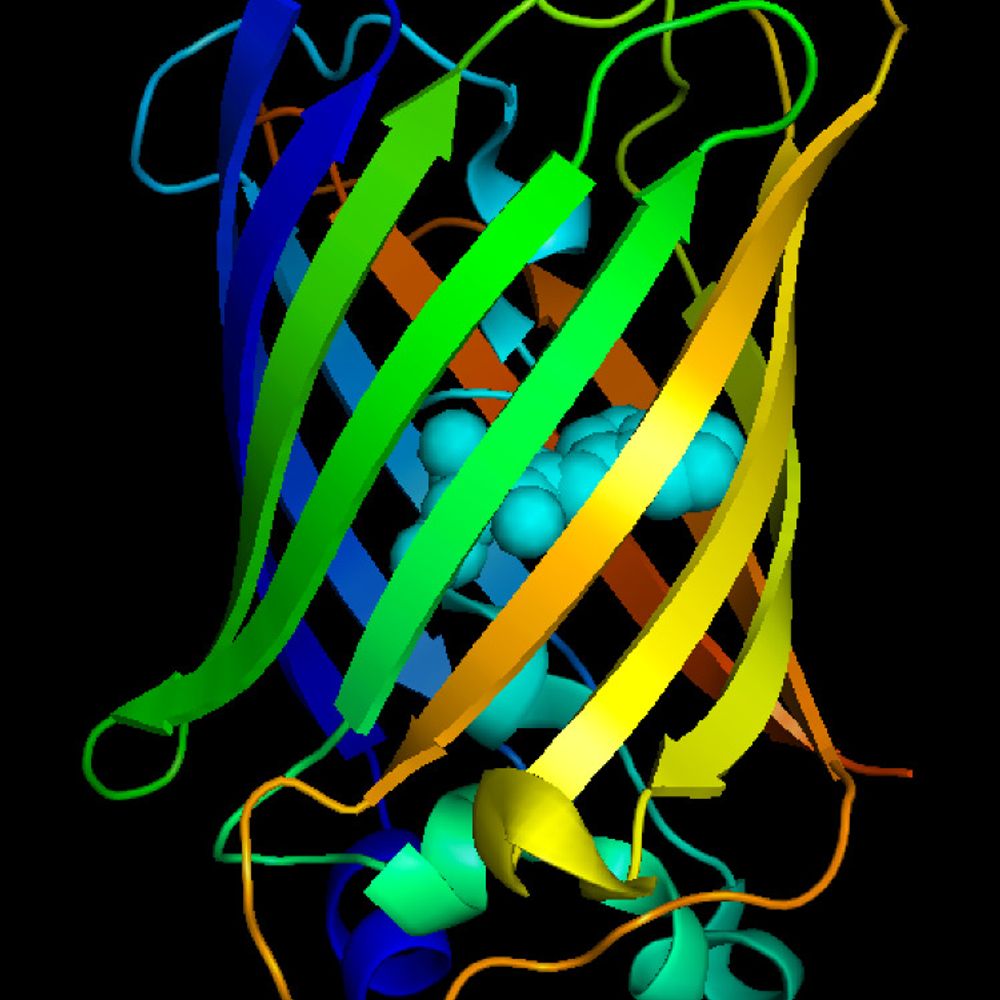
A reminder to use the right P2A sequence to produce separate proteins - the images are from a GPCR-P2A-mCherry construct using a P2A variant without (upper row) and with (lower row) a preceding GSG linker.

December 12, 2025 at 5:55 PM
A reminder to use the right P2A sequence to produce separate proteins - the images are from a GPCR-P2A-mCherry construct using a P2A variant without (upper row) and with (lower row) a preceding GSG linker.
Reposted by Jesse Engreitz
GWAS has been an incredible discovery tool for human genetics: it regularly identifies *causal* links from 1000s of SNPs to any given trait. But mechanistic interpretation is usually difficult.
Our latest work on causal models for this is out yesterday:
www.nature.com/articles/s41...
A short🧵:
Our latest work on causal models for this is out yesterday:
www.nature.com/articles/s41...
A short🧵:

Causal modelling of gene effects from regulators to programs to traits - Nature
Approaches combining genetic association and Perturb-seq data that link genetic variants to functional programs to traits are described.
www.nature.com
December 11, 2025 at 5:54 PM
GWAS has been an incredible discovery tool for human genetics: it regularly identifies *causal* links from 1000s of SNPs to any given trait. But mechanistic interpretation is usually difficult.
Our latest work on causal models for this is out yesterday:
www.nature.com/articles/s41...
A short🧵:
Our latest work on causal models for this is out yesterday:
www.nature.com/articles/s41...
A short🧵:
Reposted by Jesse Engreitz

The new Enabling Discovery through GEnomics (EDGE) Program page is posted. Please contact us at BIOEDGE@nsf.gov if you have questions. www.nsf.gov/funding/oppo...

Enabling Discovery Through Genomics (EDGE)
www.nsf.gov
December 8, 2025 at 9:00 PM
The new Enabling Discovery through GEnomics (EDGE) Program page is posted. Please contact us at BIOEDGE@nsf.gov if you have questions. www.nsf.gov/funding/oppo...
Reposted by Jesse Engreitz
The Court wrote a roadmap for illegal gerrymanders: Just wait to pass them until the “eve” of the election, and no one can stop you.

Supreme Court Just Okayed One Neat Trick to Illegally Gerrymander Your State
The Supreme Court was simply hamstrung, Justice Samuel Alito wrote, unable to...
talkingpointsmemo.com
December 5, 2025 at 2:07 PM
The Court wrote a roadmap for illegal gerrymanders: Just wait to pass them until the “eve” of the election, and no one can stop you.
Reposted by Jesse Engreitz

Oh hey, looks like I can upload longer videos here now!
Here’s my most recent one covering the latest findings on ecDNA retention mechanisms from the Chang & Mischel labs.
Here’s my most recent one covering the latest findings on ecDNA retention mechanisms from the Chang & Mischel labs.
December 4, 2025 at 1:20 AM
Oh hey, looks like I can upload longer videos here now!
Here’s my most recent one covering the latest findings on ecDNA retention mechanisms from the Chang & Mischel labs.
Here’s my most recent one covering the latest findings on ecDNA retention mechanisms from the Chang & Mischel labs.
Reposted by Jesse Engreitz

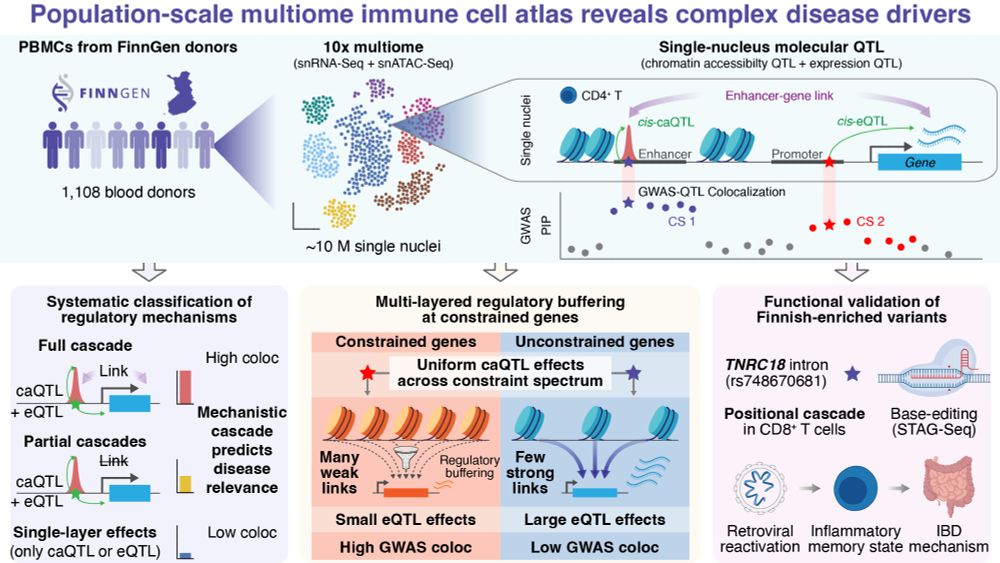
Excited to share our new FinnGen single-nucleus multiome preprint! 🧬
We profiled ~10M PBMCs (snRNA-seq + snATAC-seq) from 1,108 Finnish donors to map how genetic variants drive complex disease through chromatin and gene regulation 🧵👇
🔗 Link: www.medrxiv.org/content/10.1...
We profiled ~10M PBMCs (snRNA-seq + snATAC-seq) from 1,108 Finnish donors to map how genetic variants drive complex disease through chromatin and gene regulation 🧵👇
🔗 Link: www.medrxiv.org/content/10.1...
December 1, 2025 at 3:36 PM
Excited to share our new FinnGen single-nucleus multiome preprint! 🧬
We profiled ~10M PBMCs (snRNA-seq + snATAC-seq) from 1,108 Finnish donors to map how genetic variants drive complex disease through chromatin and gene regulation 🧵👇
🔗 Link: www.medrxiv.org/content/10.1...
We profiled ~10M PBMCs (snRNA-seq + snATAC-seq) from 1,108 Finnish donors to map how genetic variants drive complex disease through chromatin and gene regulation 🧵👇
🔗 Link: www.medrxiv.org/content/10.1...
Reposted by Jesse Engreitz

We are thrilled to announce the first official release (v0.1.8) of #𝗯𝗲𝗱𝗱𝗲𝗿, the successor to one of our flagship tool, #𝗯𝗲𝗱𝘁𝗼𝗼𝗹𝘀! Based on ideas we conceived of long ago (!), this was achieved thanks to the dedication of Brent Pedersen.
1/n
1/n
Intro to Bedder – The Quinlan Lab
quinlanlab.org
December 2, 2025 at 2:28 AM