




Harsha Gurnani
@harshag.bsky.social
Neural dynamics, control, learning. Love talking about the brain, math, poetry, science+arts! Striving for kindness. (She/her)
🌎 Postdoc @ NYU (Prev: UW, UCL, IISc)
🤓 https://harshagurnani.github.io/
🌎 Postdoc @ NYU (Prev: UW, UCL, IISc)
🤓 https://harshagurnani.github.io/
Reposted by Harsha Gurnani

Thank you for the great summary, @thetransmitter.bsky.social, and the shout-outs from scientists we admire. There is so much we don’t know about how sex hormones modulate behavior and we’ll keep exploring!

“It’s giving mechanistic insight into how estrogen modulates reinforcement learning—all the way down to the molecular mechanism,” says Ilana Witten.
By @avaskham.bsky.social
#neuroskyence
www.thetransmitter.org/sex-hormones...
By @avaskham.bsky.social
#neuroskyence
www.thetransmitter.org/sex-hormones...

Sex hormone boosts female rats’ sensitivity to unexpected rewards
During the high-estradiol stages of their estrus cycle, female rats learn faster than they do during other stages—and than male rats overall—thanks to a boost in their dopaminergic response to reward…
www.thetransmitter.org
November 26, 2025 at 3:25 PM
Thank you for the great summary, @thetransmitter.bsky.social, and the shout-outs from scientists we admire. There is so much we don’t know about how sex hormones modulate behavior and we’ll keep exploring!
Reposted by Harsha Gurnani

Another nail in the coffin for PCA?
- doesn’t linearize, distorting similarity metrics
- is biased by temporal jitter across epochs
- may miss important dimensions for transient amplification
If you think there is a state space, use a state space model!
- doesn’t linearize, distorting similarity metrics
- is biased by temporal jitter across epochs
- may miss important dimensions for transient amplification
If you think there is a state space, use a state space model!

“Our findings challenge the conventional focus on low-dimensional coding subspaces as a sufficient framework for understanding neural computations, demonstrating that dimensions previously considered task-irrelevant and accounting for little variance can have a critical role in driving behavior.”

Neural dynamics outside task-coding dimensions drive decision trajectories through transient amplification
Most behaviors involve neural dynamics in high-dimensional activity spaces. A common approach is to extract dimensions that capture task-related variability, such as those separating stimuli or choice...
www.biorxiv.org
November 23, 2025 at 3:16 PM
Another nail in the coffin for PCA?
- doesn’t linearize, distorting similarity metrics
- is biased by temporal jitter across epochs
- may miss important dimensions for transient amplification
If you think there is a state space, use a state space model!
- doesn’t linearize, distorting similarity metrics
- is biased by temporal jitter across epochs
- may miss important dimensions for transient amplification
If you think there is a state space, use a state space model!
Reposted by Harsha Gurnani
Note: this has a computational scientist track! It’s for you, too, math nerds!

Applications for our Fellows-to-Faculty Award are now open! This program supports early career scientists in #autism or #neuroscience research by facilitating their transition into tenure-track faculty positions. Apply by 1/14/2026: www.simonsfoundation.org/2025/10/31/a... #science

Applications for Fellows-to-Faculty Awards Now Open
Applications for Fellows-to-Faculty Awards Now Open on Simons Foundation
www.simonsfoundation.org
October 31, 2025 at 4:30 PM
Note: this has a computational scientist track! It’s for you, too, math nerds!
Reposted by Harsha Gurnani

paper🚨
When we learn a category, do we learn the structure of the world, or just where to draw the line? In a cross-species study, we show that humans, rats & mice adapt optimally to changing sensory statistics, yet rely on fundamentally different learning algorithms.
www.biorxiv.org/content/10.1...
When we learn a category, do we learn the structure of the world, or just where to draw the line? In a cross-species study, we show that humans, rats & mice adapt optimally to changing sensory statistics, yet rely on fundamentally different learning algorithms.
www.biorxiv.org/content/10.1...

Different learning algorithms achieve shared optimal outcomes in humans, rats, and mice
Animals must exploit environmental regularities to make adaptive decisions, yet the learning algorithms that enabels this flexibility remain unclear. A central question across neuroscience, cognitive science, and machine learning, is whether learning relies on generative or discriminative strategies. Generative learners build internal models the sensory world itself, capturing its statistical structure; discriminative learners map stimuli directly onto choices, ignoring input statistics. These strategies rely on fundamentally different internal representations and entail distinct computational trade-offs: generative learning supports flexible generalisation and transfer, whereas discriminative learning is efficient but task-specific. We compared humans, rats, and mice performing the same auditory categorisation task, where category boundaries and rewards were fixed but sensory statistics varied. All species adapted their behaviour near-optimally, consistent with a normative observer constrained by sensory and decision noise. Yet their underlying algorithms diverged: humans predominantly relied on generative representations, mice on discriminative boundary-tracking, and rats spanned both regimes. Crucially, end-point performance concealed these differences, only learning trajectories and trial-to-trial updates revealed the divergence. These results show that similar near-optimal behaviour can mask fundamentally different internal representations, establishing a comparative framework for uncovering the hidden strategies that support statistical learning. ### Competing Interest Statement The authors have declared no competing interest. Wellcome Trust, https://ror.org/029chgv08, 219880/Z/19/Z, 225438/Z/22/Z, 219627/Z/19/Z Gatsby Charitable Foundation, GAT3755 UK Research and Innovation, https://ror.org/001aqnf71, EP/Z000599/1
www.biorxiv.org
November 17, 2025 at 7:18 PM
paper🚨
When we learn a category, do we learn the structure of the world, or just where to draw the line? In a cross-species study, we show that humans, rats & mice adapt optimally to changing sensory statistics, yet rely on fundamentally different learning algorithms.
www.biorxiv.org/content/10.1...
When we learn a category, do we learn the structure of the world, or just where to draw the line? In a cross-species study, we show that humans, rats & mice adapt optimally to changing sensory statistics, yet rely on fundamentally different learning algorithms.
www.biorxiv.org/content/10.1...
Reposted by Harsha Gurnani
Who wore it better? Our new paper shows that rat OFC supports Bayesian inference of hidden states! With neural correlates of inferred state transitions at the level of single neurons and population-level latent factors. www.sciencedirect.com/science/arti...

November 17, 2025 at 6:06 PM
Who wore it better? Our new paper shows that rat OFC supports Bayesian inference of hidden states! With neural correlates of inferred state transitions at the level of single neurons and population-level latent factors. www.sciencedirect.com/science/arti...
Reposted by Harsha Gurnani
Thrilled to share our new paper, out now in @natneuro.nature.com, uncovering how estradiol, the most potent estrogen, modulates reinforcement learning and reward prediction errors across biological levels. www.nature.com/articles/s41...
#blueprint 1/7
#blueprint 1/7

Estrogen modulates reward prediction errors and reinforcement learning - Nature Neuroscience
Dopamine encoding of reward prediction errors naturally fluctuates over females’ reproductive cycles with estrogenic signaling due to reduced expression of dopamine reuptake proteins.
www.nature.com
November 11, 2025 at 2:41 PM
Thrilled to share our new paper, out now in @natneuro.nature.com, uncovering how estradiol, the most potent estrogen, modulates reinforcement learning and reward prediction errors across biological levels. www.nature.com/articles/s41...
#blueprint 1/7
#blueprint 1/7
Reposted by Harsha Gurnani

I've been waiting some years to make this joke and now it’s real:
I conned somebody into giving me a faculty job!
I’m starting as a W1 Tenure-Track Professor at Goethe University Frankfurt in a week (lol), in the Faculty of CS and Math
and I'm recruiting PhD students 🤗
I conned somebody into giving me a faculty job!
I’m starting as a W1 Tenure-Track Professor at Goethe University Frankfurt in a week (lol), in the Faculty of CS and Math
and I'm recruiting PhD students 🤗

a man wearing a white shirt and tie smiles in front of a window
ALT: a man wearing a white shirt and tie smiles in front of a window
media.tenor.com
September 23, 2025 at 1:00 PM
I've been waiting some years to make this joke and now it’s real:
I conned somebody into giving me a faculty job!
I’m starting as a W1 Tenure-Track Professor at Goethe University Frankfurt in a week (lol), in the Faculty of CS and Math
and I'm recruiting PhD students 🤗
I conned somebody into giving me a faculty job!
I’m starting as a W1 Tenure-Track Professor at Goethe University Frankfurt in a week (lol), in the Faculty of CS and Math
and I'm recruiting PhD students 🤗
I love watching mentees transform wonderment into knowledge & growth, it reminds me of our collective responsibility & power 👩🏻🏫 Also surreal that it was 10y that my UG experience was transformed by amazing, kind mentors like Eve, Rishi and Tim 😊 @timothyoleary.bsky.social
@cnl-mbu-iisc.bsky.social
@cnl-mbu-iisc.bsky.social
September 22, 2025 at 12:03 AM
I love watching mentees transform wonderment into knowledge & growth, it reminds me of our collective responsibility & power 👩🏻🏫 Also surreal that it was 10y that my UG experience was transformed by amazing, kind mentors like Eve, Rishi and Tim 😊 @timothyoleary.bsky.social
@cnl-mbu-iisc.bsky.social
@cnl-mbu-iisc.bsky.social
Job post alert!👩🔬 Postdoctoral fellow in CompNeuro/ML in the Artificial and Biological Computation lab at NYU (csavin.wixsite.com/savinlab).
Exciting opening in the Data and Theory team in the new Simons Collaboration in Ecological Neuroscience!
www.simonsfoundation.org/2025/04/24/s...
#neuroskyence
Exciting opening in the Data and Theory team in the new Simons Collaboration in Ecological Neuroscience!
www.simonsfoundation.org/2025/04/24/s...
#neuroskyence

Simons Foundation Launches Collaboration on Ecological Neuroscience
Simons Foundation Launches Collaboration on Ecological Neuroscience on Simons Foundation
www.simonsfoundation.org
September 15, 2025 at 9:28 PM
Job post alert!👩🔬 Postdoctoral fellow in CompNeuro/ML in the Artificial and Biological Computation lab at NYU (csavin.wixsite.com/savinlab).
Exciting opening in the Data and Theory team in the new Simons Collaboration in Ecological Neuroscience!
www.simonsfoundation.org/2025/04/24/s...
#neuroskyence
Exciting opening in the Data and Theory team in the new Simons Collaboration in Ecological Neuroscience!
www.simonsfoundation.org/2025/04/24/s...
#neuroskyence
Reposted by Harsha Gurnani

Of potential interest to those keen on motor control and/or multi-task networks. Congrats to Elom and Eric.
www.biorxiv.org/content/10.1...
www.biorxiv.org/content/10.1...

Motor cortex flexibly deploys a high-dimensional repertoire of subskills
Skilled movement often requires flexibly combining multiple subskills, each requiring dedicated control strategies and underlying computations. How the motor system achieves such versatility remains u...
www.biorxiv.org
September 8, 2025 at 4:34 PM
Of potential interest to those keen on motor control and/or multi-task networks. Congrats to Elom and Eric.
www.biorxiv.org/content/10.1...
www.biorxiv.org/content/10.1...
Reposted by Harsha Gurnani
Excited to announce that my first postdoc paper is now online!
Links:
www.nature.com/articles/s41...
rdcu.be/eAcN7
In it, we examine the perennial question: what changes in the brain when learning a new motor skill?
Read more below to find out 👇
Links:
www.nature.com/articles/s41...
rdcu.be/eAcN7
In it, we examine the perennial question: what changes in the brain when learning a new motor skill?
Read more below to find out 👇
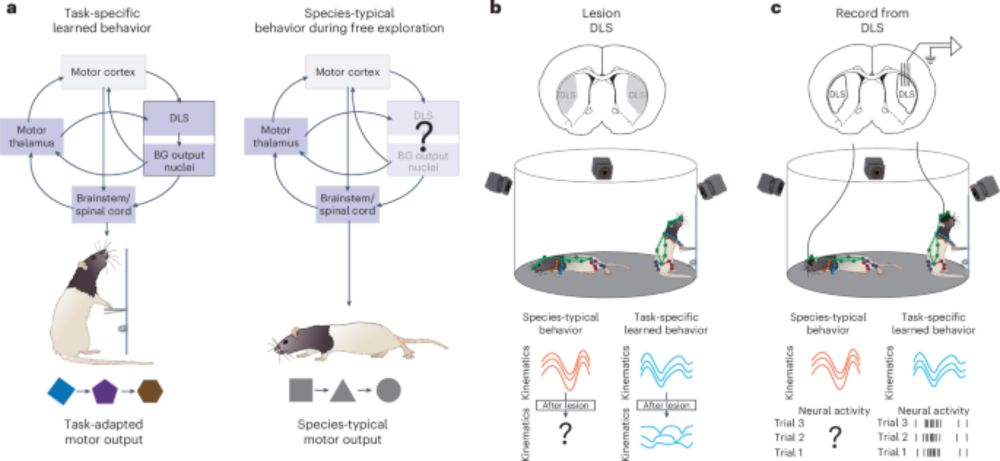
Differential kinematic coding in sensorimotor striatum across behavioral domains reflects different contributions to movement - Nature Neuroscience
Hardcastle and Marshall et al. show that striatal function is domain specific, required for task-related but not spontaneously expressed movements. This functional distinction is reflected in starkly ...
www.nature.com
August 12, 2025 at 6:26 PM
Excited to announce that my first postdoc paper is now online!
Links:
www.nature.com/articles/s41...
rdcu.be/eAcN7
In it, we examine the perennial question: what changes in the brain when learning a new motor skill?
Read more below to find out 👇
Links:
www.nature.com/articles/s41...
rdcu.be/eAcN7
In it, we examine the perennial question: what changes in the brain when learning a new motor skill?
Read more below to find out 👇
Reposted by Harsha Gurnani
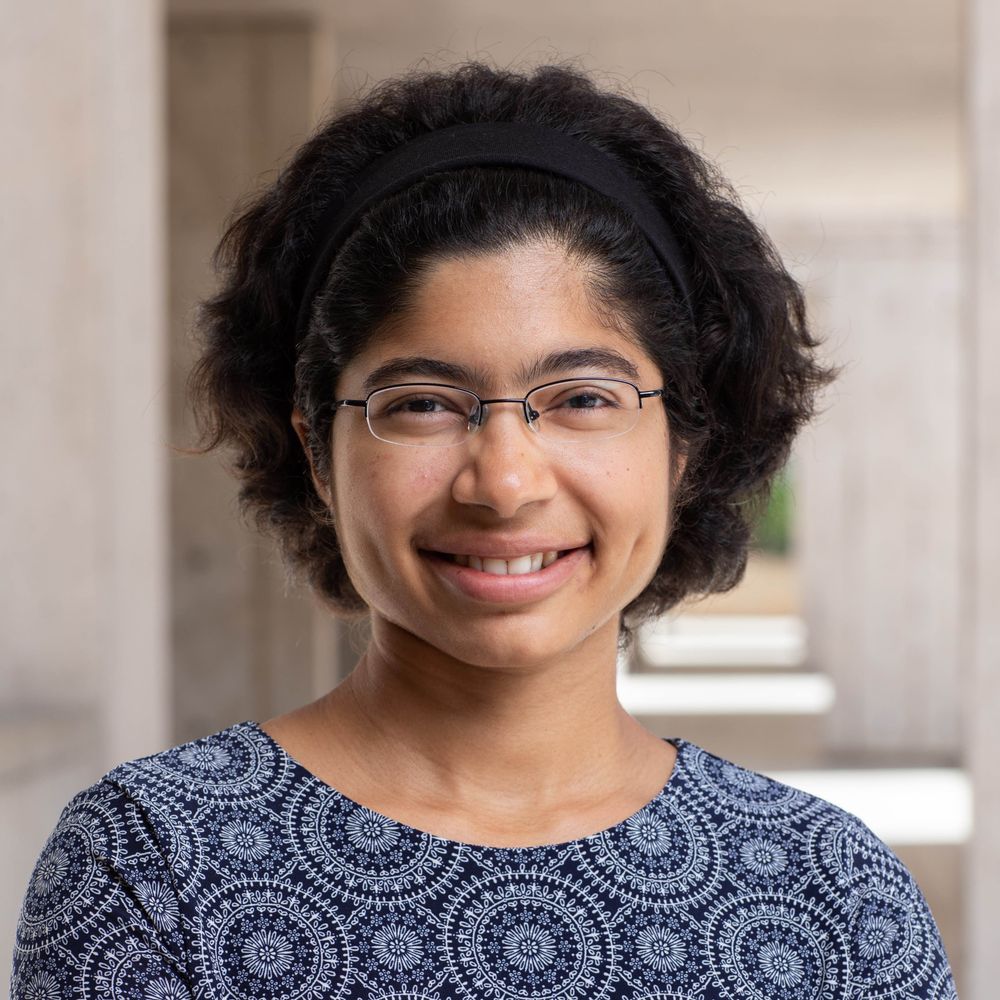
Excited to share this profile + interview with Dr. Emily Jacobs! Amazing work on human precision brain imaging across hormonal fluctuations, and such an inspiring story! I had such a great time interviewing her!
Our latest profile just dropped! Dr. Emily Jacobs (@emilyjacobs.bsky.social) studies how hormonal fluctuations influence the brain. Follow the link below to listen to the full interview!
www.storiesofwin.org/profiles/202...
#WomenInNeuroscience #StoriesOfWiN
www.storiesofwin.org/profiles/202...
#WomenInNeuroscience #StoriesOfWiN

Dr. Emily Jacobs — Stories of WiN
studies how hormonal fluctuations influence the brain
www.storiesofwin.org
August 6, 2025 at 7:59 PM
Excited to share this profile + interview with Dr. Emily Jacobs! Amazing work on human precision brain imaging across hormonal fluctuations, and such an inspiring story! I had such a great time interviewing her!
Reposted by Harsha Gurnani
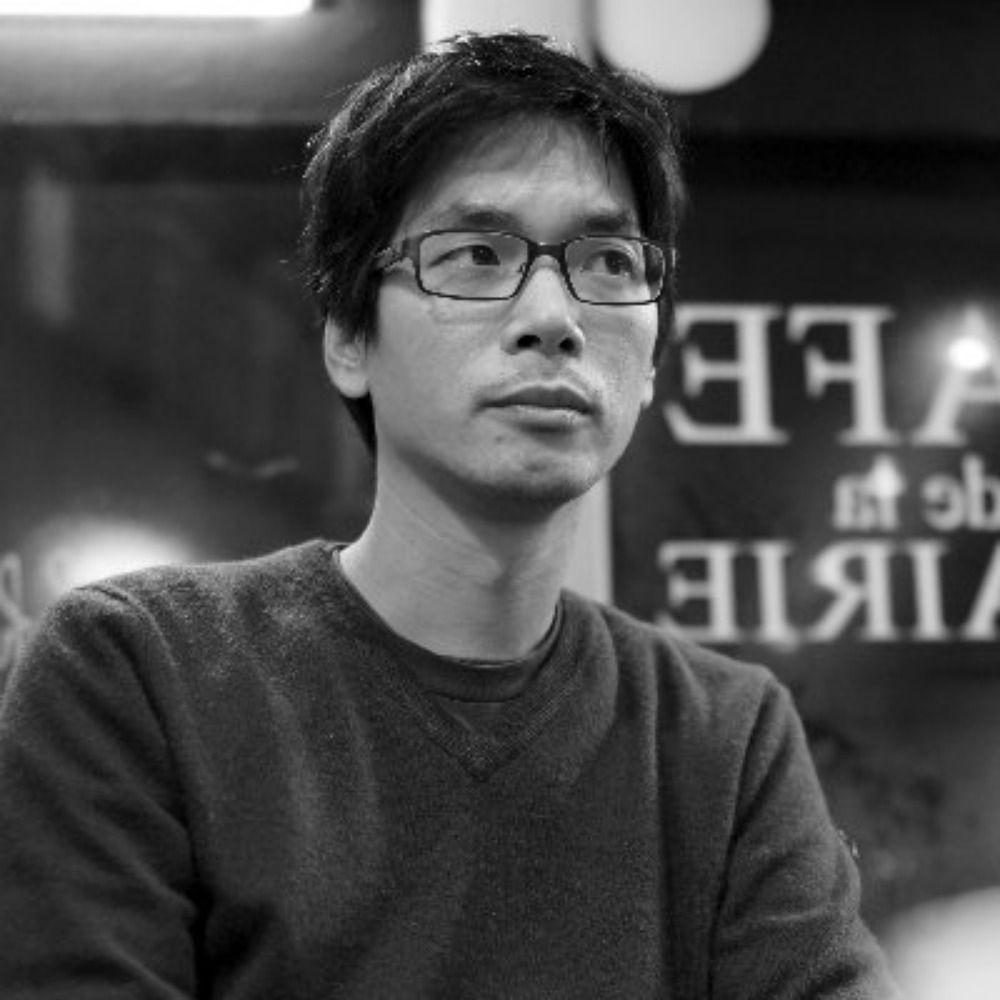
Delightful story about a 17-year-old homeschooler who disproved the 40-year-old Mizohata-Takeuchi conjecture. She decided to apply straight to graduate school, skipping the rest of high school and college. When she finishes, a PhD will be her first degree.

At 17, Hannah Cairo Solved a Major Math Mystery | Quanta Magazine
After finding the homeschooling life confining, the teen petitioned her way into a graduate class at Berkeley, where she ended up disproving a 40-year-old conjecture.
www.quantamagazine.org
August 2, 2025 at 1:01 AM
Delightful story about a 17-year-old homeschooler who disproved the 40-year-old Mizohata-Takeuchi conjecture. She decided to apply straight to graduate school, skipping the rest of high school and college. When she finishes, a PhD will be her first degree.
Reposted by Harsha Gurnani

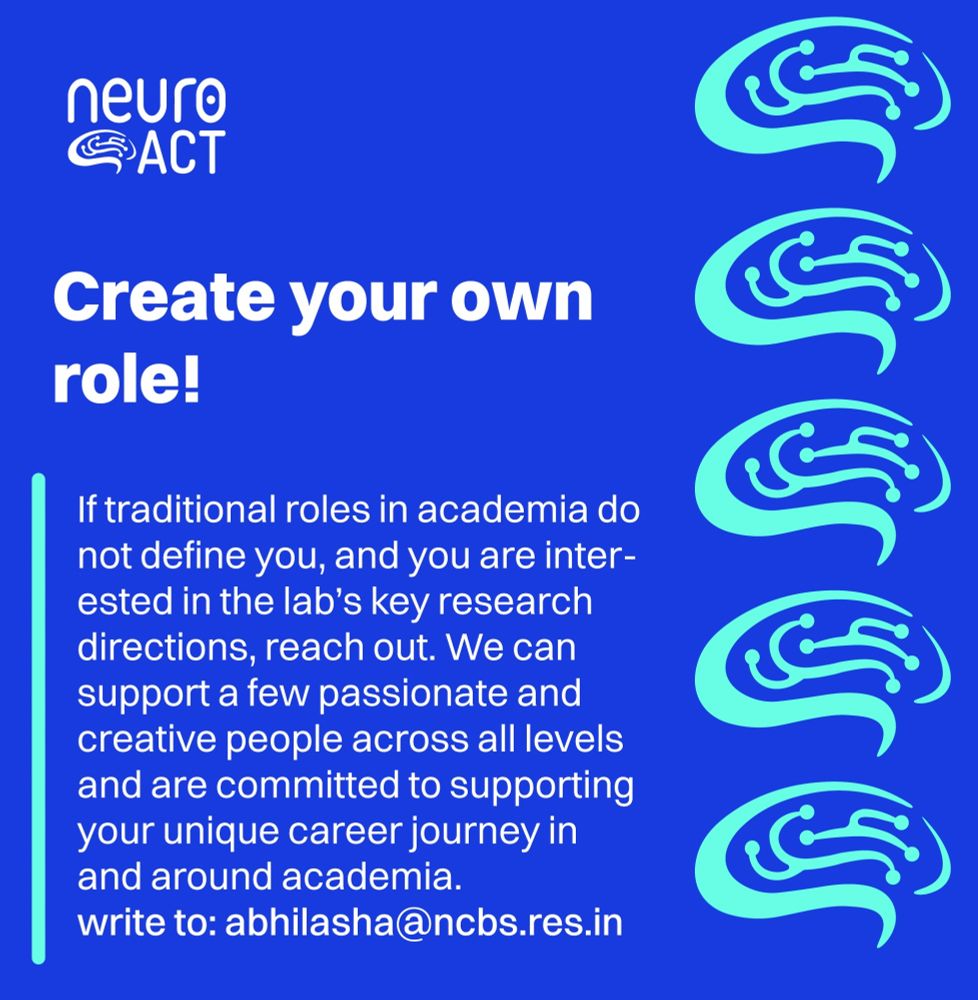
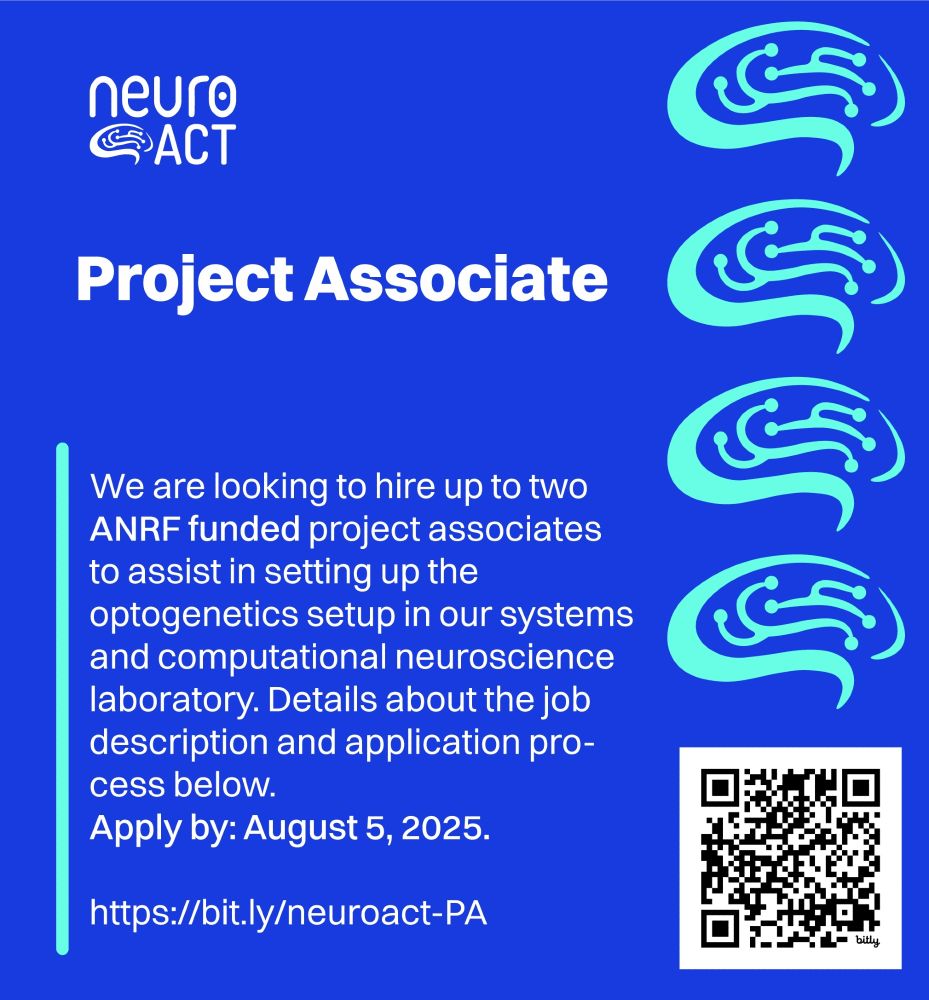
📣 We are expanding! Repost 🙏🏽
- Postdoc (funded by @simonsfoundation.org grant on synchronisation between cognitive representations and stepping)
- Project Associates
- Create your role! (Reach out if you are keen on these topics and these roles do not define you 👀🤗)
www.neuroact.in
- Postdoc (funded by @simonsfoundation.org grant on synchronisation between cognitive representations and stepping)
- Project Associates
- Create your role! (Reach out if you are keen on these topics and these roles do not define you 👀🤗)
www.neuroact.in
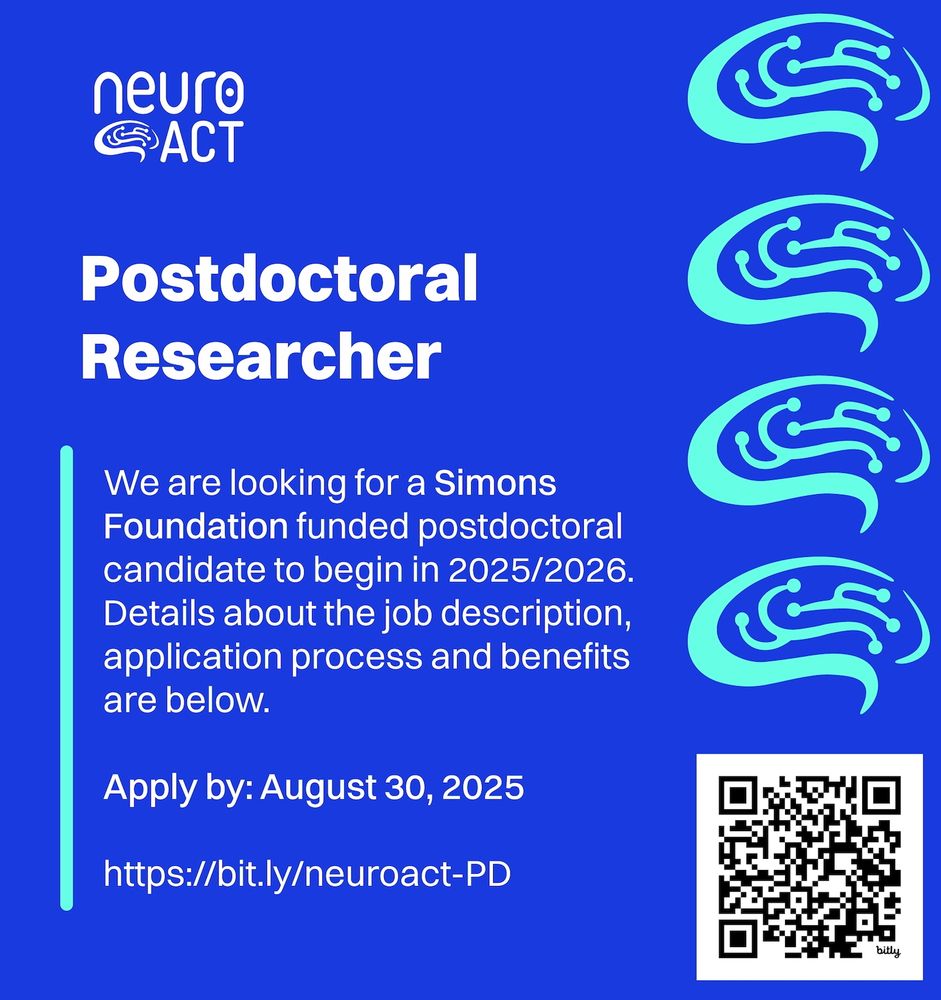
August 1, 2025 at 12:22 PM
📣 We are expanding! Repost 🙏🏽
- Postdoc (funded by @simonsfoundation.org grant on synchronisation between cognitive representations and stepping)
- Project Associates
- Create your role! (Reach out if you are keen on these topics and these roles do not define you 👀🤗)
www.neuroact.in
- Postdoc (funded by @simonsfoundation.org grant on synchronisation between cognitive representations and stepping)
- Project Associates
- Create your role! (Reach out if you are keen on these topics and these roles do not define you 👀🤗)
www.neuroact.in
Reposted by Harsha Gurnani

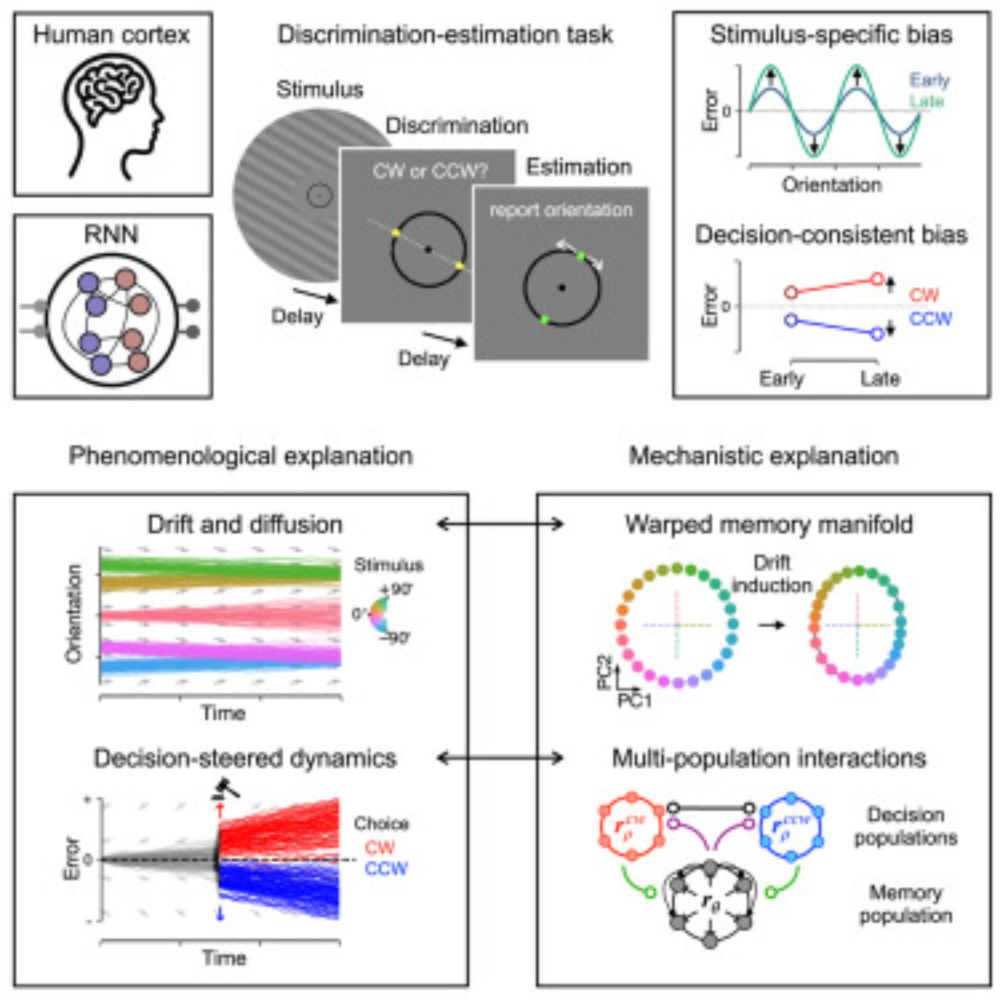
Excited to share that our paper is now out in Neuron @cp-neuron.bsky.social (dlvr.it/TM9zJ8).
Our perception isn't a perfect mirror of the world. It's often biased by our expectations and beliefs. How do these biases unfold over time, and what shapes their trajectory? A summary thread. (1/13)
Our perception isn't a perfect mirror of the world. It's often biased by our expectations and beliefs. How do these biases unfold over time, and what shapes their trajectory? A summary thread. (1/13)
Attractor dynamics of working memory explain a concurrent evolution of stimulus-specific and decision-consistent biases in visual estimation
People exhibit biases when perceiving features of the world, shaped by both external
stimuli and prior decisions. By tracking behavioral, neural, and mechanistic markers
of stimulus- and decision-rela...
dlvr.it
July 29, 2025 at 4:02 PM
Excited to share that our paper is now out in Neuron @cp-neuron.bsky.social (dlvr.it/TM9zJ8).
Our perception isn't a perfect mirror of the world. It's often biased by our expectations and beliefs. How do these biases unfold over time, and what shapes their trajectory? A summary thread. (1/13)
Our perception isn't a perfect mirror of the world. It's often biased by our expectations and beliefs. How do these biases unfold over time, and what shapes their trajectory? A summary thread. (1/13)
Reposted by Harsha Gurnani

When neurons change, but behavior doesn’t: Excitability changes driving representational drift
New preprint of work with Christian Machens: www.biorxiv.org/content/10.1...
New preprint of work with Christian Machens: www.biorxiv.org/content/10.1...

Representational drift without synaptic plasticity
Neural computations support stable behavior despite relying on many dynamically changing biological processes. One such process is representational drift (RD), in which neurons' responses change over ...
www.biorxiv.org
July 29, 2025 at 2:02 PM
When neurons change, but behavior doesn’t: Excitability changes driving representational drift
New preprint of work with Christian Machens: www.biorxiv.org/content/10.1...
New preprint of work with Christian Machens: www.biorxiv.org/content/10.1...
Reposted by Harsha Gurnani

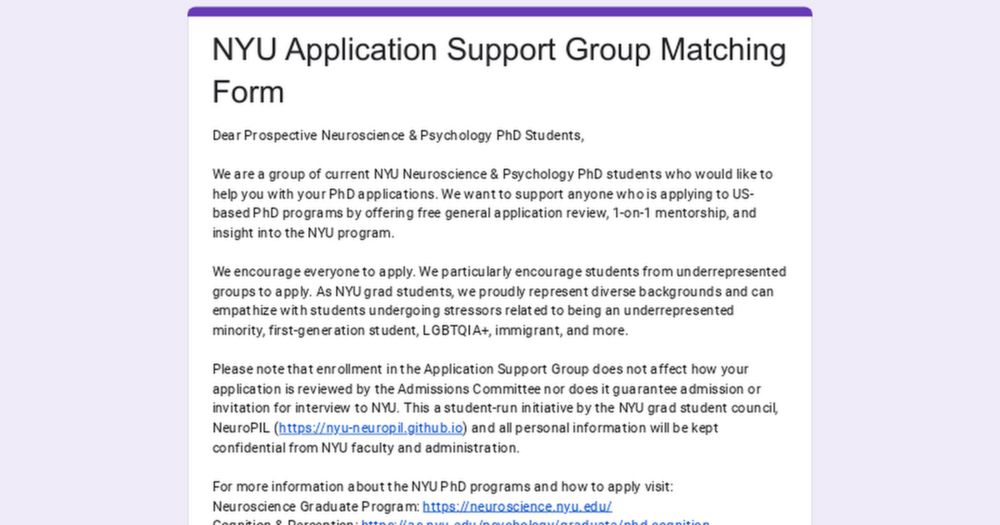
Thinking of applying to US-based Ph.D. programs in neuroscience, psychology, or cognitive science? We’ve got your back! NYU’s Application Support Group is a student-led, free mentorship program offering 1-on-1 support and guidance. Apply now! docs.google.com/forms/d/e/1F...
NYU Application Support Group Matching Form
Dear Prospective Neuroscience & Psychology PhD Students,
We are a group of current NYU Neuroscience & Psychology PhD students who would like to help you with your PhD applications. We want to support...
docs.google.com
July 28, 2025 at 3:15 PM
Thinking of applying to US-based Ph.D. programs in neuroscience, psychology, or cognitive science? We’ve got your back! NYU’s Application Support Group is a student-led, free mentorship program offering 1-on-1 support and guidance. Apply now! docs.google.com/forms/d/e/1F...
Reposted by Harsha Gurnani
📣 Heads-up that our amazing dept (Berkeley Psych) is anticipating hiring *two* TT Asst Profs this Fall, under the themes of (1) Social & Personality Psychology, and (2) Biological Basis of Behavior.
Official job ads coming soon...
Send qs for (1) to Iris Mauss/Serena Chen, (2) to Linda Wilbrecht
Official job ads coming soon...
Send qs for (1) to Iris Mauss/Serena Chen, (2) to Linda Wilbrecht
July 25, 2025 at 4:12 PM
📣 Heads-up that our amazing dept (Berkeley Psych) is anticipating hiring *two* TT Asst Profs this Fall, under the themes of (1) Social & Personality Psychology, and (2) Biological Basis of Behavior.
Official job ads coming soon...
Send qs for (1) to Iris Mauss/Serena Chen, (2) to Linda Wilbrecht
Official job ads coming soon...
Send qs for (1) to Iris Mauss/Serena Chen, (2) to Linda Wilbrecht
Reposted by Harsha Gurnani

First Bluesky post! I'm excited to share a preprint from my postdoctoral work where we 1) define the developmental mechanisms guiding formation of a vagal gut-brain circuit and 2) discover that this circuit regulates much more than just appetite. www.biorxiv.org/content/10.1...

Ontogeny of the vagal gut-brain axis
Gut-brain communication is a key component of homeostasis which regulates behaviors such as appetite and reward. Intestinal entero-endocrine cells (EECs) translate nutrient intake into signals which a...
www.biorxiv.org
May 8, 2025 at 8:18 PM
First Bluesky post! I'm excited to share a preprint from my postdoctoral work where we 1) define the developmental mechanisms guiding formation of a vagal gut-brain circuit and 2) discover that this circuit regulates much more than just appetite. www.biorxiv.org/content/10.1...
Reposted by Harsha Gurnani

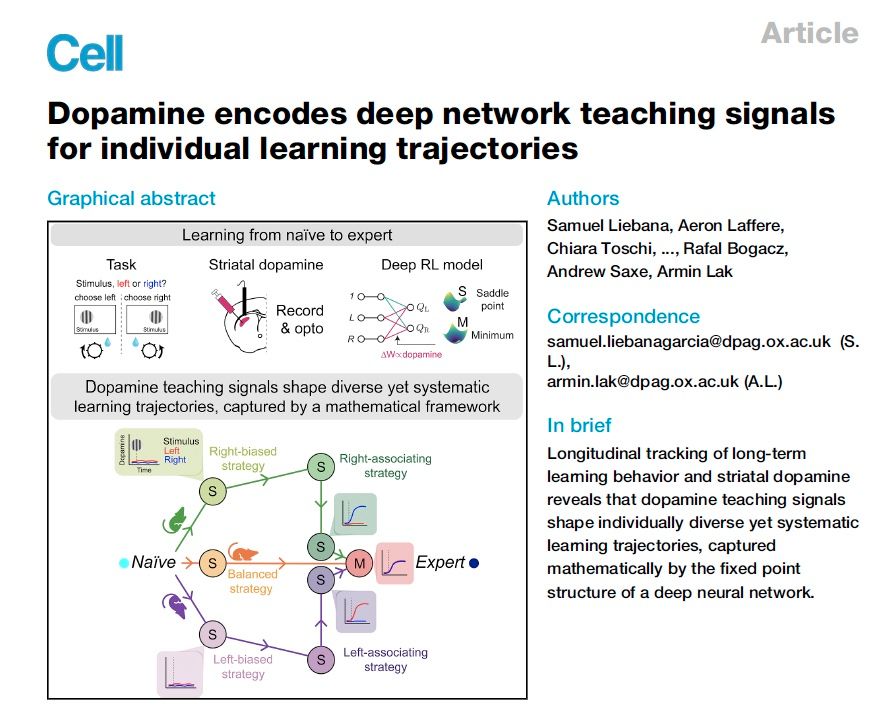
Our work, out at Cell, shows that the brain’s dopamine signals teach each individual a unique learning trajectory. Collaborative experiment-theory effort, led by Sam Liebana in the lab. The first experiment my lab started just shy of 6y ago & v excited to see it out: www.cell.com/cell/fulltex...
June 11, 2025 at 3:18 PM
Our work, out at Cell, shows that the brain’s dopamine signals teach each individual a unique learning trajectory. Collaborative experiment-theory effort, led by Sam Liebana in the lab. The first experiment my lab started just shy of 6y ago & v excited to see it out: www.cell.com/cell/fulltex...
Reposted by Harsha Gurnani

New #NeuroAI #compneurosky preprint! To better understand how target-directed learning works in the brain, we sought to engineer an artificial neural network capable of solving complex image classification tasks that comprises only experimentally-supported biological building blocks. (1/15)

May 27, 2025 at 6:40 PM
New #NeuroAI #compneurosky preprint! To better understand how target-directed learning works in the brain, we sought to engineer an artificial neural network capable of solving complex image classification tasks that comprises only experimentally-supported biological building blocks. (1/15)
Reposted by Harsha Gurnani

Neuronal computation in the cerebellum via a vector calculus.
Work of Mohammad Amin Fakharian, Alden Shoup, Paul Hage, and Hisham Elseweifi
www.science.org/doi/10.1126/...
Work of Mohammad Amin Fakharian, Alden Shoup, Paul Hage, and Hisham Elseweifi
www.science.org/doi/10.1126/...
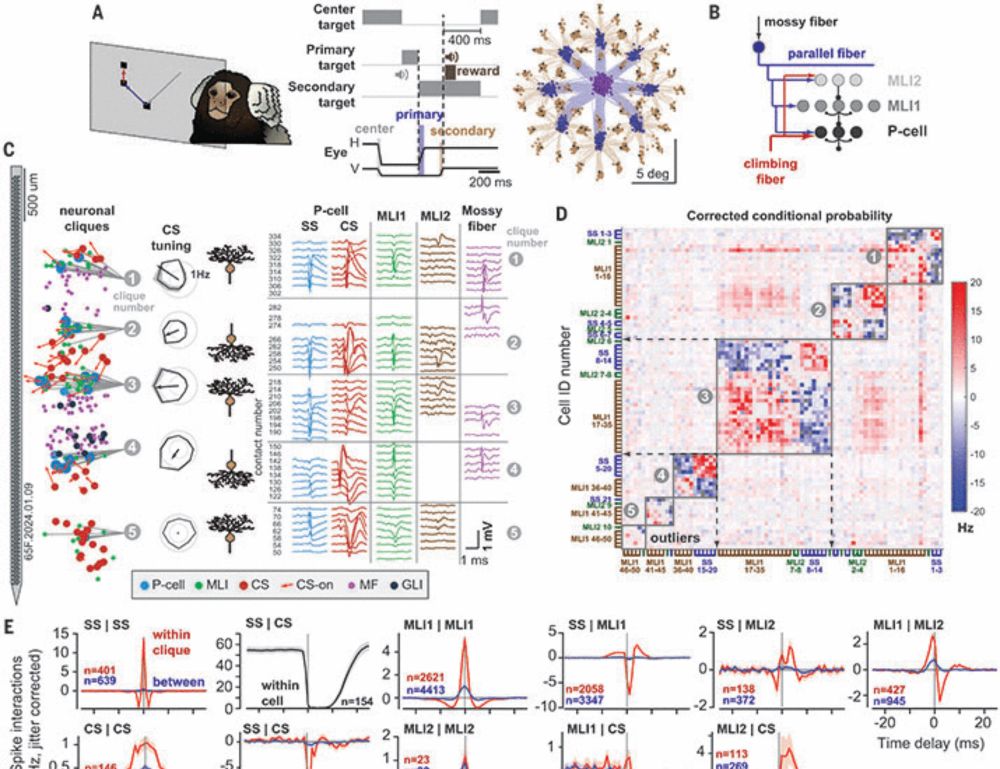
A vector calculus for neural computation in the cerebellum
Null space theory predicts that neurons generate spikes not only to produce behavior but also to prevent the undesirable effect of other neurons on behavior. In this work, we show that this competitiv...
www.science.org
May 22, 2025 at 6:56 PM
Neuronal computation in the cerebellum via a vector calculus.
Work of Mohammad Amin Fakharian, Alden Shoup, Paul Hage, and Hisham Elseweifi
www.science.org/doi/10.1126/...
Work of Mohammad Amin Fakharian, Alden Shoup, Paul Hage, and Hisham Elseweifi
www.science.org/doi/10.1126/...