



Gerry Brien
@gerrybrien.bsky.social
Childhood Cancer | Chromatin Biology | Therapeutics | Outdoor Adventures
https://www.brienlab.com/
https://www.brienlab.com/
Pinned
SS18-SSX co-opts P300 to sustain oncogenic transcription independent of SWI/SNF activity
Synovial sarcoma is driven by the SS18-SSX fusion oncoprotein, which has been assumed to promote tumorigenesis through its incorporation into the SWI/SNF chromatin remodeling complexes. Accordingly, therapeutic efforts have focused on targeting SS18-SSX containing SWI/SNF assemblies, yet these approaches have produced limited clinical benefit. Here, we demonstrate that SS18-SSX sustains oncogenic transcription independent of SWI/SNF activity. Despite efficient degradation and dismantling of SWI/SNF complexes, fusion occupancy at target loci and associated gene expression programs remain largely intact. Instead, we identify the acetyltransferase P300 as an essential co-factor supporting SS18-SSX chromatin binding and transcriptional activation. Targeting P300 displaces the fusion from chromatin, suppresses its transcriptional output, compromising synovial sarcoma viability. Notably, dual PROTAC mediated degradation of P300 and SWI/SNF produces strong synergistic effects, broadly disrupting SS18-SSX localization and function. These findings redefine the mechanistic basis of synovial sarcoma and reveal a mechanistically anchored therapeutic strategy for targeting its core oncogenic driver. ### Competing Interest Statement C.R.V. has been a consultant for Flare Therapeutics, Roivant Sciences and C4 Therapeutics; has served on the advisory boards of KSQ Therapeutics, Syros Pharmaceuticals and Treeline Biosciences; has received research funding from Boehringer Ingelheim and Treeline Biosciences; and owns stock in Treeline Biosciences. S.A.A. has been a consultant and/or shareholder for Neomorph, Imago Biosciences, Hyku Therapeutics, C4 Therapeutics, Accent Therapeutics and Nimbus Therapeutics; and has received research support from Janssen and Syndax. N.O.C. is a co-founder, shareholder and management consultant for PhenoTherapeutics Ltd; and a shareholder in Amplia Therapeutics Ltd All other authors declare no financial interests UKRI, EP/X039633/1 Worldwide Cancer Research, https://ror.org/031tfbz57, 21-0271 Science Foundation Ireland, https://ror.org/0271asj38, 18/SIRG/5573
www.biorxiv.org
Synovial sarcoma is driven almost exclusively by a single oncofusion – SS18-SSX
For years, the assumptions on disease mechanisms were simple:
➡️ SS18-SSX works by hijacking SWI/SNF chromatin remodeling activity
Our new study shows that assumption was wrong 🧵👇
www.biorxiv.org/content/10.6...
For years, the assumptions on disease mechanisms were simple:
➡️ SS18-SSX works by hijacking SWI/SNF chromatin remodeling activity
Our new study shows that assumption was wrong 🧵👇
www.biorxiv.org/content/10.6...
Reposted by Gerry Brien

📣 I'm excited to share our latest preprint!
We adapt and characterise a neurosphere-based CNCC differentiation protocol, and demonstrate utility for quantitative phenotyping and craniofacial disease modelling! 🧫
Read about Array-CNCC here:
www.biorxiv.org/content/10.6...
@uoe-igc.bsky.social
We adapt and characterise a neurosphere-based CNCC differentiation protocol, and demonstrate utility for quantitative phenotyping and craniofacial disease modelling! 🧫
Read about Array-CNCC here:
www.biorxiv.org/content/10.6...
@uoe-igc.bsky.social

January 28, 2026 at 2:37 PM
📣 I'm excited to share our latest preprint!
We adapt and characterise a neurosphere-based CNCC differentiation protocol, and demonstrate utility for quantitative phenotyping and craniofacial disease modelling! 🧫
Read about Array-CNCC here:
www.biorxiv.org/content/10.6...
@uoe-igc.bsky.social
We adapt and characterise a neurosphere-based CNCC differentiation protocol, and demonstrate utility for quantitative phenotyping and craniofacial disease modelling! 🧫
Read about Array-CNCC here:
www.biorxiv.org/content/10.6...
@uoe-igc.bsky.social
Synovial sarcoma is driven almost exclusively by a single oncofusion – SS18-SSX
For years, the assumptions on disease mechanisms were simple:
➡️ SS18-SSX works by hijacking SWI/SNF chromatin remodeling activity
Our new study shows that assumption was wrong 🧵👇
www.biorxiv.org/content/10.6...
For years, the assumptions on disease mechanisms were simple:
➡️ SS18-SSX works by hijacking SWI/SNF chromatin remodeling activity
Our new study shows that assumption was wrong 🧵👇
www.biorxiv.org/content/10.6...
SS18-SSX co-opts P300 to sustain oncogenic transcription independent of SWI/SNF activity
Synovial sarcoma is driven by the SS18-SSX fusion oncoprotein, which has been assumed to promote tumorigenesis through its incorporation into the SWI/SNF chromatin remodeling complexes. Accordingly, therapeutic efforts have focused on targeting SS18-SSX containing SWI/SNF assemblies, yet these approaches have produced limited clinical benefit. Here, we demonstrate that SS18-SSX sustains oncogenic transcription independent of SWI/SNF activity. Despite efficient degradation and dismantling of SWI/SNF complexes, fusion occupancy at target loci and associated gene expression programs remain largely intact. Instead, we identify the acetyltransferase P300 as an essential co-factor supporting SS18-SSX chromatin binding and transcriptional activation. Targeting P300 displaces the fusion from chromatin, suppresses its transcriptional output, compromising synovial sarcoma viability. Notably, dual PROTAC mediated degradation of P300 and SWI/SNF produces strong synergistic effects, broadly disrupting SS18-SSX localization and function. These findings redefine the mechanistic basis of synovial sarcoma and reveal a mechanistically anchored therapeutic strategy for targeting its core oncogenic driver. ### Competing Interest Statement C.R.V. has been a consultant for Flare Therapeutics, Roivant Sciences and C4 Therapeutics; has served on the advisory boards of KSQ Therapeutics, Syros Pharmaceuticals and Treeline Biosciences; has received research funding from Boehringer Ingelheim and Treeline Biosciences; and owns stock in Treeline Biosciences. S.A.A. has been a consultant and/or shareholder for Neomorph, Imago Biosciences, Hyku Therapeutics, C4 Therapeutics, Accent Therapeutics and Nimbus Therapeutics; and has received research support from Janssen and Syndax. N.O.C. is a co-founder, shareholder and management consultant for PhenoTherapeutics Ltd; and a shareholder in Amplia Therapeutics Ltd All other authors declare no financial interests UKRI, EP/X039633/1 Worldwide Cancer Research, https://ror.org/031tfbz57, 21-0271 Science Foundation Ireland, https://ror.org/0271asj38, 18/SIRG/5573
www.biorxiv.org
January 28, 2026 at 9:54 AM
Synovial sarcoma is driven almost exclusively by a single oncofusion – SS18-SSX
For years, the assumptions on disease mechanisms were simple:
➡️ SS18-SSX works by hijacking SWI/SNF chromatin remodeling activity
Our new study shows that assumption was wrong 🧵👇
www.biorxiv.org/content/10.6...
For years, the assumptions on disease mechanisms were simple:
➡️ SS18-SSX works by hijacking SWI/SNF chromatin remodeling activity
Our new study shows that assumption was wrong 🧵👇
www.biorxiv.org/content/10.6...
Reposted by Gerry Brien

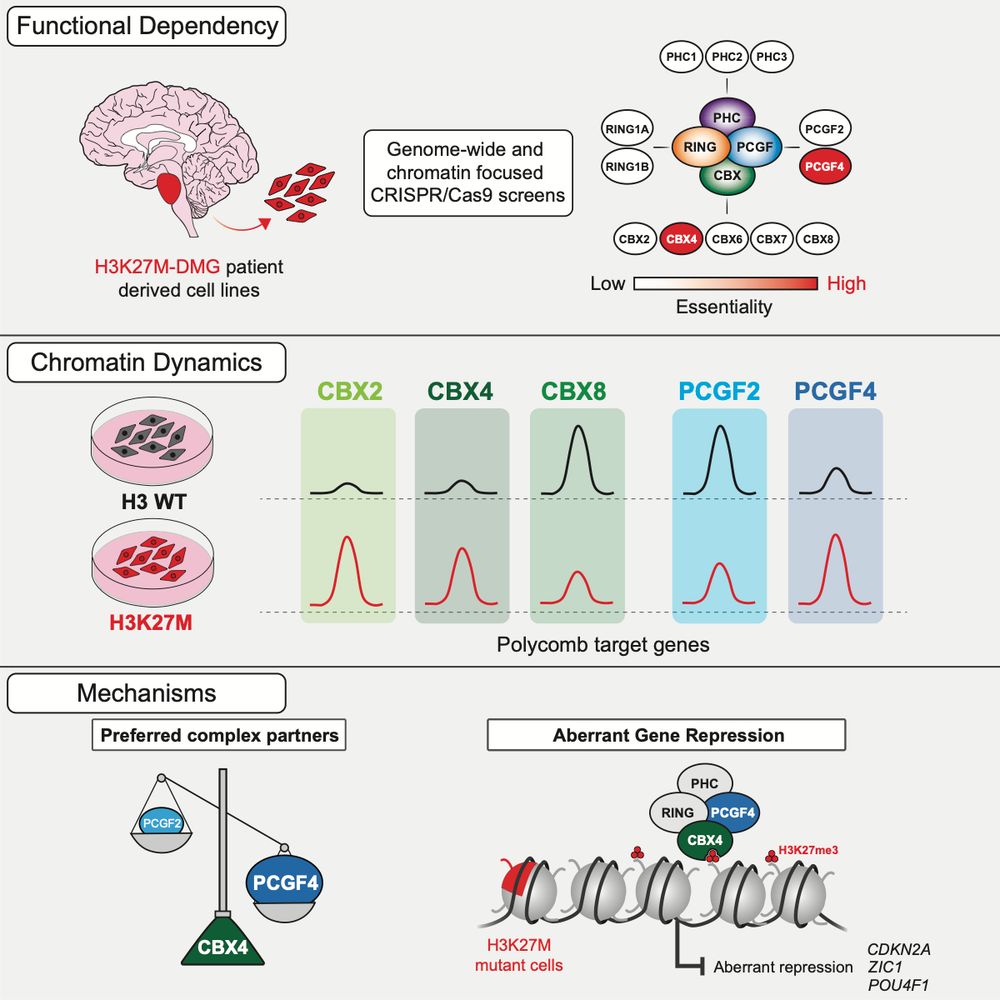
Excited to share our new paper out today in @cp-molcell.bsky.social! We show that the H3K27M oncohistone rewires cPRC1, creating a unique dependency on CBX4/PCGF4-containing complexes, and also reveal a previously unknown function of CBX4. Highlights below (1/11).
May 21, 2025 at 4:13 PM
Excited to share our new paper out today in @cp-molcell.bsky.social! We show that the H3K27M oncohistone rewires cPRC1, creating a unique dependency on CBX4/PCGF4-containing complexes, and also reveal a previously unknown function of CBX4. Highlights below (1/11).
Reposted by Gerry Brien

Online Now: A specific form of cPRC1 containing CBX4 is co-opted to mediate oncogenic gene repression in diffuse midline glioma Online now:
A specific form of cPRC1 containing CBX4 is co-opted to mediate oncogenic gene repression in diffuse midline glioma
Lagan, Gannon, et al. reveal that H3K27M-DMGs depend on a specific form of cPRC1 containing CBX4 and PCGF4. H3K27M alters H3K27me3 distribution, causing increased binding of CBX4-PCGF4-cPRC1 and oncogenic gene repression. CBX4’s ability to read H3K27me3 and to form a specific cPRC1 complex with PCGF4 makes it essential in DMG.
dlvr.it
May 21, 2025 at 3:19 PM
Online Now: A specific form of cPRC1 containing CBX4 is co-opted to mediate oncogenic gene repression in diffuse midline glioma Online now: