


Elizabeth Pyman
@elizabethpyman.bsky.social
Biomedical Research PhD Student, BHF funded
Imperial College London, NHLI
I'm researching epicardial adipose tissue and its link to arrhythmia
Imperial College London, NHLI
I'm researching epicardial adipose tissue and its link to arrhythmia
Showcasing the work of the computational side of our research group

Can AI be used to predict risks to heart health? 🤖🫀
That’s what researchers at Imperial's British Heart Foundation Centre of Research Excellence are hoping to find out.
We spoke to Dr Arun Sau and Professor Fu Siong Ng to find out more: www.youtube.com/watch?v=0nQm...
That’s what researchers at Imperial's British Heart Foundation Centre of Research Excellence are hoping to find out.
We spoke to Dr Arun Sau and Professor Fu Siong Ng to find out more: www.youtube.com/watch?v=0nQm...

AI-ECGS: Imperial BHF Centre of Research Excellence
YouTube video by Imperial NHLI
www.youtube.com
December 3, 2025 at 2:03 PM
Showcasing the work of the computational side of our research group
Reposted by Elizabeth Pyman

"Healthy obese" in UK biobank. 266 genetic variants linked to body fat distribution & metabolic health.
8 genetic subtypes of obesity; some linked to *better* lipid, blood pressure, and glucose profiles. Great read by Nathalie Chami et al. in @natmed.nature.com: doi.org/10.1038/s415... 🧪
8 genetic subtypes of obesity; some linked to *better* lipid, blood pressure, and glucose profiles. Great read by Nathalie Chami et al. in @natmed.nature.com: doi.org/10.1038/s415... 🧪

Genetic subtyping of obesity reveals biological insights into the uncoupling of adiposity from its cardiometabolic comorbidities
Nature Medicine - Genotype-phenotype data from over 450,000 individuals was analyzed to discover 205 genomic loci where an allele associated with increase adiposity was associated with a lower...
doi.org
October 17, 2025 at 12:24 PM
"Healthy obese" in UK biobank. 266 genetic variants linked to body fat distribution & metabolic health.
8 genetic subtypes of obesity; some linked to *better* lipid, blood pressure, and glucose profiles. Great read by Nathalie Chami et al. in @natmed.nature.com: doi.org/10.1038/s415... 🧪
8 genetic subtypes of obesity; some linked to *better* lipid, blood pressure, and glucose profiles. Great read by Nathalie Chami et al. in @natmed.nature.com: doi.org/10.1038/s415... 🧪
Obesity and metabolic status aren't linear scales, but a 3D landscape. This review puts it nicely.
#adipose #metabolism #medsky
pubmed.ncbi.nlm.nih.gov/40949938/
#adipose #metabolism #medsky
pubmed.ncbi.nlm.nih.gov/40949938/

Is metabolically healthy obesity shaped by inflammation, gender differences, and fat distribution? - PubMed
The obesity epidemic continues to challenge global cardiovascular (CV) health, but not all obesity is equal. Emerging evidence underscores that distinct obesity phenotypes-particularly metabolically h...
pubmed.ncbi.nlm.nih.gov
September 30, 2025 at 6:56 PM
Obesity and metabolic status aren't linear scales, but a 3D landscape. This review puts it nicely.
#adipose #metabolism #medsky
pubmed.ncbi.nlm.nih.gov/40949938/
#adipose #metabolism #medsky
pubmed.ncbi.nlm.nih.gov/40949938/
Reposted by Elizabeth Pyman
#Throwback 🧪
REVIEW | Towards a consensus atlas of human and mouse adipose tissue at single-cell resolution
@anneloftsdu.bsky.social , M Emont, E Rosen et al.
REVIEW | Towards a consensus atlas of human and mouse adipose tissue at single-cell resolution
@anneloftsdu.bsky.social , M Emont, E Rosen et al.

Towards a consensus atlas of human and mouse adipose tissue at single-cell resolution - Nature Metabolism
In this Review, the authors present a roadmap towards achieving consensus on development, analysis and interpretation of single-cell transcriptomics data in adipose tissue, including discussion of roadblocks, best practices and ideal cell-type markers for annotation of adipose tissue cell types in mice and humans.
bit.ly
September 4, 2025 at 8:01 PM
#Throwback 🧪
REVIEW | Towards a consensus atlas of human and mouse adipose tissue at single-cell resolution
@anneloftsdu.bsky.social , M Emont, E Rosen et al.
REVIEW | Towards a consensus atlas of human and mouse adipose tissue at single-cell resolution
@anneloftsdu.bsky.social , M Emont, E Rosen et al.
Reposted by Elizabeth Pyman

🏅 Professor Anthony Davis has received the 2025 Royal Medal for Applied Sciences. His work on glucose-binding molecules led to GluHUT, a synthetic receptor that could transform diabetes management. The research also led to spinouts Ziylo, Carbometrics, and Science Creates. Learn more brnw.ch/21wVeQK
August 27, 2025 at 1:41 PM
🏅 Professor Anthony Davis has received the 2025 Royal Medal for Applied Sciences. His work on glucose-binding molecules led to GluHUT, a synthetic receptor that could transform diabetes management. The research also led to spinouts Ziylo, Carbometrics, and Science Creates. Learn more brnw.ch/21wVeQK
My first Huxley! Thanks @everymanslibrary.bsky.social

August 18, 2025 at 9:12 AM
My first Huxley! Thanks @everymanslibrary.bsky.social
Reposted by Elizabeth Pyman

🌍 Our new powerhouses of innovation will focus on:
Health and Technology
Sustainability
Space, Security and Telecoms
Human and Artificial Intelligence
This is not just collaboration. It’s Convergence Science.
Read more ➡️ www.imperial.ac.uk/news/265373/...
Health and Technology
Sustainability
Space, Security and Telecoms
Human and Artificial Intelligence
This is not just collaboration. It’s Convergence Science.
Read more ➡️ www.imperial.ac.uk/news/265373/...

Imperial launches Schools of Convergence Science to drive scientific discovery | Imperial News | Imperial College London
The new Schools of Convergence Science will help Imperial supercharge scientific discovery and drive economic growth.
www.imperial.ac.uk
June 24, 2025 at 9:07 AM
🌍 Our new powerhouses of innovation will focus on:
Health and Technology
Sustainability
Space, Security and Telecoms
Human and Artificial Intelligence
This is not just collaboration. It’s Convergence Science.
Read more ➡️ www.imperial.ac.uk/news/265373/...
Health and Technology
Sustainability
Space, Security and Telecoms
Human and Artificial Intelligence
This is not just collaboration. It’s Convergence Science.
Read more ➡️ www.imperial.ac.uk/news/265373/...
Reposted by Elizabeth Pyman
🧬🖥️ Meta-scRNAseq maps lipid-associated macrophages (LAMs) in mouse & human. 14 core genes (Trem2, Lpl, Gpnmb…) + tissue-specific tweaks. Insights point to LAM-targeted therapies for atherosclerosis, obesity & MASLD by Jesse W. Williams et al. in @commsbio.nature.com
www.nature.com/artic... 🧪
www.nature.com/artic... 🧪

Identification of conserved and tissue-restricted transcriptional profiles for lipid associated macrophages
Communications Biology - Transcriptional analysis of lipid associated macrophages across chronic inflammatory diseases and tissues reveals shared and tissue-restricted gene expression programs.
www.nature.com
June 24, 2025 at 9:58 AM
🧬🖥️ Meta-scRNAseq maps lipid-associated macrophages (LAMs) in mouse & human. 14 core genes (Trem2, Lpl, Gpnmb…) + tissue-specific tweaks. Insights point to LAM-targeted therapies for atherosclerosis, obesity & MASLD by Jesse W. Williams et al. in @commsbio.nature.com
www.nature.com/artic... 🧪
www.nature.com/artic... 🧪
Reposted by Elizabeth Pyman

Role of Macrophage PARP1 in the Regulation of Crosstalk between Adipose Immune Cells and Adipocytes during Diet-induced Obesity https://www.biorxiv.org/content/10.1101/2025.06.20.660762v1
June 23, 2025 at 3:18 AM
Role of Macrophage PARP1 in the Regulation of Crosstalk between Adipose Immune Cells and Adipocytes during Diet-induced Obesity https://www.biorxiv.org/content/10.1101/2025.06.20.660762v1
Reposted by Elizabeth Pyman
🩳 Cold reshapes brown fat. We uncover a ChREBP-dependent lipogenic adipocyte subtype that vanishes in the cold; but BAT adapts. A Wnt–ChREBP axis emerges as key to lipogenic adipocyte identity.
🧪 Read the full preprint here: doi.org/10.1101/2025... 🔓
🏁
7/7
🧪 Read the full preprint here: doi.org/10.1101/2025... 🔓
🏁
7/7

Single-nucleus mRNA-sequencing reveals dynamics of lipogenic and thermogenic adipocyte populations in murine brown adipose tissue in response to cold exposure
Brown adipose tissue (BAT) comprises a heterogeneous population of adipocytes and non-adipocyte cell types. To characterize these cellular subpopulations and their adaptation to cold, we performed single-nucleus mRNA-sequencing (snRNA-seq) on interscapular BAT from mice maintained at room temperature or exposed to acute (24h) or chronic (10 days) cold (6 degree Celsius). To investigate the role of the de novo lipogenesis (DNL)-regulating transcription factor carbohydrate response element-binding protein (ChREBP), we analyzed control and brown adipocyte-specific ChREBP knockout mice. We identified different cell populations, including seven brown adipocyte subtypes with distinct metabolic profiles. One of them highly expressed ChREBP and DNL enzymes. Notably, these lipogenic adipocytes were highly sensitive to acute cold exposure, showing a marked depletion in BAT of control mice that was compensated by other brown adipocyte subtypes maintaining DNL. Chronic cold exposure resulted in an expansion of basal brown adipocytes and adipocytes putatively derived from stromal and endothelial precursors. In ChREBP-deficient mice, lipogenic adipocytes were almost absent under all conditions, identifying the transcription factor as a key determinant of this adipocyte subtype. Pathway and cell-cell interaction analyses implicated a Wnt-ChREBP axis in the maintenance of lipogenic adipocytes, with Wnt ligands from stromal and muscle cells providing instructive cues. Our findings provide a comprehensive atlas of BAT cellular heterogeneity and reveal a critical role for ChREBP in lipogenic adipocyte identity, with implications for BAT plasticity and metabolic function.
### Competing Interest Statement
The authors have declared no competing interest.
doi.org
April 7, 2025 at 9:23 AM
🩳 Cold reshapes brown fat. We uncover a ChREBP-dependent lipogenic adipocyte subtype that vanishes in the cold; but BAT adapts. A Wnt–ChREBP axis emerges as key to lipogenic adipocyte identity.
🧪 Read the full preprint here: doi.org/10.1101/2025... 🔓
🏁
7/7
🧪 Read the full preprint here: doi.org/10.1101/2025... 🔓
🏁
7/7
Reposted by Elizabeth Pyman
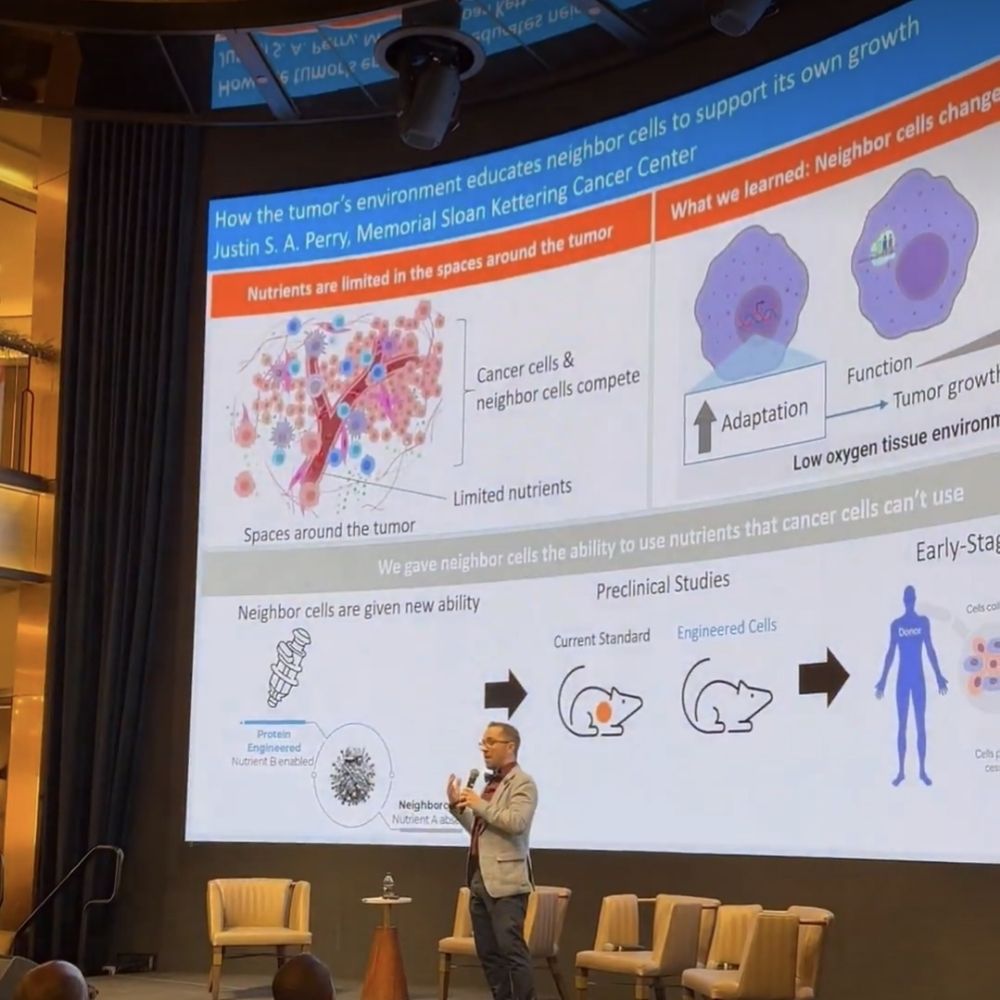
New from @masslab.bsky.social @unibonn.bsky.social @immunosens.bsky.social out @natureportfolio.nature.com also shows maternal diet affects offspring macrophage function & disease susceptibility.
Mass Lab study: www.nature.com/articles/s41...
Our study: rdcu.be/eqx2G
Mass Lab study: www.nature.com/articles/s41...
Our study: rdcu.be/eqx2G
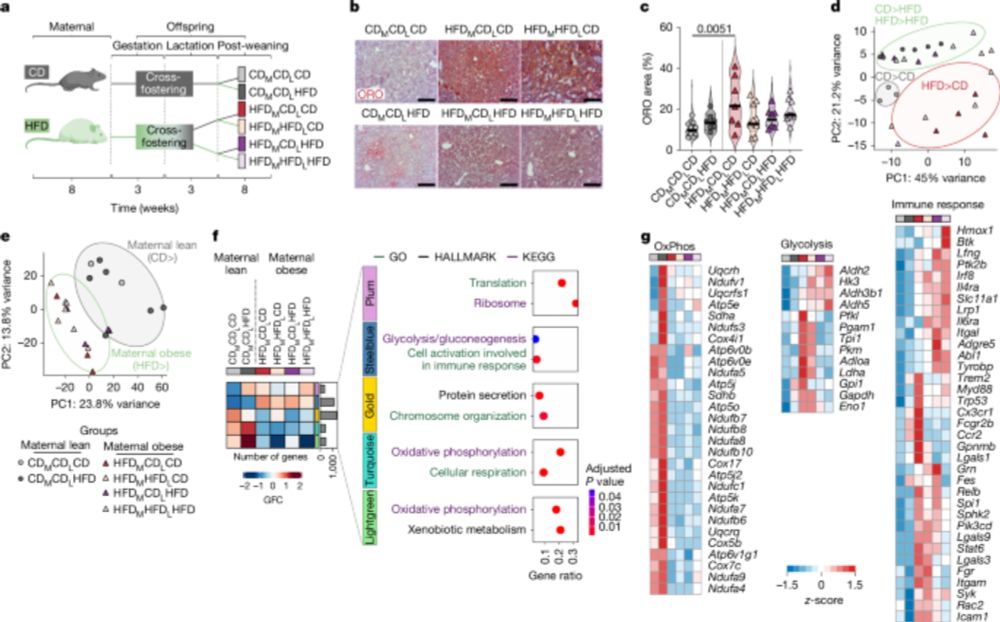
Kupffer cell programming by maternal obesity triggers fatty liver disease - Nature
In a mouse model, maternal obesity during pregnancy can lead to fatty liver disease in the offspring, driven by aberrant developmental programming of Kuppfer cells.
www.nature.com
June 18, 2025 at 5:57 PM
New from @masslab.bsky.social @unibonn.bsky.social @immunosens.bsky.social out @natureportfolio.nature.com also shows maternal diet affects offspring macrophage function & disease susceptibility.
Mass Lab study: www.nature.com/articles/s41...
Our study: rdcu.be/eqx2G
Mass Lab study: www.nature.com/articles/s41...
Our study: rdcu.be/eqx2G
Reposted by Elizabeth Pyman
One of the issues with scientific peer review is that scientists are people. And people can be dicks.
www.nature.com/articles/d41...
I will never forget the review I got on a paper, I showed it to my aunt, and she cried because it was so personal and mean.
It was accept with minor revisions.
www.nature.com/articles/d41...
I will never forget the review I got on a paper, I showed it to my aunt, and she cried because it was so personal and mean.
It was accept with minor revisions.
‘Substandard and unworthy’: why it’s time to banish bad-mannered reviews
The publisher of Physics World and other journals is marking Peer Review Week 2024 by calling for more courtesy in the process.
www.nature.com
October 1, 2024 at 1:27 PM
One of the issues with scientific peer review is that scientists are people. And people can be dicks.
www.nature.com/articles/d41...
I will never forget the review I got on a paper, I showed it to my aunt, and she cried because it was so personal and mean.
It was accept with minor revisions.
www.nature.com/articles/d41...
I will never forget the review I got on a paper, I showed it to my aunt, and she cried because it was so personal and mean.
It was accept with minor revisions.