




David Richter
@davidrichter.bsky.social
Cognitive Neuroscientist | Predictive Processing & Perception Researcher.
At: CIMCYC, Granada. Formerly: VU Amsterdam & Donders Institute.
https://www.richter-neuroscience.com/
At: CIMCYC, Granada. Formerly: VU Amsterdam & Donders Institute.
https://www.richter-neuroscience.com/
Pinned

Rapid computation of high-level visual surprise
Health sciences
www.cell.com
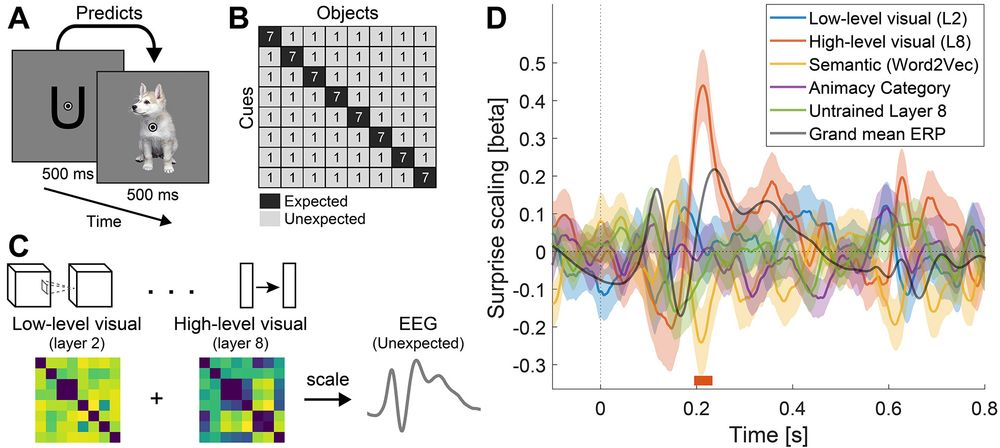
High-level visual surprise is rapidly integrated during perceptual inference!
🚨 New paper 🚨 out now in @cp-iscience.bsky.social with @paulapena.bsky.social and @mruz.bsky.social
www.cell.com/iscience/ful...
Summary 🧵 below 👇
🚨 New paper 🚨 out now in @cp-iscience.bsky.social with @paulapena.bsky.social and @mruz.bsky.social
www.cell.com/iscience/ful...
Summary 🧵 below 👇
🧠 Feature-specific predictive processing: What’s in a prediction error? 🧠
Perspective article w/ Cem Uran, @martinavinck.bsky.social & @predictivebrain.bsky.social now in @imagingneurosci.bsky.social, highlighting recent work on the nature of surprise reflected in visual prediction errors.
🧵👇
Perspective article w/ Cem Uran, @martinavinck.bsky.social & @predictivebrain.bsky.social now in @imagingneurosci.bsky.social, highlighting recent work on the nature of surprise reflected in visual prediction errors.
🧵👇

January 8, 2026 at 5:12 PM
🧠 Feature-specific predictive processing: What’s in a prediction error? 🧠
Perspective article w/ Cem Uran, @martinavinck.bsky.social & @predictivebrain.bsky.social now in @imagingneurosci.bsky.social, highlighting recent work on the nature of surprise reflected in visual prediction errors.
🧵👇
Perspective article w/ Cem Uran, @martinavinck.bsky.social & @predictivebrain.bsky.social now in @imagingneurosci.bsky.social, highlighting recent work on the nature of surprise reflected in visual prediction errors.
🧵👇
High-level visual surprise is rapidly integrated during perceptual inference!
🚨 New paper 🚨 out now in @cp-iscience.bsky.social with @paulapena.bsky.social and @mruz.bsky.social
www.cell.com/iscience/ful...
Summary 🧵 below 👇
🚨 New paper 🚨 out now in @cp-iscience.bsky.social with @paulapena.bsky.social and @mruz.bsky.social
www.cell.com/iscience/ful...
Summary 🧵 below 👇
Rapid computation of high-level visual surprise
Health sciences
www.cell.com
December 5, 2025 at 2:37 PM
High-level visual surprise is rapidly integrated during perceptual inference!
🚨 New paper 🚨 out now in @cp-iscience.bsky.social with @paulapena.bsky.social and @mruz.bsky.social
www.cell.com/iscience/ful...
Summary 🧵 below 👇
🚨 New paper 🚨 out now in @cp-iscience.bsky.social with @paulapena.bsky.social and @mruz.bsky.social
www.cell.com/iscience/ful...
Summary 🧵 below 👇
Reposted by David Richter

🧠 Regularization, Action, and Attractors in the Dynamical “Bayesian” Brain
direct.mit.edu/jocn/article...
(still uncorrected proofs, but they should post the corrected one soon--also OA is forthcoming, for now PDF at brainandexperience.org/pdf/10.1162-...)
direct.mit.edu/jocn/article...
(still uncorrected proofs, but they should post the corrected one soon--also OA is forthcoming, for now PDF at brainandexperience.org/pdf/10.1162-...)

Regularization, Action, and Attractors in the Dynamical “Bayesian” Brain
Abstract. The idea that the brain is a probabilistic (Bayesian) inference machine, continuously trying to figure out the hidden causes of its inputs, has become very influential in cognitive (neuro)sc...
direct.mit.edu
October 22, 2025 at 8:59 AM
🧠 Regularization, Action, and Attractors in the Dynamical “Bayesian” Brain
direct.mit.edu/jocn/article...
(still uncorrected proofs, but they should post the corrected one soon--also OA is forthcoming, for now PDF at brainandexperience.org/pdf/10.1162-...)
direct.mit.edu/jocn/article...
(still uncorrected proofs, but they should post the corrected one soon--also OA is forthcoming, for now PDF at brainandexperience.org/pdf/10.1162-...)
Reposted by David Richter

@dotproduct.bsky.social's first first author paper is finally out in @sfnjournals.bsky.social! Her findings show that content-specific predictions fluctuate with alpha frequencies, suggesting a more specific role for alpha oscillations than we may have thought. With @jhaarsma.bsky.social. 🧠🟦 🧠🤖

Contents of visual predictions oscillate at alpha frequencies
Predictions of future events have a major impact on how we process sensory signals. However, it remains unclear how the brain keeps predictions online in anticipation of future inputs. Here, we combin...
www.jneurosci.org
October 21, 2025 at 11:05 AM
@dotproduct.bsky.social's first first author paper is finally out in @sfnjournals.bsky.social! Her findings show that content-specific predictions fluctuate with alpha frequencies, suggesting a more specific role for alpha oscillations than we may have thought. With @jhaarsma.bsky.social. 🧠🟦 🧠🤖
If you’re into predictive processing and curious about the ‘what & when of visual surprise’, come see me at #CCN2025 in Amsterdam!
Poster B23 · Wednesday at 1:00 pm · de Brug.
Poster B23 · Wednesday at 1:00 pm · de Brug.
August 11, 2025 at 3:46 PM
If you’re into predictive processing and curious about the ‘what & when of visual surprise’, come see me at #CCN2025 in Amsterdam!
Poster B23 · Wednesday at 1:00 pm · de Brug.
Poster B23 · Wednesday at 1:00 pm · de Brug.
Reposted by David Richter

Hi, we will have three NeuroAI postdoc openings (3 years each, fully funded) to work with Sebastian Musslick (@musslick.bsky.social), Pascal Nieters and myself on task-switching, replay, and visual information routing.
Reach out if you are interested in any of the above, I'll be at CCN next week!
Reach out if you are interested in any of the above, I'll be at CCN next week!
August 9, 2025 at 8:13 AM
Hi, we will have three NeuroAI postdoc openings (3 years each, fully funded) to work with Sebastian Musslick (@musslick.bsky.social), Pascal Nieters and myself on task-switching, replay, and visual information routing.
Reach out if you are interested in any of the above, I'll be at CCN next week!
Reach out if you are interested in any of the above, I'll be at CCN next week!
Reposted by David Richter
We are recruiting a new PI at the FIL @imagingneuroucl.bsky.social, Associate or Full Professor. This is an amazing place to do cognitive neuroscience, in the heart of London. If you or someone you know might be interested, please pass it on. #neuroskyence
www.ucl.ac.uk/work-at-ucl/...
www.ucl.ac.uk/work-at-ucl/...

UCL – University College London
UCL is consistently ranked as one of the top ten universities in the world (QS World University Rankings 2010-2022) and is No.2 in the UK for research power (Research Excellence Framework 2021).
www.ucl.ac.uk
August 8, 2025 at 10:52 AM
We are recruiting a new PI at the FIL @imagingneuroucl.bsky.social, Associate or Full Professor. This is an amazing place to do cognitive neuroscience, in the heart of London. If you or someone you know might be interested, please pass it on. #neuroskyence
www.ucl.ac.uk/work-at-ucl/...
www.ucl.ac.uk/work-at-ucl/...
Reposted by David Richter

If you are interested in pursuing a PhD in cognitive neuroscience, specially targeting conscious vs. unconscious processing, contact me. We are recruiting 🙏🧠 please RT
July 21, 2025 at 11:50 AM
If you are interested in pursuing a PhD in cognitive neuroscience, specially targeting conscious vs. unconscious processing, contact me. We are recruiting 🙏🧠 please RT
Reposted by David Richter
🚨 We’re hiring a postdoc!
Join the FLARE project @cimcyc.bsky.social to study sudden perceptual learning using fMRI, RSA, and DNNs.
🧠 2 years, fully funded, flexible start
More info 👉 gonzalezgarcia.github.io/postdoc/
DMs or emails welcome! Please share!
Join the FLARE project @cimcyc.bsky.social to study sudden perceptual learning using fMRI, RSA, and DNNs.
🧠 2 years, fully funded, flexible start
More info 👉 gonzalezgarcia.github.io/postdoc/
DMs or emails welcome! Please share!
Postdoc Position – FLARE Project
gonzalezgarcia.github.io
July 18, 2025 at 11:17 AM
🚨 We’re hiring a postdoc!
Join the FLARE project @cimcyc.bsky.social to study sudden perceptual learning using fMRI, RSA, and DNNs.
🧠 2 years, fully funded, flexible start
More info 👉 gonzalezgarcia.github.io/postdoc/
DMs or emails welcome! Please share!
Join the FLARE project @cimcyc.bsky.social to study sudden perceptual learning using fMRI, RSA, and DNNs.
🧠 2 years, fully funded, flexible start
More info 👉 gonzalezgarcia.github.io/postdoc/
DMs or emails welcome! Please share!
Reposted by David Richter
Exciting new preprint from the lab: “Adopting a human developmental visual diet yields robust, shape-based AI vision”. A most wonderful case where brain inspiration massively improved AI solutions.
Work with @zejinlu.bsky.social @sushrutthorat.bsky.social and Radek Cichy
arxiv.org/abs/2507.03168
Work with @zejinlu.bsky.social @sushrutthorat.bsky.social and Radek Cichy
arxiv.org/abs/2507.03168
arxiv.org
July 8, 2025 at 1:04 PM
Exciting new preprint from the lab: “Adopting a human developmental visual diet yields robust, shape-based AI vision”. A most wonderful case where brain inspiration massively improved AI solutions.
Work with @zejinlu.bsky.social @sushrutthorat.bsky.social and Radek Cichy
arxiv.org/abs/2507.03168
Work with @zejinlu.bsky.social @sushrutthorat.bsky.social and Radek Cichy
arxiv.org/abs/2507.03168
The what and when of visual surprise:
EEG shows that high-level visual surprise emerges rapidly and modulates neural responses ~200ms after stimulus onset.
New preprint with @paulapena.bsky.social and @mruz.bsky.social available here: doi.org/10.1101/2025...
Summary 🧵 below
EEG shows that high-level visual surprise emerges rapidly and modulates neural responses ~200ms after stimulus onset.
New preprint with @paulapena.bsky.social and @mruz.bsky.social available here: doi.org/10.1101/2025...
Summary 🧵 below
June 26, 2025 at 10:22 AM
The what and when of visual surprise:
EEG shows that high-level visual surprise emerges rapidly and modulates neural responses ~200ms after stimulus onset.
New preprint with @paulapena.bsky.social and @mruz.bsky.social available here: doi.org/10.1101/2025...
Summary 🧵 below
EEG shows that high-level visual surprise emerges rapidly and modulates neural responses ~200ms after stimulus onset.
New preprint with @paulapena.bsky.social and @mruz.bsky.social available here: doi.org/10.1101/2025...
Summary 🧵 below
Reposted by David Richter
Out now @cp-trendscognsci.bsky.social, w/ @akalt.bsky.social & @drmattdavis.bsky.social.
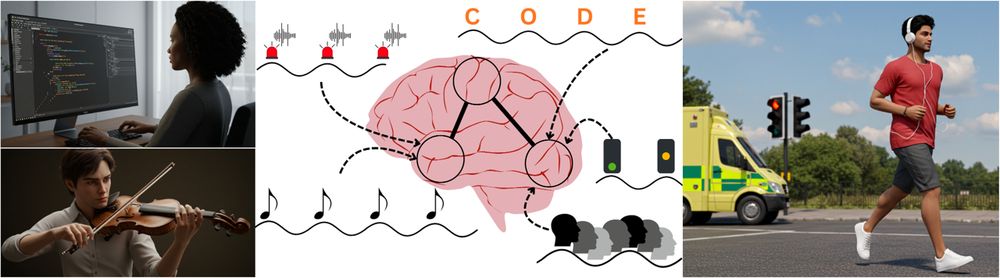
Are sensory sampling rhythms fixed by intrinsically-determined processes, or do they couple to external structure? Here we highlight the incompatibility between these accounts and propose a resolution [1/6]
Are sensory sampling rhythms fixed by intrinsically-determined processes, or do they couple to external structure? Here we highlight the incompatibility between these accounts and propose a resolution [1/6]
June 19, 2025 at 11:18 AM
Out now @cp-trendscognsci.bsky.social, w/ @akalt.bsky.social & @drmattdavis.bsky.social.
Are sensory sampling rhythms fixed by intrinsically-determined processes, or do they couple to external structure? Here we highlight the incompatibility between these accounts and propose a resolution [1/6]
Are sensory sampling rhythms fixed by intrinsically-determined processes, or do they couple to external structure? Here we highlight the incompatibility between these accounts and propose a resolution [1/6]
Reposted by David Richter
New MEG paper by @jhaarsma.bsky.social and @dotproduct.bsky.social! Same design and behavioural results as our 7T layer fMRI study (www.jneurosci.org/content/43/4...), but now shedding light on the temporal dynamics of the sensory signals underlying false percepts. #neuroskyence

Shared and diverging neural dynamics underlying false and veridical perception
We often mistake visual noise for meaningful images, which sometimes appear as convincing as veridical percepts. This suggests considerable overlap between the mechanisms that underlie false and verid...
www.jneurosci.org
June 10, 2025 at 9:27 AM
New MEG paper by @jhaarsma.bsky.social and @dotproduct.bsky.social! Same design and behavioural results as our 7T layer fMRI study (www.jneurosci.org/content/43/4...), but now shedding light on the temporal dynamics of the sensory signals underlying false percepts. #neuroskyence
Reposted by David Richter

Looking for a PhD in #psychology or #cogneuro ? I’m recruiting a fully-funded @leverhulme.ac.uk PhD student to join my lab at @birkbeckpsychology.bsky.social. If you’re interested in metacognition, learning, social cognition and culture I’d love you to apply 🧠👇
www.jobs.ac.uk/job/DNJ330/p...
www.jobs.ac.uk/job/DNJ330/p...

PhD Studentship: Public Communication and Private Confidence at Birkbeck, University of London
Find a PhD Studentship: Public Communication and Private Confidence on jobs.ac.uk, the top job board in higher education. Click to view more!
www.jobs.ac.uk
June 6, 2025 at 12:07 PM
Looking for a PhD in #psychology or #cogneuro ? I’m recruiting a fully-funded @leverhulme.ac.uk PhD student to join my lab at @birkbeckpsychology.bsky.social. If you’re interested in metacognition, learning, social cognition and culture I’d love you to apply 🧠👇
www.jobs.ac.uk/job/DNJ330/p...
www.jobs.ac.uk/job/DNJ330/p...
Reposted by David Richter
I am so excited to share that our paper 'A neural basis for distinguishing imagination from reality' is now published in @cp-neuron.bsky.social! 🧠✨ See thread below! doi.org/10.1016/j.ne...
June 5, 2025 at 3:05 PM
I am so excited to share that our paper 'A neural basis for distinguishing imagination from reality' is now published in @cp-neuron.bsky.social! 🧠✨ See thread below! doi.org/10.1016/j.ne...
Reposted by David Richter
Introducing All-TNNs: Topographic deep neural networks that exhibit ventral-stream-like feature tuning and a better match to human behaviour than the gold standard. Now out in Nature Human Behaviour. 👇

Now out in Nature Human Behaviour @nathumbehav.nature.com : “End-to-end topographic networks as models of cortical map formation and human visual behaviour”. Please check our NHB link: www.nature.com/articles/s41...
June 6, 2025 at 11:00 AM
Introducing All-TNNs: Topographic deep neural networks that exhibit ventral-stream-like feature tuning and a better match to human behaviour than the gold standard. Now out in Nature Human Behaviour. 👇
Reposted by David Richter

PhD position alert!!!
Together with @predictivebrain.bsky.social and Sonja Kotz we are looking for a PhD candidate to join a great project on the biological foundations of perceptual decisions vacancies.maastrichtuniversity.nl/job/Maastric...
Happy to answer any question you may have!
Together with @predictivebrain.bsky.social and Sonja Kotz we are looking for a PhD candidate to join a great project on the biological foundations of perceptual decisions vacancies.maastrichtuniversity.nl/job/Maastric...
Happy to answer any question you may have!
PhD position in biological foundations of neural control
PhD position in biological foundations of neural control
vacancies.maastrichtuniversity.nl
June 3, 2025 at 4:54 AM
PhD position alert!!!
Together with @predictivebrain.bsky.social and Sonja Kotz we are looking for a PhD candidate to join a great project on the biological foundations of perceptual decisions vacancies.maastrichtuniversity.nl/job/Maastric...
Happy to answer any question you may have!
Together with @predictivebrain.bsky.social and Sonja Kotz we are looking for a PhD candidate to join a great project on the biological foundations of perceptual decisions vacancies.maastrichtuniversity.nl/job/Maastric...
Happy to answer any question you may have!
Reposted by David Richter
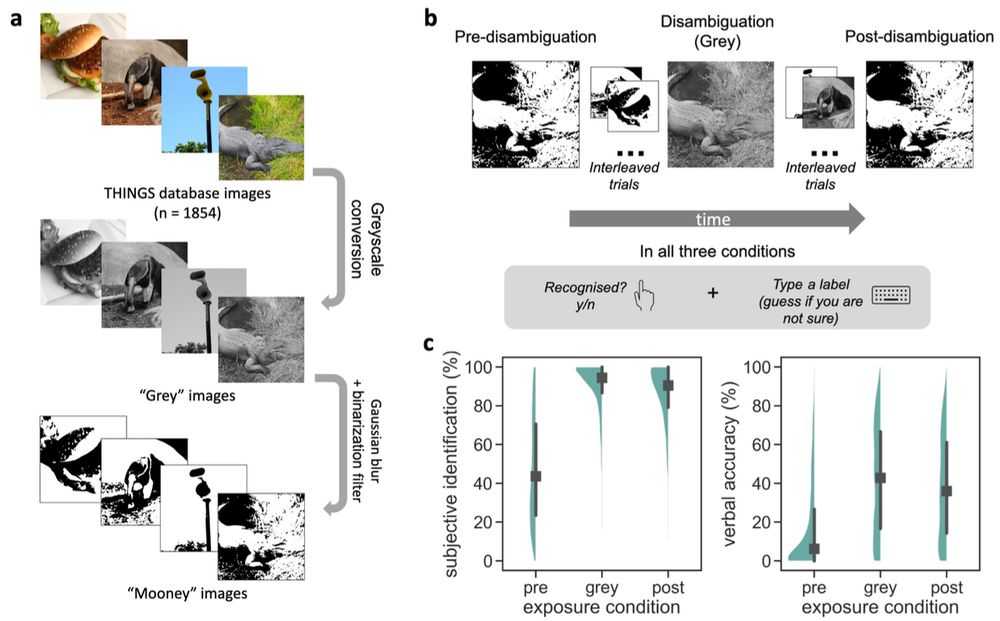
New preprint! 🚨→ Determinants of Visual Ambiguity Resolution. A new work with @ortiztudela.bsky.social @jvoeller.bsky.social @martinhebart.bsky.social and @gonzalezgarcia.bsky.social
We created ~2k images and collected ~100k responses to study visual ambiguity.
www.biorxiv.org/content/10.1...
We created ~2k images and collected ~100k responses to study visual ambiguity.
www.biorxiv.org/content/10.1...
May 29, 2025 at 12:46 PM
New preprint! 🚨→ Determinants of Visual Ambiguity Resolution. A new work with @ortiztudela.bsky.social @jvoeller.bsky.social @martinhebart.bsky.social and @gonzalezgarcia.bsky.social
We created ~2k images and collected ~100k responses to study visual ambiguity.
www.biorxiv.org/content/10.1...
We created ~2k images and collected ~100k responses to study visual ambiguity.
www.biorxiv.org/content/10.1...
Reposted by David Richter

New paper from the lab!!
We add to the (lack of) evidence for expectation effects in carefully-controlled predictive cueing designs.
doi.org/10.1111/psyp...
Led by Carla den Ouden and Máire Kashyap, collaborating with Morgan Kikkawa
We add to the (lack of) evidence for expectation effects in carefully-controlled predictive cueing designs.
doi.org/10.1111/psyp...
Led by Carla den Ouden and Máire Kashyap, collaborating with Morgan Kikkawa

<em>Psychophysiology</em> | SPR Journal | Wiley Online Library
Stimulus expectations are widely assumed to modulate the responsiveness of neurons in the visual system. However, there is currently a lack of clear evidence from electrophysiological studies to supp....
doi.org
May 27, 2025 at 3:46 AM
New paper from the lab!!
We add to the (lack of) evidence for expectation effects in carefully-controlled predictive cueing designs.
doi.org/10.1111/psyp...
Led by Carla den Ouden and Máire Kashyap, collaborating with Morgan Kikkawa
We add to the (lack of) evidence for expectation effects in carefully-controlled predictive cueing designs.
doi.org/10.1111/psyp...
Led by Carla den Ouden and Máire Kashyap, collaborating with Morgan Kikkawa
Reposted by David Richter

my lab (lacns.github.io) at @mpi-nl.bsky.social and @dondersinst.bsky.social is recruiting for two PhD and two postdoctoral positions funded by an @erc.europa.eu Consolidator - come join us!
PhD: www.mpi.nl/career-educa...
Postdoc: www.mpi.nl/career-educa...
(please share widely)
PhD: www.mpi.nl/career-educa...
Postdoc: www.mpi.nl/career-educa...
(please share widely)
Language and Computation in Neural Systems
We are an international group of scientists consisting of linguists, cognitive scientists, cognitive neuroscientists, computational neuroscientists, computational modellers, computational scientists, ...
lacns.github.io
May 20, 2025 at 1:49 PM
my lab (lacns.github.io) at @mpi-nl.bsky.social and @dondersinst.bsky.social is recruiting for two PhD and two postdoctoral positions funded by an @erc.europa.eu Consolidator - come join us!
PhD: www.mpi.nl/career-educa...
Postdoc: www.mpi.nl/career-educa...
(please share widely)
PhD: www.mpi.nl/career-educa...
Postdoc: www.mpi.nl/career-educa...
(please share widely)
Reposted by David Richter

New preprint, w/ @predictivebrain.bsky.social !
we've found that visual cortex, even when just viewing natural scenes, predicts *higher-level* visual features
The aligns with developments in ML, but challenges some assumptions about early sensory cortex
www.biorxiv.org/content/10.1...
we've found that visual cortex, even when just viewing natural scenes, predicts *higher-level* visual features
The aligns with developments in ML, but challenges some assumptions about early sensory cortex
www.biorxiv.org/content/10.1...

Higher-level spatial prediction in natural vision across mouse visual cortex
Theories of predictive processing propose that sensory systems constantly predict incoming signals, based on spatial and temporal context. However, evidence for prediction in sensory cortex largely co...
www.biorxiv.org
May 23, 2025 at 11:39 AM
New preprint, w/ @predictivebrain.bsky.social !
we've found that visual cortex, even when just viewing natural scenes, predicts *higher-level* visual features
The aligns with developments in ML, but challenges some assumptions about early sensory cortex
www.biorxiv.org/content/10.1...
we've found that visual cortex, even when just viewing natural scenes, predicts *higher-level* visual features
The aligns with developments in ML, but challenges some assumptions about early sensory cortex
www.biorxiv.org/content/10.1...
Reposted by David Richter
Our study using layer fMRI to study the direction of communication between the hippocampus and cortex during perceptual predictions is finally out in Science Advances! Predicted-but-omitted shapes are represented in CA2/3 and correlate specifically with deep layers of PHC, suggesting feedback. 🧠🟦
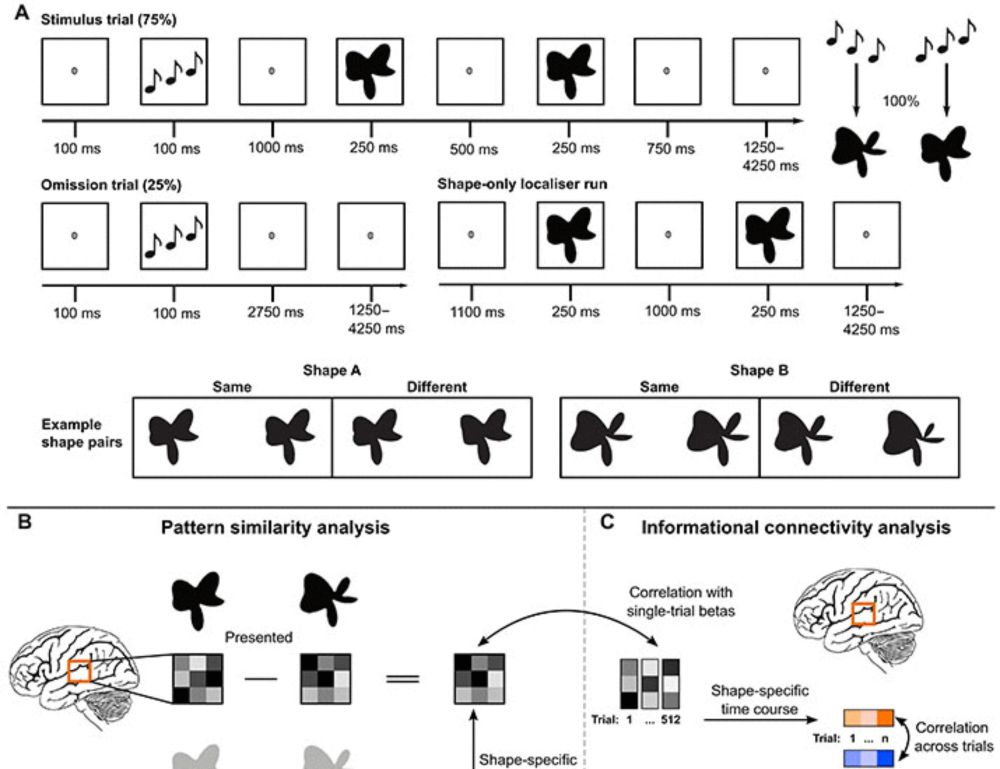
Communication of perceptual predictions from the hippocampus to the deep layers of the parahippocampal cortex
High-resolution neuroimaging reveals stimulus-specific predictions sent from hippocampus to the neocortex during perception.
www.science.org
May 22, 2025 at 1:55 AM
Our study using layer fMRI to study the direction of communication between the hippocampus and cortex during perceptual predictions is finally out in Science Advances! Predicted-but-omitted shapes are represented in CA2/3 and correlate specifically with deep layers of PHC, suggesting feedback. 🧠🟦
Reposted by David Richter

Our @nature.com paper is out! Bringing together 2 major theories of consciousness - Integrated Information Theory (IIT) and Global Neuronal Workspace Theory (GNWT) - in an unprecedented collaboration. Here’s the story of how we advanced theory testing in neuroscience
www.nature.com/articles/s41...
www.nature.com/articles/s41...
April 30, 2025 at 3:34 PM
Our @nature.com paper is out! Bringing together 2 major theories of consciousness - Integrated Information Theory (IIT) and Global Neuronal Workspace Theory (GNWT) - in an unprecedented collaboration. Here’s the story of how we advanced theory testing in neuroscience
www.nature.com/articles/s41...
www.nature.com/articles/s41...
Proactive distractor suppression in early visual cortex!
In collaboration with Dirk van Moorselaar and @jthee.bsky.social we investigated how the brain suppresses distracting stimuli before they appear.
Paper here: doi.org/10.7554/eLif...
Summary 🧵 below
In collaboration with Dirk van Moorselaar and @jthee.bsky.social we investigated how the brain suppresses distracting stimuli before they appear.
Paper here: doi.org/10.7554/eLif...
Summary 🧵 below
March 21, 2025 at 3:01 PM
Proactive distractor suppression in early visual cortex!
In collaboration with Dirk van Moorselaar and @jthee.bsky.social we investigated how the brain suppresses distracting stimuli before they appear.
Paper here: doi.org/10.7554/eLif...
Summary 🧵 below
In collaboration with Dirk van Moorselaar and @jthee.bsky.social we investigated how the brain suppresses distracting stimuli before they appear.
Paper here: doi.org/10.7554/eLif...
Summary 🧵 below
Prediction errors are a cornerstone of predictive processing, but what exactly does the brain predict? Recent studies suggest that even early visual areas may encode high-level visual surprise, raising questions about both the mechanisms and the content of prediction errors...
March 13, 2025 at 12:01 PM
Prediction errors are a cornerstone of predictive processing, but what exactly does the brain predict? Recent studies suggest that even early visual areas may encode high-level visual surprise, raising questions about both the mechanisms and the content of prediction errors...