



Irina Barnaveli
@barnaveliirina.bsky.social
PhD Student in Cognitive Neuroscience @doellerlab.bsky.social
Pinned
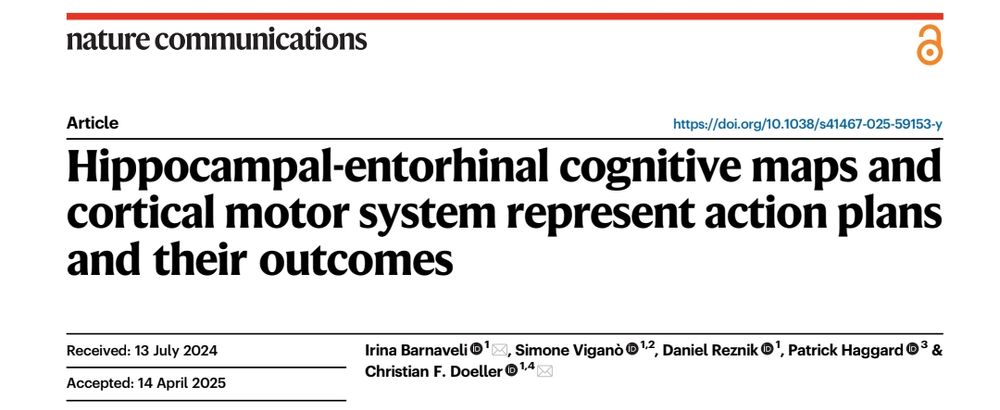
Our paper in @natcomms.nature.com, we show how cognitive maps in the hippocampal system could solve the general problem of representing and relating multiple alternative action plans.
doi.org/10.1038/s414...
With @doellerlab.bsky.social, Patrick Haggard, @vigano.bsky.social, Daniel Reznik
doi.org/10.1038/s414...
With @doellerlab.bsky.social, Patrick Haggard, @vigano.bsky.social, Daniel Reznik
Reposted by Irina Barnaveli
New preprint! Have you ever wondered, what are these fuzzy simplicial sets, the theoretical framework behind e.g. UMAP? Here we show that you may simply see them as marginal distributions over simplicial sets. This provides a generative model for UMAP. (1/2)
arxiv.org/abs/2512.03899
arxiv.org/abs/2512.03899

Probabilistic Foundations of Fuzzy Simplicial Sets for Nonlinear Dimensionality Reduction
Fuzzy simplicial sets have become an object of interest in dimensionality reduction and manifold learning, most prominently through their role in UMAP. However, their definition through tools from alg...
arxiv.org
December 4, 2025 at 12:31 PM
New preprint! Have you ever wondered, what are these fuzzy simplicial sets, the theoretical framework behind e.g. UMAP? Here we show that you may simply see them as marginal distributions over simplicial sets. This provides a generative model for UMAP. (1/2)
arxiv.org/abs/2512.03899
arxiv.org/abs/2512.03899
Reposted by Irina Barnaveli
Our new paper, now published in @natcomms.nature.com , asks a simple question: when two tasks share a common structure, does the brain learn them more efficiently? Surprisingly, this was not the case. Thread below (1/7)
rdcu.be/eSwvU
rdcu.be/eSwvU

The effects of task similarity during representation learning in brains and neural networks
Nature Communications - Here, the authors show learning tasks with similar structures can initially cause interference and slow down learning, but both the brain and artificial networks gradually...
rdcu.be
December 2, 2025 at 9:42 AM
Our new paper, now published in @natcomms.nature.com , asks a simple question: when two tasks share a common structure, does the brain learn them more efficiently? Surprisingly, this was not the case. Thread below (1/7)
rdcu.be/eSwvU
rdcu.be/eSwvU
Reposted by Irina Barnaveli

New preprint from the lab and great work by Fei Wang. We show how subiculum trace vector cells can be modeled consistent with known effects in CA1. Traces are driven by a mismatch learning rule to keep associative memories in line with experience.
www.biorxiv.org/content/10.1...
www.biorxiv.org/content/10.1...

Dynamic updating of cognitive maps via traces of experience in the subiculum
In the classical view of hippocampal function, the subiculum is assigned the role as the output layer. In spatial paradigms, some subiculum neurons manifest as so-called boundary vector cells (BVCs), ...
www.biorxiv.org
October 3, 2025 at 7:01 AM
New preprint from the lab and great work by Fei Wang. We show how subiculum trace vector cells can be modeled consistent with known effects in CA1. Traces are driven by a mismatch learning rule to keep associative memories in line with experience.
www.biorxiv.org/content/10.1...
www.biorxiv.org/content/10.1...
Reposted by Irina Barnaveli
🚨 New preprint! Impact of Task Similarity and Training Regimes on Cognitive Transfer and Interference 🧠
We compare humans and neural networks in a learning task, showing how training regime and task similarity interact to drive transfer or interference.
www.biorxiv.org/content/10.1...
We compare humans and neural networks in a learning task, showing how training regime and task similarity interact to drive transfer or interference.
www.biorxiv.org/content/10.1...

Impact of Task Similarity and Training Regimes on Cognitive Transfer and Interference
Learning depends not only on the content of what we learn, but also on how we learn and on how experiences are structured over time. To investigate how task similarity and training regime interact dur...
www.biorxiv.org
September 23, 2025 at 11:58 AM
🚨 New preprint! Impact of Task Similarity and Training Regimes on Cognitive Transfer and Interference 🧠
We compare humans and neural networks in a learning task, showing how training regime and task similarity interact to drive transfer or interference.
www.biorxiv.org/content/10.1...
We compare humans and neural networks in a learning task, showing how training regime and task similarity interact to drive transfer or interference.
www.biorxiv.org/content/10.1...
Reposted by Irina Barnaveli

Huge congratulations 🥳 to
@sofievalk.bsky.social
&
@reznikdan.bsky.social
for receiving ERC Starting Grants 2025! We're proud of you!
Learn more about their projects: www.cbs.mpg.de/2397348/2025...
@sofievalk.bsky.social
&
@reznikdan.bsky.social
for receiving ERC Starting Grants 2025! We're proud of you!
Learn more about their projects: www.cbs.mpg.de/2397348/2025...

Sofie Valk and Daniel Reznik receive ERC Starting Grants
Sofie Valk and Daniel Reznik receive ERC Starting Grants
www.cbs.mpg.de
September 5, 2025 at 2:55 PM
Huge congratulations 🥳 to
@sofievalk.bsky.social
&
@reznikdan.bsky.social
for receiving ERC Starting Grants 2025! We're proud of you!
Learn more about their projects: www.cbs.mpg.de/2397348/2025...
@sofievalk.bsky.social
&
@reznikdan.bsky.social
for receiving ERC Starting Grants 2025! We're proud of you!
Learn more about their projects: www.cbs.mpg.de/2397348/2025...
Reposted by Irina Barnaveli
New theory: Categorization is Baked Into the Brain
Categorization is not a late stage of sensory processing but a core computation that begins at the earliest stages, occurring throughout the cortex as predictive feedback shapes feedforward processing.
doi.org/10.31234/osf...
#neuroscience
Categorization is not a late stage of sensory processing but a core computation that begins at the earliest stages, occurring throughout the cortex as predictive feedback shapes feedforward processing.
doi.org/10.31234/osf...
#neuroscience
OSF
doi.org
August 15, 2025 at 11:40 AM
New theory: Categorization is Baked Into the Brain
Categorization is not a late stage of sensory processing but a core computation that begins at the earliest stages, occurring throughout the cortex as predictive feedback shapes feedforward processing.
doi.org/10.31234/osf...
#neuroscience
Categorization is not a late stage of sensory processing but a core computation that begins at the earliest stages, occurring throughout the cortex as predictive feedback shapes feedforward processing.
doi.org/10.31234/osf...
#neuroscience
Reposted by Irina Barnaveli

🚨Preprint Alert: Who Does What in Deep Learning? Multidimensional Contribution of Neural Units using Game Theory: arxiv.org/abs/2506.19732
The result of my MSc thesis is out with @kayson.bsky.social @fatemehhadaeghi.bsky.social @patrickmineault.bsky.social @kordinglab.bsky.social, Claus C. Hilgetag
The result of my MSc thesis is out with @kayson.bsky.social @fatemehhadaeghi.bsky.social @patrickmineault.bsky.social @kordinglab.bsky.social, Claus C. Hilgetag

Who Does What in Deep Learning? Multidimensional Game-Theoretic Attribution of Function of Neural Units
Neural networks now generate text, images, and speech with billions of parameters, producing a need to know how each neural unit contributes to these high-dimensional outputs. Existing explainable-AI ...
arxiv.org
June 25, 2025 at 9:18 AM
🚨Preprint Alert: Who Does What in Deep Learning? Multidimensional Contribution of Neural Units using Game Theory: arxiv.org/abs/2506.19732
The result of my MSc thesis is out with @kayson.bsky.social @fatemehhadaeghi.bsky.social @patrickmineault.bsky.social @kordinglab.bsky.social, Claus C. Hilgetag
The result of my MSc thesis is out with @kayson.bsky.social @fatemehhadaeghi.bsky.social @patrickmineault.bsky.social @kordinglab.bsky.social, Claus C. Hilgetag
Reposted by Irina Barnaveli
Excited to share that our work on the interplay of symmetric learning rules and successor representations (SR) is published in @plos.org (comp.bio)
Work done together with @doellerlab.bsky.social, @caswell.bsky.social and Juergen Jost.
doi.org/10.1371/jour...
#neuroskyence #compneurosky
1/n
Work done together with @doellerlab.bsky.social, @caswell.bsky.social and Juergen Jost.
doi.org/10.1371/jour...
#neuroskyence #compneurosky
1/n

Impact of symmetry in local learning rules on predictive neural representations and generalization in spatial navigation
Author summary The hippocampus is a brain region which plays a crucial role in spatial navigation for both animals and humans. Contemporarily, it’s thought to store predictive representations of the e...
doi.org
June 25, 2025 at 1:19 PM
Excited to share that our work on the interplay of symmetric learning rules and successor representations (SR) is published in @plos.org (comp.bio)
Work done together with @doellerlab.bsky.social, @caswell.bsky.social and Juergen Jost.
doi.org/10.1371/jour...
#neuroskyence #compneurosky
1/n
Work done together with @doellerlab.bsky.social, @caswell.bsky.social and Juergen Jost.
doi.org/10.1371/jour...
#neuroskyence #compneurosky
1/n
Reposted by Irina Barnaveli

📣 Very excited for our symposium on “Building Knowledge Structures” tomorrow at 16:30 at @pug2025.bsky.social
Together with amazing people:
@barnaveliirina.bsky.social
@lukaskunz.bsky.social @mirkothm.bsky.social
and Andrea Greve
Together with amazing people:
@barnaveliirina.bsky.social
@lukaskunz.bsky.social @mirkothm.bsky.social
and Andrea Greve
June 19, 2025 at 1:42 PM
📣 Very excited for our symposium on “Building Knowledge Structures” tomorrow at 16:30 at @pug2025.bsky.social
Together with amazing people:
@barnaveliirina.bsky.social
@lukaskunz.bsky.social @mirkothm.bsky.social
and Andrea Greve
Together with amazing people:
@barnaveliirina.bsky.social
@lukaskunz.bsky.social @mirkothm.bsky.social
and Andrea Greve
Reposted by Irina Barnaveli
New preprint! We explored how learned movement patterns affect our sense of traveled distance and proposed a neurocomputational model that leverages embodied memories to denoise spatial codes.
🔗 www.biorxiv.org/cgi/content/...
🔗 www.biorxiv.org/cgi/content/...

Re-enacting steps supports human path integration consistent with motor-corrected grid cell drift
Efficient navigation, especially in the absence of vision, requires path integration - the continuous updating of spatial position from self-motion cues. However, path integration is prone to cumulati...
www.biorxiv.org
May 22, 2025 at 8:47 AM
New preprint! We explored how learned movement patterns affect our sense of traveled distance and proposed a neurocomputational model that leverages embodied memories to denoise spatial codes.
🔗 www.biorxiv.org/cgi/content/...
🔗 www.biorxiv.org/cgi/content/...
Reposted by Irina Barnaveli
🧠 Can a short period of awake, quiet rest help you generalize better? In our new study, we tested this with a learning paradigm comparing offline vs online wake period.
www.sciencedirect.com/science/arti...
www.sciencedirect.com/science/arti...
Delayed emergence of EEG-based task-relevant representations
This paper examines the effect of a period of quiet wakefulness (an “offline wake” state) on the performance of a decision making task. An initial fee…
www.sciencedirect.com
May 8, 2025 at 9:10 AM
🧠 Can a short period of awake, quiet rest help you generalize better? In our new study, we tested this with a learning paradigm comparing offline vs online wake period.
www.sciencedirect.com/science/arti...
www.sciencedirect.com/science/arti...
Our paper in @natcomms.nature.com, we show how cognitive maps in the hippocampal system could solve the general problem of representing and relating multiple alternative action plans.
doi.org/10.1038/s414...
With @doellerlab.bsky.social, Patrick Haggard, @vigano.bsky.social, Daniel Reznik
doi.org/10.1038/s414...
With @doellerlab.bsky.social, Patrick Haggard, @vigano.bsky.social, Daniel Reznik
May 8, 2025 at 7:24 PM
Our paper in @natcomms.nature.com, we show how cognitive maps in the hippocampal system could solve the general problem of representing and relating multiple alternative action plans.
doi.org/10.1038/s414...
With @doellerlab.bsky.social, Patrick Haggard, @vigano.bsky.social, Daniel Reznik
doi.org/10.1038/s414...
With @doellerlab.bsky.social, Patrick Haggard, @vigano.bsky.social, Daniel Reznik