



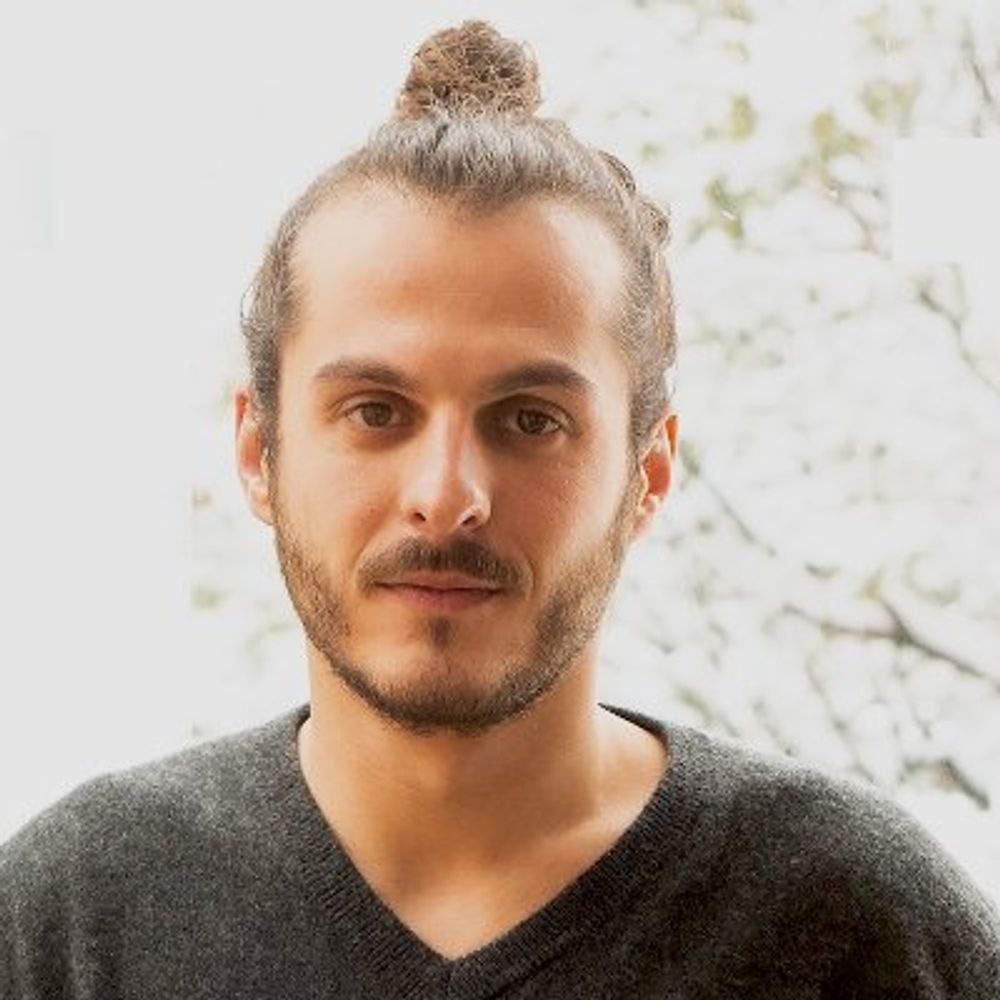
Artemy Kolchinsky
@artemyte.bsky.social
Researcher studying nonequilibrium thermodynamics, information theory, origin of life, complexity. Currently at Universitat Pompeu Fabra in Barcelona, Spain
Reposted by Artemy Kolchinsky
If you work on the origins of life / prebiotic chemistry, consider joining OoLEN 🧬🌍
We’re an early-career community for connecting across disciplines, sharing opportunities, and building momentum together.
Join: oolen.org/join
(And feel free to reply with what you work on!)
#OriginOfLife
We’re an early-career community for connecting across disciplines, sharing opportunities, and building momentum together.
Join: oolen.org/join
(And feel free to reply with what you work on!)
#OriginOfLife
January 12, 2026 at 8:00 AM
If you work on the origins of life / prebiotic chemistry, consider joining OoLEN 🧬🌍
We’re an early-career community for connecting across disciplines, sharing opportunities, and building momentum together.
Join: oolen.org/join
(And feel free to reply with what you work on!)
#OriginOfLife
We’re an early-career community for connecting across disciplines, sharing opportunities, and building momentum together.
Join: oolen.org/join
(And feel free to reply with what you work on!)
#OriginOfLife
Reposted by Artemy Kolchinsky

Interested in the intersection of nonequilibrium thermodynamics and biophysics? Think Canada might be a nice place for your PhD/postdoc? Talk to me! Brand-new funding opportunity has quick deadline (so likely undersubscribed). nserc-crsng.canada.ca/en/news/laun...
SFU internal deadline Feb 11
SFU internal deadline Feb 11

Launch of new Canada Impact+ Research Training Awards
As announced in Budget 2025 -
nserc-crsng.canada.ca
January 6, 2026 at 2:04 PM
Interested in the intersection of nonequilibrium thermodynamics and biophysics? Think Canada might be a nice place for your PhD/postdoc? Talk to me! Brand-new funding opportunity has quick deadline (so likely undersubscribed). nserc-crsng.canada.ca/en/news/laun...
SFU internal deadline Feb 11
SFU internal deadline Feb 11
Reposted by Artemy Kolchinsky
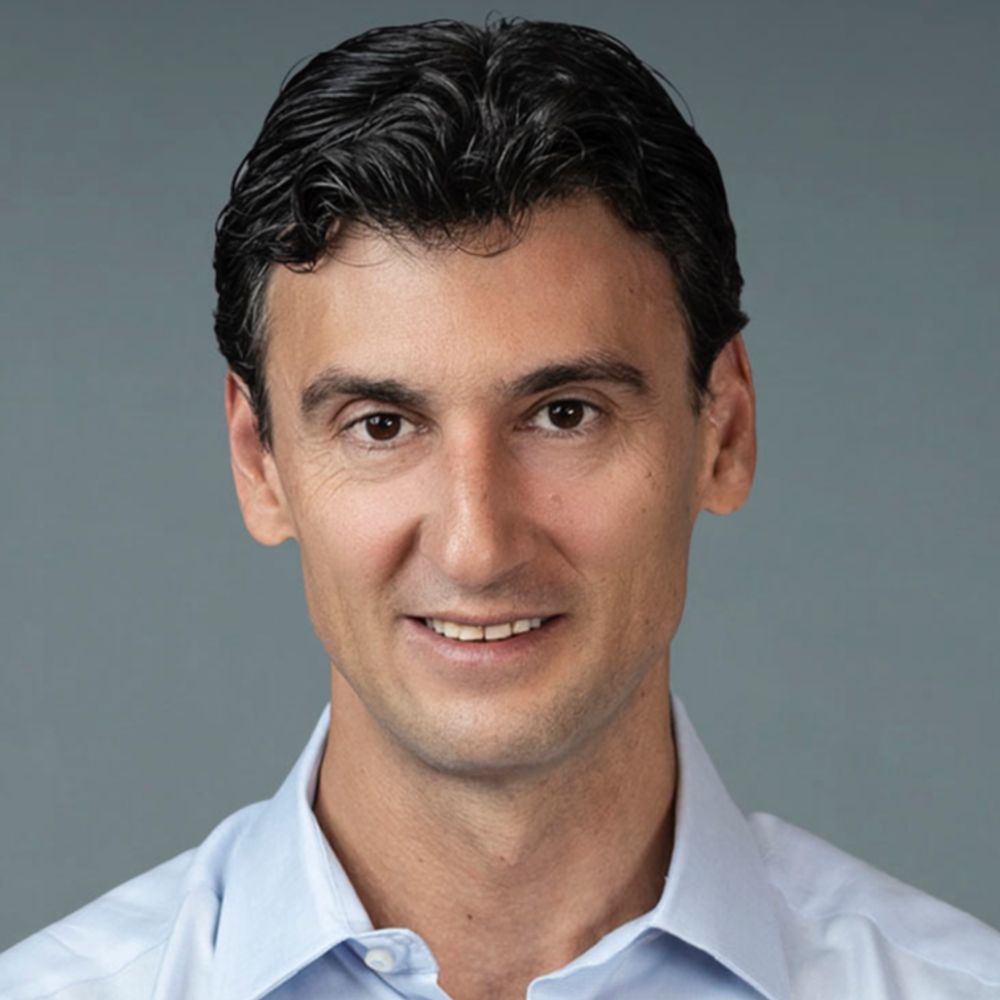
"Choosing problems is the primary determinant of what one accomplishes in science."
'Now What?' by Nobel Laureate John Hopfield should be required reading for aspiring scientists.
pni.princeton.edu/document/1136
'Now What?' by Nobel Laureate John Hopfield should be required reading for aspiring scientists.
pni.princeton.edu/document/1136

January 5, 2026 at 3:09 PM
"Choosing problems is the primary determinant of what one accomplishes in science."
'Now What?' by Nobel Laureate John Hopfield should be required reading for aspiring scientists.
pni.princeton.edu/document/1136
'Now What?' by Nobel Laureate John Hopfield should be required reading for aspiring scientists.
pni.princeton.edu/document/1136
New paper in PRL on the relationship between thermodynamic driving and eigenvalues in Markovian master equations. We prove a weaker version of a beautiful conjecture proposed by Uhl and Seifert. Led by Guo-Hua Xu, with Jean-Charles Delvenne and Sosuke Ito
journals.aps.org/prl/abstract...
journals.aps.org/prl/abstract...

Thermodynamic Geometric Constraint on the Spectrum of Markov Rate Matrices
A thermodynamic constraint is placed on the spectrum of Markov rate matrices, allowing for a better understanding of the dynamics of biochemical clocks.
journals.aps.org
December 20, 2025 at 2:08 AM
New paper in PRL on the relationship between thermodynamic driving and eigenvalues in Markovian master equations. We prove a weaker version of a beautiful conjecture proposed by Uhl and Seifert. Led by Guo-Hua Xu, with Jean-Charles Delvenne and Sosuke Ito
journals.aps.org/prl/abstract...
journals.aps.org/prl/abstract...
Reposted by Artemy Kolchinsky

Cooperation is a universal feature of complex systems, from the origins of life and microbiomes to societies. What universal patterns can be found in these systems? Here's our new @pnas.org paper. @jordipinero.bsky.social @artemyte.bsky.social @sfiscience.bsky.social www.pnas.org/doi/epdf/10....

December 19, 2025 at 6:44 PM
Cooperation is a universal feature of complex systems, from the origins of life and microbiomes to societies. What universal patterns can be found in these systems? Here's our new @pnas.org paper. @jordipinero.bsky.social @artemyte.bsky.social @sfiscience.bsky.social www.pnas.org/doi/epdf/10....
Reposted by Artemy Kolchinsky
The characterization of life as a thermodynamic phenomenon out of equilibrium is usually attributed to Schrödinger.
What if I told you that he wasn't the first (not even the second😶🌫️) to reach that famous and influential conclusion?/1
#complexitycat🐈⬛
amahury.github.io/posts/reinve...
What if I told you that he wasn't the first (not even the second😶🌫️) to reach that famous and influential conclusion?/1
#complexitycat🐈⬛
amahury.github.io/posts/reinve...
When Schrödinger Reinvented the Wheel
Erwin Schrödinger’s “What is Life?” is perhaps one of the most influential works in theoretical biology, but what if I told you that one of the key ideas discussed in it was nothing new?
amahury.github.io
October 17, 2025 at 1:35 PM
The characterization of life as a thermodynamic phenomenon out of equilibrium is usually attributed to Schrödinger.
What if I told you that he wasn't the first (not even the second😶🌫️) to reach that famous and influential conclusion?/1
#complexitycat🐈⬛
amahury.github.io/posts/reinve...
What if I told you that he wasn't the first (not even the second😶🌫️) to reach that famous and influential conclusion?/1
#complexitycat🐈⬛
amahury.github.io/posts/reinve...
After a long time in the making, my paper on nonequilibrium thermodynamics of Darwinian evolution has been published in Philosophical Transactions B. Updated version: arxiv.org/abs/2112.02809


October 7, 2025 at 9:33 AM
After a long time in the making, my paper on nonequilibrium thermodynamics of Darwinian evolution has been published in Philosophical Transactions B. Updated version: arxiv.org/abs/2112.02809
Reposted by Artemy Kolchinsky
How dit life originate in our planet? How can we create it in the lab?Our @royalsocietypublishing.org Theme Issue "Origins of Life: the possible and the actual", coedited with @sfiscience.bsky.social C Kempes and Susan Stepney is out! royalsocietypublishing.org/toc/rstb/202... @manlius.bsky.social

Philosophical Transactions of the Royal Society B: Biological Sciences: Vol 380, No 1936
royalsocietypublishing.org
October 2, 2025 at 9:04 AM
How dit life originate in our planet? How can we create it in the lab?Our @royalsocietypublishing.org Theme Issue "Origins of Life: the possible and the actual", coedited with @sfiscience.bsky.social C Kempes and Susan Stepney is out! royalsocietypublishing.org/toc/rstb/202... @manlius.bsky.social
Possible biosignatures detected on Mars
www.nature.com/articles/d41...
www.nature.com/articles/d41...
September 15, 2025 at 9:19 PM
Possible biosignatures detected on Mars
www.nature.com/articles/d41...
www.nature.com/articles/d41...
Reading this beautiful review of the "cutoff timescale" in Markov chains, the timescale over which a system relaxes from nonequilibrium to equilibrium behavior arxiv.org/abs/2508.21055

Modern aspects of Markov chains: entropy, curvature and the cutoff phenomenon
The cutoff phenomenon is an abrupt transition from out of equilibrium to equilibrium undergone by certain Markov processes in the limit where the size of the state space tends to infinity: instead of ...
arxiv.org
September 15, 2025 at 8:54 PM
Reading this beautiful review of the "cutoff timescale" in Markov chains, the timescale over which a system relaxes from nonequilibrium to equilibrium behavior arxiv.org/abs/2508.21055
Reposted by Artemy Kolchinsky

This new center strikes the right tone in approaching the AI alignment problem. alignmentalignment.ai

Center for the Alignment of AI Alignment Centers
We align the aligners
alignmentalignment.ai
September 11, 2025 at 8:47 PM
This new center strikes the right tone in approaching the AI alignment problem. alignmentalignment.ai
Reposted by Artemy Kolchinsky
Can a single cell learn? Even without a brain, some microbes show simple forms of cognition. Can this basal cognition be engineered? Check our new paper with @jordiplam.bsky.social on the minimal synthetic circuits & their cognitive limits. @drmichaellevin.bsky.social www.biorxiv.org/content/10.1...

September 10, 2025 at 11:48 AM
Can a single cell learn? Even without a brain, some microbes show simple forms of cognition. Can this basal cognition be engineered? Check our new paper with @jordiplam.bsky.social on the minimal synthetic circuits & their cognitive limits. @drmichaellevin.bsky.social www.biorxiv.org/content/10.1...
Helping to organize this workshop on quantum and stochastic thermodynamics in Kyoto, Japan, Dec 8-12. Resource theory, optimal transport, and more. Submissions open!
indico.yukawa.kyoto-u.ac.jp/event/68/
indico.yukawa.kyoto-u.ac.jp/event/68/

Kyoto Workshop on Quantum Thermodynamics and Stochastic Thermodynamics 2025
Schedule and VenueDecember 8-12, 2025 Panasonic Auditorium, Yukawa Hall, YITP, Kyoto University, JapanScopeRecent advances in physics have increasingly highlighted the need to understand energy conver...
indico.yukawa.kyoto-u.ac.jp
September 5, 2025 at 12:43 AM
Helping to organize this workshop on quantum and stochastic thermodynamics in Kyoto, Japan, Dec 8-12. Resource theory, optimal transport, and more. Submissions open!
indico.yukawa.kyoto-u.ac.jp/event/68/
indico.yukawa.kyoto-u.ac.jp/event/68/
Reposted by Artemy Kolchinsky
Here is our new paper that we're really excited about. What makes a cell different from a rock? The answer we argue is the USE of information. But information carries meaning and that changes everything if we want to understand the "physics of life".
journals.aps.org/prxlife/abst...
journals.aps.org/prxlife/abst...
Physics of Life: Exploring Information as a Distinctive Feature of Living Systems
Living systems are defined by their active acquisition and use of information. This Roadmap surveys current research on life's information processes and their importance for the search for life beyond...
journals.aps.org
September 4, 2025 at 11:38 AM
Here is our new paper that we're really excited about. What makes a cell different from a rock? The answer we argue is the USE of information. But information carries meaning and that changes everything if we want to understand the "physics of life".
journals.aps.org/prxlife/abst...
journals.aps.org/prxlife/abst...
Reposted by Artemy Kolchinsky
Proud of this preprint with my friends Jonathan Bauermann and @artemyte.bsky.social, about chemical oscillators & phase separation! Main findings:
1. Phase separation controls frequency and amplitude of oscillations
2. If reactions are fast, spirals of droplets emerge!
arxiv.org/abs/2507.16030
1. Phase separation controls frequency and amplitude of oscillations
2. If reactions are fast, spirals of droplets emerge!
arxiv.org/abs/2507.16030
August 1, 2025 at 8:13 AM
Proud of this preprint with my friends Jonathan Bauermann and @artemyte.bsky.social, about chemical oscillators & phase separation! Main findings:
1. Phase separation controls frequency and amplitude of oscillations
2. If reactions are fast, spirals of droplets emerge!
arxiv.org/abs/2507.16030
1. Phase separation controls frequency and amplitude of oscillations
2. If reactions are fast, spirals of droplets emerge!
arxiv.org/abs/2507.16030
Reposted by Artemy Kolchinsky
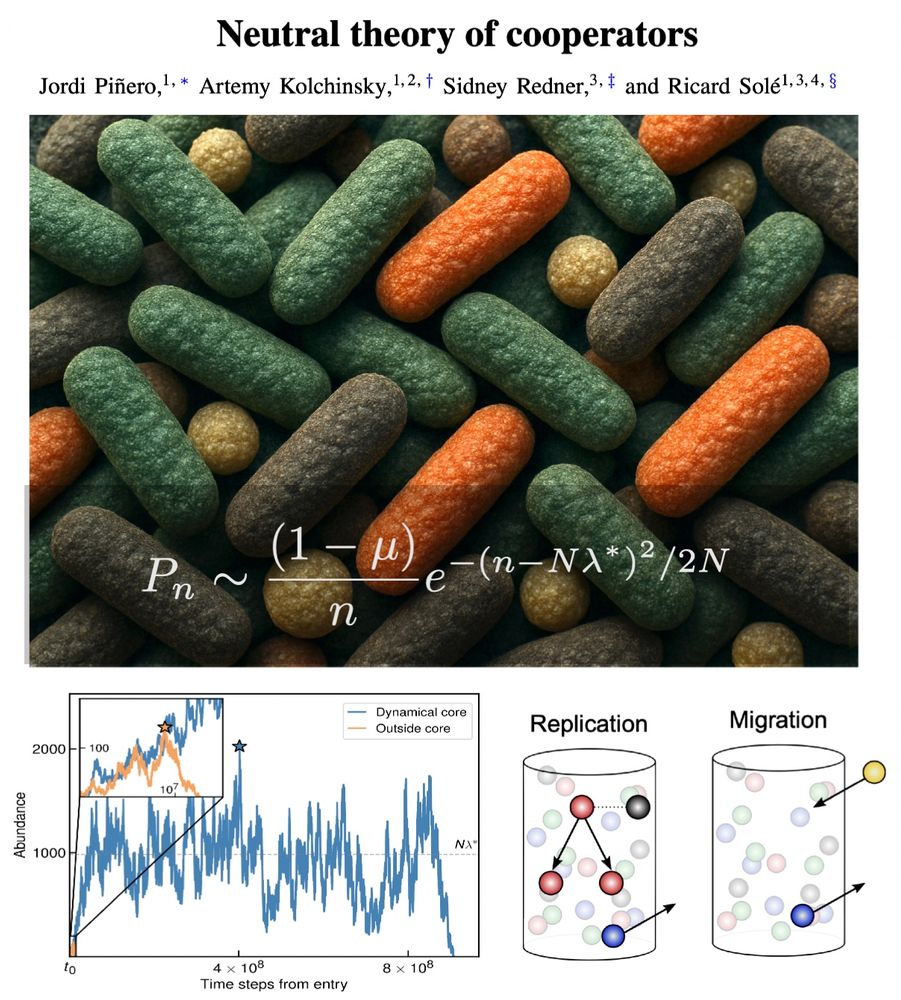
How can we build a general theory of mutualistic communities? After five years, we finally completed a new Neutral Theory of Cooperation that is fully solved analytically and displays remarkable properties @jordipinero.bsky.social @artemyte.bsky.social @manlius.bsky.social arxiv.org/abs/2506.09737
June 12, 2025 at 8:16 PM
How can we build a general theory of mutualistic communities? After five years, we finally completed a new Neutral Theory of Cooperation that is fully solved analytically and displays remarkable properties @jordipinero.bsky.social @artemyte.bsky.social @manlius.bsky.social arxiv.org/abs/2506.09737
We have a new preprint about measuring entropy production in high-dimensional systems, using ideas from information geometry. We successfully infer EP from brain recordings and spin models containing 1000+ degrees of freedom. With
@maguilera.net and Sosuke Ito arxiv.org/abs/2505.10444
@maguilera.net and Sosuke Ito arxiv.org/abs/2505.10444

June 10, 2025 at 2:29 PM
We have a new preprint about measuring entropy production in high-dimensional systems, using ideas from information geometry. We successfully infer EP from brain recordings and spin models containing 1000+ degrees of freedom. With
@maguilera.net and Sosuke Ito arxiv.org/abs/2505.10444
@maguilera.net and Sosuke Ito arxiv.org/abs/2505.10444
Reposted by Artemy Kolchinsky
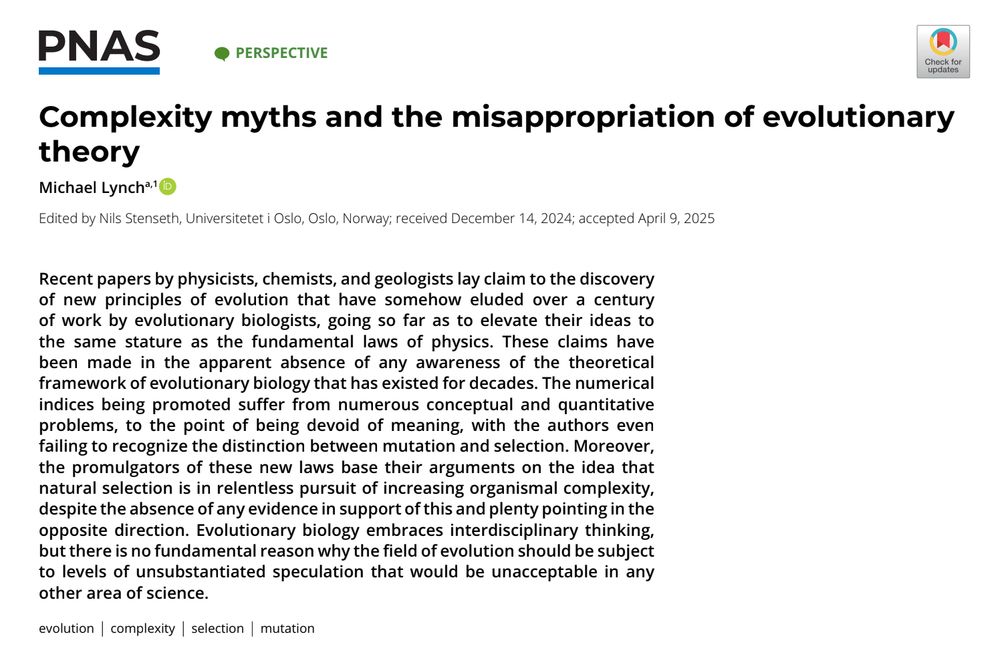
How can physics contribute to understanding the evolution of complexity? Although great results have been produced over the last decades, some recent "theories" appear to ignore key ideas from evolutionary theory and are seriously flawed. Check this paper in PNAS www.pnas.org/doi/abs/10.1...
May 31, 2025 at 3:55 PM
How can physics contribute to understanding the evolution of complexity? Although great results have been produced over the last decades, some recent "theories" appear to ignore key ideas from evolutionary theory and are seriously flawed. Check this paper in PNAS www.pnas.org/doi/abs/10.1...
Reposted by Artemy Kolchinsky
If anyone in the complex systems/computational neuroscience field in Europe is looking to poach an American scientist, I'm interested in what might be out there.
My scholar profile: scholar.google.com/citations?hl...
My scholar profile: scholar.google.com/citations?hl...
February 23, 2025 at 4:48 PM
If anyone in the complex systems/computational neuroscience field in Europe is looking to poach an American scientist, I'm interested in what might be out there.
My scholar profile: scholar.google.com/citations?hl...
My scholar profile: scholar.google.com/citations?hl...
Joint European Thermodynamics Conference, May 26-30, Belgrade, Serbia. Honored to participate in a mini-symposium on stochastic thermo alongside Sarah Loos and Cai Dieball, and other sessions look fascinating. Abstracts due March 15. www.mi.sanu.ac.rs/JETC2025
JETC 2025
www.mi.sanu.ac.rs
February 21, 2025 at 3:45 PM
Joint European Thermodynamics Conference, May 26-30, Belgrade, Serbia. Honored to participate in a mini-symposium on stochastic thermo alongside Sarah Loos and Cai Dieball, and other sessions look fascinating. Abstracts due March 15. www.mi.sanu.ac.rs/JETC2025
TIL that scipost.org publishes several high quality physics journals, all open-access and without any publication fees. Maybe its one way to move beyond the current nightmare of academic publishing....
February 7, 2025 at 4:14 PM
TIL that scipost.org publishes several high quality physics journals, all open-access and without any publication fees. Maybe its one way to move beyond the current nightmare of academic publishing....
Reposted by Artemy Kolchinsky

How do systems—biological or technological—maximize energy harvested from their environments? A new study explores how the initial state of a system impacts free energy gain and extractable work and illustrates the findings through a simple information-engine model. https://doi.org/10.3390/e27

Maximizing Free Energy Gain
Maximizing the amount of work harvested from an environment is important for a wide variety of biological and technological processes, from energy-harvesting processes such as photosynthesis to energy storage systems such as fuels and batteries. Here, we consider the maximization of free energy—and by extension, the maximum extractable work—that can be gained by a classical or quantum system that undergoes driving by its environment. We consider how the free energy gain depends on the initial state of the system while also accounting for the cost of preparing the system. We provide simple necessary and sufficient conditions for increasing the gain of free energy by varying the initial state. We also derive simple formulae that relate the free energy gained using the optimal initial state rather than another suboptimal initial state. Finally, we demonstrate that the problem of finding the optimal initial state may have two distinct regimes, one easy and...
doi.org
January 28, 2025 at 6:28 PM
How do systems—biological or technological—maximize energy harvested from their environments? A new study explores how the initial state of a system impacts free energy gain and extractable work and illustrates the findings through a simple information-engine model. https://doi.org/10.3390/e27
Reposted by Artemy Kolchinsky
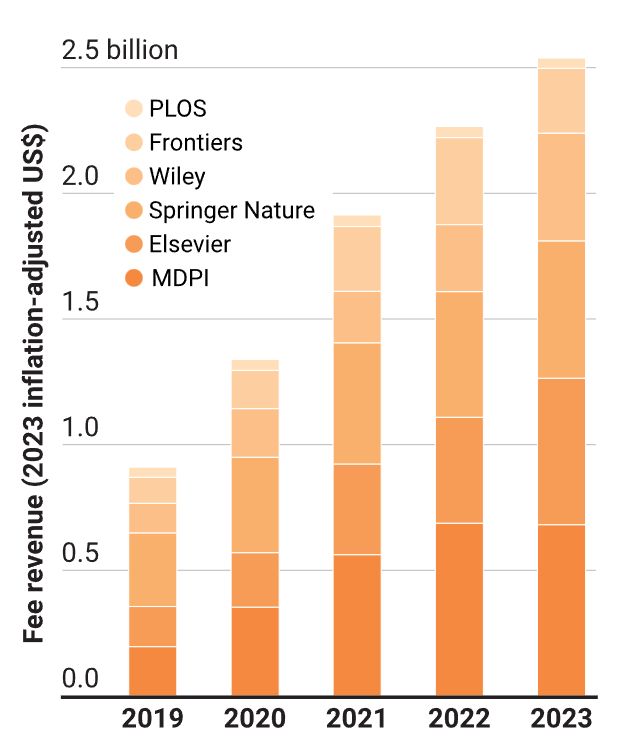
Between 2019 and 2023, researchers paid $8.968 billion to make papers open access. Imagine what else could be done with this money if it wasnt paid to for profit publishing companies...
👉 arxiv.org/abs/2407.16551
👉 arxiv.org/abs/2407.16551
January 27, 2025 at 12:33 AM
Between 2019 and 2023, researchers paid $8.968 billion to make papers open access. Imagine what else could be done with this money if it wasnt paid to for profit publishing companies...
👉 arxiv.org/abs/2407.16551
👉 arxiv.org/abs/2407.16551
Reposted by Artemy Kolchinsky

Can we design ecosystems? Can synthetic biology help unravel ecological complexity?
In this work, we define the scales of synthetic ecosystems: from test tube to the biosphere. With @ricardsole.bsky.social @jordiplam.bsky.social Dani Amor & Núria Conde. Plus, we got the front cover shorturl.at/1KHe1
In this work, we define the scales of synthetic ecosystems: from test tube to the biosphere. With @ricardsole.bsky.social @jordiplam.bsky.social Dani Amor & Núria Conde. Plus, we got the front cover shorturl.at/1KHe1

November 24, 2024 at 1:22 AM
Can we design ecosystems? Can synthetic biology help unravel ecological complexity?
In this work, we define the scales of synthetic ecosystems: from test tube to the biosphere. With @ricardsole.bsky.social @jordiplam.bsky.social Dani Amor & Núria Conde. Plus, we got the front cover shorturl.at/1KHe1
In this work, we define the scales of synthetic ecosystems: from test tube to the biosphere. With @ricardsole.bsky.social @jordiplam.bsky.social Dani Amor & Núria Conde. Plus, we got the front cover shorturl.at/1KHe1