



Antonino Greco
@agreco.bsky.social
Computational Cognitive Scientist 🧠🤖 • NeuroAI, Predictive Coding, RL & Deep Learning, Complex Systems • Postdoc at @siegellab.bsky.social, @unituebingen.bsky.social • Husband & Dad
🎓 https://scholar.google.com/citations?hl=en&user=k5eR8_oAAAAJ
🎓 https://scholar.google.com/citations?hl=en&user=k5eR8_oAAAAJ
Pinned
Antonino Greco
@agreco.bsky.social
· Aug 18

Are top-down feedback connections enough for robust vision?
We found ConvRNN with top-down feedback exhibiting OOD robustness only when trained with dropout, revealing a dual mechanism for robust sensory coding
with @marco-d.bsky.social, Karl Friston, Giovanni Pezzulo & @siegellab.bsky.social
🧵👇
We found ConvRNN with top-down feedback exhibiting OOD robustness only when trained with dropout, revealing a dual mechanism for robust sensory coding
with @marco-d.bsky.social, Karl Friston, Giovanni Pezzulo & @siegellab.bsky.social
🧵👇
Reposted by Antonino Greco

Recent work has shown how vulnerable online survey research is to LLMs. Motivated by this, we examined our online Posner cueing data from Prolific. It's concerning. We now must carefully consider when (or whether?) online behavioral data can be trusted.
see our comment:
www.pnas.org/doi/10.1073/...
see our comment:
www.pnas.org/doi/10.1073/...
February 19, 2026 at 12:00 PM
Recent work has shown how vulnerable online survey research is to LLMs. Motivated by this, we examined our online Posner cueing data from Prolific. It's concerning. We now must carefully consider when (or whether?) online behavioral data can be trusted.
see our comment:
www.pnas.org/doi/10.1073/...
see our comment:
www.pnas.org/doi/10.1073/...
Reposted by Antonino Greco

Hiring now!
📢 The CRC 1233 Robust Vision consortium at @unituebingen.bsky.social is looking for a Research Coordinator to lead science management, support project execution, and help steer our interdisciplinary research in neuroscience, machine learning and computer vision.
📢 The CRC 1233 Robust Vision consortium at @unituebingen.bsky.social is looking for a Research Coordinator to lead science management, support project execution, and help steer our interdisciplinary research in neuroscience, machine learning and computer vision.

February 19, 2026 at 2:03 PM
Hiring now!
📢 The CRC 1233 Robust Vision consortium at @unituebingen.bsky.social is looking for a Research Coordinator to lead science management, support project execution, and help steer our interdisciplinary research in neuroscience, machine learning and computer vision.
📢 The CRC 1233 Robust Vision consortium at @unituebingen.bsky.social is looking for a Research Coordinator to lead science management, support project execution, and help steer our interdisciplinary research in neuroscience, machine learning and computer vision.
Reposted by Antonino Greco

Man I really need to go back and watch this show again
February 19, 2026 at 1:45 PM
Man I really need to go back and watch this show again
I think this is worth a read
A perspective at how AI is becoming part of how we work 👇👇👇
A perspective at how AI is becoming part of how we work 👇👇👇

This piece really nails how I have been feeling in the last couple of weeks. fortune.com/2026/02/11/s...

Something big is happening in AI — and most people will be blindsided | Fortune
It’s not like a light switch... more like the moment you realize the water has been rising around you and is now at your chest.
fortune.com
February 12, 2026 at 10:59 AM
I think this is worth a read
A perspective at how AI is becoming part of how we work 👇👇👇
A perspective at how AI is becoming part of how we work 👇👇👇
Reposted by Antonino Greco

Our paper is out in @natneuro.nature.com!
www.nature.com/articles/s41...
We develop a geometric theory of how neural populations support generalization across many tasks.
@zuckermanbrain.bsky.social
@flatironinstitute.org
@kempnerinstitute.bsky.social
1/14
www.nature.com/articles/s41...
We develop a geometric theory of how neural populations support generalization across many tasks.
@zuckermanbrain.bsky.social
@flatironinstitute.org
@kempnerinstitute.bsky.social
1/14

February 10, 2026 at 3:56 PM
Our paper is out in @natneuro.nature.com!
www.nature.com/articles/s41...
We develop a geometric theory of how neural populations support generalization across many tasks.
@zuckermanbrain.bsky.social
@flatironinstitute.org
@kempnerinstitute.bsky.social
1/14
www.nature.com/articles/s41...
We develop a geometric theory of how neural populations support generalization across many tasks.
@zuckermanbrain.bsky.social
@flatironinstitute.org
@kempnerinstitute.bsky.social
1/14
Reposted by Antonino Greco

New preprint with Giovanni Pezzulo:
arxiv.org/abs/2602.08079
Bootstrapping Life-Inspired Machine Intelligence: The Biological Route from Chemistry to Cognition and Creativity
arxiv.org/abs/2602.08079
Bootstrapping Life-Inspired Machine Intelligence: The Biological Route from Chemistry to Cognition and Creativity

Bootstrapping Life-Inspired Machine Intelligence: The Biological Route from Chemistry to Cognition and Creativity
Achieving advanced machine intelligence remains a central challenge in AI research, often approached through scaling neural architectures and generative models. However, biological systems offer a bro...
arxiv.org
February 10, 2026 at 12:52 PM
New preprint with Giovanni Pezzulo:
arxiv.org/abs/2602.08079
Bootstrapping Life-Inspired Machine Intelligence: The Biological Route from Chemistry to Cognition and Creativity
arxiv.org/abs/2602.08079
Bootstrapping Life-Inspired Machine Intelligence: The Biological Route from Chemistry to Cognition and Creativity
Reposted by Antonino Greco

Why don’t neural networks learn all at once, but instead progress from simple to complex solutions? And what does “simple” even mean across different neural network architectures?
Sharing our new paper @iclr_conf led by Yedi Zhang with Peter Latham
arxiv.org/abs/2512.20607
Sharing our new paper @iclr_conf led by Yedi Zhang with Peter Latham
arxiv.org/abs/2512.20607
February 3, 2026 at 4:19 PM
Why don’t neural networks learn all at once, but instead progress from simple to complex solutions? And what does “simple” even mean across different neural network architectures?
Sharing our new paper @iclr_conf led by Yedi Zhang with Peter Latham
arxiv.org/abs/2512.20607
Sharing our new paper @iclr_conf led by Yedi Zhang with Peter Latham
arxiv.org/abs/2512.20607
Reposted by Antonino Greco

"The Self-Evidencing Agent" - my new book - is out now with @mitpress.bsky.social
Can be purchased, or just download the whole thing for free, via the 'Open Access' option.
I'm grateful to @anilseth.bsky.social and Karl Friston for the generous endorsements.
mitpress.mit.edu/978026255389...
Can be purchased, or just download the whole thing for free, via the 'Open Access' option.
I'm grateful to @anilseth.bsky.social and Karl Friston for the generous endorsements.
mitpress.mit.edu/978026255389...

The Self-Evidencing Agent
What is it to be a human individual, an agent? According to Jakob Hohwy, it is to “self-evidence,” to actively seek out sensory evidence for one&...
mitpress.mit.edu
February 7, 2026 at 8:21 AM
"The Self-Evidencing Agent" - my new book - is out now with @mitpress.bsky.social
Can be purchased, or just download the whole thing for free, via the 'Open Access' option.
I'm grateful to @anilseth.bsky.social and Karl Friston for the generous endorsements.
mitpress.mit.edu/978026255389...
Can be purchased, or just download the whole thing for free, via the 'Open Access' option.
I'm grateful to @anilseth.bsky.social and Karl Friston for the generous endorsements.
mitpress.mit.edu/978026255389...
Reposted by Antonino Greco

By end of Feb @bsky.app will be the 2nd largest social media source for research sharing in our database
- Google+ managed 945,000 mentions of research during its life
- Facebook pages (not people's profiles) have shared papers 6.6m times
- Reddit = 600k
Bluesky is currently at 6m and climbing
- Google+ managed 945,000 mentions of research during its life
- Facebook pages (not people's profiles) have shared papers 6.6m times
- Reddit = 600k
Bluesky is currently at 6m and climbing
January 28, 2026 at 10:23 AM
By end of Feb @bsky.app will be the 2nd largest social media source for research sharing in our database
- Google+ managed 945,000 mentions of research during its life
- Facebook pages (not people's profiles) have shared papers 6.6m times
- Reddit = 600k
Bluesky is currently at 6m and climbing
- Google+ managed 945,000 mentions of research during its life
- Facebook pages (not people's profiles) have shared papers 6.6m times
- Reddit = 600k
Bluesky is currently at 6m and climbing
Reposted by Antonino Greco
How to start the year off right 😊
Our commentary in Nature Mental Health proposes using AI and VR to simulate experiences similar to those produced by traditional psychedelics, offering a novel pathway to advance psychedelic-assisted therapy research🤩
Link 👉 www.nature.com/articles/s44...
Our commentary in Nature Mental Health proposes using AI and VR to simulate experiences similar to those produced by traditional psychedelics, offering a novel pathway to advance psychedelic-assisted therapy research🤩
Link 👉 www.nature.com/articles/s44...
January 26, 2026 at 8:26 AM
How to start the year off right 😊
Our commentary in Nature Mental Health proposes using AI and VR to simulate experiences similar to those produced by traditional psychedelics, offering a novel pathway to advance psychedelic-assisted therapy research🤩
Link 👉 www.nature.com/articles/s44...
Our commentary in Nature Mental Health proposes using AI and VR to simulate experiences similar to those produced by traditional psychedelics, offering a novel pathway to advance psychedelic-assisted therapy research🤩
Link 👉 www.nature.com/articles/s44...
Reposted by Antonino Greco

At @elife.bsky.social you can now include explainer videos with every figure. Like going to a seminar while you engage with the paper. First example here elifesciences.org/articles/106...
Click the arrows next to each figure to get a video of @mathiassablemeyer.bsky.social explaining it for you!
Click the arrows next to each figure to get a video of @mathiassablemeyer.bsky.social explaining it for you!

January 22, 2026 at 6:16 PM
At @elife.bsky.social you can now include explainer videos with every figure. Like going to a seminar while you engage with the paper. First example here elifesciences.org/articles/106...
Click the arrows next to each figure to get a video of @mathiassablemeyer.bsky.social explaining it for you!
Click the arrows next to each figure to get a video of @mathiassablemeyer.bsky.social explaining it for you!
Reposted by Antonino Greco

🚨 New paper out in Science Advances 🚨
With @suryagayet.bsky.social and @peelen.bsky.social, in two fMRI studies we investigate mental object rotations that are driven by the scene context, rather than purely by cognitive operations. 🧵 www.science.org/doi/10.1126/...
With @suryagayet.bsky.social and @peelen.bsky.social, in two fMRI studies we investigate mental object rotations that are driven by the scene context, rather than purely by cognitive operations. 🧵 www.science.org/doi/10.1126/...

January 23, 2026 at 3:16 PM
🚨 New paper out in Science Advances 🚨
With @suryagayet.bsky.social and @peelen.bsky.social, in two fMRI studies we investigate mental object rotations that are driven by the scene context, rather than purely by cognitive operations. 🧵 www.science.org/doi/10.1126/...
With @suryagayet.bsky.social and @peelen.bsky.social, in two fMRI studies we investigate mental object rotations that are driven by the scene context, rather than purely by cognitive operations. 🧵 www.science.org/doi/10.1126/...
Reposted by Antonino Greco

Cost of being female lead/corresponding author in biomedical sciences: "[T]he median amount of time spent under review is 7.4%–14.6% longer for female-authored articles than for male-authored articles" even in disciplines where women well-represented. #AcademicSky
journals.plos.org/plosbiology/...
journals.plos.org/plosbiology/...

Biomedical and life science articles by female researchers spend longer under review
Women are underrepresented in academia, especially in STEMM fields, at top institutions, and in senior positions. This study analyzes millions of biomedical and life science articles, revealing that f...
journals.plos.org
January 21, 2026 at 2:38 PM
Cost of being female lead/corresponding author in biomedical sciences: "[T]he median amount of time spent under review is 7.4%–14.6% longer for female-authored articles than for male-authored articles" even in disciplines where women well-represented. #AcademicSky
journals.plos.org/plosbiology/...
journals.plos.org/plosbiology/...
Reposted by Antonino Greco

Interpreting EEG requires understanding how the skull smears electrical fields as they propagate from the cortex. I made a browser-based simulator for my EEG class to visualize how dipole depth/orientation change the topomap.
dbrang.github.io/EEG-Dipole-D...
Github page: github.com/dbrang/EEG-D...
dbrang.github.io/EEG-Dipole-D...
Github page: github.com/dbrang/EEG-D...
January 20, 2026 at 5:00 PM
Interpreting EEG requires understanding how the skull smears electrical fields as they propagate from the cortex. I made a browser-based simulator for my EEG class to visualize how dipole depth/orientation change the topomap.
dbrang.github.io/EEG-Dipole-D...
Github page: github.com/dbrang/EEG-D...
dbrang.github.io/EEG-Dipole-D...
Github page: github.com/dbrang/EEG-D...
Reposted by Antonino Greco

Introducing a new scientific computing library: syntropy.
Syntropy is a comprehensive package for information theory, aimed at both theoreticians and data analysts working on discrete, continuous, and mixed data.
1/N
github.com/thosvarley/s...
Syntropy is a comprehensive package for information theory, aimed at both theoreticians and data analysts working on discrete, continuous, and mixed data.
1/N
github.com/thosvarley/s...

GitHub - thosvarley/syntropy: A python package for information-theoretic analysis of discrete and continuous data.
A python package for information-theoretic analysis of discrete and continuous data. - thosvarley/syntropy
github.com
January 19, 2026 at 3:30 PM
Introducing a new scientific computing library: syntropy.
Syntropy is a comprehensive package for information theory, aimed at both theoreticians and data analysts working on discrete, continuous, and mixed data.
1/N
github.com/thosvarley/s...
Syntropy is a comprehensive package for information theory, aimed at both theoreticians and data analysts working on discrete, continuous, and mixed data.
1/N
github.com/thosvarley/s...
Reposted by Antonino Greco
New preprint on unifying the zoo of multivariate higher-order information measures into a common form.
May be of interest to anyone interested in higher-order interactions, complex systems, emergence, or complexity.
1/N
arxiv.org/abs/2601.08030
May be of interest to anyone interested in higher-order interactions, complex systems, emergence, or complexity.
1/N
arxiv.org/abs/2601.08030

The many faces of multivariate information
Extracting higher-order structures from multivariate data has become an area of intensive study in complex systems science, as these multipartite interactions can reveal insights into fundamental feat...
arxiv.org
January 14, 2026 at 3:43 PM
New preprint on unifying the zoo of multivariate higher-order information measures into a common form.
May be of interest to anyone interested in higher-order interactions, complex systems, emergence, or complexity.
1/N
arxiv.org/abs/2601.08030
May be of interest to anyone interested in higher-order interactions, complex systems, emergence, or complexity.
1/N
arxiv.org/abs/2601.08030
Reposted by Antonino Greco
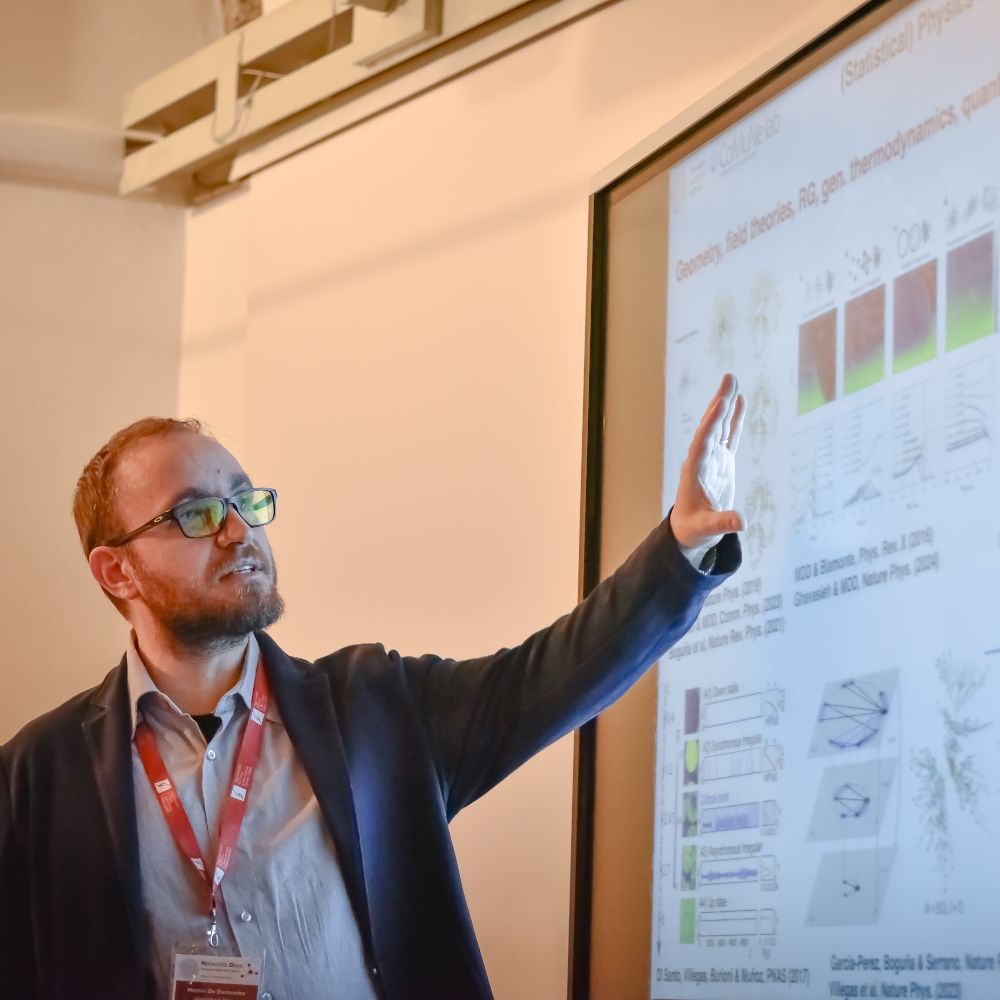
How complex should network models be?
🚨 In our latest paper we quantify (if and) when higher-order interactions are informative versus reducible to pairwise structure without losing functional signal (e.g., diffusion behavior).
👉 www.nature.com/articles/s41...
1/
🚨 In our latest paper we quantify (if and) when higher-order interactions are informative versus reducible to pairwise structure without losing functional signal (e.g., diffusion behavior).
👉 www.nature.com/articles/s41...
1/

January 15, 2026 at 1:36 PM
How complex should network models be?
🚨 In our latest paper we quantify (if and) when higher-order interactions are informative versus reducible to pairwise structure without losing functional signal (e.g., diffusion behavior).
👉 www.nature.com/articles/s41...
1/
🚨 In our latest paper we quantify (if and) when higher-order interactions are informative versus reducible to pairwise structure without losing functional signal (e.g., diffusion behavior).
👉 www.nature.com/articles/s41...
1/
🔵 New comment paper out in Nature Mental Health! 🔵
@natmentalhealth.nature.com
We propose AI-generated psychedelic-like experiences in VR as a non-pharmacological and controllable research tool to bridge digital and psychedelic mental health research
Link 👉 www.nature.com/articles/s44...
🧵👇
@natmentalhealth.nature.com
We propose AI-generated psychedelic-like experiences in VR as a non-pharmacological and controllable research tool to bridge digital and psychedelic mental health research
Link 👉 www.nature.com/articles/s44...
🧵👇

January 16, 2026 at 2:58 PM
🔵 New comment paper out in Nature Mental Health! 🔵
@natmentalhealth.nature.com
We propose AI-generated psychedelic-like experiences in VR as a non-pharmacological and controllable research tool to bridge digital and psychedelic mental health research
Link 👉 www.nature.com/articles/s44...
🧵👇
@natmentalhealth.nature.com
We propose AI-generated psychedelic-like experiences in VR as a non-pharmacological and controllable research tool to bridge digital and psychedelic mental health research
Link 👉 www.nature.com/articles/s44...
🧵👇
cool work about information decomposition in artificial systems!
Synergistic information processing emerges through learning in LLMs and ablating these synergistic components causes large performance drops
#NeuroAI
👇👇👇
Synergistic information processing emerges through learning in LLMs and ablating these synergistic components causes large performance drops
#NeuroAI
👇👇👇

Preprint time:
A Brain-like Synergistic Core in LLMs Drives Behaviour and Learning
arxiv.org/abs/2601.06851
LLMs are clearly different from actual brains… but could they share a similar functional architecture related to how they process information?
A Brain-like Synergistic Core in LLMs Drives Behaviour and Learning
arxiv.org/abs/2601.06851
LLMs are clearly different from actual brains… but could they share a similar functional architecture related to how they process information?

A Brain-like Synergistic Core in LLMs Drives Behaviour and Learning
The independent evolution of intelligence in biological and artificial systems offers a unique opportunity to identify its fundamental computational principles. Here we show that large language models...
arxiv.org
January 15, 2026 at 3:21 PM
cool work about information decomposition in artificial systems!
Synergistic information processing emerges through learning in LLMs and ablating these synergistic components causes large performance drops
#NeuroAI
👇👇👇
Synergistic information processing emerges through learning in LLMs and ablating these synergistic components causes large performance drops
#NeuroAI
👇👇👇
Reposted by Antonino Greco

I continue to be impressed with Scholar Inbox!
- Personal recommendations the day after the papers land on arXiv (significantly faster than Google Scholar?? 😱)
- Very good recommendations
- Email notifications for digests
- Super slick UI, both on mobile and desktop... check this out! 👇
- Personal recommendations the day after the papers land on arXiv (significantly faster than Google Scholar?? 😱)
- Very good recommendations
- Email notifications for digests
- Super slick UI, both on mobile and desktop... check this out! 👇

January 13, 2026 at 11:04 AM
I continue to be impressed with Scholar Inbox!
- Personal recommendations the day after the papers land on arXiv (significantly faster than Google Scholar?? 😱)
- Very good recommendations
- Email notifications for digests
- Super slick UI, both on mobile and desktop... check this out! 👇
- Personal recommendations the day after the papers land on arXiv (significantly faster than Google Scholar?? 😱)
- Very good recommendations
- Email notifications for digests
- Super slick UI, both on mobile and desktop... check this out! 👇
Reposted by Antonino Greco

Same sound, different perception: Do expectations change what you hear?👂🧠
We paired faces w topics and played the same ambiguous speech w different faces. The brain sharpened sensory signals toward predictions and showed gated prediction errors at higher levels.
Read @plosbiology.org. Blueprint👇
We paired faces w topics and played the same ambiguous speech w different faces. The brain sharpened sensory signals toward predictions and showed gated prediction errors at higher levels.
Read @plosbiology.org. Blueprint👇

Sensory sharpening and semantic prediction errors unify competing models of predictive processing in human speech comprehension
Speech comprehension relies on predictive mechanisms, but models disagree on whether the brain prioritizes expected or unexpected information. This study shows that sharpening of sensory representatio...
dx.plos.org
January 12, 2026 at 10:34 AM
Same sound, different perception: Do expectations change what you hear?👂🧠
We paired faces w topics and played the same ambiguous speech w different faces. The brain sharpened sensory signals toward predictions and showed gated prediction errors at higher levels.
Read @plosbiology.org. Blueprint👇
We paired faces w topics and played the same ambiguous speech w different faces. The brain sharpened sensory signals toward predictions and showed gated prediction errors at higher levels.
Read @plosbiology.org. Blueprint👇
Reposted by Antonino Greco

Excited to announce a new book telling the story of mathematical approaches to studying the mind, from the origins of cognitive science to modern AI! The Laws of Thought will be published in February and is available for pre-order now.

December 18, 2025 at 3:59 PM
Excited to announce a new book telling the story of mathematical approaches to studying the mind, from the origins of cognitive science to modern AI! The Laws of Thought will be published in February and is available for pre-order now.
Incredible resource for the computational cognitive neuroscience community! 👇👇
With some trepidation, I'm putting this out into the world:
gershmanlab.com/textbook.html
It's a textbook called Computational Foundations of Cognitive Neuroscience, which I wrote for my class.
My hope is that this will be a living document, continuously improved as I get feedback.
gershmanlab.com/textbook.html
It's a textbook called Computational Foundations of Cognitive Neuroscience, which I wrote for my class.
My hope is that this will be a living document, continuously improved as I get feedback.
January 9, 2026 at 8:25 AM
Incredible resource for the computational cognitive neuroscience community! 👇👇
Reposted by Antonino Greco

With some trepidation, I'm putting this out into the world:
gershmanlab.com/textbook.html
It's a textbook called Computational Foundations of Cognitive Neuroscience, which I wrote for my class.
My hope is that this will be a living document, continuously improved as I get feedback.
gershmanlab.com/textbook.html
It's a textbook called Computational Foundations of Cognitive Neuroscience, which I wrote for my class.
My hope is that this will be a living document, continuously improved as I get feedback.
January 9, 2026 at 1:27 AM
With some trepidation, I'm putting this out into the world:
gershmanlab.com/textbook.html
It's a textbook called Computational Foundations of Cognitive Neuroscience, which I wrote for my class.
My hope is that this will be a living document, continuously improved as I get feedback.
gershmanlab.com/textbook.html
It's a textbook called Computational Foundations of Cognitive Neuroscience, which I wrote for my class.
My hope is that this will be a living document, continuously improved as I get feedback.
Reposted by Antonino Greco
Wanna compare dynamics across neural data, RNNs, or dynamical systems? We got a fast and furious method🏎️
The 1st preprint of my PhD 🥳 fast dynamical similarity analysis (fastDSA):
📜: arxiv.org/abs/2511.22828
💻: github.com/CMC-lab/fast...
I’ll be @cosynemeeting.bsky.social - happy to chat 😉
The 1st preprint of my PhD 🥳 fast dynamical similarity analysis (fastDSA):
📜: arxiv.org/abs/2511.22828
💻: github.com/CMC-lab/fast...
I’ll be @cosynemeeting.bsky.social - happy to chat 😉

January 8, 2026 at 4:08 PM
Wanna compare dynamics across neural data, RNNs, or dynamical systems? We got a fast and furious method🏎️
The 1st preprint of my PhD 🥳 fast dynamical similarity analysis (fastDSA):
📜: arxiv.org/abs/2511.22828
💻: github.com/CMC-lab/fast...
I’ll be @cosynemeeting.bsky.social - happy to chat 😉
The 1st preprint of my PhD 🥳 fast dynamical similarity analysis (fastDSA):
📜: arxiv.org/abs/2511.22828
💻: github.com/CMC-lab/fast...
I’ll be @cosynemeeting.bsky.social - happy to chat 😉
