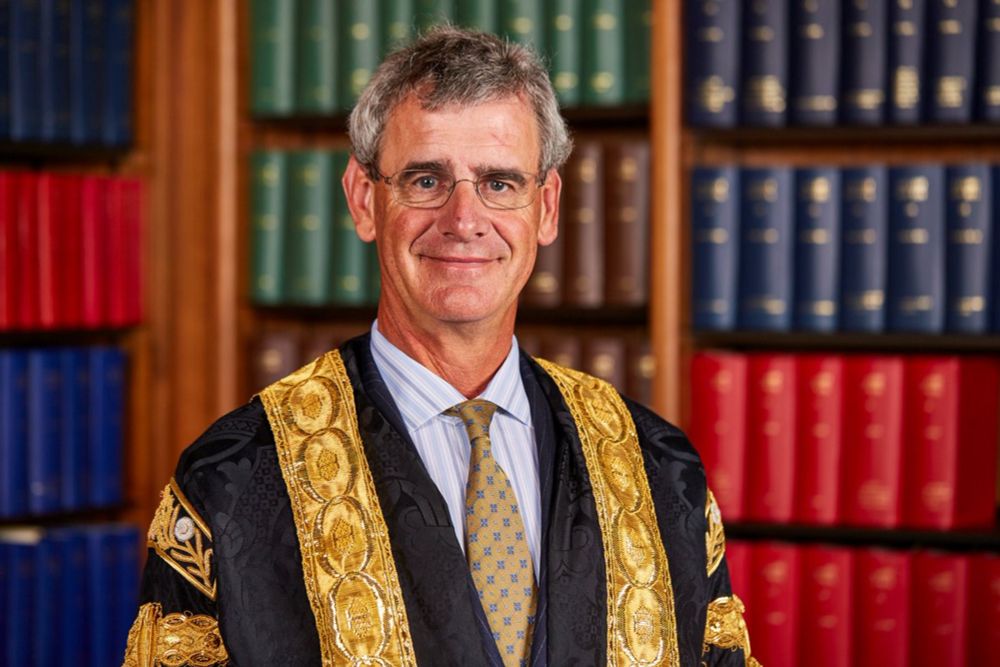
Mark Elliott
banner
profmarkelliott.bsky.social
Mark Elliott
@profmarkelliott.bsky.social

Professor of Public Law, University of Cambridge. Fellow, St Catharine's College, Cambridge. Blog: www.publiclawforeveryone.com. Website: www.markelliott.org

Mark C. Elliott is the Mark Schwartz Professor of Chinese and Inner Asian History at Harvard University, where he is Vice Provost for International Affairs. He is also a seminal figure of the school called the New Qing History. .. more

Political science 51%
Law 27%

Reposted by Elliot Gold

"In Defence of Classical Administrative Law", by @philipmurraylaw and me, has now been published in the Cambridge Law Journal on FirstView. It is available via the following link (open access): doi.org/10.1017/S000...

A reminder, following the conviction of Jimmy Lai, that two senior British lawyers—a former Law Lord and a former Supreme Court President—continue to lend respectability to the Hong Kong legal system by sitting as non-permanent judges on its highest court.
www.theguardian.com/world/2025/d...
Jimmy Lai: conviction of Hong Kong pro-democracy figure decried as attack on press freedom
Rights groups dismiss ‘sham conviction’ of media tycoon on national security offences in city’s most closely watched rulings in decades
www.theguardian.com

I'm grateful to the Sunday Times for publishing my letter on the constitutional role of the House of Lords, correcting the misleading impression created by an open letter signed by several former Cabinet Secretaries. www.thetimes.com/comment/lett...

Reposted by Mark Elliott

My speech of today to NIHRC now published in full by Joshua Rozenberg: “The ECHR - the view from London and Strasbourg”

Many thanks for reading, Anurag.

Lord Sales devoted a recent lecture on the principle of legality to responding to my critique of one of his judgments. Here, I argue that our disagreement ultimately turns on sharply contrasting, and increasingly consequential, visions of the constitution
publiclawforeveryone.com/2025/12/07/t...
Taking the constitution seriously: A response to Lord Sales
The incoming Deputy President of the Supreme Court devoted a recent lecture to a critique of my commentary on his judgment in the Spitalfields case, highlighting differences between us concerning t…
publiclawforeveryone.com

* Post 4 should say the existence of those *limits* (on the Lords' powers) proves the incorrectness of the claim in the letter.

But there is no general principle that the Lords must always give way to the Commons. If there was, the more modest legal and conventional limits on the Lords' powers would be redundant. The existence of those powers proves the incorrectness of the claim in the letter. /4

The primacy of the Commons is constitutionally acknowledged in certain limited ways, including via the Salisbury convention (Lords should not block manifesto bills) and law (Parliament Acts enable Commons to legislate unilaterally subject to Lords' one-year delaying power). /3

The letter asserts that: 'Respect for the primacy of the Commons is not optional; it is the foundation of our parliamentary legitimacy.' However, this statement is so partial as to be misleading and incorrect. /2

This letter from former Cabinet Secretaries and others is straightforwardly wrong regarding the constitutional role of the House of Lords relative to the role of the Commons. /1
NEW: In a joint letter, senior peers including 3 former cabinet secretaries and 3 former Lords speakers have warned peers not to use procedural manoeuvres to thwart the assisted dying bill.

With 1,100+ amendments tabled, they warn the reputation of Parliament is on the line.

Reposted by Mark Elliott

NEW: In a joint letter, senior peers including 3 former cabinet secretaries and 3 former Lords speakers have warned peers not to use procedural manoeuvres to thwart the assisted dying bill.

With 1,100+ amendments tabled, they warn the reputation of Parliament is on the line.

Simon Jenkins claims in the Guardian that it would be a 'democratic outrage' if the House of Lords were to block the Terminally Ill Adults Bill: www.theguardian.com/commentisfre...

That claim is constitutional nonsense, for the reasons I explain here: publiclawforeveryone.com/2025/06/20/w...
Unelected Lords are blocking assisted dying – this is a democratic outrage | Simon Jenkins
Second chambers are a good idea, but they should not be able to overturn clear decisions reached by an elected body, says Guardian columnist Simon Jenkins
www.theguardian.com

Reposted by Patrick O’Brien

New post: Tyranny, anarchy and the rule of law: Reflections on a major report by the Constitution Committee

publiclawforeveryone.com/2025/11/20/t...
Tyranny, anarchy and the rule of law: Reflections on a major report by the Constitution Committee
The House of Lords Constitution Committee’s new report on the rule of law provides an excellent overview of the concept and of the many challenges it finds itself under in the UK today. But the rep…
publiclawforeveryone.com

Now published in the Cambridge Law Journal (open access):

'Administrative Law Doctrine and Constitutional Principle in the Supreme Court'

My case note on the judgment in R (Spitalfields) v Tower Hamlets LBC [2025] UKSC 11

doi.org/10.1017/S000...
ADMINISTRATIVE LAW DOCTRINE AND CONSTITUTIONAL PRINCIPLE IN THE SUPREME COURT | The Cambridge Law Journal | Cambridge Core
ADMINISTRATIVE LAW DOCTRINE AND CONSTITUTIONAL PRINCIPLE IN THE SUPREME COURT - Volume 84 Issue 2
doi.org

Thank you, Conor. That's very kind.

Indeed. There are plenty of other questions, too, that are unanswered by a white paper that, given how long it has been in the making, is surprisingly light on detail. I flag some of the key legal and constitutional questions that need to be answered here: publiclawforeveryone.com/2025/11/17/t...

I agree, Jess.

That's very kind, David. But I was home alone and looking for something to do ... I am much more likely to be watching something on Netflix this evening!

Thanks for reading, Stefan. And I agree with your points. Presumably while some of what they want to do re Art 8 will be relatively straightforward, as you say, other aspects will at least test the Strasbourg envelope, as it were, depending on exacrly what the new legislation ends up saying.

Thanks, Schona.

Thanks, Stefan. And I agree with you.

Reposted by Steve Peers

New post

In a recent lecture, Lord Briggs places renewed emphasis on the common law’s ability to protect human rights, and argues that we should not doubt its capaity to step in if the UK were to withdraw from the ECHR. Is such optimism well-founded?

publiclawforeveryone.com/2025/11/14/m...
Misplaced optimism? Lord Briggs on the common law’s capacity to protect human rights in the event of ECHR withdrawal
In a recent lecture, Supreme Court Justice Lord Briggs places renewed emphasis on the common law’s ability to protect human rights, and argues that we should not doubt its capaity to step in if the…
publiclawforeveryone.com

An interesting opportunity from the Constitution Society:

'The Constitution Society invites applications for a Research Fellowship dedicated to promoting the life and constitutional contributions of Richard Haldane (1856-1928).'

consoc.org.uk/haldane-rese...
Research Fellowship - The Constitution Society
The Society invites applications for a Research Fellowship on the life and constitutional contributions of Richard Haldane (1856-1928).
consoc.org.uk
New post

Prompted by an excellent conference at @biicl.bsky.social marking the ECHR's 75th anniversary, I reflect in this piece on key themes about the likely trajectory of the UK's human rights debate, given the current (and developing) political climate.

publiclawforeveryone.com/2025/11/07/t...
The ‘othering’ of human rights and the agenda underlying calls for UK withdrawal from the ECHR
A recent conference marking the 75th anniversary anniversary of the European Convention on Human Rights provided a sobering opportunity for reflection on possible trajectories of human rights prote…
publiclawforeveryone.com

I wrote a short piece on their '50 problematic cases' (publiclawforeveryone.com/2016/05/09/a...) and also a response to John Finnis's lecture that (I think) launched the JPP (publiclawforeveryone.com/2015/11/05/j...)
Judicial Power’s 50 “problematic” cases and the limits of the judicial role
The Judicial Power Project has published a list of 50 “problematic” cases. It makes for interesting reading. The aim of the Judicial Power Project is to address the “problem” of “judicial overreach…
publiclawforeveryone.com

One of the highlights of one of the Covid lockdowns was the arrival of hard copies of the new edition of my textbook; the feline member of the household, who loves boxes rather than books, was also delighted.